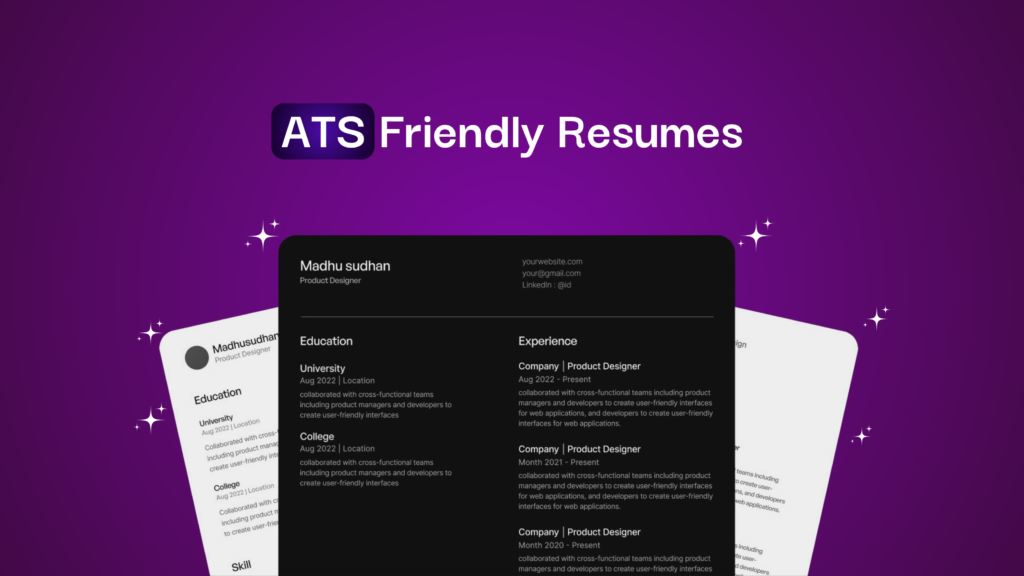
The journey from “Apply” to “Hired” has changed fundamentally.
Today, over 90% of Fortune 500 companies use ATS (Applicant Tracking Systems) to manage the flood of digital applications they receive daily. These systems act as a digital gatekeeper, scanning thousands of documents in seconds to identify the top candidates based on specific criteria.
If your document isn’t built with ATS optimisation in mind, it may never reach a human recruiter’s desk, regardless of your qualifications. Resume optimisation is no longer just a “pro tip“, it is a mandatory step for anyone looking to increase their chances of landing an interview in 2026.
To succeed, you must learn to optimize your resume so it speaks the language of the machine while still impressing the human eye.
Top ATS Optimisation Tips You Can’t Ignore
- Use a Standard Resume Format: Stick to a reverse-chronological layout. ATS technology is programmed to read your career history from newest to oldest; complex “functional” formats often lead to parsing errors.
- Mirror Keywords from the Job Description: Identify the specific “Hard Skills” and “Job Titles” in the posting. Optimize your resume by using those exact terms (e.g., if they ask for “Project Management,” don’t just write “Leading Teams”).
- Stick to a Single-Column Layout: Multi-column designs look great to humans but often cause ats systems to read across the page, jumbling your text. A single-column layout ensures a clean scan.
- Avoid Tables and Text Boxes: Most applicant tracking systems struggle to “see” text inside these elements. If you put your contact info in a text box, the system may think the document is blank.
- Use Standard Section Headings: Don’t get creative with titles like “My Professional Story.” Use standard tags like “Work Experience,” “Education,” and “Skills” so the bot knows exactly where to find your data.
- Include Both Acronyms and Long-Form Terms: To pass ats screening, cover all bases. Write “Search Engine Optimization (SEO)” so the system recognises the match regardless of which term the recruiter searched for.
- Choose ATS-Friendly Fonts: Use modern, web-safe fonts like Aptos, Calibri, Arial, or Georgia. Avoid script fonts or special characters that the system might misinterpret as symbols or “glitch” text.
- Quantify Your Achievements: Use numbers, percentages, and dollar signs (e.g., “Increased sales by 20%“). High-quality ats tools look for these metrics to rank “result-oriented” candidates higher.
- Keep Contact Info in the Main Body: Many parsers skip headers and footers entirely. To ensure that your resume is parsed correctly, place your email and phone number at the very top of the main document body.
- The “Select All” Final Test: Before you upload your resume, press
Ctrl+A(orCmd+A). If any text—like text in a graphic or chart isn’t highlighted, the ATS cannot read it.
Why Resume Optimisation is No Longer Optional?
- Volume Control: Large enterprises receive hundreds of resumes per opening; the applicant tracking system is the only way they can feasibly filter the noise.
- Ranking Algorithms: Most ATS technology doesn’t just store your data; it ranks you against the job description.
- The “Black Hole” Effect: Without an ATS-friendly resume, your application can be automatically rejected due to simple formatting errors that the system cannot read.
Key Stats for Your Intro
| Metric | Impact |
| Usage | 98% of Fortune 500 companies use an ATS. |
| Filter Rate | Up to 75% of resumes are filtered out before a human sees them. |
| Optimization Benefit | Tailored resumes see a 3x higher rate of interview invites. |
ATS Technology: Why Your Resume Needs an Upgrade?
To beat the “bot,” you first have to understand how it thinks. Modern ATS technology is no longer just a digital filing cabinet; it’s an intelligent processor that determines your professional value in milliseconds.
What is an Applicant Tracking System and How Does it Work?
An Applicant Tracking System (ATS) is a software application used by HR departments to manage the entire recruitment lifecycle. In 2026, these systems perform three primary functions:
- Digital Intake: When you submit your application, the system “parses” your document, stripping away the design to convert it into a structured digital profile.
- Database Management: It stores your resume in a massive, searchable database alongside thousands of others.
- Search & Retrieval: Recruiters don’t read every resume; they search for specific keywords (like “Nuclear Safety Standards” or “Python”) and the ATS brings up the candidates who match.
The Truth About ATS Screening: How Algorithms Rank Candidates?
The “screening” phase is where the ATS resume optimization truly matters. Most systems use a scoring algorithm to rank you against the job description:
- Keyword Frequency & Placement: The system looks for how often and where you use keywords. A keyword in your “Work Experience” carries more weight than one tucked in a “Skills” list.
- Semantic Matching: Advanced 2026 systems now understand context. They know that “Project Management” and “Agile Delivery” are related, but they still prioritize exact matches to the recruiter’s specific search terms.
- Predictive Scoring: Some AI-driven bots now “predict” your success by comparing your career trajectory to successful hires currently at the company.
Common Reasons Your Current Resume is Being Filtered Out
Even the most qualified candidates can disappear into the “ATS Black Hole” due to technical glitches.
- Formatting Failures: Using tables, text boxes, or multiple columns. These often cause the ats technology to “read” the text out of order, turning your experience into gibberish.
- Non-Standard Headings: If you name your experience section “My Professional Journey” instead of “Work Experience,” the system may fail to recognize your career history.
- The “Image” Trap: Many modern templates (especially from creative sites like Canva) save text as an image or use complex layering. If the text isn’t selectable, the applicant tracking system sees a blank page.
- Wrong File Format: While some systems are getting better, many still struggle with anything other than a clean DOCX or a text-based PDF.
How to Make Your Resume ATS-Friendly?
Creating an ats-friendly resume is about removing technical hurdles. If the system can’t read your document, it can’t rank you—period.
Choosing the Right Resume Format for Modern Systems
The “Reverse-Chronological” format remains the gold standard for ATS resume optimization in 2026.
- Reverse-Chronological: Lists your experience from newest to oldest. It is the easiest for an ATS to parse because it follows a linear timeline that the software is programmed to recognise.
- Hybrid (Combination): A strong second choice for those with specialized technical skills. It balances a top-heavy skills section with a chronological history.
- Avoid Pure Functional Formats: These often confuse ATS technology as they lack the clear date-and-title anchors needed to build your candidate profile.
Why a Simple Resume Template Beats a Complex Design Every Time?
It’s tempting to use a graphic-heavy resume template from creative platforms, but for companies using ats screening, these are often “unreadable.”
- The Single-Column Rule: Stick to a single-column layout. Multi-column designs often cause the ATS to read across the page (merging Column A and Column B), resulting in a jumbled mess of text.
- No Graphics or Tables: Most systems still struggle to extract text from inside tables or text boxes. If you use them, there’s a high risk your data will simply disappear.
- White Space is Your Friend: Clean margins (1 inch) and standard spacing help both the bot and the human recruiter scan your document quickly.
How to Structure Your Resume for Better Parsability?
To structure your resume effectively, you must use the “tags” that the system expects. Use standard section headings—don’t get creative.
- Use: “Work Experience,” “Education,” “Skills,” and “Certifications.”
- Avoid: “Where I’ve Been,” “Knowledge Base,” or “Academic Pedigree.”
- Contact Info: Keep this out of the Header or Footer. Many applicant tracking systems ignore headers/footers entirely, meaning your phone number and email might never be imported.
Critical Fonts and File Types: Ensuring Your Resume is ATS-Friendly
Your choice of font and file type is the final technical hurdle to getting your resume into the “Yes” pile.
- The Best Fonts for 2026: Use “Web-Safe” fonts like Calibri, Arial, Helvetica, or Georgia. Avoid script or decorative fonts that the system might interpret as symbols or “glyph” errors.
- The Aptos Factor: As the new Microsoft default, Aptos is now fully recognized by all modern ATS technology.
- File Types:
- .DOCX: The safest bet for maximum compatibility with older and newer systems alike.
- .PDF: Ideal for preserving your layout for human eyes, but only if it is a text-based PDF (not an image scan).
Step-by-Step Guide: Optimise Your Resume for ATS Success
Once the foundation is set, you must fine-tune the content to match the specific “signals” the applicant tracking system is programmed to find.
How to Customise Your Resume for Every Application?
A generic resume is the quickest way to find the “Black Hole.” To optimize your resume for ATS, you must treat every application as a unique project:
- The 80% Rule: Aim to mirror at least 80% of the “Hard Skills” listed in the job description.
- Mirror the Language: If the job calls for “Search Engine Optimisation” but you wrote “SEO,” use the full term followed by the acronym: “Search Engine Optimisation (SEO).”
- The Prompt Audit: Use tools or AI prompts to identify the “Keyword Gap“—the specific terms the posting uses that your resume currently lacks.
Technical Resume Optimisation Tips: Headers, Footers, and Charts
While they look great to humans, these elements are “invisible” or “scramblers” for ats technology:
- Headers/Footers: Many parsers skip these entirely. Never put your contact information (phone, email, LinkedIn) in a header. Place it in the main body text.
- Charts & Images: If you use a bar chart to show your “Skill Level: 90%,” the ATS sees nothing. Replace these with text-based lists.
- Tables: These often scramble the reading order. A two-column table might be read left-to-right across the rows, merging your “Job Title” with “Dates of Employment.”
Using Standard Job Titles to Optimise for Searchability
Recruiters search for standard roles, not creative descriptions. To optimize for searchability:
- Avoid Creative Titles: “Sales Ninja” or “Code Wizard” will never show up in a recruiter’s search.
- The “Bracket” Hack: If your official title was “Customer Happiness Lead” but you did the work of a “Customer Success Manager,” list it as: Customer Happiness Lead (Customer Success Manager).
Make Your Resume Stand Out by Focusing on Quantifiable Results
The ATS looks for keywords, but it also identifies “signal density” via numbers and symbols (%, $, +).
- Weak Entry: “Responsible for increasing website traffic.”
- ATS-Optimized Entry: “Boosted website traffic by 60% through targeted SEO strategies and keyword optimisation.”
- The Impact: Numbers prove you didn’t just perform a task; you delivered a result.
Advanced ATS Resume Optimisation Strategies
As you move toward final submission, you must bridge the gap between the machine’s logic and the human’s intuition.
Balancing Human Readability with ATS Resume Logic
The “Bot” gets you the interview; the “Human” gives you the job.
- Natural Integration: Don’t just list keywords at the bottom in white text (a “black hat” SEO trick that modern ATS can now detect and penalize). Weave them naturally into your bullet points.
- The Skim Test: A recruiter will look at your resume for 6 seconds. Use bolding for your Standard Job Titles and Standard Headings to guide their eyes quickly.
How to Create an ATS-Friendly Resume for Career Changers?
If you are transitioning (e.g., from Oil & Gas to Nuclear Energy), the applicant tracking system may struggle to see your fit.
- Hybrid Layout: Use a “Core Competencies” section at the top to front-load the keywords from your new industry.
- Transferable Skills: Focus on the methodology. If you “Managed high-stakes safety protocols” in one field, those are the exact keywords needed for the next.
Tools and Checklists to Optimize Your Resume Before Applying
Before you hit “Submit,” run through this 2026 ATS Resume Optimization checklist:
- The “Select All” Test: Press
Ctrl+A(orCmd+A). If any text (like text in a chart or image) isn’t highlighted, the ATS can’t read it. - File Format Check: Is it a .DOCX or a text-based PDF?
- Keyword Alignment: Did you include the exact job title from the posting?
- Formatting Check: Are there any tables, columns, or graphics that could scramble the parse?
- Online Scanners: Use tools like Jobscan, ResumeAdapter, or Rezi to get a “Match Score” against the job description.
🚀 2026 ATS Optimisation Cheat Sheet: The “Beat the Bot” Checklist
1. The Technical Foundation (Formatting)
- File Type: Use .docx for maximum safety; use PDF only if the portal specifically allows it (ensure it is a text-based PDF, not a scan).
- Layout: Strictly single-column. Avoid tables, text boxes, and sidebars which scramble the “reading order” for ATS technology.
- Margins & Spacing: Keep margins at 1 inch and use standard line spacing.
- Fonts: Stick to Aptos (the 2026 standard), Calibri, Arial, or Georgia.
- Headers/Footers: Never put contact info here. Most applicant tracking systems skip these sections entirely.
2. The Content Strategy (Keywords)
- The “Double Entry” Rule: Always include both the acronym and the full term.
- Example: “Search Engine Optimization (SEO)” or “Applicant Tracking System (ATS).”
- Keyword Mirroring: Copy the exact phrasing from the job description. If they say “Customer Relationship Management,” don’t just say “CRM.”
- Standard Headings: Use only these four: Work Experience, Education, Skills, Certifications.
- Standard Job Titles: If your internal title was “Digital Growth Guru,” list it as “Digital Marketing Manager (Growth Focus).”
3. The Performance Boosters (Ranking)
- Quantify Everything: Use the formula: Action Verb + Task + Quantifiable Result ($ or %).
- Example: “Optimised ad spend by 20% resulting in $50k monthly savings.”
- Skill Density: Place your most important keyword at least twice—once in the Skills section and once within a Work Experience bullet point.
- Location Signal: Include your City, State in the body text. Some systems filter by proximity to the job location.
4. The “Red Flag” Filter (What to Avoid)
- No “Black Hat” SEO: Do not hide white text keywords in the background. Modern systems can detect this and will auto-reject your resume.
- No Graphics/Images: Icons for phone numbers or skills (like star ratings) are invisible to the bot. Use text instead.
- Standard Bullets: Use simple round (●) or square (■) bullets. Fancy arrows or checkmarks can be read as garbled symbols.
🕒 The 30-Second Final Audit
Before you hit submit, perform the “Select All” Test:
- Open your resume.
- Press Ctrl+A (or Cmd+A).
- If any text is NOT highlighted (like text in a chart or image), the ATS cannot read it. Fix those areas before applying!
Frequently Asked Questions Over ATS Optimisation Tips
How do I Optimise your Resume for ATS?
To optimise your resume for ATS, use a clean resume format, include relevant keywords, and avoid complex graphics or tables, if you want to cut the chase using tools like avua can increase the chances of your selection.
What is the best way to create an ATS-friendly resume?
Create an ATS friendly resume by using a simple resume template, standard headings, and mirroring keywords from the job description throughout.
How can I ensure that your resume will pass ats screening?
Ensure that your resume is a text-based .docx or PDF and incorporates keywords throughout your resume to pass ats screening.
Why do companies use applicant tracking systems?
Companies use ATS because ATS is software used to manage high application volumes and efficiently parse your resume for top talent.
What happens if my resume isn’t ATS friendly?
If your resume isn’t formatted correctly, ATS screening may fail to read your data, causing your application to be automatically rejected.
How should I use keywords in an ATS compliant resume?
Use keywords naturally into your resume bullet points; avoid overloading your resume with lists that don’t provide professional context.
Can I Use a Free Resume Builder for an ATS Optimised resume?
Yes, provided the free resume tools like avua allows a structure your resume in a single-column layout that meets modern ats requirements.
Should I Customise my Resume for each role?
Absolutely. You must enhance your resume for every application by aligning your resume with the right keywords found in the posting.
How does Resume scanning work?
Resume scanning is the process where ats systems extract text to calculate an ats match score based on the job description.
What are common resume mistakes that hurt ATS compatibility?
Common resume mistakes include using images, placing contact info in headers, and using a format of your resume that is non-standard.
Mastering the Future of Job Applications
In 2026, understanding how Fortune 500 companies use ATS is the single most important factor in a successful job search.
Your qualifications only matter if the ATS technology can actually read them. By applying these optimisation tips, using a chronological or hybrid resume, and ensuring your resume is optimized for both bots and humans, you bridge the gap between being a “candidate on paper” and a “candidate in the interview.”
Remember, ats resume optimisation isn’t about “gaming the system“—it’s about making it as easy as possible for ATS tools to parse your resume and recognize your value. Make sure your resume follows these ats standards, and you will consistently pass ATS filters to reach the hands of a human recruiter.