Every compensation conversation boils down to one figure: the base salary. As the fixed foundation of any offer, it remains the primary metric candidates use to negotiate and compare roles.
In 2026, pay transparency is no longer optional; it defines the Candidate Experience. With legislation covering most of the workforce, candidates now expect precise ranges within every Branded Job Posting. They arrive at the table armed with real-time data, shifting the focus from “what can I get?” to “where do I fit?”
To keep pace, employers take advantage of AI Hiring tools to benchmark live market data and ensure internal equity. This precision allows companies to build a robust Candidate Pipeline and maintain a high-quality Applicant Pool by making offers that are both competitive and defensible. While benefits matter, the base salary is still the “make or break” number that determines whether a candidate signs.
The primary metric governing this function is the Compa-Ratio: the relationship between an individual employee’s base salary and the midpoint of the salary range for their role. It is the instrument that tells compensation teams, at a glance, whether any given employee is paid at, above, or below the intended market position.
Compa-Ratio = Your Pay ÷ Typical Pay
A compa-ratio of 1.0 means the employee is paid exactly at the range midpoint. Below 1.0 means they are paid below midpoint, which may indicate a new hire still developing into full proficiency or a pay equity concern that requires investigation. Above 1.0 means they are paid above midpoint, which may reflect long tenure, exceptional performance, or a range that has not been updated to reflect current market conditions.
What is Base Salary?
Base salary is the guaranteed fixed cash amount an employer pays an employee on a regular schedule, typically expressed as an annual figure and paid in equal installments on a weekly, biweekly, or monthly basis, exclusive of variable pay, benefits, or other compensation elements.
The distinction between base salary and total compensation matters significantly in practice. A candidate comparing offers is not comparing base salaries. They are comparing base salaries alongside bonus structure, equity vesting schedule, benefits value, retirement contributions, and flexibility. An employer who wins on base but loses on total package is not competitive. An employer who loses on base but wins significantly on everything else may still close the offer, but only if they communicate the total value clearly and credibly.
In 2026, the growing adoption of salary transparency in job postings has shifted the dynamics of the base salary conversation. When a role is posted with a salary range of $95,000 to $130,000, both parties arrive at the offer conversation with a shared reference point. The candidate knows the range. The employer knows the candidate knows the range. The negotiation is no longer about discovering a number; it is about justifying a position within a disclosed range, which requires different skills and different data on both sides.
Is Your Base Salary Strategy Winning Talent or Quietly Losing It?
There is a version of compensation strategy that goes like this: the hiring manager picks a number that feels right, the recruiter adds 10% as negotiating room, and the offer goes out. If the candidate pushes back, the number goes up until either the candidate accepts or the hiring manager decides the candidate is too expensive. This is not a compensation strategy. It is improvised negotiation with variable outcomes and no institutional learning.
The version that actually builds a competitive talent position looks fundamentally different. It starts with a documented salary structure: defined ranges for each role level that are anchored to reliable market data, reviewed at least annually, and applied consistently across the organization. It uses compa-ratio analysis to identify where employees are sitting relative to those ranges and flags compression problems before they drive attrition. It models offer scenarios based on what the data says about acceptance probability at different salary points for a given role and market. And it produces offers that are competitive not because someone guessed correctly, but because the number is informed by evidence.
The cost of getting base salary wrong operates in both directions. Offering too low drives two failure modes: offer rejection from qualified candidates who have better alternatives, and below-market hires who accept the offer but begin looking for an upgrade within six months. Offering too high drives a different set of problems: internal equity disruption when existing employees discover that new hires are making more than they do for equivalent work, budget compression that reduces the pool available for merit increases, and the signal to the market that the organization pays inconsistently.
Research on candidate behavior in 2026 consistently shows that base salary is the primary reason candidates decline job offers in 71% of cases where compensation is cited. It is also the primary driver of the first-year resignation pattern visible in attrition data: candidates who accept offers at below-market rates do not stay once they have used the new role to reset their market positioning.
For TA leaders, the strategic reframe is this: base salary decisions are not made at the offer stage. They are made when the salary range is set, when the internal equity analysis is last updated, and when the compensation philosophy is defined. By the time a recruiter is presenting an offer, the competitive window has either been opened or closed by decisions made weeks or months earlier. The recruiter who cannot make a competitive offer is usually not failing at negotiation. They are operating within a salary structure that was built without sufficient market data.
Consider the scenario that illustrates the compounding cost of this failure. A cybersecurity firm is trying to hire a senior threat analyst. The role has been open for 11 weeks. Three candidates have been presented with offers and all three have declined, citing compensation. The hiring manager believes the salary range ($140,000 to $155,000) is competitive because it was set at the start of the fiscal year based on the previous year’s market data. The current market for this role, driven by elevated demand and constrained supply in the cybersecurity sector, has moved to $158,000 to $185,000. The salary range is not competitive. It is 12% below the current market floor.
The organization has spent 11 weeks of recruiter time, hiring manager time, and interview resource on a salary structure problem that no amount of skilled negotiation was going to solve. Updating the range takes two hours. Losing three qualified candidates and delaying the hire by nearly three months cost, in fully loaded terms, significantly more than $85,000 in productivity gap, recruiting resource, and opportunity cost.
The ROI math on a well-calibrated base salary structure is not speculative. Organizations with active compensation benchmarking programs report offer acceptance rates 23% higher than those with static, infrequently reviewed salary ranges. That delta, across 100 hires per year at an average recruiting cost of $8,000 per hire, represents a recoverable spend of approximately $184,000 annually in avoided failed searches and rescinded processes.
Your Resume Isn’t Getting Read
Let’s Get That Fixed!
75% of resumes get auto-rejected. avua’s AI Resume Builder optimizes formatting, keywords, and scoring in under 3 minutes, so you land in the “yes” pile.
The Psychology Behind Base Salary Decisions
Base salary is not purely a financial transaction. It is a signal. Candidates and employees interpret it as information about how the organization values their contribution, how they compare to peers, and how seriously the organization takes its stated commitment to fairness.
Anchoring and the First Number Effect
In any salary negotiation, the first number stated has a disproportionate influence on the outcome. This is the anchoring effect: once a number is in the conversation, both parties unconsciously calibrate their positions relative to it. For employers, this means that posting a salary range is not just a transparency compliance measure. It is an anchoring decision. The range you post shapes what candidates expect, what they negotiate toward, and what they will feel aggrieved about if the offer comes in below the stated floor. In jurisdictions where asking about current salary is prohibited (now the majority of US states), employers must build offers from market data rather than candidate history, which is generally both more defensible and more equitable.
Pay Transparency and Fairness Perception
Research on pay transparency consistently shows that employees who know what their peers earn and feel their own pay is fair relative to that information are significantly more engaged and less likely to leave. Fairness perception does not require that everyone earns the same. It requires that pay differences are explicable by factors the employee understands and accepts: experience level, performance rating, role scope, or market demand for a specific skill. Organizations that cannot explain pay differences credibly pay a trust tax visible in engagement scores and, eventually, in attrition.
The Salary-Identity Link
For many candidates, especially those considering a pay cut to enter a more desirable sector or take a role with greater growth potential, the base salary conversation is also an identity negotiation. Accepting a pay reduction can feel like accepting a professional downgrade, even when the total opportunity is clearly superior. Recognizing this dynamic helps recruiters frame compensation conversations in ways that acknowledge the psychological complexity of the decision rather than treating it as a purely arithmetic comparison.
Base Salary vs. Other Compensation Elements
Base salary is the foundation of total compensation, but it is not the totality of it. Understanding how the components relate to each other is essential for building offers that are competitive and for communicating their value accurately to candidates:
| Compensation Element | Definition | Relationship to Base Salary |
|---|---|---|
| Total Cash Compensation | Base salary plus cash bonuses and commissions | Base salary is the guaranteed floor; total cash adds variable earnings |
| Total Compensation | All monetary and non-monetary benefits combined | The full value proposition; base salary is one component among several |
| Bonus | Variable cash payment tied to individual or company performance | Not guaranteed; supplements base but does not replace it |
| Equity / Stock Options | Ownership stake in the company, vesting over time | Long-term compensation; value depends on company performance |
| Benefits | Health insurance, retirement contributions, PTO, and other non-cash value | Quantifiable but indirect; often undervalued by candidates |
| Salary Band | The defined range (minimum, midpoint, maximum) for a role | The structural framework within which a specific base salary is set |
The practical implication for offer strategy: candidates frequently compare base salaries across competing offers and underweight everything else. Organizations with strong total compensation packages relative to base salary need to make the value of the full package explicit and quantified.
A candidate comparing an offer of $120,000 base from a competitor against $110,000 base from your organization is not making an informed comparison if they are not also comparing the $18,000 annual retirement contribution, the employer-paid health premium, and the equity grant that together make the second offer more valuable in total by a significant margin.
What the Experts Say?
Base salary is the organization’s public statement about what it believes a role is worth. Candidates read that statement carefully. The gap between what you post and what you offer tells them everything they need to know about how much they can trust the rest of what you say.
– Ann Hiatt, former executive assistant to Jeff Bezos, Eric Schmidt, and Marissa Mayer, and author of “Bet on Yourself
How to Build and Maintain a Base Salary Structure?
A base salary structure is not a spreadsheet with numbers in it. It is a documented, defensible, regularly maintained framework that connects every role in the organization to an external market reference and an internal equity position.
Formula: Compa-Ratio
Compa-Ratio = (Your Salary ÷ Standard Salary) × 100
A compa-ratio expressed as a percentage makes the relative position more immediately readable: 85 means the employee is at 85% of the range midpoint, 115 means they are at 115%. Most compensation philosophies target a compa-ratio of 90 to 110 for fully proficient employees in good standing, with ranges below 90 flagged for equity review and ranges above 110 examined for range obsolescence or outlier exceptions.
Salary Range Architecture
A salary range for any given role is defined by three points: the minimum (the floor below which the organization will not hire), the midpoint (the market reference point for a fully proficient performer), and the maximum (the ceiling above which the organization will not pay regardless of tenure). The spread between minimum and maximum is called the range width and typically varies by role level: entry-level ranges tend to be narrower (40 to 50% spread between minimum and maximum) while senior and executive ranges are wider (60 to 80%) to accommodate the greater variance in experience, capability, and market value within those populations.
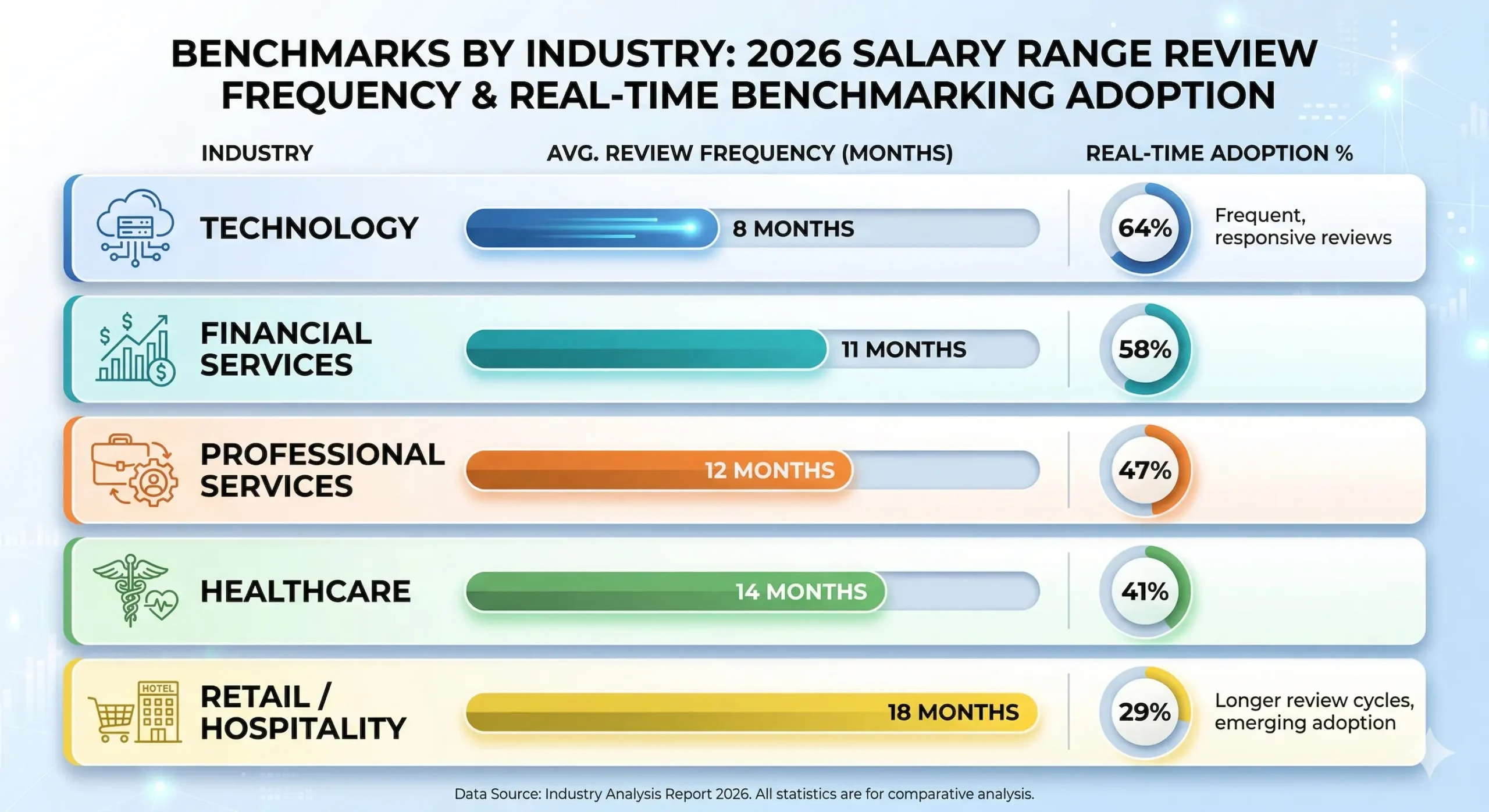
Benchmarks by Industry (2026 Salary Range Review Frequency)
| Industry | Avg. Range Review Frequency | Organizations with Real-Time Benchmarking |
|---|---|---|
| Technology | Every 8 months | 64% |
| Financial Services | Every 11 months | 58% |
| Healthcare | Every 14 months | 41% |
| Retail / Hospitality | Every 18 months | 29% |
| Professional Services | Every 12 months | 47% |
The technology sector’s more frequent review cycle reflects the faster-moving compensation market for technical roles, where demand spikes and supply constraints can shift market rates significantly within a single quarter. The retail and hospitality sector’s longer review cycle reflects both the lower market volatility for frontline roles and the historically lower investment in compensation infrastructure in those industries, which is increasingly becoming a competitive disadvantage as frontline worker attrition drives attention to compensation.
Key Strategies for Improving Base Salary Competitiveness
How AI and Data Are Reshaping Base Salary Decisions?
The compensation function has historically operated on lagging data: annual salary surveys, biennial market studies, and anecdotal intelligence from recruiters. AI and real-time data aggregation are changing this meaningfully.
Real-Time Market Benchmarking
AI-powered compensation platforms aggregate salary data from job postings, self-reported employee data, verified offer records, and third-party survey sources to produce continuously updated market benchmarks at the role, level, and location level. Rather than waiting for the annual survey cycle to discover a range has fallen behind the market, organizations using real-time benchmarking receive alerts when a role’s market rate moves outside the posted range. Compensation management shifts from a periodic review process into a continuous monitoring function.
Offer Acceptance Probability Modeling
Machine learning models trained on offer outcomes can predict, with meaningful accuracy, the probability that a specific offer amount will be accepted by a candidate in a given role, market, and competitive context. This gives recruiters and hiring managers a data-informed view of where decline risk is highest and where there is room to move without spending unnecessary budget. The result is offers that are more competitive on average and more efficiently priced relative to the outcome they are trying to achieve.
Pay Equity Analytics
AI-powered pay equity analysis tools can examine an organization’s entire salary dataset simultaneously, controlling for legitimate pay-determining factors (role, level, performance rating, location, tenure) and surfacing residual pay differences not explained by those factors. This analysis, which would require weeks of manual statistical work at scale, runs in minutes against live payroll data. Organizations with AI-powered pay equity analytics identify and remediate pay gaps faster, and the ongoing monitoring capability flags new equity issues before they compound.
Salary Negotiation Intelligence
AI tools embedded in hiring platforms analyze the negotiation history of similar roles and candidates, including which counteroffers were accepted and which were declined, to provide recruiters with real-time guidance on responding to a candidate’s counter. This replaces the recruiter’s personal anecdotal experience (limited to roles they have personally filled) with pattern data from a much larger population of comparable negotiations.
Stop Juggling
10 Job Boards.
Search One
Your next role is already here. avua pulls opportunities from across the web into a single searchable feed; filtered by role, location, salary, and remote preference.
1.5 Million+
Active Jobs
380+
Job Categories
Base Salary and Diversity and Inclusion
Pay equity is not an aspiration. In most jurisdictions with meaningful employment law, it is a legal requirement, and beyond the legal floor, it is one of the most direct mechanisms through which organizational values about fairness are either demonstrated or contradicted.
The Gender Pay Gap and Structured Offer Processes
The gender pay gap in base salary is documented across industries, geographies, and role levels. Within-role gaps (equivalent pay for equivalent work) are addressable through compensation strategy. Transparent salary ranges, structured offer processes that do not rely on negotiation to determine final pay, and annual pay equity audits are the three structural interventions with the most consistent evidence of closing within-role gender pay gaps. Organizations implementing all three report significantly smaller gender pay gaps within two to three years.
Research also demonstrates that the likelihood of negotiating base salary, and the magnitude of negotiation gains, correlates with demographic factors in ways that disadvantage women and underrepresented candidates. When final base salary is determined primarily by negotiation, the organization is allowing a process known to produce inequitable outcomes to set compensation. Structured offer processes that start at consistent, market-calibrated points within a range reduce this inequity mechanism without requiring behavioral change from candidates.
Geographic Pay Equity
Remote work has created a new dimension of pay equity complexity. Organizations that pay geographic differentials (lower base salaries for employees in lower-cost locations) face increasing pressure from employees who observe that their output is identical to colleagues in higher-cost markets but their pay reflects their zip code rather than their contribution. In 2026, geographic pay philosophy is one of the most actively contested dimensions of compensation strategy. Whatever approach an organization takes must be consistently applied, transparently communicated, and regularly reviewed against its retention and recruitment impact across each geographic population.
Common Challenges and Solutions
| Challenge | Solution |
|---|---|
| Salary Ranges Falling Behind Market | Implement quarterly benchmarking reviews; use real-time market data tools rather than annual survey cycles |
| Salary Compression Driving Attrition | Run annual compression analysis; establish a budget for targeted equity adjustments separate from the merit increase cycle |
| Offer Declines Due to Below-Market Pay | Audit rejection reasons systematically; update ranges before re-posting a role that has received multiple below-market declines |
| Pay Equity Gaps Across Demographic Groups | Conduct annual pay equity audits with statistical controls; implement structured offer processes that reduce negotiation variance |
| Internal Inequity When New Hires Earn More Than Peers | Proactively adjust internal salaries when market rates for a role rise significantly; do not wait for attrition to surface the problem |
Real-World Case Studies
Case Study 1: The Software Company
A Series C software company was experiencing a specific and costly pattern: offers for senior engineering roles were declining at a rate of 68%, compared to an industry benchmark of 31%. Post-decline surveys revealed that 84% of declining candidates cited compensation as the primary reason, and that in 79% of those cases, candidates had received competing offers that were between $22,000 and $38,000 higher.
The company’s engineering salary ranges had been set 18 months earlier based on survey data that was already 6 months old at the time of the review. Effectively, their ranges were reflecting a market that was 24 months in the past. They implemented a real-time benchmarking tool and updated their engineering salary ranges within four weeks. Offer decline rates for senior engineering roles dropped from 68% to 29% within two hiring cycles. The cost of the benchmarking tool implementation was recovered in avoided recruiting costs within 90 days.
Case Study 2: The Financial Services Firm
A regional financial services firm conducted its first structured pay equity audit and found that female employees in equivalent analyst roles were earning an average of 8.3% less than their male counterparts after controlling for performance rating, tenure, and location. The gap was not the result of explicit policy. It was the accumulated result of years of negotiation-dependent offer processes in which male candidates had negotiated more successfully on average, compounded by merit increase decisions that had applied subjective performance assessments inconsistently across demographic groups.
They implemented a structured offer process that set initial offers at the 50th percentile of the market range for all candidates regardless of negotiation, and committed to annual pay equity audits with an adjustment budget. Within two years, the adjusted gender pay gap had closed to 1.1%, within the range attributable to statistical noise rather than systematic inequity.
Case Study 3: The Healthcare System
A healthcare system operating across urban and rural locations was struggling to hire clinical staff in its rural facilities, where it had historically applied a geographic pay differential that reduced base salaries by 12% relative to its urban locations. Candidate survey data revealed that remote-capable clinical roles (telehealth physicians, remote case managers, clinical educators) were declining offers at rural-rated compensation because candidates were comparing them to urban-market opportunities available from competitors who paid on a national rate basis.
The system differentiated its pay philosophy: on-site clinical roles retained the geographic differential, reflecting genuine cost differences in those markets. Remote-eligible roles moved to a national rate basis. Within 18 months, offer acceptance rates for remote-eligible clinical roles at rural locations improved by 41%, with no budget impact on the on-site role population.
Building a Base Salary Analytics Dashboard: What to Track?
An AC without measurement infrastructure is a process masquerading as a system. Six metrics form the core of a useful performance dashboard:
Base Salary Across the Candidate and Employee Lifecycle
Job Posting and Market Positioning
The base salary conversation begins before a candidate applies, the moment the salary range is published in the job posting. In jurisdictions with pay transparency requirements, this is a legal obligation. In all jurisdictions, it is a competitive decision: the range you post determines who applies, what candidates expect, and what negotiating position you are implicitly taking before the first conversation has occurred.
Offer Stage
A well-calibrated salary range and a documented offer process reduce variance in this conversation and improve consistency of outcomes. Recruiters who understand where an offer sits relative to the range, what the acceptance probability data suggests at different price points, and what the total compensation package looks like in full are significantly more effective at closing offers than those working from instinct and ad hoc approval authority.
Annual Merit Review
Merit increases that are below inflation, below market movement, or below employee performance expectations are a documented attrition driver. Organizations that treat merit increases as a budget exercise rather than a retention investment systematically accelerate the departure of their highest performers, who have the most options available and who will use the merit cycle as a diagnostic of how valued they actually are.
Promotion and Role Change
When an employee is promoted, their base salary should move to a position within the new role’s salary range that reflects their proficiency in that role, not simply an increment above their previous rate. The common practice of applying a standard 10 to 15% promotion increase regardless of range position can result in newly promoted employees still sitting below the minimum of their new salary range, which is both inequitable and operationally indefensible.
Retention and Counter-Offer Management
When an employee receives a competing offer, blanket counter-offer policies (always match, never match) are strategically unsophisticated. The relevant questions are: is this employee in a critical role with high replacement cost, is their salary below market in a way that reflects a structural gap rather than an individual outlier, and is the competing offer a genuine market signal or a negotiating tactic? Organizations that answer these questions consistently and with data make better retention decisions and spend their retention budget more effectively.
The Real Cost of Base Salary Misalignment: By the Numbers

| Scenario | Offer Acceptance Rate | Avg. First-Year Attrition | Estimated Annual Cost (100 hires/year) |
|---|---|---|---|
| Below-Market Salary Ranges | 54% | 28% | $980,000 |
| At-Market Salary Ranges | 74% | 16% | $420,000 |
| Above-Market Salary Ranges (avua-Optimized) | 89% | 9% | $165,000 |
The cost calculation includes failed search spend (recruiter time on declined offers that must be restarted), first-year attrition replacement costs, and productivity gap during unfilled and ramping periods. The above-market scenario’s costs are not zero because no compensation strategy eliminates attrition entirely; they are lower because the primary compensation-driven attrition driver (below-market pay) has been addressed.
Related Terms
| Term | Definition |
|---|---|
| Compa-Ratio | The ratio of an employee’s base salary to the midpoint of their salary range, used to assess market position |
| Salary Band | The defined minimum, midpoint, and maximum for a given role or job level |
| Total Compensation | The full value of all monetary and non-monetary rewards provided to an employee |
| Pay Equity | The principle and practice of ensuring equivalent pay for equivalent work across demographic groups |
| Salary Compression | The narrowing gap between the pay of new hires and longer-tenured employees in the same role |
| Market Median | The 50th percentile of pay for a given role in a defined market, used as the standard benchmarking reference point |
Frequently Asked Questions
What is the difference between base salary and total compensation?
Base salary is fixed pay, but total compensation, which includes bonuses, equity, and benefits, is the more accurate measure of an employee’s true earnings and an employer’s total investment.
How often should base salary ranges be reviewed?
Annual reviews are the baseline for competitive pay, though high-velocity sectors (like tech) often require quarterly updates. To remain proactive, anchor ranges to current market data rather than reacting only when recruitment fails.
What is a reasonable base salary increase at the time of a job offer?
While a 10–20% raise is the traditional benchmark for job changes, pay transparency has shifted the focus toward range positioning. Rather than chasing a specific percentage increase, the right offer must balance market competitiveness, the candidate’s experience level, and internal equity.
Can a company legally pay different salaries to employees doing the same job?
Pay differences are legally permissible only when justified by factors like seniority, merit, or performance. Gaps tied to protected characteristics (e.g., gender or race) create significant legal risk. To mitigate this exposure, maintain clear documentation and conduct regular pay audits to ensure equity.
How should organizations handle salary negotiations with candidates who disclose a competing offer?
Treat competing offers as market signals rather than demands. If an offer aligns with market rates, matching it is a defensible way to retain qualified talent. However, if the offer is an outlier, matching it can compromise internal equity and increase long-term costs. To ensure consistency, always base your decision on a documented framework rather than reacting to pressure in the moment.
Conclusion
Base salary is where the employment relationship begins. It is the number that candidates use to decide whether an opportunity is worth pursuing, the figure that employees use to assess whether they are valued fairly, and the foundation upon which every other element of the compensation package is built and evaluated.
Getting it right requires more than a competitive instinct and a salary survey from last year. It requires a salary structure grounded in current market data, applied consistently across the organization, maintained with enough frequency to track a market that does not hold still, and connected to a pay equity framework that ensures the structure is fair in practice and not just in design.
The organizations that treat base salary as a strategic tool rather than an administrative line item attract better candidates, close more offers, retain talent longer, and build compensation reputations that compound in value over time. In a labor market where candidates arrive at offer conversations with more information than they have ever had, that reputation is not a nice-to-have. It is a competitive asset that either works for the organization or against it, every single time an offer goes out.