The average recruiter spends six to eight seconds on an initial resume review. In that window, a hiring decision is already forming. And more often than most talent teams are comfortable admitting, it is not forming around qualifications.
It is forming around a name, a university, a postcode. Signals that trigger automatic impressions before any structured behavioral interview logic or aptitude test score enters the picture. AI resume screening does not fix this by default. If the training data carries those signals, the model replicates the bias at scale.
Blind resume review is the practice of removing identifying information from applications before evaluation, so that screening decisions are grounded in actual skills and experience rather than demographic-correlating shortcuts. It is one of the most evidence-backed interventions available at the resume stage, and with modern redaction tools, the operational barrier to implementation is close to zero.
What remains is the harder problem: convincing organizations that their candidate experience and assessment quality both improve when evaluators see less, not more.
The core metric governing blind resume review effectiveness is the Shortlist Diversity Index (SDI): the ratio of demographic representation at the shortlist stage to demographic representation at the application stage. An SDI of 1.0 indicates that the screening process is advancing candidates from each demographic group in proportion to their representation in the applying pool.
An SDI significantly below 1.0 for any group indicates that the screening process is filtering that group out at a rate that exceeds their proportional representation, which is the definition of screening-stage bias.
Shortlist Diversity Index = Proportion of Group X in Shortlist / Proportion of Group X in Applicant Pool
What is Blind Resume Review?
Blind resume review is a structured evaluation methodology in which identifying information is removed or obscured from candidate resumes and application materials before shortlisting review, preventing evaluators from being influenced by characteristics unrelated to role performance.
The information typically removed includes the candidate’s name (which encodes perceived gender and ethnicity), photograph (where included), home address (which correlates with socioeconomic background and in some geographies with ethnicity), graduation year (which encodes approximate age), and in more comprehensive implementations, university and employer names (which encode institutional prestige associations).
What remains after the identifying information is removed is the substance of the application: the roles held, the responsibilities carried, the outcomes delivered, the skills demonstrated, and the trajectory of the career. This is, by definition, the information that is relevant to predicting job performance. Blind resume review is not a technique for making evaluation harder. It is a technique for making it more focused.
Is Blind Resume Review a Fairness Initiative or a Better Hiring Decision?
The framing that most organizations get wrong is positioning blind resume review as a fairness initiative for the benefit of underrepresented candidates. This framing, while not incorrect, is incomplete in a way that costs it support from the business stakeholders who control implementation decisions.
Blind resume review is, more accurately, a decision quality improvement. When an evaluator reviews a resume with a name, an address, and a graduation year visible, they are processing information that is statistically unrelated to job performance. The cognitive bandwidth used to process that information is not available for the information that is relevant. The implicit associations triggered by the visible demographic signals distort the evaluation of the substantive content. The result is a screening decision that is less accurate than it would be if the irrelevant information had been absent.
Removing the irrelevant information does not make the decision fairer by lowering the bar. It makes the decision more accurate by raising the signal-to-noise ratio. The candidates who benefit from the increased accuracy are not marginal candidates who barely qualified. They are qualified candidates who were previously being assessed through a distorting lens.
The evidence is not ambiguous. Resume audit studies consistently demonstrate callback rate differentials of 30 to 50% based on perceived name ethnicity for resumes with equivalent qualifications. Studies on gender and resume evaluation find that identical content described in language patterns that correlate with gender is rated differently based on that correlation. Studies on university prestige find that hiring managers can identify target versus non-target institutions in under six seconds and that this identification influences shortlisting decisions independently of the candidate’s actual qualifications.
Organizations implementing structured blind resume review report an average 34% improvement in shortlist diversity at the initial screening stage, with a simultaneous improvement in hiring manager satisfaction with shortlist quality. The satisfaction improvement reflects a real effect: blind shortlists contain more candidates who are genuinely qualified on the metrics that predict performance, because the screening process is no longer filtering on metrics that do not.
For TA leaders, the business case is straightforward. A hiring process that systematically filters out qualified candidates based on information unrelated to their qualifications is not maintaining quality. It is reducing the effective size of the qualified candidate pool and then hiring from the remaining fraction. Blind resume review recovers access to the filtered portion without changing the quality threshold. It is talent pool expansion through accuracy improvement, not quality reduction through social intervention.
The scenario that makes the cost of the status quo concrete: a technology company has been trying to hire a data engineering lead for 14 weeks. The role requires specific experience with a distributed data architecture stack. The pipeline has included 96 applicants. Eighteen have been shortlisted. All 18 are male. When a bias audit is conducted on the full application pool, it reveals that 31 of the 96 applicants were women, 11 of whom had directly relevant technical experience. None of the 11 were shortlisted.
Post-audit review of their resumes against the stated role criteria finds them substantively equivalent to several of the shortlisted candidates. The blind resume review would have surfaced all 11 for consideration. The company has spent 14 weeks, three recruiting cycles, and approximately $34,000 in recruiting resource looking at 65% of its qualified candidate pool.
Your Resume Isn’t Getting Read
Let’s Get That Fixed!
75% of resumes get auto-rejected. avua’s AI Resume Builder optimizes formatting, keywords, and scoring in under 3 minutes, so you land in the “yes” pile.
What Gets Removed and Why?
The specific fields removed in a blind resume review are not arbitrary. Each is removed because research has identified it as a trigger for a specific bias mechanism that reduces screening accuracy.
- Name: Encodes perceived gender and ethnicity. Name-based bias is among the most replicated findings in hiring research. It operates in the first fraction of a second of resume exposure and is effectively impossible to consciously suppress without removing the stimulus entirely.
- Photograph: Where resumes include photographs (common in many non-US markets), appearance-based bias is immediate and significant. Attractive candidates receive higher ratings. Candidates whose physical appearance is associated with the majority demographic profile of the role receive higher ratings. Photograph removal eliminates the most powerful single trigger of appearance-based evaluation distortion.
- Home Address: Encodes socioeconomic background and, in many geographies, correlates with ethnicity and educational access. Recruiters and hiring managers demonstrate documented zip code bias, rating otherwise equivalent candidates differently based on the socioeconomic connotations of their listed address. Address removal does not compromise the evaluation; no valid performance criterion is meaningfully associated with where a candidate lives.
- Graduation Year: Encodes approximate age. Age-related bias is among the most legally significant and operationally common forms of hiring discrimination. Removing the graduation year eliminates the most reliable age proxy on the resume without removing any information about what the candidate actually learned or demonstrated during their education.
- University Name and Employer Name (advanced implementation): Encode institutional prestige. Prestige bias is one of the most stubborn and most costly forms of resume-stage filtering, consistently excluding candidates from non-elite institutions who are substantively as qualified as candidates from target schools. In the most comprehensive blind review implementations, these fields are also removed or anonymized, though this requires more sophisticated redaction capability and more substantial evaluator training on how to assess the remaining experience content.
Blind Resume Review vs. Related Approaches
| Approach | What It Removes | Stage | Limitation |
|---|---|---|---|
| Blind Resume Review | Name, address, photo, graduation year | Resume screening | Cannot apply to live interview stage |
| Blind Work Sample Assessment | Author attribution on submitted tasks | Assessment stage | Requires structured task design |
| Blind Interview Scoring | Video/audio of candidate during response review | Asynchronous interview | Removes communication signal as well as bias signal |
| Structured Interviewing | No removal; adds evaluation structure | Live interview | Reduces but cannot eliminate live-stage bias |
| Blind Job Application | Company name and prestige removed from applicant’s view | Not applicable; this is a candidate tool | Different application of the principle |
| AI Resume Screening | Can be configured to exclude fields | Resume screening | AI may contain its own trained-in biases |
Blind resume review is most effective as the first layer in a multi-stage bias reduction architecture. Its impact at the resume stage creates the accurate candidate pool that subsequent structured evaluation stages can then assess fairly. It is not a substitute for structured interviewing at later stages; it is the prerequisite for it.
What the Experts Say?
Removing names from resumes is not radical. It is rational. The name does not predict performance. Everything else we say we care about might. So we should look at everything else first.
– Siri Chilazi, researcher at the Women and Public Policy Program at Harvard Kennedy School and co-author of research on gender equity in hiring
How to Measure Blind Resume Review Effectiveness?
Formula: Shortlist Diversity Index
SDI = (Number of people shortlisted from a group ÷ Total applicants from that group)
SDI values above 1.0 indicate a group is advancing at above-proportional rates; values below 1.0 indicate underrepresentation at the shortlist stage relative to the applying pool.
Benchmarks by Implementation Level (2026 Data)
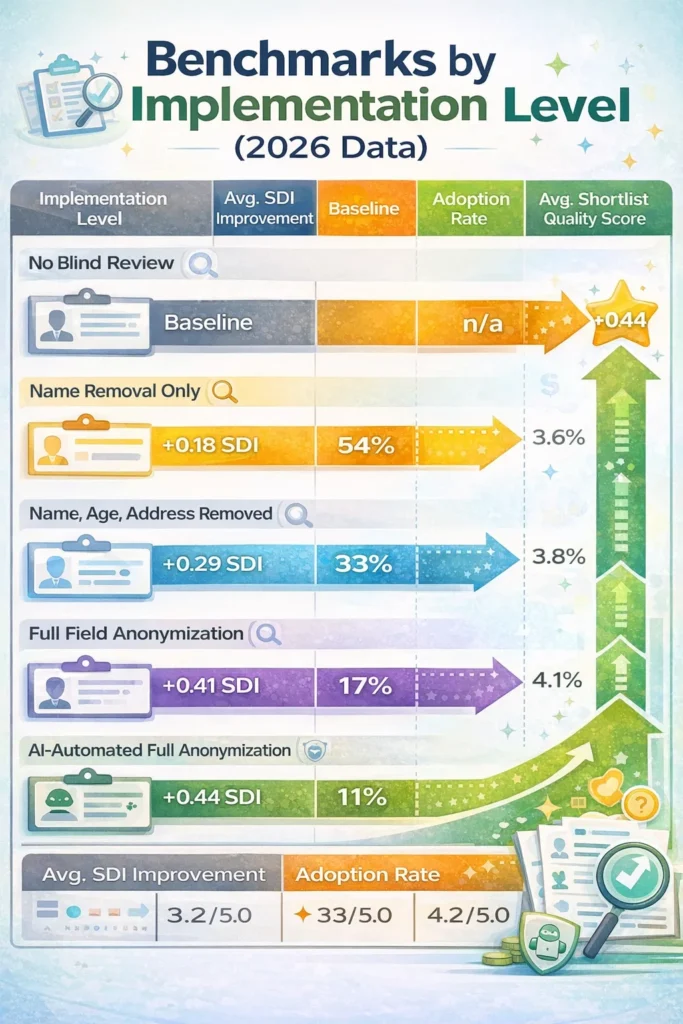
| Implementation Level | Avg. SDI Improvement | Adoption Rate | Avg. Shortlist Quality Score |
|---|---|---|---|
| No Blind Review | Baseline | n/a | 3.2 / 5.0 |
| Name Removal Only | +0.18 SDI | 54% | 3.6 / 5.0 |
| Name, Age, Address Removed | +0.29 SDI | 33% | 3.8 / 5.0 |
| Full Field Anonymization | +0.41 SDI | 17% | 4.1 / 5.0 |
| AI-Automated Full Anonymization | +0.44 SDI | 11% | 4.2 / 5.0 |
The shortlist quality score, reflecting hiring manager satisfaction with the candidates presented, improves monotonically with implementation depth. This is the data point most useful for internal business case conversations: blind review produces better shortlists by the metric that hiring managers themselves care about.
Key Strategies for Effective Blind Resume Review
How AI Enables Blind Resume Review at Scale?
The operational barrier that historically limited blind resume review to well-resourced organizations or small-scale pilot programs was the labor cost of manual anonymization. Reviewing, identifying, and removing specified fields from hundreds or thousands of resumes was simply not achievable as a routine process without dedicated resource. AI has largely resolved this constraint.
Automated Field Redaction
Modern AI-powered redaction tools can identify and remove specified fields from both structured (form-based) and unstructured (free-text) resume documents at volume, processing a pipeline of several hundred applications in minutes rather than hours. The accuracy of AI-powered field identification has reached the point where manual verification of redaction outputs is needed only for edge cases rather than for the full application volume.
Proxy Signal Detection
More advanced AI implementations include natural language processing capability that identifies not just specified fields but proxy signals for those fields embedded in remaining text. An AI system that can flag a resume mentioning a specific diversity-affiliated organization, or a cover letter whose phrasing correlates with a specific educational background, gives the evaluation process a second layer of anonymization quality control that manual review could not systematically provide.
Consistent Application Across Volume
Human reviewers applying manual anonymization processes introduce inconsistency at volume: the first few applications may be carefully anonymized while later applications in a large batch receive less thorough treatment as fatigue sets in. AI anonymization applies identical processing to every application regardless of batch position, eliminating the quality degradation that manual processes experience at scale.
Integration with ATS Workflows
The most effective implementations of AI-powered blind resume review integrate directly with the organization’s ATS so that redaction occurs automatically at the point of application ingestion, before any human reviewer accesses the candidate record. This integration removes the procedural step that is most vulnerable to being skipped or inconsistently applied, and it ensures that the blind review discipline is maintained even when individual evaluators are working under time pressure.
Stop Juggling
10 Job Boards.
Search One
Your next role is already here. avua pulls opportunities from across the web into a single searchable feed; filtered by role, location, salary, and remote preference.
1.5 Million+
Active Jobs
380+
Job Categories
Blind Resume Review and Diversity, Equity, and Inclusion
Blind resume review is frequently categorized as a DEI initiative, which is accurate but incomplete. Its relationship to diversity outcomes is a consequence of its function as a bias-reduction mechanism, not a goal in itself.
The diversity outcomes that blind resume review produces are specifically improvements in the representation of groups that are currently being screened out at rates disproportionate to their representation in the qualified candidate pool. For most organizations in most role categories, these groups include women (whose names encode gender and whose career histories may encode caregiving-related gaps), candidates from ethnic minority backgrounds (whose names encode perceived ethnicity), older candidates (whose graduation years encode age), and candidates from lower socioeconomic backgrounds (whose addresses and institutional affiliations encode access history).
Blind resume review does not produce diversity by selecting less-qualified candidates from these groups. It produces diversity by removing the filters that were excluding them from consideration based on information unrelated to their qualifications. The distinction matters because it determines how the intervention should be evaluated: not by whether the shortlist becomes more diverse, but by whether the shortlisted candidates perform as well as or better than the candidates shortlisted through non-blind processes.
The answer, consistently across implementations, is that they do. The diversity produced by blind resume review is the diversity of accurate assessment, not the diversity of compromised standards. Organizations that understand this distinction are the ones that sustain blind review programs through internal resistance and build on them rather than abandoning them when the initial novelty wears off.
Common Challenges and Solutions
| Challenge | Solution |
|---|---|
| Evaluators Seeking Out Removed Information | Audit shortlisting decisions against application content for evidence of proxy-based decision-making; establish clear governance protocols |
| Proxy Signal Leakage Through Remaining Fields | Implement AI proxy signal detection; train evaluators on proxy signal awareness and escalation protocol |
| Resistance from Hiring Managers | Share SDI data and post-hire performance comparisons between blind and non-blind cohorts; frame as quality improvement |
| Inconsistent Implementation Across Role Types | Build blind review into ATS workflow so it applies automatically at application ingestion regardless of role |
| Cover Letters Containing Identifying Information | Either blind review cover letters separately or exclude them from the initial shortlisting review, using them only as supplementary context after the blind decision has been made |
Real-World Case Studies
Case Study 1: The National Public Broadcaster
A national public broadcaster implemented name-blind and address-blind resume review for all entry-level and mid-level roles after internal diversity data showed significant underrepresentation of candidates from lower socioeconomic backgrounds at the shortlisting stage despite those candidates making up a substantial portion of the applying pool. In the first hiring cycle under the blind system, the proportion of shortlisted candidates from addresses associated with lower socioeconomic areas increased from 19% to 38%.
Hiring managers, who were not informed which candidates had been shortlisted through the blind system until after the interview stage, rated the interview-stage candidate pool as the highest quality they had seen in three years. Twelve-month performance ratings for the new cohort were equivalent to the previous year’s cohort. The program was extended to all roles within 18 months.
Case Study 2: The Investment Bank
A global investment bank introduced blind resume review for its graduate recruitment program after analysis revealed that candidates from non-target universities were advancing at less than a third of the rate of candidates from a small set of elite institutions, despite equivalent scores on the bank’s structured numerical reasoning assessment included in the application process. The gap between application stage diversity and shortlist stage diversity had been invisible in aggregate diversity reporting because it occurred before the shortlist was formally tracked.
Blind review, which removed university names from resumes before initial shortlisting, produced a shortlist that was 44% non-target university candidates in the first implementation cycle. The two-year performance ratings for that cohort were not statistically different from the preceding cohort of predominantly target-university hires. The bank’s graduate program now has a 27% higher representation of first-generation university graduates than the sector average.
Case Study 3: The Healthcare Recruitment Agency
A healthcare staffing agency implementing blind resume review for clinical nursing roles discovered, within two hiring cycles, that the process had surfaced a consistent pattern in the non-blind evaluation that had not been visible before implementation. Candidates with nursing degrees from internationally accredited institutions outside the UK were advancing at 0.41 of the rate of candidates with UK-accredited degrees, despite equivalent clinical competency scores and equivalent reference quality.
Post-blind-review analysis confirmed that the gap was driven by evaluator familiarity with institution names rather than by any quality difference in the actual qualifications. The agency redesigned its competency-based evaluation criteria to focus exclusively on clinical competency indicators rather than institutional affiliation. Within three cycles, the SDI for internationally qualified nurses improved from 0.41 to 0.86, and client satisfaction scores for placed nurses from international institutions were equivalent to those from domestic institutions.
Building a Blind Resume Review Dashboard: What to Track?
An AC without measurement infrastructure is a process masquerading as a system. Six metrics form the core of a useful performance dashboard:
Blind Resume Review Across the Hiring Funnel
Job Posting and Application Design
Blind resume review begins before the resume is submitted, in the design of the application form. Organizations that require candidates to submit a photo, disclose a specific address format, or provide a graduation year in a mandatory field are structuring the application to produce information that blind review will then need to remove. Designing the application form to request only the information needed for evaluation reduces the redaction burden and the proxy signal risk simultaneously.
Initial Shortlisting
The primary deployment stage for blind resume review: the evaluation of submitted applications to produce an initial shortlist for screening calls or structured interviews. At this stage, blind review has the most leverage because it is operating on the largest volume of applications with the least per-application time investment, which are precisely the conditions under which bias-driven shortcuts have the greatest influence on outcomes.
Second-Round Shortlisting
In high-volume pipelines where an initial blind shortlist is produced from a large applicant pool and then further narrowed to a smaller interview-stage pool, a second round of blind review applied to the detailed evaluation of the initial shortlist continues the bias-reduction principle into the more intensive evaluation phase. At this stage, evaluators typically have more information per candidate and more time to consider it, which reduces but does not eliminate the value of the blind review structure.
Offer-Stage Reference
When a final hiring decision is being made between two or three finalists, returning to the blind review records of the initial evaluation provides a useful check on whether the assessment has remained consistent with the substantive criteria that guided the shortlisting decision, or whether additional identifying information accumulated through the interview process has introduced new bias into the evaluation.
The Real Cost of Skipping Blind Resume Review: By the Numbers
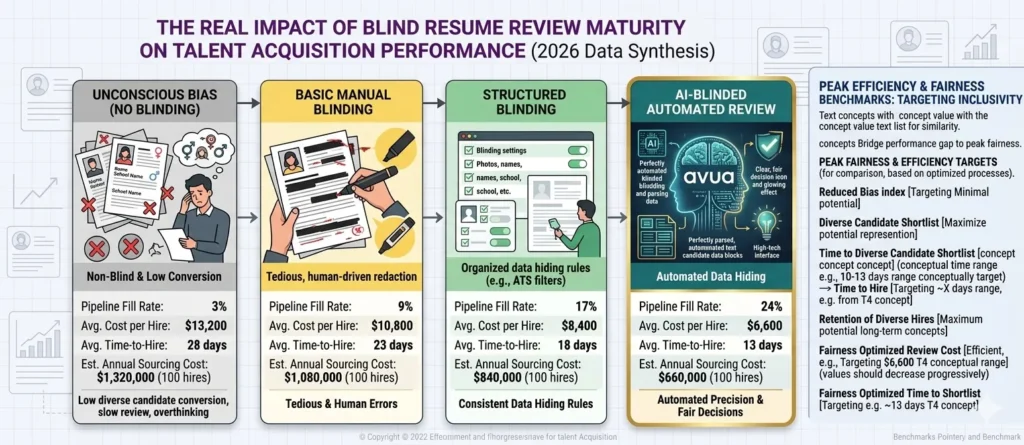
| Scenario | Effective Qualified Pool Accessed | Avg. Time to Fill | Est. Annual Cost of Bias (100 hires) |
|---|---|---|---|
| No Blind Review | 48% of qualified pool | 31 days | $960,000 |
| Name Removal Only | 61% of qualified pool | 27 days | $620,000 |
| Full Field Blind Review | 83% of qualified pool | 22 days | $280,000 |
The cost of bias at the resume review stage includes extended time-to-fill driven by an artificially constrained candidate pool, additional sourcing spend required to compensate for the portion of the qualified pool being screened out, and first-year attrition from candidates selected from a filtered pool whose average fit quality is lower than that of the full qualified pool. The improvement from no blind review to full field blind review represents approximately $680,000 in recoverable annual cost at 100 hires per year.
Related Terms
| Term | Definition |
|---|---|
| Blind Hiring | The broader methodology of removing identifying information across multiple hiring stages |
| Adverse Impact | A statistically significant difference in selection rates between demographic groups, often the measured consequence of unblinded screening |
| Shortlist Diversity Index | The ratio of a demographic group’s representation in the shortlist to their representation in the applicant pool |
| Implicit Bias | Unconscious attitudes that influence evaluation without the evaluator’s awareness; the mechanism that blind review is designed to interrupt |
| Resume Anonymization | The technical process of removing or obscuring identifying fields from resume documents |
| Structured Screening | The use of defined, pre-established criteria and rubrics to evaluate applications consistently; the complement to blind review that ensures accurate application of the bias-reduced evaluation |
Frequently Asked Questions
Is blind resume review the same as blind hiring?
Blind resume review is a specific implementation of the broader blind hiring methodology, applied to the resume screening stage. Blind hiring encompasses blind evaluation at any stage of the hiring process, including assessment scoring, work sample evaluation, and offer construction. Blind resume review is the most commonly implemented and most operationally accessible component of a blind hiring program.
Can blind resume review be implemented without technology?
Yes, though at limited scale. Manual blind review requires a team member who is not involved in the shortlisting decision to physically or digitally redact the identifying fields from each application before it is passed to the reviewer. This is feasible for low-volume hiring but becomes operationally unsustainable above approximately 50 applications per role. AI-powered redaction tools are the practical requirement for implementing blind review consistently at any significant volume.
What should evaluators do when a resume contains information that reveals the candidate’s identity despite the blind review?
The appropriate response is to flag the application for a secondary review check rather than proceeding with the evaluation as though the identity information had not been seen. Many organizations have a designated blind review compliance contact who handles flagged applications, either re-anonymizing the relevant content or conducting the evaluation themselves to preserve the blind principle. The key is that the evaluator who has seen the identifying information should not be the person who makes the final shortlisting decision for that application.
Does blind resume review work equally well for all role types?
The evidence is strongest for professional and knowledge-worker roles where the resume is the primary application document and where qualifications can be meaningfully assessed from the remaining content after anonymization. For roles where personal presentation is a primary performance criterion (some client-facing, public-facing, or media roles), the application of blind review requires more careful design to ensure that the removed information is genuinely irrelevant to role performance. For highly technical roles where skills and competency can be evaluated from work history without reference to the institution or employer that provided the context, blind review is highly effective.
How does blind resume review affect candidate experience?
Candidates are typically not informed whether the organization uses blind resume review, which means it has a neutral effect on candidate experience in most implementations. In some organizations, disclosing the use of blind review in job postings has had a positive effect on application rates from underrepresented groups, who interpret the disclosure as a signal that the organization is serious about equitable evaluation. The disclosure does not disadvantage any candidate and may attract applicants who specifically value evidence-based evaluation processes.
Conclusion
The resume is a document. The name on it is a label. The label does not predict performance. Every second a recruiter spends processing the label is a second not spent evaluating the document, and every impression the label creates distorts the evaluation of everything that follows it.
Blind resume review is not a statement. It is a correction. It corrects the signal-to-noise ratio in the most automated, highest-volume, lowest-time-per-decision stage of the hiring process. It does so reliably, at scale, and with documented positive effects on both the equity and the quality of the shortlists it produces.
The organizations that have implemented it are not running a social experiment. They are running a better hiring process. The organizations that have not implemented it are spending recruiter time processing information that does not predict performance, using that information to make decisions that filter out qualified candidates, and then wondering why their pipeline is narrow and their shortlists are homogeneous.
The fix is specific. The evidence is clear. The technology is available. The remaining question is organizational will, which is a different kind of problem but a more tractable one.