Modern talent doesn’t just look for jobs during business hours. If a top-tier candidate browses your roles at midnight only to find a static “Submit Resume” button and a digital black hole, you’ve likely already lost them to a more responsive competitor. In a high-stakes market, accessibility is the ultimate differentiator for a superior Candidate Experience.
This is where AI Hiring through conversational chatbots changes the game. Far from simple FAQ bots, these sophisticated interfaces guide an Active Candidate through the entire Candidate Journey, from initial inquiry to screening and even instant self-scheduling. By providing immediate, 24/7 interaction, these tools significantly reduce the Abandonment Rate that typically plagues long, friction-filled application forms.
These interfaces aren’t meant to replace recruiters; they act as an always-on extension of the team, ensuring your Candidate Pipeline keeps moving while the office is closed. By integrating directly with your Candidate Management System, they turn passive interest into active engagement. When the best talent expects instant answers, providing a seamless, automated entry point ensures your Applicant Pool is filled with high-quality leads who feel supported from their very first interaction.
The primary metric governing chatbot recruiting effectiveness is the Chatbot Engagement-to-Application Rate (CEAR): the proportion of candidates who engage meaningfully with the recruiting chatbot and subsequently submit a complete application.
CEAR (%) = (Complete Applications from Chatbot-Engaged Candidates ÷ Total Meaningful Chatbot Engagements) × 100
Organizations with well-designed chatbot implementations achieve CEARs of 28 to 42%, compared to 8 to 15% for comparable careers page visitors without chat assistance. That gap represents a significant volume of candidates who needed a nudge, a question answered, or a scheduling barrier removed before they would commit to applying.
What is Chatbot Recruiting?
Chatbot recruiting is the deployment of AI-powered conversational agents in the talent acquisition workflow to automate candidate communication, guide applicants through the hiring process, answer common questions, collect initial screening information, and facilitate scheduling, reducing manual recruiter workload while maintaining responsiveness and personalization at scale.
The evolution matters here. The first generation of recruiting chatbots were essentially glorified FAQ pages with a chat interface: they followed rigid scripts, had no ability to interpret natural language meaningfully, and frustrated candidates who asked anything outside the predefined question set. Many candidates who encountered them in the early days formed a lasting negative impression of the format.
Second-generation chatbots, which most organizations are deploying in 2026, operate on large language models that understand intent rather than matching keywords. They can engage in genuine back-and-forth conversations, interpret ambiguous questions, provide contextually relevant answers, escalate to humans when needed, and complete multi-step tasks like scheduling interviews or collecting screening responses within a single conversational thread.
The best implementations feel less like interacting with a bot and more like texting with a knowledgeable, responsive, consistently available contact who has answers to the questions that usually cause candidates to drop off: what does the application process look like, is my experience relevant for this role, when can I expect to hear back, and can I reschedule my interview?
Is Your Hiring Process Available When Your Candidates Are?
Here is the honest truth about when candidate interest peaks. It is frequently not between 9 AM and 5 PM on weekdays. It is on Sunday evenings when someone has spent the weekend thinking about their career. It is on Tuesday night at 10 PM when a commuter is scrolling their phone on the train. It is at 7 AM on a Friday when someone has decided that today is the day they are going to do something about their situation.
And what does the standard hiring process offer at those moments? A static application form. An email address. A phone number that rings to voicemail. Or nothing at all.
The friction between the moment a candidate’s interest peaks and the moment they actually take action is where a meaningful proportion of potential applications are lost. Research consistently shows that candidates who encounter a friction barrier at the moment of peak interest, a form they cannot complete on mobile, a question they cannot get answered, a scheduling process that requires waiting, are significantly less likely to re-engage with the application later than they were to complete it in the moment.
Recruiting chatbots that engage candidates at the moment of peak interest capture 3.7 times more applications from the same traffic volume than static careers pages with no interactive element. The candidates who were going to apply anyway still apply. But the candidates on the fence, those who needed a question answered, a barrier removed, or simply a signal that the organization is accessible and responsive, are converted at dramatically higher rates.
For talent acquisition leaders, the case for chatbot recruiting is really a case about availability. Your recruiting team cannot be available at 11 PM on a Wednesday. A well-designed chatbot can be, and in a competitive hiring market, being available when a candidate decides to engage is not a minor advantage. It can be the difference between capturing a great candidate and losing them to a competitor who had better coverage.
There is also an internal efficiency argument that is worth taking seriously. The volume of repetitive, low-complexity candidate inquiries that consume recruiter time, including application status questions, interview logistics, basic role information, and scheduling requests, can be handled almost entirely by a well-configured chatbot. In high-volume hiring environments, this automation frees recruiter bandwidth for the high-judgment activities that actually require human involvement: relationship building, complex candidate questions, offer negotiation, and hiring manager partnership.
Consider a staffing agency hiring for 200 roles across 40 client organizations simultaneously. Their two-person candidate communication team was spending approximately 65% of their time answering questions that fell into eight predictable categories: application status, interview logistics, role requirements, compensation range, start dates, background check status, onboarding information, and scheduling requests. All eight were addressable through a well-designed chatbot. After implementation, candidate communication time dropped from 65% to 21% of team capacity, freeing roughly 18 recruiter-hours per week for activities that required genuine human judgment.
The cost savings from that reallocation alone were estimated at $47,000 annually, and candidate satisfaction scores, measured by post-interaction survey, were higher with the chatbot than they had been with the human communication team for routine inquiries, because the chatbot was available immediately rather than within a business day.
Your Resume Isn’t Getting Read
Let’s Get That Fixed!
75% of resumes get auto-rejected. avua’s AI Resume Builder optimizes formatting, keywords, and scoring in under 3 minutes, so you land in the “yes” pile.
Where Chatbots Add the Most Value in the Hiring Process?
Not every recruiting interaction benefits equally from chatbot involvement. The highest-value chatbot applications are concentrated at the specific stages where volume, repetition, and timing sensitivity make human handling either impractical or disproportionately expensive.
Careers Page Engagement and Application Guidance
The moment a candidate lands on a careers page with interest but uncertainty, the chatbot’s primary job is to reduce that uncertainty quickly. Common questions at this stage include: “Is my background relevant for this role?”, “How long does the application take?”, “Do you have openings in X location?”, and “What does the hiring process look like?” Each of these questions, unanswered, increases the probability that the candidate closes the page without applying.
A well-designed chatbot at this stage can answer these questions in seconds, guide the candidate to the most relevant role listing, provide a preview of what the application involves, and in some implementations, initiate a lightweight pre-screen conversation that collects the information the recruiter would otherwise gather in a phone call. Candidates who receive this guidance before applying submit more complete, more qualified applications than those who navigate the process without assistance.
Application Status and Follow-Up Communication
One of the most consistently cited sources of negative candidate experience is the absence of communication about application status. The recruiter who manages 40 active candidates across 8 roles cannot send personalized status updates to each of them daily. But candidates want to know where they stand, and the uncertainty of not knowing is one of the primary drivers of withdrawal and competitive offer acceptance during the process.
A chatbot integrated with the ATS can provide accurate, real-time application status to candidates who inquire, 24 hours a day, without consuming recruiter time. More proactively, it can trigger outbound status notifications at defined points in the process, ensuring that candidates hear from the organization at regular intervals rather than experiencing prolonged silence that they interpret as disinterest.
Screening and Qualification Conversations
For high-volume roles, chatbot-led initial screening conversations can replace or supplement the first-round recruiter phone screen. The chatbot asks structured screening questions, records responses, scores answers against defined criteria, and routes qualified candidates to scheduling and non-qualified candidates to an appropriate rejection pathway. This automation compresses the time from application to first qualified interaction from days to hours, and it maintains consistent screening criteria across all candidates without the evaluator variability that affects human screening at volume.
The candidate experience quality of this screening format depends heavily on conversation design: a chatbot screening that feels like a helpful conversation produces different candidate satisfaction scores than one that feels like a bureaucratic interrogation. Tone, question structure, and acknowledgment of responses all matter for how the interaction is received.
Interview Scheduling
Scheduling friction is one of the most reliably frustrating experiences in the hiring process, for candidates and recruiters alike. The email chain that takes three exchanges to confirm a 30-minute interview slot is a process that benefits nobody. A chatbot that presents available time slots, accepts candidate selection, sends calendar invitations, and handles rescheduling requests without human involvement eliminates this friction entirely. Candidates who can schedule their own interviews immediately, at the moment of invitation, at whatever time works for them, show rates are measurably higher than those who must wait for human scheduling coordination.
Chatbot Recruiting vs. Related Talent Technology
| Technology | Interaction Type | Response Capability | Primary Use | Requires Human to Initiate? |
|---|---|---|---|---|
| Recruiting Chatbot | Conversational, real-time | Dynamic, context-aware | Candidate guidance, screening, scheduling | No |
| Email Automation | One-way, asynchronous | Template-based | Status updates, process communications | Yes (typically) |
| ATS Notifications | One-way, event-triggered | Fixed templates | Application confirmations, stage updates | No (automated) |
| Live Chat | Conversational, real-time | Human-powered | Complex questions, relationship building | Yes |
| Conversational AI Interview | Structured conversational assessment | AI-scored | Early-stage candidate evaluation | No |
The critical distinction between a recruiting chatbot and live chat is availability and scalability. Live chat is excellent for complex interactions but requires a human to be available and actively attending to the interface. A recruiting chatbot is available continuously, handles unlimited simultaneous conversations, and never gets tired, frustrated, or inconsistent. The two are complementary rather than competing: chatbots handle the volume and the off-hours, human live chat handles the complex and sensitive interactions that benefit from genuine human presence.
What the Experts Say?
The best recruiting chatbot is one candidates forget is a chatbot because it actually helps them. The worst recruiting chatbot is one they remember as a chatbot because it got in their way. The gap between those two experiences is entirely in the design.
– Madeline Laurano, Founder of Aptitude Research and one of the most widely cited analysts in HR technology and talent acquisition innovation
How to Measure Chatbot Recruiting Effectiveness?
Formula: Chatbot Engagement-to-Application Rate
CEAR (%) = (Complete Applications from Chatbot-Engaged Candidates ÷ Total Meaningful Chatbot Engagements) × 100
Track alongside Resolution Rate: the proportion of chatbot interactions that are successfully resolved without requiring escalation to a human recruiter. A high resolution rate indicates that the chatbot is adequately equipped to handle the questions it is receiving. A low resolution rate indicates either that candidates are asking questions outside the chatbot’s knowledge base or that the chatbot’s answers are not satisfying candidate needs and are generating follow-up requests.
Benchmarks by Chatbot Maturity (2026 Data)
| Chatbot Maturity | CEAR | Resolution Rate | Recruiter Time Saved |
|---|---|---|---|
| No Chatbot | 8 to 15% (static page) | N/A | Baseline |
| Basic Rule-Based Bot | 19% | 48% | 12% reduction |
| NLP-Powered Conversational | 31% | 74% | 34% reduction |
| AI-Integrated Full Workflow (avua) | 38% | 89% | 52% reduction |
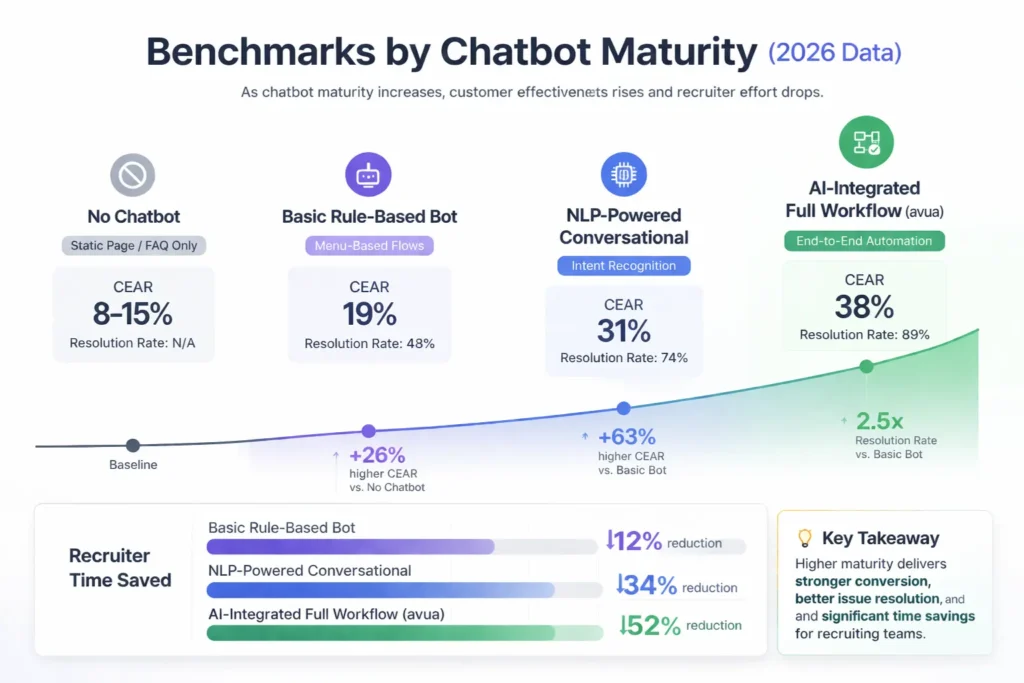
The recruiter time saved increases with chatbot sophistication because more capable chatbots handle not just FAQ-type interactions but substantive workflow steps: screening conversations, scheduling, status updates, and document collection. The 52% recruiter time reduction for fully integrated AI chatbots does not mean half the recruiter team is unnecessary. It means the existing team can handle significantly higher candidate volumes while maintaining the relationship quality that only human involvement can deliver for the interactions that genuinely require it.
Key Strategies for Building an Effective Recruiting Chatbot
How AI Is Raising the Bar for Recruiting Chatbots?
Natural Language Understanding
The most significant capability leap in recruiting chatbots over the past three years is in natural language understanding. Earlier systems matched keywords to response templates. Current AI-powered chatbots interpret the intent behind a question even when it is phrased in unpredictable ways, handle follow-up questions that reference earlier points in the conversation, and recognize when a candidate is expressing concern or frustration and adapt the response tone accordingly. This shift from keyword-matching to intent-understanding is what makes modern recruiting chatbots genuinely useful rather than merely present.
Multi-System Integration
A chatbot that can only answer questions but cannot take actions is a limited tool. The most capable recruiting chatbots in 2026 integrate directly with ATS platforms to retrieve and update candidate records, with scheduling tools to book and confirm interview slots without human intervention, with CRM systems to log conversations and trigger follow-up workflows, and with assessment platforms to deliver and score screening questions within the conversation. This integration transforms the chatbot from an information interface into an active workflow participant.
Sentiment Analysis and Escalation Intelligence
AI-powered chatbots can analyze the sentiment and emotional content of candidate responses in real time, identifying signals of frustration, confusion, or distress that warrant a different response approach. A candidate who is clearly agitated about a delayed process is not well-served by another template response about timelines. A chatbot that recognizes this signal and either adapts its response or escalates to a human contact with context about the candidate’s situation is delivering a significantly better candidate experience than one that continues on autopilot regardless of the candidate’s emotional state.
Continuous Learning from Conversation Data
Modern AI recruiting chatbots improve over time through the analysis of conversation data: identifying the questions most frequently asked that the chatbot could not answer, the conversation paths that most consistently lead to drop-off, and the response formulations that most frequently satisfy candidate needs. This continuous improvement loop means the chatbot is a better tool after six months of deployment than it was on day one, without requiring manual reprogramming for every improvement.
Stop Juggling
10 Job Boards.
Search One
Your next role is already here. avua pulls opportunities from across the web into a single searchable feed; filtered by role, location, salary, and remote preference.
1.5 Million+
Active Jobs
380+
Job Categories
Chatbot Recruiting and Diversity, Equity, and Inclusion
Chatbots, like most hiring tools, can support or undermine equity depending on how they are designed and deployed. The design choices matter more than the technology itself.
24/7 Availability as an Equity Feature
This one is often overlooked. Business-hours-only recruiting processes systematically disadvantage candidates who cannot engage during those hours: people in front-line, shift-work, or caregiving-constrained roles whose professional lives do not accommodate a Tuesday afternoon phone call with a recruiter. A recruiting chatbot that is available around the clock removes a structural barrier that disproportionately affects specific candidate populations. That is an equity outcome embedded in an operational efficiency tool.
Language and Communication Style
Chatbots whose conversational tone is calibrated to a specific cultural communication style, whether formal-professional, casual-informal, or something in between, may feel welcoming to candidates whose communication norms match that style and alienating to those whose do not. Multilingual chatbot capability, where relevant to the organization’s candidate population, is not merely a courtesy feature. It is a meaningful access improvement for candidates who are fluent in the language of the role but more comfortable initiating a conversation in their primary language.
Screening Question Equity
Chatbot-administered screening questions are subject to the same equity considerations as any screening instrument. Questions that are poorly designed, that contain cultural assumptions, or that systematically disadvantage specific candidate groups produce adverse impact in the chatbot context just as they would in a human screening conversation. The structured, automated nature of chatbot screening makes it simultaneously more consistent (all candidates answer the same questions in the same order) and more risky (bias in the questions is applied uniformly at scale). Screening question audits are as important for chatbot screening as they are for human screening.
Common Challenges and Solutions
| Challenge | Solution |
|---|---|
| Candidates Finding Chatbot Unhelpful and Abandoning | Audit conversation drop-off points; rebuild knowledge base around the actual questions candidates are asking |
| Chatbot Failing to Escalate Appropriately | Review escalation triggers; establish clear criteria for when the chatbot should proactively offer human assistance |
| Candidate Frustration with Chatbot-Only Contact Option | Always provide a visible, accessible human contact pathway alongside the chatbot option |
| Integration Failures Between Chatbot and ATS | Audit integration quality before launch; test every connected workflow end-to-end |
| Chatbot Conversations Feeling Robotic or Generic | Invest in conversation design as a distinct discipline; test with real candidates before launch |
Real-World Case Studies
Case Study 1: The Retail Chain
A national retail chain hiring approximately 4,000 store associates per year was struggling with a specific and costly problem: candidates who expressed initial interest through job postings but then did not complete applications. Analysis revealed that 61% of application abandonment occurred between 6 PM and 9 AM, when the careers page was active with visitor traffic but no recruiter support was available to assist with questions or incomplete applications.
They implemented a recruiting chatbot on the careers page that was specifically designed to capture off-hours candidate interest: answering common questions about roles and working conditions, guiding candidates through the application process step by step, and collecting basic qualifying information that could be used to pre-populate the formal application. Within three months of launch, application completion rates increased by 44% overall, with the majority of the improvement concentrated in the 6 PM to 9 AM window. Off-hours application submissions, previously negligible, grew to represent 38% of total monthly applications. The hiring manager satisfaction with application quality improved, because the chatbot guidance produced more complete and more accurate applications than the self-directed process.
Case Study 2: The Healthcare Network
A healthcare network with acute nursing shortages across multiple facilities was losing candidates during the scheduling phase of the hiring process. Analysis showed that nurse candidates who received interview invitations were scheduling their interviews an average of 6.8 days after the invitation was sent, and that 23% were not scheduling at all. The delay and dropout were attributed to the scheduling process: a recruiter-coordinated email exchange that averaged four messages over three to four days.
They implemented a chatbot-integrated scheduling tool that sent interview invitations with embedded scheduling links, allowing candidates to select times from the interviewer’s calendar immediately, without email exchange. The average time-from-invitation-to-scheduled-interview dropped from 6.8 days to 1.1 days. Scheduling dropout reduced from 23% to 6%. The nursing hiring timeline reduced by 8 days on average, and the nursing team’s estimate of the revenue value of an 8-day reduction in vacancy time per hire across 340 annual nursing hires was approximately $2.4 million annually.
Case Study 3: The Professional Services Firm
A professional services firm with a high-volume graduate recruitment program was receiving approximately 12,000 applications per year for 180 graduate positions. Their two-person graduate recruitment team was spending an estimated 70 hours per week answering candidate questions through email, the majority of which were about application status, process timelines, and interview logistics.
They deployed a recruiting chatbot trained on the full graduate recruitment process and integrated with their ATS for real-time application status retrieval. Within the first full recruitment cycle, the chatbot handled 89% of candidate inquiries without human involvement. The graduate recruitment team’s time allocation to email correspondence dropped from 70 hours to 12 hours per week. That recovered capacity was redirected toward candidate relationship building for the highest-priority candidates, which the team credited with an improvement in offer acceptance rate from 74% to 83% in the same cycle.
Building a Chatbot Recruiting Performance Dashboard: What to Track?
Chatbot Recruiting Across the Hiring Funnel
Top of Funnel: Awareness and Initial Inquiry
At the awareness stage, the chatbot serves candidates who have encountered the organization’s employer brand and have a question before deciding whether to invest further. It answers the questions that determine whether interest converts to action: “Is there anything for someone with my background?”, “What is the culture like?”, “How long does your hiring process take?” Getting these answers right, quickly and helpfully, is the chatbot’s most important first function.
Middle of Funnel: Application and Screening
The chatbot guides candidates through the application process, collects screening information, and provides real-time responses to procedural questions. At this stage it is doing substantial operational work: reducing application abandonment, maintaining screening consistency, and compressing the time between application and qualified pipeline entry.
Late Funnel: Scheduling, Status, and Offer Support
Interview scheduling, application status updates, and offer-stage logistics are the late-funnel chatbot functions that have the most direct impact on offer acceptance rates. A candidate who receives immediate, clear, helpful communication at the offer stage, even through an automated interface, is more likely to accept and less likely to go quiet than one experiencing an information vacuum.
The Real Cost of Chatbot-Free Recruiting: By the Numbers
| Recruiting Approach | CEAR | Off-Hours Application Rate | Recruiter Hours per 100 Hires (Comms) | Est. Annual Cost (1,000 hires) |
|---|---|---|---|---|
| No Chatbot | 11% | Under 5% | 420 hours | $1,890,000 |
| Basic Chatbot | 22% | 18% | 310 hours | $1,540,000 |
| NLP Chatbot | 33% | 31% | 240 hours | $1,210,000 |
| AI-Integrated (avua) | 40% | 42% | 170 hours | $990,000 |
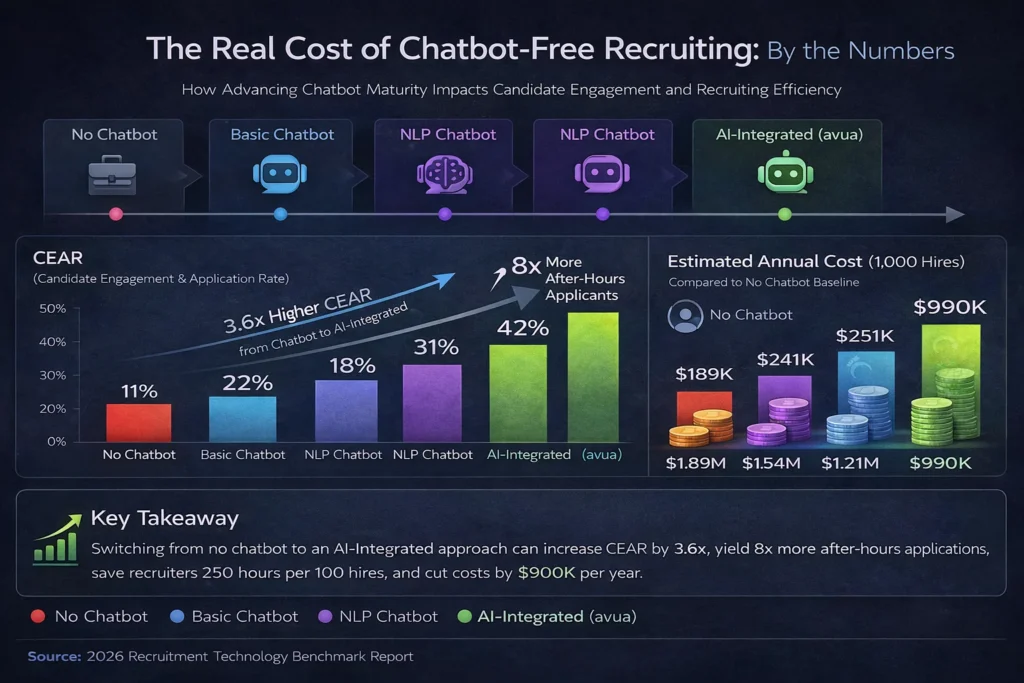
The cost comparison includes recruiter communication time at $60 per hour, application attrition cost at an estimated $85 per lost qualified candidate (reflecting the sourcing investment made to generate their interest), and the vacancy cost contribution from longer time-to-hire in chatbot-free environments. At 1,000 hires per year, AI-integrated chatbot recruiting saves approximately $900,000 annually compared to no chatbot, primarily through higher conversion (generating more applications from the same traffic) and lower recruiter communication overhead.
Related Terms
| Term | Definition |
|---|---|
| Conversational AI | AI systems designed to conduct natural language interactions; the technology underlying modern recruiting chatbots |
| Candidate Experience | The broader practice of maintaining candidate interest and participation through the hiring process; chatbots are a key tool |
| Application Completion Rate | The proportion of started applications that are completed and submitted; chatbots directly improve this rate |
| Recruiting Automation | The broader category of technology that automates repetitive recruiting tasks; chatbots are one component |
| Natural Language Processing (NLP) | The AI capability that enables chatbots to understand and generate human language; the key differentiator of modern chatbot quality |
| Chatbot Engagement-to-Application Rate (CEAR) | The proportion of chatbot-engaged candidates who submit complete applications; the primary chatbot effectiveness metric |
Frequently Asked Questions
Will candidates feel put off by interacting with a chatbot instead of a human?
The evidence is more nuanced than the instinctive concern suggests. Candidate satisfaction data consistently shows that what candidates care about is responsiveness and helpfulness, not whether the entity providing it is human or AI. A chatbot that answers their question in 30 seconds produces higher satisfaction than a human who responds in 24 hours. Where dissatisfaction emerges is when the chatbot fails to help effectively, forces the candidate through a frustrating experience, or conceals its AI nature in a way that feels deceptive. Design quality, not the chatbot format itself, determines whether the experience is well-received.
How should recruiting chatbots be disclosed to candidates?
Clearly and upfront. The opening message of every chatbot interaction should identify that the candidate is talking with an AI assistant and explain what it can and cannot help with. The chatbot should always make it easy for candidates to request human assistance. Concealing the AI nature of the interaction is both an ethical concern and a practical one: candidates who discover mid-conversation that they were misled about who they were talking to experience a trust violation that damages their perception of the organization.
What types of recruiting interactions should chatbots never handle?
Sensitive or emotionally complex conversations should always involve a human recruiter. Delivering news about a declined application to a candidate who has expressed significant emotional investment in the role, navigating a candidate’s concerns about a workplace accommodation, discussing a compensation dispute, or responding to a candidate who appears distressed are all interactions where empathy, judgment, and genuine human presence are not substitutable by AI. The chatbot’s role is to identify these situations and route to a human promptly, not to attempt them autonomously.
Can chatbots handle multilingual candidate interactions?
Yes, and this is increasingly a standard feature rather than an advanced capability. AI-powered recruiting chatbots with multilingual capability can detect a candidate’s preferred language from their input and switch to that language for the remainder of the interaction. For organizations recruiting in multilingual markets or for roles where language diversity in the candidate pool is significant, multilingual chatbot capability is a meaningful access improvement that expands the effective reach of the careers page.
How long does it take to implement a recruiting chatbot effectively?
A basic chatbot with a pre-built knowledge base can be configured and deployed in two to four weeks. A fully integrated chatbot that connects with the ATS, scheduling tools, and CRM typically requires six to twelve weeks, including integration testing and conversation quality review. The difference in timeline is worth investing in: a chatbot that is connected to live data and can take workflow actions is significantly more valuable than one that can only answer static questions.
Conclusion
Here is the simplest way to think about chatbot recruiting: it is the difference between a hiring process that is open for business only when your team is at their desks and one that is available whenever a candidate is ready to engage.
In a world where candidate interest is unpredictable, where the best candidates are often employed and making decisions in their personal time, and where the margin between a candidate who applies and one who does not is frequently just an unanswered question or an unavailable scheduling option, that difference in availability is genuinely meaningful.
The organizations that have implemented recruiting chatbots well have not replaced their recruiting teams. They have given those teams superpowers: the ability to be present at every candidate touchpoint without being personally present at every moment, to maintain process consistency without becoming bottlenecks, and to focus human attention on the interactions that genuinely benefit from it.
The candidates applying to those organizations at 11 PM are getting their questions answered. The candidates applying to everyone else are staring at a static form and probably deciding to try again tomorrow. Most of them do not come back.
Build the chatbot. Answer the questions. Be available when your candidates are ready.