Imagine hiring a real estate agent but only paying if you close the deal. Now imagine five agents racing to show you the same house. That’s contingency recruiting: a model where the recruiter’s fee is contingent on the hire, not the effort. While popular for its “no-win, no-fee” structure, the incentives often prioritize speed over the depth of the Candidate Experience.
Because recruiters are in a race to submit first, they tend to focus on the Active Candidate who is ready to move immediately, rather than digging into a long-term Candidate Pipeline. This can result in a rushed Candidate Journey that expands your Applicant Pool quickly but might bypass the rigorous vetting of internal Active Sourcing.
To use this model effectively, talent leaders must ensure that the pressure for a fast placement doesn’t sacrifice quality, which could lead to a spiked Attrition Rate later. It’s a powerful tool for urgent needs, provided you maintain control over the standards of your final selection.
The primary metric governing contingency recruiting ROI is the Contingency Placement Rate (CPR): the proportion of contingency search engagements that result in a successful hire through the engaging firm.
CPR (%) = (Successful Hires from Contingency Firms ÷ Total Contingency Search Engagements) × 100
Industry benchmarks for CPR range from 18 to 35% for most commercial contingency search arrangements. The range is wide because CPR is influenced by role complexity, the number of firms engaged simultaneously, the exclusivity of the brief, and the quality of the briefing. Organizations that brief multiple contingency firms simultaneously typically see individual firm CPRs at the lower end of this range. Those that provide well-structured, exclusive or near-exclusive briefs typically see higher individual CPR from better-motivated recruiting partners.
What is Contingency Recruiting?
Contingency recruiting is a fee-based external recruiting model where a recruiter or recruiting firm sources and presents candidates for client roles without any guaranteed payment, earning a placement fee (typically 15 to 25% of the placed candidate’s first-year base salary) only upon successful hire of a submitted candidate.
The model creates a specific dynamic between client and recruiter that is worth naming honestly. The recruiter takes on the financial risk of the search: they invest time and resources without any certainty of payment. This risk is offset by the potentially high fee on successful placement and by the ability to run multiple client searches simultaneously, spreading the risk across a portfolio of opportunities.
For the client, the attraction is obvious: there is no upfront financial commitment and no cost if the search does not produce a hire. The potential downside, which organizations often underestimate, is that a recruiter working on contingency is rationally motivated to present quickly rather than thoroughly, to submit candidates from their existing network before searching the broader market, and to minimize the time they spend on briefs with low close probability.
None of this reflects bad intentions. It reflects rational behavior within a specific incentive structure. Understanding the structure is what allows organizations to design their contingency recruiting arrangements to get the best from it.
When Does Contingency Recruiting Make Sense, and When Does It Not?
This question matters more than most organizations think about it, and the answer is more nuanced than the contingency model’s default popularity suggests.
Contingency recruiting works well in several specific circumstances. It makes genuine sense for roles where the candidate profile is common enough in the market that speed of access matters more than depth of search. It is a reasonable choice when the organization wants to supplement its internal sourcing capability without committing to a full retained arrangement. And it is defensible for volume hiring scenarios where multiple firms working in parallel genuinely expand the candidate reach faster than a single firm could.
What it is less suited for is roles where the candidate profile is genuinely scarce, where the search requires sustained relationship development with a narrow population of passive candidates, where confidentiality is essential, or where the organization’s specific culture fit requirements are complex enough to require deep briefing and sustained recruiter immersion. In these scenarios, the contingency model’s structural incentives, the pressure toward speed and the risk of shallow search, work against the quality of outcome the organization actually needs.
A 2025 study of mid-market hiring outcomes found that roles filled through contingency firms had a first-year attrition rate of 28%, compared to 19% for roles filled through retained search and 16% for roles filled through structured internal hiring. The attrition gap reflects not a difference in recruiter quality but a difference in the depth of search and candidate assessment that the fee structure incentivizes.
For TA leaders, the most useful framing is to think of contingency recruiting as a specific tool with specific use cases rather than a default model for any external search. The fee structure makes it attractive as a low-risk option. The incentive structure makes it important to understand what “low risk” actually means in context: low financial risk to the organization in the event of no hire, but not necessarily low risk of a poor hire if the search is not structured to counteract the model’s natural limitations.
The scenario that illustrates the difference clearly: a technology company needs to hire a Chief Information Security Officer. They brief three contingency firms simultaneously, providing a brief and a 20% fee on successful placement. Within two weeks, they have received 14 candidate submissions from across the three firms. Nine of the 14 are candidates the firms had readily available in their existing networks. Five are from targeted outreach to the CISO community. Twelve of the 14 have LinkedIn profiles that are publicly visible and easily searched by anyone with a Recruiter license.
A retained search firm engaged exclusively for the same role, with a clear engagement fee structure and a defined search methodology, would spend the first two to three weeks on thorough market mapping, confidential passive candidate outreach to individuals who are not actively searching, and candidate development through relationship rather than transaction. The candidate pool accessed would be different, and for a senior security role where the hire’s judgment and network matter enormously, the difference in the candidate pool would translate directly into the quality of the outcome.
Neither model is universally superior. The contingency model is faster and cheaper for accessible candidate profiles. The retained model is more thorough and more relationship-oriented for genuinely scarce ones. The error is applying the contingency model to a brief that requires retained-level depth.
Your Resume Isn’t Getting Read
Let’s Get That Fixed!
75% of resumes get auto-rejected. avua’s AI Resume Builder optimizes formatting, keywords, and scoring in under 3 minutes, so you land in the “yes” pile.
The Economics of Contingency Recruiting
Understanding the fee structure and its implications helps organizations design arrangements that get more from the contingency model.
Fee Structure
The standard contingency fee is 15 to 25% of the placed candidate’s first-year base salary, collected as a one-time payment upon hire. Some firms add a guarantee period (typically 60 to 90 days) during which they will replace the candidate without charge if the hire exits voluntarily. The fee is typically calculated on base salary only, though some arrangements include bonus or total compensation, particularly for senior roles.
At a 20% fee on a $120,000 base salary, the placement fee is $24,000. For a $200,000 base salary, it is $40,000. These figures are meaningful: they exceed the fully-loaded cost of many internal hiring process investments, and they should be compared against the total cost of alternative approaches rather than simply against the perceived “no-cost-if-no-hire” baseline.
The Multiple Firm Problem
When organizations engage multiple contingency firms simultaneously on the same brief, each firm faces a decision about how much time to invest. The calculation is straightforward: expected fee equals the fee amount multiplied by the probability of being the firm whose candidate is hired. If three firms are competing, the probability for any individual firm drops, and rational resource allocation shifts the effort toward faster, more transactional submission rather than deeper, more invested search.
Organizations that routinely brief five or six contingency firms simultaneously frequently receive a high volume of early submissions followed by declining recruiter engagement as firms triage their time toward more productive briefs. The perception that more firms means better coverage is often inaccurate in practice: more firms can mean shallower coverage from each, with significant overlap in the readily accessible candidate pool and diminishing incremental reach.
A more productive approach for most mid-complexity roles is to engage two firms maximum, brief them thoroughly, and provide enough structure and commitment to motivate sustained engagement. This arrangement produces better recruiter motivation, better brief adherence, and typically better outcomes than a six-firm broadcast.
Exclusivity and Semi-Exclusivity
Offering a contingency firm a defined period of exclusivity (typically two to four weeks) in exchange for committed search activity and specific deliverables is a middle path between retained and open contingency that often produces meaningfully better outcomes than pure contingency. The firm has sufficient probability of payment to invest properly. The client retains the option to open the search more broadly if the exclusive period does not produce sufficient pipeline. And the quality of engagement during the exclusive window typically exceeds what firms produce under fully competitive conditions.
Contingency Recruiting vs. Related Models
| Model | Payment Structure | Exclusivity | Depth of Search | Best For |
|---|---|---|---|---|
| Contingency Recruiting | Fee on placement only | Non-exclusive typically | Moderate; network-first | Accessible candidate profiles; speed priority |
| Retained Search | Upfront retainer plus completion fee | Exclusive | Deep; market mapping | Senior and scarce roles; long-horizon search |
| Engaged Search | Partial upfront plus placement fee | Often exclusive | Moderate to deep | Mid-complexity roles; structured brief |
| RPO (Recruitment Process Outsourcing) | Monthly management fee | Exclusive internally | Varies; process-driven | High-volume, structured hiring at scale |
| Internal Sourcing | Salary cost only | N/A | Depends on team capability | Any role; best when capability is strong |
| Staffing Agency | Margin on temp/contract billing | Non-exclusive | Shallow; volume-focused | Temporary and contract staffing; rapid fill |
The most important comparison in this table is between contingency and retained search, because these two models are often positioned as alternatives for the same senior role. The decision should be driven by role complexity and candidate scarcity, not by the client’s preference for deferred payment. Choosing contingency to avoid the upfront cost of a retained engagement for a genuinely scarce senior role typically results in a longer search, a shallower candidate pool, and ultimately higher total cost when the poor-fit hire from a contingency process is replaced within 18 months.
What the Experts Say?
Contingency works beautifully when the market is liquid and speed matters. It starts to break down when you need someone who is not looking, who requires months of relationship building to even have a conversation, and whose decision to move will be influenced more by trust than by a job description. That is retained territory, and no amount of fee innovation changes the fundamental incentive structure.
– Chris Russell, Founder of RecTech Media
How to Measure Contingency Recruiting Effectiveness?
Formula: Contingency Placement Rate
CPR (%) = (Successful Hires from Contingency Engagement ÷ Total Contingency Engagements) × 100
Track alongside Contingency Quality Score: the 12-month performance rating of hires placed through contingency search versus those placed through internal sourcing or retained search. If the contingency CPR is acceptable but the contingency quality score is significantly lower, the fee structure may be producing faster but shallower searches that advance candidates who appear strong but are not.
Benchmarks by Engagement Structure (2026 Data)
| Engagement Structure | Avg. CPR | Avg. Time-to-Submit | First-Year Attrition |
|---|---|---|---|
| Multiple Firm (5+), Open Brief | 18% | 6 days | 31% |
| Multiple Firm (2 to 3), Structured Brief | 27% | 9 days | 24% |
| Single Firm, Exclusive Window | 34% | 12 days | 19% |
| Engaged Search (Partial Upfront) | 41% | 16 days | 15% |
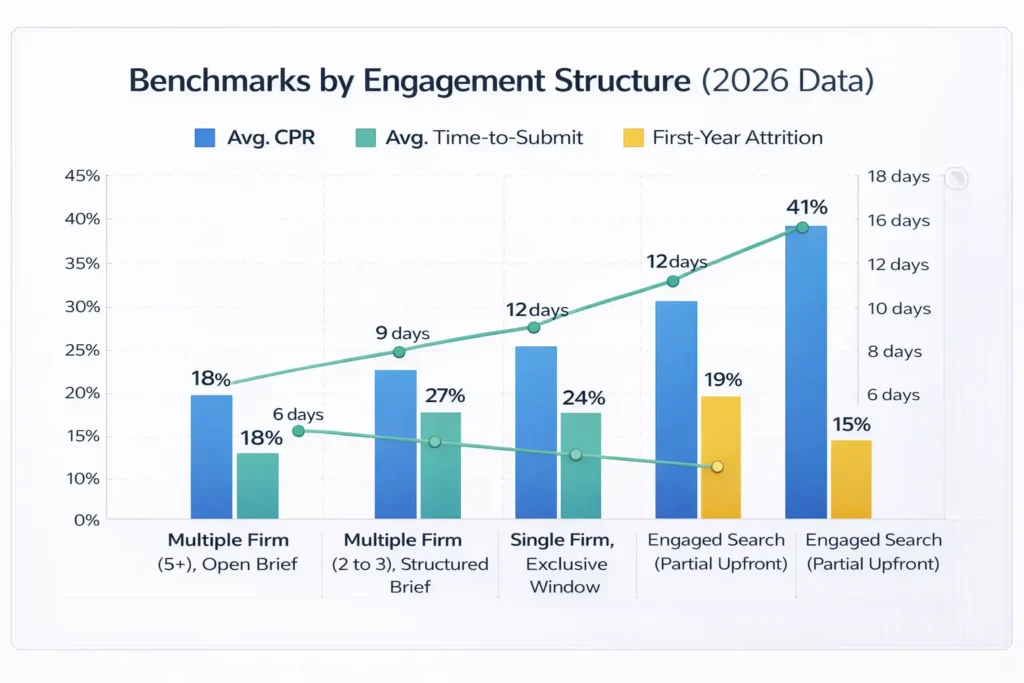
The relationship between submission speed and attrition rate across these models is worth sitting with for a moment. Faster submissions (6 days average) come with significantly higher first-year attrition (31%). Slower, more structured searches (16 days average) produce dramatically lower attrition (15%). Speed and thoroughness are in genuine tension in the contingency model, and the optimal engagement structure is the one that appropriately balances both for the role’s actual requirements.
Key Strategies for Getting More from Contingency Recruiting
How AI Is Changing the Contingency Recruiting Landscape?
The growth of AI-powered sourcing tools is reshaping the contingency recruiting market in ways that are worth understanding for both organizations and recruiting firms.
Commoditization of Network-Based Search
The primary value proposition of many contingency recruiting firms has historically been access: their networks contained candidates that client organizations could not easily find on their own. AI-powered sourcing platforms that can scan professional databases, identify passive candidates, and generate personalized outreach at scale have significantly reduced this access advantage for readily searchable candidate profiles. For roles where the qualified candidate population is visible on professional networks and searchable through standard talent intelligence tools, the premium charged for contingency firm access is increasingly difficult to justify against the cost of building or expanding internal sourcing capability.
Specialization and Relationship Advantages
The contingency firms most resilient to AI-driven commoditization are those whose value comes not from database access but from genuine specialization and relationship capital: the executive search firm whose principals have spent 20 years building trust with a narrow community of passive candidates who will not respond to cold outreach from a company they have never heard of. AI tools cannot replicate established human relationships, and this is where specialized contingency and engaged search firms retain a genuine competitive advantage.
Fee Compression
As internal sourcing capability has improved through AI tools, some organizations have used this leverage to negotiate lower contingency fees or to shift toward engaged-search or RPO models that offer more predictable cost structures. The contingency market is not disappearing, but fee pressure is a real feature of 2026, particularly for mid-market roles where internal capability has genuinely improved.
Stop Juggling
10 Job Boards.
Search One
Your next role is already here. avua pulls opportunities from across the web into a single searchable feed; filtered by role, location, salary, and remote preference.
1.5 Million+
Active Jobs
380+
Job Categories
Contingency Recruiting and Diversity, Equity, and Inclusion
The contingency model has specific DEI implications that organizations should consider when designing their external recruiting strategy.
Network Homogeneity in Candidate Submission
Contingency recruiters working quickly tend to draw first from their existing networks. Professional recruiting networks, like most professional networks, tend to reflect the demographic characteristics of the industry segments and geographic markets the recruiter has historically operated in. If the recruiter’s network is demographically concentrated, the candidates they submit first and most confidently will reflect that concentration. This is not intentional bias. It is the natural outcome of network-based search, and it is one of the primary reasons that contingency search for senior roles tends to reproduce existing demographic patterns in leadership.
Organizations that have DEI requirements for their executive and senior hiring should explicitly include diversity sourcing expectations in the brief and should ask contingency firms specifically about their approach to reaching underrepresented candidate populations before the search begins.
Specification Bias
Contingency firms who are eager to submit quickly sometimes interpret role specifications narrowly: searching for candidates who look like the prior incumbent or who match the most literal reading of the job description rather than searching for the full range of candidates who could succeed in the role with different experience profiles. This narrow interpretation systematically disadvantages candidates with non-traditional paths, career changes, or backgrounds that require more interpretation to connect to the role requirements.
Briefing firms explicitly on what alternative backgrounds could be suitable, alongside the core requirements, helps counteract this tendency.
Common Challenges and Solutions
| Challenge | Solution |
|---|---|
| High Volume of Low-Quality Submissions | Establish explicit submission standards and conduct an initial quality screen before sharing with the hiring manager |
| Firms Losing Interest Mid-Search | Limit simultaneous engagements; provide regular feedback to keep firms motivated; consider an exclusivity window |
| Duplicate Candidate Submissions from Multiple Firms | Establish a clear first-submission ownership policy in the engagement agreement; track submissions centrally |
| Poor Hire Quality from Contingency Placements | Track 12-month performance by firm; reward high-quality placements with repeat engagements; discontinue partnerships with consistently poor quality ratios |
| Candidates Being Submitted Without Prior Contact | Require candidate consent verification in the submission standard; establish a policy that firms cannot submit candidates who have not been contacted and have agreed to be presented |
Real-World Case Studies
Case Study 1: The Technology Company
A technology company had been engaging six contingency firms simultaneously for senior software engineering roles, receiving an average of 23 submissions per role within the first two weeks. Despite this volume, hiring manager satisfaction was low: most submissions were described as “technically adequate but not differentiated,” and first-year attrition among contingency placements was running at 29%.
They restructured their approach: reduced to two contingency firms per search, both with specialist engineering recruiting backgrounds, briefed each firm for 90 minutes with the hiring manager, established a submission standard requiring a written assessment of each candidate’s specific technical fit and cultural alignment reasoning, and introduced a 30-day exclusive window for the primary firm before opening to the second.
Within three hiring cycles, average submission volume per search dropped from 23 to 9. Hiring manager satisfaction with submission quality improved from 3.1 to 4.3 out of 5.0. First-year attrition for engineering contingency placements dropped from 29% to 14%. The firm that received the exclusive window and thorough briefing was producing fundamentally different search behavior than the same firm had exhibited under the prior arrangement.
Case Study 2: The Financial Services Organization
A mid-size financial services organization was spending approximately $380,000 annually on contingency recruiting fees across 40 placements, an average fee of $9,500 per hire. Analysis of placement outcomes revealed that 31% of contingency hires had exited within 12 months, generating replacement costs that, when added to the placement fees, brought the true cost per successful long-tenure contingency hire to approximately $22,000.
For their most common hire type (mid-level financial analysts), they invested in building an internal sourcing capability over six months, using AI-powered talent intelligence tools and a structured CRM program. In the following year, the proportion of financial analyst hires from internal sourcing grew from 8% to 54%, reducing contingency fee spend for that role category by $148,000. The total cost per internally sourced hire, including the infrastructure investment, was $4,200, with a 12-month attrition rate of 11% compared to the prior contingency cohort’s 28%.
They maintained contingency relationships for senior and specialist roles where internal capability did not yet match the market access advantage external firms provided.
Case Study 3: The Healthcare Provider
A healthcare provider was using four contingency firms simultaneously for specialist physician recruiting, a role category where the qualified candidate market is genuinely constrained and where the firms’ network access should have provided real value. Despite this, the search for a specific specialty was in its 14th week with no suitable hire.
Investigation revealed that the firms were primarily recirculating the same pool of actively searching candidates who had already declined other opportunities in the market, and that none of them had conducted meaningful passive candidate outreach to the physicians most relevant to the brief who were not actively looking.
The organization restructured the search: dropped two of the four firms, shifted to a semi-engaged model with the remaining two (paying a small engagement fee in exchange for a defined search methodology and passive candidate outreach commitment), and provided a structured 60-minute briefing with the department head.
Within six weeks, both firms had conducted genuine passive candidate outreach to 34 specifically targeted physicians, 8 of whom were willing to have an initial conversation. One of those conversations produced the hire in week 21 of the overall search, from a candidate who had not been active in the market and would not have been accessible through active-candidate-only search.
The lesson was not that contingency does not work for scarce searches. It is that contingency without passive candidate outreach commitment does not work for scarce searches. The engagement structure was what unlocked the behavior change.
Building a Contingency Recruiting Dashboard: What to Track?
Contingency Recruiting Across the Hiring Workflow
Role Assessment and Model Selection
Before engaging any external recruiting partner, the most valuable step is assessing whether the role’s candidate profile and the organization’s internal sourcing capability suggest that external support is needed, and if so, what model is most appropriate. This assessment should consider the candidate market’s liquidity, the role’s seniority and sensitivity, the organization’s timeline, and the strength of the internal sourcing infrastructure. Contingency is not the right answer by default for any role that requires external support.
Brief Development
A thorough brief is disproportionately valuable in contingency recruiting because the recruiter’s investment is proportional to their confidence that their effort will be rewarded with a close. A strong brief gives the firm the clarity and the conviction to invest properly. It should cover not just the technical requirements of the role but the cultural context, the history of the position, the team dynamics, the growth trajectory, and the specific indicators the hiring manager will use to distinguish strong from acceptable candidates.
Pipeline Review and Quality Management
Incoming submissions from contingency firms should be reviewed against the brief requirements consistently and with documented criteria, not impressionistically. Providing specific written feedback on each submitted candidate, explaining why they do or do not meet the brief, gives the recruiter the calibration they need to improve subsequent submissions and reduces the volume of off-brief candidates that consume evaluation time.
Placement and Post-Placement Tracking
When a contingency placement is made, the search does not end. Tracking the 12-month performance and retention of every contingency placement, and feeding that data back into the firm relationship management conversation, creates the accountability loop that improves placement quality over time.
The Real Cost of Contingency Recruiting: By the Numbers
| Search Structure | CPR | First-Year Attrition | True Cost per Successful Long-Tenure Hire |
|---|---|---|---|
| Open Contingency, 5+ Firms | 18% | 31% | $38,400 |
| Structured Contingency, 2 Firms | 27% | 22% | $26,700 |
| Exclusive Contingency Window | 34% | 17% | $19,800 |
| Engaged Search | 41% | 13% | $16,200 |
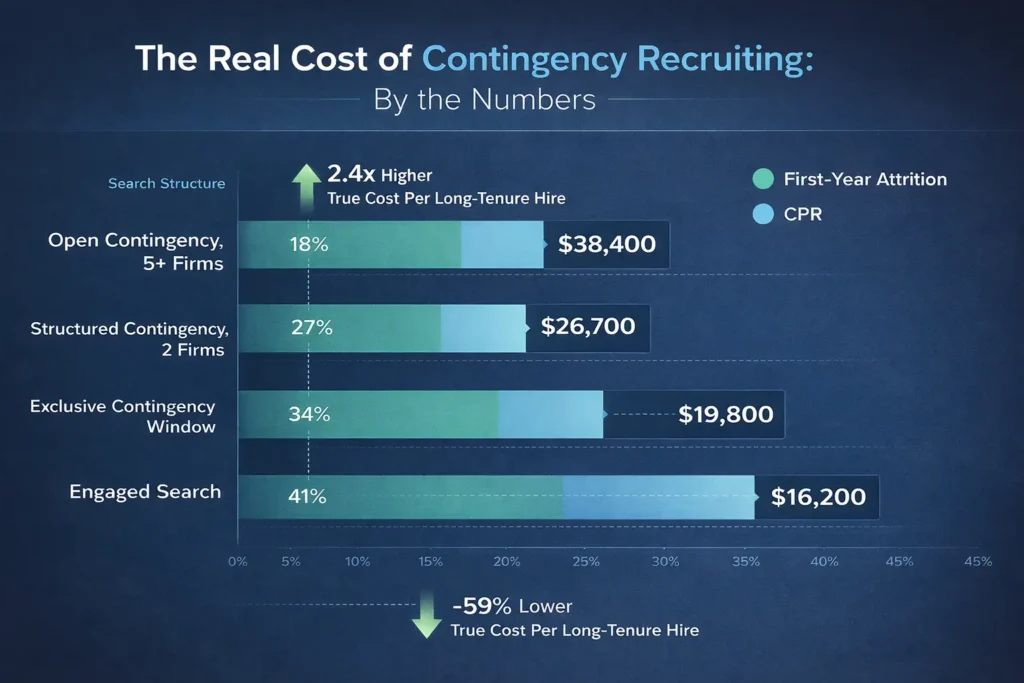
The “true cost per successful long-tenure hire” incorporates the placement fee, the replacement cost for the proportion of hires that exit within 12 months (estimated at $28,000 per departure), and the proportion of search engagements that do not result in a placement from the contingency firm (requiring a restart cost of approximately $8,000). The open contingency model with five-plus firms produces the highest true cost per successful long-tenure hire despite appearing to have no upfront financial risk, because the attrition rate and the low CPR together mean the organization pays multiple cycles of replacement cost on top of the initial placement fee.
Related Terms
| Term | Definition |
|---|---|
| Retained Search | A search engagement where the client pays an upfront retainer, the firm commits exclusively to the search, and the fee is structured across milestones rather than contingent on placement |
| Placement Fee | The fee paid to a contingency firm upon successful hire of a submitted candidate, typically 15 to 25% of first-year base salary |
| Engaged Search | A hybrid model between contingency and retained; a partial upfront payment secures exclusivity and committed search methodology |
| RPO (Recruitment Process Outsourcing) | An arrangement where the client outsources part or all of the recruiting function to an external provider on a managed service basis |
| Contingency Placement Rate (CPR) | The proportion of contingency search engagements that result in a successful hire from the engaging firm |
| Candidate Guarantee Period | A defined window post-placement during which the contingency firm will replace the candidate without charge if they exit voluntarily |
Frequently Asked Questions
How does contingency recruiting differ from retained search?
Retained search involves an upfront fee regardless of outcome. Contingency recruiting is fee-free until placement, making it lower risk but typically less prioritised by agencies.
What roles suit contingency recruiting best?
Contingency recruiting works best for mid-level, high-volume, or non-specialist roles where multiple agencies can compete and speed of placement is prioritised over exclusivity.
What are the risks of contingency recruiting for employers?
Agencies may prioritise speed over fit to secure the fee. Without exclusivity, candidate quality and recruiter investment can vary significantly across competing agencies.
How is the contingency recruiting fee typically calculated?
Fees are usually 15 to 25 percent of the placed candidate’s first-year salary, paid once the candidate starts and clears an agreed guarantee period.
What happens if a contingency hire leaves early?
Most contingency agreements include a rebate or replacement guarantee period, typically 8 to 12 weeks. If the candidate leaves within this window, a partial refund or free replacement applies.
Conclusion
Contingency recruiting is not a good deal or a bad deal. It is a specific deal with specific terms, and those terms create specific behaviors. Understanding what those behaviors are, and what circumstances produce the best outcomes within the model, is what separates organizations that use contingency recruiting effectively from those that use it as a default and wonder why the results are inconsistent.
At its best, contingency recruiting provides fast, cost-effective access to an accessible candidate market with no financial commitment when the search does not produce a result. That value proposition is real and significant for the right role type and the right engagement structure.
At its worst, it produces high-volume, low-quality submissions from firms motivated by speed rather than thoroughness, a revolving door of placements who exit within a year, and a cumulative fee spend that exceeds what a well-resourced internal function or a retained engagement would have cost for a fraction of the replacement cycles.
The difference between best and worst is not primarily about which firms you engage. It is about how you brief them, how many you engage simultaneously, what standards you set for submissions, and whether you measure the quality of placements over time or just the cost of the fee.
Contingency recruiting is a tool. Use it like one.