Nobody agrees on the cover letter anymore. Candidates debate whether to write one. Recruiters debate whether to read one. Hiring managers debate whether to require one. And somewhere in the middle of this collective ambivalence, the cover letter persists: requested on most professional job applications, written with varying degrees of effort, read with varying degrees of attention, and influential in ways that are genuinely difficult to predict from the outside.
The confusion is understandable. The cover letter is a document that has been declared dead so many times it has developed a kind of professional immortality. And yet in 2026, it remains one of the few places in a hiring process where a candidate can communicate something about themselves that a resume structurally cannot: the reasoning behind their interest, the narrative connecting their experience to this specific role, the voice and judgment that will characterize their actual presence in the job.
A cover letter is a candidate-authored document submitted as part of a job application that contextualizes the resume, articulates the candidate’s specific interest in the role and organization, and provides additional evidence of the skills, motivation, and judgment relevant to the position that a resume’s chronological structure cannot accommodate.
It is not a summary of the resume. It is not a list of qualifications reformatted into prose. And it is not a template with the company name inserted. When it works, it is the document that turns a qualified candidate into a compelling one.
In 2026, the cover letter exists in an environment shaped by three simultaneous forces: AI writing tools that have made it trivially easy to generate a passable cover letter for any role in under two minutes, recruiter screening processes that frequently involve automated filtering before any human reads a cover letter, and a persistent subset of hiring managers and search committees for whom the cover letter is still the primary differentiating document in the final stages of candidate evaluation. Understanding which environment you are in is part of what makes the cover letter strategic.
The primary metric most relevant to cover letter effectiveness is Cover Letter Advancement Rate (CLAR): the proportion of applications that include a substantive, role-specific cover letter and advance to the next stage of the hiring process, compared to the proportion without one.
CLAR (%) = (Applications with Cover Letter Advancing to Screen ÷ Total Applications with Cover Letter) × 100
Tracked alongside the equivalent rate for applications without cover letters, CLAR reveals whether cover letters are influencing hiring decisions in a specific organizational context, and by how much.
What is a Cover Letter?
A cover letter is a written document submitted alongside a resume as part of a job application, typically one page or fewer in length, that explains the candidate’s interest in the specific role and organization, draws connections between the candidate’s experience and the position’s requirements, and communicates qualities of voice, judgment, and motivation that a resume’s format does not allow.
The name comes from its original function: in the era of physical document submission, the cover letter literally covered the resume in the envelope, serving as the first document a reader encountered. The format has persisted into digital hiring, where it is typically uploaded as a separate document or entered into a text field in an ATS, though its structural role, as the document that provides context and voice to the more data-dense resume, remains the same.
The cover letter is distinct from other application documents in one important way: it is the only document in a standard application that is written in the candidate’s own voice, in prose, about this specific opportunity. The resume is largely structured data. The application form fields are typically binary or multiple-choice. The cover letter is the only place where a candidate’s judgment about what matters, their ability to communicate in full sentences, and their genuine motivation for this particular role are all visible simultaneously.
Does the Cover Letter Still Matter?
The honest answer is: it depends. And that dependency is more structured than it first appears.
The cover letter’s influence in any given hiring process is determined by three variables: whether the organization requires it, whether recruiters read it before shortlisting, and whether hiring managers use it to differentiate finalists. These three variables do not always align, and the candidate who understands the process they are in can calibrate their cover letter effort accordingly.
In processes where the cover letter is optional and recruiter screening is high-volume, a well-written cover letter is unlikely to influence early-stage advancement but may significantly influence hiring manager decisions at the finalist stage. In processes where the cover letter is required and explicitly assessed as part of the application review, it can be decisive much earlier. In processes involving academic positions, grant applications, senior leadership roles, or creative fields, the cover letter is frequently the primary screening document and the resume is secondary.
Research consistently finds that 83% of hiring managers say a strong cover letter influences their decision to interview a candidate, and 72% say a poorly written cover letter will cause them to reject an otherwise qualified applicant. These figures suggest that while many recruiters may not read cover letters in volume screening contexts, the hiring managers who do read them weight them heavily.
The AI writing tool complication deserves direct attention. In 2026, a significant and increasing proportion of cover letters submitted for professional roles are partially or entirely AI-generated. Recruiters and hiring managers are aware of this, and the response has been mixed: some organizations have deprioritized cover letters precisely because they can no longer assume the document reflects the candidate’s own voice; others have doubled down on cover letter specificity requirements (asking candidates to respond to specific prompts, reference specific company details, or address specific challenges) specifically because these requirements are more difficult to fulfill with generic AI output.
The cover letter has not become less important. Its function has shifted: from demonstrating that a candidate can write to demonstrating that a candidate has thought specifically and authentically about this role, this organization, and this moment in their career. That shift, if anything, raises the bar for what a genuinely effective cover letter looks like.
The scenario that makes the stakes concrete: a nonprofit organization is hiring a Director of Development. They receive 74 applications. The application portal requests but does not require a cover letter; 51 of the 74 applicants include one. The hiring committee reviews all applications and notes that 14 applications make the initial shortlist.
Of those 14, 13 included a cover letter. Of the 51 cover letters submitted, 11 are clearly templated (generic language, no organizational specificity), 28 are competent but formulaic, and 12 are genuinely substantive: they reference specific programs, articulate a clear perspective on the organization’s current fundraising challenges, and make a convincing case for why this specific candidate is suited to this specific moment.
Those 12 applications do not all make the shortlist. But the hiring committee discusses them by name. The others are discussed by category. In a competitive finalist pool, that is a meaningful difference.
Your Resume Isn’t Getting Read
Let’s Get That Fixed!
75% of resumes get auto-rejected. avua’s AI Resume Builder optimizes formatting, keywords, and scoring in under 3 minutes, so you land in the “yes” pile.
The Anatomy of an Effective Cover Letter
There is no single formula for a strong cover letter. But the most effective ones share a structural logic that is worth understanding as a framework, even when breaking from it deliberately.
The Opening: Specificity Over Formula
The weakest opening in any cover letter is a statement of what the candidate is doing: “I am writing to express my interest in the Marketing Manager position at Acme Corp, which I found on LinkedIn.” This sentence communicates nothing that the application submission itself has not already communicated. It wastes the one moment in the document where the reader’s attention is highest.
Strong cover letter openings establish specificity immediately: a specific observation about the organization, a specific connection between the candidate’s experience and the role’s requirements, or a specific perspective on why this opportunity and this moment align. The opening should answer the question the reader is implicitly asking: why does this candidate care about this particular job, and why should I keep reading?
The Body: Evidence, Not Reiteration
The body of the cover letter should not summarize the resume. A hiring manager who has already read the resume does not need to read it again in prose form. What they need to understand is the reasoning that the resume cannot provide: why this candidate’s experience, including the parts that might not look immediately relevant, actually makes them well-suited for this role; what specific accomplishments are most relevant and why; and what perspective or approach they would bring that addresses something the organization actually cares about.
The most effective body paragraphs in a cover letter make an argument, not a list. They connect specific past experience to specific current needs and explain the connection in terms of the candidate’s judgment, not just their credentials.
The Close: Conviction, Not Formula
The standard cover letter close (“I look forward to the opportunity to discuss my qualifications further”) is a placeholder. It conveys nothing distinctive and invites nothing specific. Stronger closes articulate a clear next step, express genuine enthusiasm for the conversation, and occasionally introduce a final, memorable thought that gives the reader something specific to associate with the candidate after the document is closed.
Components of a Strong Cover Letter
| Component | Purpose | Common Failure Mode |
|---|---|---|
| Opening paragraph | Establish specific interest and context | Generic enthusiasm; no organizational specificity |
| Experience bridge | Connect past work to this role’s needs | Resume summary in prose; no connection to specific requirements |
| Motivation statement | Explain why this organization and this role | Vague interest; reads as applicable to any employer |
| Evidence of fit | Provide one to two specific accomplishments most relevant to the role | List of all accomplishments; no prioritization or connection |
| Closing | Express conviction and establish next step | Formulaic “I look forward to” language; passive |
Cover Letter vs. Related Application Documents
| Document | Primary Function | Length | Voice |
|---|---|---|---|
| Cover Letter | Contextualizes resume; communicates motivation and judgment | 250 to 400 words typically | Candidate’s own prose |
| Resume | Structured chronological record of experience and credentials | 1 to 2 pages typically | Structured data format |
| Personal Statement | Detailed narrative of professional philosophy and goals | 500 to 1,000+ words; academic/professional programs | Extended first-person narrative |
| LinkedIn Summary | Public professional brand statement | 200 to 300 words | First-person; semi-public |
| Application Form | Structured employer-defined data collection | Variable | Answers to specific prompts |
| Writing Sample | Demonstration of professional writing quality | Variable; employer-specified | Depends on sample type |
The cover letter occupies a specific and irreplaceable position in this table: it is the only short-form, role-specific, candidate-voiced document in a standard application package. A resume cannot provide motivation context. A LinkedIn summary is not role-specific. A personal statement is too long for standard application contexts. The cover letter’s structural uniqueness is part of why it has proven so durable despite repeated declarations of obsolescence
What the Experts Say?
The best cover letters I have read do one thing that no other application document can do: they show me how the candidate thinks about the work. Not what they have done, but why it matters, how they made decisions in the middle of it, and what they would do differently now. That is not in the resume. It is never in the resume. It is only in the letter.
– Liz Ryan, founder of Human Workplace and widely cited career and workplace culture commentator
How to Write a Cover Letter That Gets Read?
Research First, Write Second
The most common reason cover letters are formulaic is not that the candidate cannot write. It is that they started writing before they knew enough about the organization and role to say anything specific. Before writing a single word, effective cover letter writers answer three questions: What is the specific challenge or opportunity this role is designed to address? What does the organization care about most right now, based on their public communications, recent news, and job description language? And what specific aspect of the candidate’s experience is most directly relevant to both?
The answers to these questions generate the cover letter. Everything else is formatting.
Write to the Reader, Not to the Record
The resume is written for a database and a format. The cover letter is written for a person. The reader is typically a recruiter or hiring manager with limited time and a specific set of questions they are trying to answer about each candidate. Writing to those questions, rather than writing to a general standard of cover letter completeness, produces documents that feel purposeful rather than obligatory.
The reader’s primary questions are: Does this candidate understand what we are looking for? Do they have the experience that is most relevant? And do they actually want this job, or are they applying everywhere? A cover letter that answers all three concisely is a strong cover letter. A cover letter that takes 600 words to answer none of them is not.
Match Tone to Context
The cover letter’s tone should reflect the organization’s culture and the role’s level. A cover letter for a startup marketing role can be warmer and more personal than one for a financial services compliance position. A senior leadership application warrants more formal language than an entry-level creative role. The candidate who applies the same tone to every application regardless of context is signaling, possibly accurately, that they have not thought carefully about the specific organization they are applying to.
Keep It to One Page, Usually
The standard guidance on cover letter length (one page, 250 to 400 words) exists for good reasons: hiring managers and recruiters reading 40 applications in a day do not have the bandwidth for a 600-word letter, and verbosity is rarely a virtue in professional written communication. Exceptions exist: senior academic positions, fellowship applications, and certain senior leadership roles have conventions that allow or expect longer letters. For the vast majority of professional roles, concision is respect for the reader’s time.
Cover Letter Benchmarks: What the Data Shows (2026)
| Application Scenario | Cover Letter Advancement Rate | Without Cover Letter Rate | Delta |
|---|---|---|---|
| Required cover letter, senior role | 34% | N/A (required) | N/A |
| Optional cover letter, professional role | 28% | 19% | +9 points |
| Optional cover letter, entry-level role | 21% | 18% | +3 points |
| Highly structured ATS screening | 22% | 21% | +1 point |
| Hiring manager direct review | 41% | 24% | +17 points |
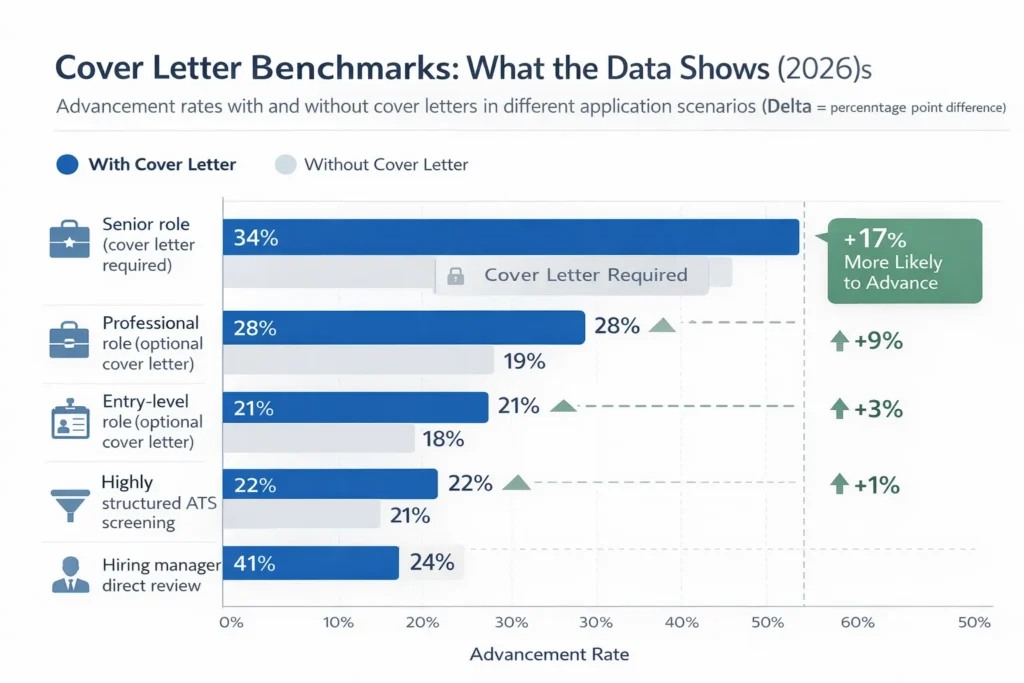
The most striking figure in this table is the last row. When hiring managers are reviewing applications directly rather than through an ATS-filtered or recruiter-filtered shortlist, the cover letter advancement rate gap nearly doubles compared to structured ATS screening environments. This reflects the hiring manager’s greater interest in motivation and voice and their greater capacity to weight the cover letter as a differentiating document relative to the resume.
The practical implication: in highly automated early-stage screening, cover letter effort has limited yield. In processes where hiring managers are involved early, it has substantial yield. Knowing which environment you are in should calibrate how much effort you invest.
Key Strategies for Cover Letter Effectiveness
How AI Is Changing the Cover Letter?
AI-Generated Cover Letters: The Signal Problem
AI writing tools can now produce grammatically correct, structurally competent cover letters for any role in under two minutes. The result is a generational shift in cover letter quality distribution: the floor has risen (fewer egregiously bad letters), but the ceiling has flattened (fewer letters that feel unmistakably personal and specific). For hiring managers and recruiters who valued cover letters as a signal of writing quality, this shift has reduced the signal value of a competent letter significantly.
The response from sophisticated hiring organizations has been to raise specificity requirements: asking candidates to respond to specific prompts about the organization’s challenges, reference a recent development in the field, or explain their reasoning for a specific career decision. These requirements are more resistant to generic AI output because they require knowledge of the specific organization that AI tools without research capability cannot provide.
AI as a Drafting Tool, Used Well
For candidates, the most productive use of AI writing tools in cover letter preparation is not full generation but structured drafting: using AI to generate an initial structure, identify the most relevant connections between the resume and the job description, and flag gaps in the argument, then rewriting substantially in the candidate’s own voice with specific organizational research and authentic motivation layered in. This approach uses AI to reduce the friction of starting a cover letter without producing the generic output that sophisticated hiring managers can identify immediately.
Authenticity as the New Differentiator
In a market where AI-generated cover letters are common, the documents that stand out are those that feel unmistakably written by a specific person about a specific opportunity. The presence of genuine organizational knowledge, a distinctive voice, a specific personal connection to the work, or a direct engagement with something the organization has actually said or done publicly are all authenticity signals that AI-generated content rarely replicates without substantial human editing. The cover letter that differentiates in 2026 is not the most polished one. It is the most specific one.
Stop Juggling
10 Job Boards.
Search One
Your next role is already here. avua pulls opportunities from across the web into a single searchable feed; filtered by role, location, salary, and remote preference.
1.5 Million+
Active Jobs
380+
Job Categories
Cover Letter and Diversity, Equity, and Inclusion
The cover letter has a complex relationship with DEI goals in hiring that is worth examining directly.
Writing Quality as a Proxy for Educational Background
Formal writing quality in cover letters, including vocabulary, sentence structure, and adherence to professional writing conventions, correlates with educational background and with access to writing instruction and coaching. Using cover letter writing quality as a primary screening criterion can inadvertently disadvantage candidates from backgrounds with less access to these resources, even when their professional qualifications for the role are strong.
Organizations committed to equitable hiring should assess cover letters for the substance of the argument (specific motivation, relevant experience connection, knowledge of the organization) rather than for prose sophistication. A cover letter that makes a compelling, specific case in direct language is demonstrating the judgment and research that matters. One that demonstrates elegant prose but no specific organizational knowledge may be demonstrating the inverse.
Optional vs. Required: The Equity Dimension
Making cover letters required creates a barrier that candidates with more familiarity with professional application conventions will navigate more easily. Making them optional removes a potential signal of genuine motivation that hiring managers value. Neither is a complete solution to the equity dimension. A middle path, asking candidates to respond to one or two specific prompts rather than writing a traditional letter, standardizes the information collected while reducing the advantage that familiarity with cover letter conventions confers.
Cover Letter Requirements and Disability Access
Candidates with certain disabilities, including some forms of dyslexia, motor conditions affecting writing, and neurodivergent processing differences, may face disproportionate difficulty producing cover letters that meet conventional standards even when their professional qualifications are strong. Organizations that require cover letters and use writing quality as a screening criterion should consider whether accommodations are available and whether the cover letter is genuinely necessary to assess job-relevant qualifications for the specific role.
Common Challenges and Solutions
| Challenge | Solution |
|---|---|
| Candidates Submitting Generic AI-Generated Letters | Introduce specific prompts or organizational knowledge requirements that resist generic generation |
| Recruiters Not Reading Cover Letters in High-Volume Screening | Make them optional; reserve cover letter review for the hiring manager shortlist stage where they add the most signal value |
| Cover Letters Disadvantaging Non-Traditional Backgrounds | Assess for argument quality and specificity rather than prose sophistication; consider structured prompts as an alternative format |
| Candidates Uncertain Whether Cover Letters Are Read | State explicitly in the job posting whether a cover letter is required, how it will be used, and at what stage it will be reviewed |
| Inconsistent Hiring Manager Weighting | Provide hiring managers with guidance on what to assess in a cover letter; integrate cover letter assessment into the structured evaluation framework |
Real-World Case Studies
Case Study 1: The Research Institution
A research institution filling a senior scientist role received 62 applications, all with cover letters (required). The search committee used a structured cover letter assessment rubric scoring four dimensions: clarity of research focus, connection to the institution’s current priorities, evidence of independent thinking, and quality of scientific communication.
Of the 62 letters, 11 scored above threshold on all four dimensions. Of those 11, 9 were invited to a first-round interview. The hiring committee noted that the cover letter assessment had significantly outperformed resume screening as a predictor of first-round interview quality: candidates who performed strongly in interviews had an average cover letter score of 4.1 out of 5.0, compared to 2.8 for candidates who did not advance beyond the first interview. The structured cover letter rubric became a permanent part of the institution’s senior hiring process.
Case Study 2: The Technology Startup
A 60-person technology startup was receiving 200-plus applications for a product marketing role, with cover letters optional. The founding team was spending significant time reviewing applications and finding the cover letter review inconsistent: some team members weighted it heavily, others ignored it.
They introduced a structured prompt replacing the open cover letter: candidates were asked to answer two questions in 250 words total. First: describe a product launch or campaign you contributed to and what you would do differently now. Second: what do you know about our company’s current market positioning that makes you interested in this role specifically?
Application volume dropped 34% (the prompt filtered out candidates not motivated enough to complete it), but the quality of applications forwarded to the hiring manager improved significantly. Time-to-hire for the role decreased from 47 to 28 days, and the hire made was described by the founder as one of the strongest in the company’s history in terms of immediate contribution quality.
Case Study 3: The Professional Services Network
A national professional services network was experiencing inconsistent cover letter outcomes: some regional offices were using them effectively to differentiate finalists, while others had stopped reviewing them altogether. A standardization initiative created a three-tiered approach: for entry-level roles, cover letters were optional and not formally assessed; for mid-level roles, a structured prompt replaced the open letter; for senior roles, a traditional cover letter was required and assessed against a rubric.
Within two hiring cycles, hiring manager satisfaction with cover letter usefulness increased from 3.2 to 4.1 out of 5.0 across all tiers, primarily because the assessment framework matched the cover letter format to the role level where it was most likely to add signal value. The entry-level change reduced application friction without reducing hire quality; the structured prompt at mid-level improved consistency; the senior-level rubric gave hiring managers a shared evaluation framework.
Building a Cover Letter Assessment Framework: What to Track?
Cover Letters Across the Candidate Journey
Application Stage
The cover letter is submitted as part of the application package and enters the hiring process alongside the resume. In ATS-heavy screening environments, it may not be read until the application has already been filtered by automated criteria. In hiring-manager-first or recruiter-review processes, it may be the first document read.
Shortlisting Stage
For roles where the hiring manager reviews a shortlist before scheduling interviews, the cover letter frequently serves its highest-value function: differentiating candidates who look similar on paper by providing context, motivation, and voice that the resume cannot.
Finalist Evaluation
In competitive finalist pools for senior or specialized roles, cover letters are sometimes re-read alongside other evaluation data to inform the final hiring decision. This is most common in academic, nonprofit, and executive search contexts.
Related Terms
| Term | Definition |
|---|---|
| Resume | A structured document presenting the candidate’s chronological professional history, credentials, and qualifications; the primary document in a job application package alongside the cover letter |
| Personal Statement | A longer narrative document describing professional philosophy, goals, and motivation; common in academic and professional program applications |
| Application Tracking System (ATS) | Software used by employers to receive, organize, and manage job applications; the system through which most cover letters are submitted and stored |
| Employer Value Proposition (EVP) | The set of attributes and benefits that define why candidates would choose to work at a specific organization; effective cover letters demonstrate knowledge of the EVP |
| Candidate Experience | The overall quality of a candidate’s interaction with the hiring process; cover letter requirements and how they are used are a component of candidate experienc |
Frequently Asked Questions
Should you always write a cover letter even when it is optional?
For roles that genuinely matter to you, yes. The evidence that cover letters improve advancement rates when hiring managers are involved in early review is consistent, and the time investment (30 to 60 minutes for a role-specific letter) is proportionate to the stakes. For high-volume applications to roles that are lower priority, or for processes where early-stage screening is entirely automated, the yield on cover letter effort is lower and the investment calculus changes.
How long should a cover letter be?
For most professional roles, 250 to 400 words across three to four paragraphs is the appropriate range. This is enough space to establish specific motivation, make one or two strong experience connections, and close with conviction, without testing the reader’s patience. Academic, senior leadership, and fellowship application letters may extend to 500 to 700 words when the conventions of the field expect more depth. Longer than that is almost never justified by the content.
Should a cover letter address salary expectations?
Only if the employer has specifically requested this information in the job posting. Volunteering salary expectations in a cover letter without being asked can create unnecessary friction before the conversation has begun and can anchor negotiations in a direction that may not serve the candidate’s interests. If asked directly, candidates can provide a range referencing current market rates for the role.
Is it acceptable to use the same cover letter for multiple applications?
Only for the structural template. The opening, the organizational references, the specific motivation statement, and the experience connection should be customized for each application. Using an identical letter for multiple applications is typically detectable by any hiring manager who reads carefully, and it communicates that the candidate did not consider this role specific enough to warrant individual attention.
How should a cover letter handle employment gaps?
Directly and briefly. A single sentence that acknowledges the gap, explains it in the most constructive available framing, and redirects to the candidate’s current readiness and enthusiasm is almost always better than hoping the gap will be overlooked. Employment gaps are visible in the resume; addressing them in the cover letter preempts the question in a controlled way and demonstrates the transparency and self-awareness that hiring managers value.
Conclusion
The cover letter’s role in 2026 is neither what its detractors claim (irrelevant and obsolete) nor what its defenders claim (the most important document in the application). It is something more specific: a high-value tool in specific contexts, a moderate-value tool in many others, and a low-yield effort in a small number of highly automated screening environments.
What has changed is not the cover letter’s potential impact when it is read. What has changed is the conditions under which it is read, the technology that surrounds the application process, and the expectations that frame what a cover letter is supposed to demonstrate.
In that environment, the cover letter that works is the one that could only have been written for this role, by this person, at this moment. Not because that is a romantic ideal, but because in a world where AI can generate competent letters instantly, specificity is the only signal left that cannot be faked at scale.
Write the letter that no algorithm would write. That is the one that gets read.