Every growing organization eventually hits a wall where quick agency fixes stop scaling. You don’t just need a body in a seat; you need a permanent team member who will shape your culture for years. This is the pivot to a direct hire model—where the relationship belongs to you from day one, rather than a third party.
By taking full ownership of the Candidate Journey, companies can focus on long-term alignment rather than just immediate coverage. Instead of relying on external vendors, modern teams use AI Hiring tools to handle Active Sourcing and manage their own Candidate Pipeline internally. This shift ensures a more cohesive Candidate Experience, as the person moves from a Branded Job Posting directly into your Candidate Management System without intermediaries.
While temporary staffing has its place, direct hiring is the gold standard for roles where performance accountability and cultural fit are paramount. It allows you to build an Applicant Pool of people who are truly invested in your mission, not just the next assignment.
The primary metric governing direct hire program effectiveness is Direct Hire Retention Rate at 24 Months (DHRR-24):
DHRR-24 (%) = (Direct Hires Still Employed at 24 Months ÷ Total Direct Hires in Cohort) × 100
A 24-month retention rate is more diagnostic than the more commonly cited 12-month figure because it captures not just initial fit but the sustained alignment between employee and organization that direct hire is specifically designed to produce. Industry benchmarks for professional roles cluster between 74 and 88% at 24 months for well-executed direct hire programs
What is Direct Hire?
Direct hire is a permanent employment model in which a candidate is recruited, assessed, and hired directly by the employing organization into a full-time employee role, with the employment relationship established immediately upon acceptance of an offer, no temporary or probationary employment period under a third-party employer, and full employee benefits and organizational membership from day one.
Three elements define direct hire in contrast to other engagement models. The first is permanence of intent: both parties enter the arrangement with the expectation that the role is ongoing, not project-bound or time-limited. The second is directness of relationship: the employment relationship is between the candidate and the hiring organization, not mediated by a staffing agency or contractor arrangement. The third is immediate full employee status: the hire receives the same benefits, protections, and organizational standing as any other permanent employee from their first day.
These three elements have significant implications for both the recruiting process and the employee experience. A direct hire is accountable to the organization from day one in a way that a temp or contractor is not. The organization has full visibility into their performance and full authority over their development from the beginning of the engagement. And both parties have made an unambiguous commitment to the employment relationship rather than a provisional one.
When Does the Employment Model Actually Matter?
Organizations that default to staffing agency arrangements or temp-to-perm models for roles that genuinely warrant direct hire are making an exchange they often do not examine carefully: they are trading the commitment clarity and cultural alignment of a direct hire for the perceived risk mitigation of a trial period or the short-term convenience of a faster start.
The exchange is sometimes worth making. A temporary engagement for a project-bound role, a contract-to-hire arrangement for a role where skills verification requires on-the-job observation, a staff augmentation play to cover a known gap without creating headcount: these are rational uses of non-direct models for roles that genuinely fit their structure.
Where the exchange is frequently not worth making is in roles where organizational fit, long-term performance trajectory, and cultural contribution are the primary success variables. A 90-day trial period under a staffing agency does not tell you whether someone will thrive in your organization over five years. It tells you whether they can perform the minimum requirements of the role under conditions where both parties are still evaluating each other. The trial period is not a reliable proxy for the long-term alignment that direct hire is designed to establish.
Research comparing 24-month retention and performance outcomes across employment models consistently finds that direct hires outperform temp-to-perm conversions by 18 to 24% on manager performance ratings and show 31% higher 24-month retention rates. The temp-to-perm model is intended to reduce bad hire risk by extending the evaluation period. In practice, it often reduces good hire retention because the best candidates, who have options, accept the first direct offer they receive rather than waiting through a temporary period for a permanent one.
The scenario that makes this concrete: a marketing agency needs a Senior Account Manager. They have used a staffing agency for the role before and found the temp-to-perm arrangement convenient. The agency sends three candidates. The strongest candidate, a high performer with two competing direct hire offers, takes the option that starts their permanent employment immediately. The agency fills the role with the second-best candidate, who is willing to wait. The agency client gets a person who passed the trial. The role the agency could not place went to the person who was not willing to wait for permanence.
This is not a hypothetical pattern. It is the systematic way in which temp-to-perm arrangements select for candidates with fewer options rather than candidates with the most capability, in every market where strong candidates are not short of alternatives.
Your Resume Isn’t Getting Read
Let’s Get That Fixed!
75% of resumes get auto-rejected. avua’s AI Resume Builder optimizes formatting, keywords, and scoring in under 3 minutes, so you land in the “yes” pile.
Direct Hire vs. Related Employment Models
| Model | Employment Relationship | Duration Intent | Risk Profile | Best For |
|---|---|---|---|---|
| Direct Hire | Employer to employee, immediate | Permanent | Standard | Permanent roles where fit and alignment matter most |
| Temp-to-Perm | Staffing agency to employee, then transfer | Trial period then permanent | Lower short-term; higher talent quality risk | Roles where skills verification requires observation |
| Contract-to-Hire | Independent contractor, then hire | Project period then evaluation | Lower cost flexibility; IP and classification risk | Specialized project work with hire option |
| Staff Augmentation | Staffing agency to contractor | Project or time-bound | Full flexibility; no long-term commitment | Known gaps, project coverage, surge capacity |
| Retained Search (Direct Hire) | Employer to employee, immediate | Permanent | Higher upfront cost; lower placement risk | Senior and scarce roles where search depth matters |
| Contingency Placement (Direct Hire) | Employer to employee, immediate | Permanent | No upfront cost; higher quality variance | Accessible roles where speed matters |
The most important distinction in this table is between the direct hire models (retained search and contingency placement) and the non-direct models (temp-to-perm, contract-to-hire, staff augmentation). The direct hire models differ in how the candidate is sourced and what the recruiting firm is paid. The employment relationship that results is identical: the candidate is an employee of the hiring organization from day one. The non-direct models differ in the employment relationship itself: the candidate may be employed by a third party during an initial period, and the permanence of the arrangement is conditional on evaluation outcomes.
The Economics of Direct Hire
Cost Structure
Direct hire typically involves one of three cost structures:
- Internal Direct Hire: The organization’s internal TA function sources, screens, and hires the candidate. Costs are entirely internal: recruiter salaries, technology, and the hiring manager’s time. For organizations with strong internal sourcing capability, this is the lowest-cost model for accessible candidate profiles and often the most effective for roles where cultural alignment is the primary selection criterion.
- Agency-Facilitated Direct Hire (Contingency): An external recruiting firm sources the candidate and presents them to the organization. The employment relationship is direct from offer acceptance: the agency receives a placement fee (typically 15 to 25% of first-year salary) but the candidate becomes an employee of the hiring organization, not the agency. The cost premium over internal direct hire is the placement fee. The value proposition is access to candidate pools the internal function cannot readily reach.
- Agency-Facilitated Direct Hire (Retained): A retained search firm conducts a structured, exclusive search and presents candidates to the organization. The employment relationship is again direct from offer acceptance. The cost structure includes an upfront retainer, milestone payments, and a completion fee, typically totaling 25 to 33% of first-year salary for senior roles. The value proposition is depth of search, access to passive candidates, and market mapping capability for genuinely scarce roles.
The Hidden Cost of Non-Direct Models
The visible cost difference between direct hire and temp-to-perm arrangements often appears to favor temp-to-perm: the immediate cost is lower, the risk appears contained by the trial period, and the staffing agency bears the employment cost during the temporary phase. What is frequently not calculated is the hidden cost of the talent quality differential.
If the best candidate for a role consistently takes the direct offer from a competitor rather than the temp-to-perm from the organization using that model, the quality of hires over time is systematically lower than it would be under a direct model. The cost of this quality differential, in performance, retention, and the compounding effect of team capability, is real and substantial even though it never appears in a cost comparison spreadsheet.
What the Experts Say?
Direct hire sends a signal that most organizations underestimate. When you offer someone a permanent role from day one, you are telling them they are worth the commitment. The best candidates know whether they are worth a commitment or whether they are being asked to prove it first. They respond accordingly.
– Jim Stroud, Author
How to Run an Effective Direct Hire Process?
Define the Role Before You Source
The most common direct hire process failure is beginning sourcing before the role is precisely defined. A vague brief produces a broad candidate pool, a wide range of submissions from external partners, and a long time-to-fill driven by hiring manager disappointment with candidates who met the brief but not the actual expectations. Direct hire roles, because they represent a permanent commitment, warrant a more thorough role definition process than short-term engagements: a specific competency framework, a clear and weighted set of must-have versus nice-to-have requirements, and explicit agreement between the recruiter and hiring manager on what the ideal candidate looks like before any outreach begins.
Design Assessment for Long-Term Fit, Not Just Immediate Capability
Because direct hire is a permanent commitment, the assessment process should evaluate not only the candidate’s current capability but their development trajectory, their cultural alignment, and their capacity to grow with the role. A structured competency-based interview that includes both performance-oriented competencies (what they can do now) and growth-oriented competencies (how they learn, adapt, and develop) is more appropriate for direct hire assessment than a purely skills-based evaluation.
Move at Market Speed on Offers
The permanent nature of a direct hire makes offer timing more critical, not less. A candidate evaluating a direct offer who is simultaneously in process with three other employers making direct offers will accept the most compelling offer they receive, not necessarily the most recent one. The organizations that consistently win the offer stage are those that have pre-cleared compensation parameters before the final interview, extend offers within 24 to 48 hours of the final conversation, and are prepared to discuss total compensation structure rather than presenting a single take-it-or-leave-it figure.
Invest in Onboarding as an Extension of the Hiring Decision
A direct hire who experiences a poorly designed onboarding process in their first 90 days is more likely to exit voluntarily within the first year than one whose early-tenure experience reinforces the commitment both parties made at offer. The direct hire investment is not complete at offer acceptance. The 90-day retention and engagement curve is where the hiring decision is either validated or undermined, and onboarding design is the primary lever available to influence that curve.
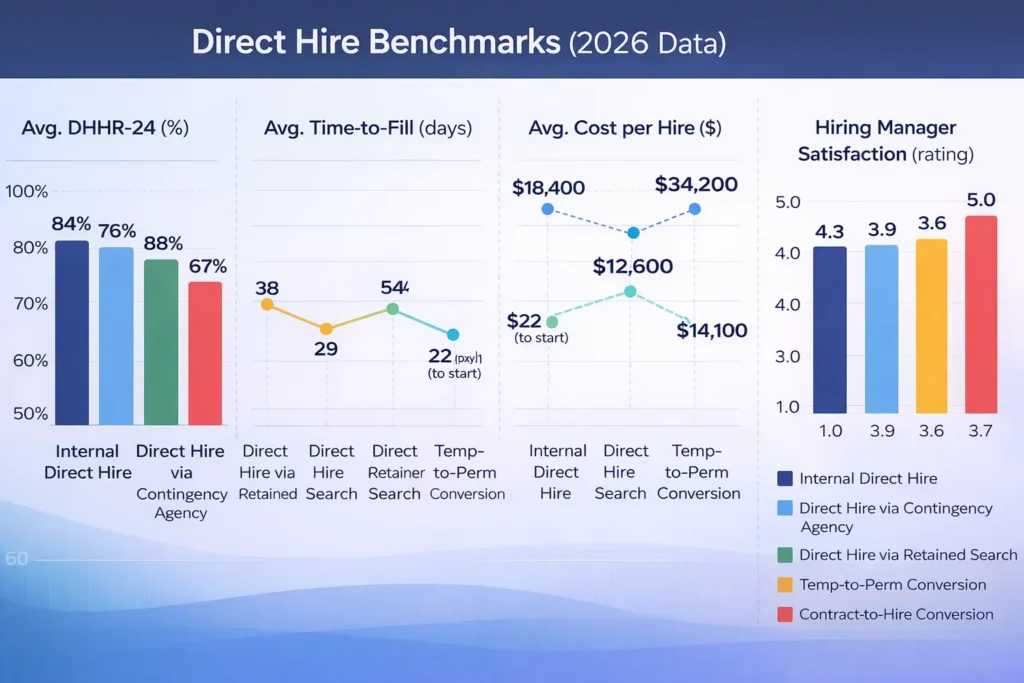
Direct Hire Benchmarks (2026 Data)
| Hiring Channel | Avg. DHRR-24 | Avg. Time-to-Fill | Avg. Cost per Hire | Hiring Manager Satisfaction (12-mo) |
|---|---|---|---|---|
| Internal Direct Hire | 84% | 38 days | $4,200 | 4.3 / 5.0 |
| Direct Hire via Contingency Agency | 76% | 29 days | $18,400 | 3.9 / 5.0 |
| Direct Hire via Retained Search | 88% | 54 days | $34,200 | 4.5 / 5.0 |
| Temp-to-Perm Conversion | 61% | 22 days (to start) | $12,600 | 3.6 / 5.0 |
| Contract-to-Hire Conversion | 67% | 18 days (to start) | $14,100 | 3.7 / 5.0 |
The most striking figure in this table is the 24-month retention gap between direct hire models (76 to 88%) and conversion models (61 to 67%). The temp-to-perm model’s apparent advantage of faster time-to-start (22 days versus 29 to 54 days) is purchased at the cost of 17 to 27 percentage points of 24-month retention. Given that replacement cost for a professional role typically runs $28,000 to $40,000, the retention differential represents a significant true cost disadvantage for the temp-to-perm model relative to its nominal cost advantage.
Key Strategies for Maximizing Direct Hire Outcomes
How AI Is Strengthening Direct Hire Programs?
Expanding Direct Sourcing Reach
AI-powered talent intelligence platforms have significantly reduced the access advantage that external agencies once held over internal TA teams for direct hire sourcing. The ability to identify, qualify, and contact passive candidates at scale using AI-assisted outreach means that organizations with modest internal TA capacity can now conduct effective direct hire searches for roles that previously required agency support. This democratization of direct sourcing is one of the primary drivers of the growth in internal direct hire volume across the mid-market.
Competency-Based Matching
AI systems that match candidate profiles against defined competency frameworks for specific roles produce better direct hire shortlists than keyword-based ATS screening, because they evaluate candidates against the behavioral and skill dimensions most predictive of performance rather than the credential and experience proxies that keyword matching relies on. For direct hire specifically, where long-term fit is the priority, competency-based matching produces candidate pools with higher potential for 24-month retention than credential-matching approaches.
Predictive Retention Modeling
Machine learning models trained on historical direct hire data, connecting recruiting process variables (sourcing channel, competency assessment scores, offer timing, compensation positioning) to 24-month retention outcomes, can generate retention probability scores for candidates in the current direct hire pipeline. These scores are most useful as one input among several in the offer prioritization decision, not as standalone selection tools, and they require regular validation against actual retention outcomes to maintain predictive accuracy.
Stop Juggling
10 Job Boards.
Search One
Your next role is already here. avua pulls opportunities from across the web into a single searchable feed; filtered by role, location, salary, and remote preference.
1.5 Million+
Active Jobs
380+
Job Categories
Direct Hire and Diversity, Equity, and Inclusion
Direct hire has specific DEI implications that differ from contingency staffing and temp-to-perm models.
Equal Access to Permanent Employment
The structure of direct hire, as a permanent employment commitment from day one, is inherently more equitable than models that require candidates to prove themselves through a trial period before accessing permanent status. Temp-to-perm models, where the path to permanence requires demonstrating fitness to an evaluator over an extended period, have documented patterns of producing demographic disparities in conversion rates that do not reflect actual performance differences. Direct hire removes this extended evaluation period and its associated bias exposure.
Direct Hire Quality and Structural Assessment
Because direct hire decisions are permanent commitments, organizations typically invest more in the assessment process than they do for temporary engagements. This higher investment in structured assessment, including competency-based interviews, standardized rubrics, and diverse panel composition, tends to produce more equitable outcomes than the more impressionistic evaluation common in short-term staffing decisions.
Pay Equity at Offer Stage
Direct hire offers establish a compensation baseline that may persist for years through raises and promotion cycles. Pay inequity at the direct hire offer stage therefore compounds over time in a way that temp-to-perm hourly rates, which are set by the staffing agency and renegotiated at conversion, do not. Organizations with pay equity commitments should be particularly attentive to ensuring that direct hire offer amounts are made at equivalent levels across demographic groups for equivalent roles, because the long-term impact of offer-stage pay gaps is larger for permanent hires than for any other employment model.
Common Challenges and Solutions
| Challenge | Solution |
|---|---|
| Longer Time-to-Fill vs. Temp-to-Perm | Frame the comparison against true cost (including 24-month attrition differential), not just time-to-start; invest in process speed improvements without compromising assessment quality |
| Hiring Manager Preference for “Trial Period” | Share 24-month retention data comparing direct hire to temp-to-perm for equivalent roles; make the talent quality differential visible |
| Strong Candidates Declining to Wait for Permanent Offers | Ensure direct hire offer is made within 24 to 48 hours of final interview; do not use temp-to-perm for roles that can support direct hire |
| High Direct Hire Placement Fees from Agencies | Build internal sourcing capability for accessible candidate profiles; use agency support selectively for roles where passive candidate access genuinely requires external partnership |
| First-Year Attrition Despite Direct Hire Model | Audit onboarding design for alignment with candidate expectations set during hiring; investigate whether offer and role representations are accurate |
Real-World Case Studies
Case Study 1: The Technology Company
A 400-person technology company had been using a staffing agency for temp-to-perm hiring across all software engineering roles, treating the 90-day agency period as a de facto working interview. Time-to-start was fast (18 to 22 days) and hiring managers appreciated the evaluation period. But engineering attrition was running at 34% in the first 24 months, and post-exit interviews consistently revealed that the most capable engineers had accepted competing direct offers rather than entering the temp-to-perm pipeline.
An analysis of the candidate population showed that the company was systematically selecting from a pool of candidates who had not received competing direct offers, which correlated strongly with lower market-assessed capability. The 90-day evaluation was producing high pass rates (91% of temps were offered permanent positions) because by the time the evaluation was complete, the company was evaluating the only candidates who had been willing to wait.
They transitioned to a direct hire model for all engineering roles, invested in a structured competency-based assessment process, and built direct sourcing capability using a talent intelligence platform. Time-to-fill increased from 22 to 41 days. The 24-month retention rate for engineering hires improved from 66% to 83%. Hiring manager satisfaction at 12 months improved from 3.4 to 4.4 out of 5.0.
The total cost per successfully retained 24-month engineering hire dropped from $31,200 (incorporating the high attrition replacement cycle cost) to $19,400 (incorporating the higher upfront direct hire process cost against the improved retention rate).
Case Study 2: The Professional Services Firm
A professional services firm had built a successful internal direct hire program for consultant-level roles but was relying on contingency agencies for senior manager and director-level hiring. Agency placement rates were acceptable but 24-month retention for agency-placed senior hires was 71%, compared to 86% for internally sourced direct hires at the same level.
An audit of the agency-facilitated process identified two root causes. First, agencies were submitting candidates with strong credentials but limited cultural alignment because the firm’s cultural requirements were not adequately conveyed in the brief. Second, the firm was accepting the first strong candidate presented rather than ensuring full market visibility before making an offer decision.
They redesigned the agency engagement: extended briefing sessions covering cultural assessment criteria explicitly, a minimum of three agency-sourced candidates evaluated before any offer was made, and a 90-day post-placement performance review shared with the agency as feedback for their calibration. Within two hiring cycles, 24-month retention for senior-level agency-facilitated direct hires improved from 71% to 81%, approaching the internally sourced benchmark.
Case Study 3: The Healthcare Network
A regional healthcare network had been using a combination of internal direct hire for nursing roles and staffing agency temp-to-perm arrangements for allied health specialist roles, on the assumption that specialist skill verification required an observation period. Analysis of outcomes by role type challenged this assumption: allied health specialist 24-month retention under the temp-to-perm model was 58%, compared to 79% for nursing under the direct hire model.
The network redesigned the allied health specialist process to use direct hire with a structured skills-based assessment (a practical competency evaluation conducted before the offer rather than during a 90-day employment trial) and a 60-day structured onboarding program designed to provide early performance feedback and support.
Within 18 months, allied health specialist 24-month retention improved from 58% to 76%, approaching the nursing benchmark. The elimination of the temp-to-perm structure removed the staffing agency employment period that had been deterring the strongest candidates from accepting agency placements in favor of direct offers from competing health systems.
Building a Direct Hire Dashboard: What to Track?
Direct Hire Across the Hiring Lifecycle
Workforce Planning
The decision to use direct hire versus other employment models should be made at the workforce planning stage, before requisitions are opened, based on the nature of the role and the organizational need it fills. Roles that are permanent, strategically important, and aligned with long-term capability building warrant direct hire. Roles that are project-bound, time-limited, or skills-verification-dependent may warrant alternatives.
Sourcing Strategy
Direct hire sourcing strategy should reflect the permanence of the commitment: passive candidate outreach, employer brand investment, and relationship building with talent communities are more valuable for direct hire sourcing than for temporary staffing because the long tenure expected from direct hires makes the upfront sourcing investment worthwhile over a longer value horizon.
Offer and Onboarding
The direct hire offer is the beginning of a relationship designed to last years. The offer process should reflect this: a compensation structure that is internally equitable and externally competitive; clear communication about role expectations, growth opportunities, and organizational culture; and an onboarding program designed to accelerate early-tenure belonging and capability rather than simply completing compliance tasks.
Related Terms
| Term | Definition |
|---|---|
| Permanent Placement | An alternative term for direct hire, used primarily by staffing and recruiting agencies to distinguish permanent placement services from temporary staffing |
| Temp-to-Perm | An employment model in which a candidate begins in a temporary role under a staffing agency and is offered permanent employment by the client organization after a trial period |
| Contract-to-Hire | An engagement model in which a candidate works as an independent contractor or through a staffing agency for a defined period, with the option for the client organization to hire them directly at the end of the contract |
| Retained Search | A recruiting engagement model in which the client pays an upfront retainer for an exclusive, structured search that results in a direct hire; one of the channels for facilitated direct hire |
| Contingency Placement | A recruiting engagement model in which the agency earns a fee only upon successful direct hire of a submitted candidate; the other primary channel for facilitated direct hire |
| Placement Fee | The fee paid to an agency upon successful direct hire of a candidate they sourced; typically 15 to 25% of first-year base salary for contingency arrangements |
Frequently Asked Questions Related to Direct Hire
What is direct hire in recruiting?
Direct hire is when an employer permanently places a candidate without a temporary or contract period. The employee joins the organisation’s payroll from their first working day.
How does direct hire differ from contract hiring?
Contract hiring places workers temporarily, often through a staffing agency. Direct hire results in immediate permanent employment with full benefits and no interim staffing arrangement involved.
When should organisations use direct hire over other methods?
Direct hire works best for permanent, senior, or specialised roles where long-term commitment is expected and a temporary or contract arrangement would be impractical or inefficient.
Does direct hire always involve a recruitment agency?
No. Organisations can hire directly through internal talent teams. Agencies are used when speed, specialist networks, or capacity constraints make external recruitment support worthwhile.
What are the main advantages of direct hire?
Direct hire builds long-term workforce stability, reduces repeat hiring costs, and gives employers full control over onboarding, culture integration, and the employee relationship from day one.
Conclusion
Direct hire is the default model for most professional hiring for a reason. The clarity of the commitment, the immediacy of the employee relationship, and the alignment signal it sends to candidates who have options are not incidental features. They are functional advantages that produce measurable outcomes in retention, performance, and organizational contribution.
What makes direct hire worth taking seriously as a strategic decision rather than a default assumption is the discipline it requires. It requires a well-defined role, a structured assessment process calibrated to long-term fit, competitive offer timing and compensation positioning, and an onboarding program that validates the commitment both parties made. When those elements are present, direct hire delivers on its potential. When they are absent, the permanence of the commitment simply makes the cost of getting it wrong more visible.
The organizations that get the most from direct hire are not those that use it most frequently. They are those that use it most deliberately: for the roles where permanence of commitment produces better outcomes than a trial period, where organizational investment in assessment produces better candidates than volume-and-hope, and where the mutual commitment of a direct employment relationship is the foundation of the performance and retention they are trying to build.
Hire directly when it matters. That is almost always.