Most organizations are genuinely committed to diversity, yet their hiring cohorts often remain unchanged year after year. This isn’t a values problem, it’s an operational one. High-level intentions frequently fail because they aren’t backed by specific, measured changes to the Candidate Pipeline.
True diversity hiring is the strategic expansion of your Applicant Pool to include underrepresented talent, combined with an assessment process designed to eliminate Bias in Hiring. It’s not enough to just “want” a different outcome; you have to track representation at every stage of the funnel. This might involve implementing Blind Resume Review to ensure merit-based selection or using calibrated Automated Screening tools to remove subjective hurdles.
While often grouped under the broader DEI umbrella, diversity hiring is specifically focused on the talent acquisition stage. It’s about building a system that replaces “gut feel” with data-driven precision. The organizations that succeed today are those that move past vague commitments and focus on the practical, evidence-based mechanics that turn a diverse shortlist into a diverse workforce.
The primary metric governing diversity hiring effectiveness is the Diversity Hiring Index (DHI): a composite measure of representation improvement across three dimensions.
DHI = (Diverse Hires % of Total Hires ÷ Diverse Candidates % of Qualified External Market) × 100
A DHI of 100 indicates that the organization is hiring from underrepresented groups at exact parity with their representation in the qualified external market. A DHI below 100 indicates underrepresentation relative to market availability. A DHI above 100 indicates overrepresentation. The DHI should be calculated separately for each underrepresented group of interest and tracked at every funnel stage, not just at the point of hire.
What is Diversity Hiring?
Diversity hiring is a structured approach to talent acquisition that combines proactive sourcing in channels that reach underrepresented candidate populations, equitable assessment design that evaluates all candidates against job-relevant criteria without systematic disadvantage, and data-driven funnel monitoring that identifies and addresses the specific stages where representation is declining relative to market availability.
The definition has three components that are each necessary and none of which is sufficient alone.
Proactive sourcing addresses the diversity dimension: ensuring that qualified candidates from all backgrounds have the opportunity to be considered. Without this, an equitable assessment process still cannot produce diverse outcomes if the candidate pool does not include diverse candidates to assess.
Equitable assessment design addresses the equity dimension: ensuring that once diverse candidates are in the pipeline, the assessment process evaluates them on job-relevant criteria rather than filtering them out through proxies that correlate with background rather than performance. Without this, sourcing investment produces diverse pipelines that the assessment process immediately narrows back to the same demographic profile.
Data-driven funnel monitoring addresses the measurement dimension: ensuring that the organization knows at each stage whether its diversity hiring efforts are producing the outcomes intended. Without this, both of the first two elements operate without feedback, and the organization cannot identify which investments are working and which are not.
What Actually Moves the Needle on Diversity Hiring?
Most diversity hiring programs invest most heavily in the most visible interventions: attending HBCU career fairs, updating job description language, featuring diverse employees in employer brand content, and publishing annual diversity reports. These are not wrong. Some of them contribute meaningfully to diverse candidate pipeline development. But research on what actually drives diversity hiring outcomes consistently points to a different set of interventions as the highest leverage.
The interventions with the most consistent research support for producing diversity hiring outcomes are structural process changes, not sourcing expansions. Structured interviews with standardized questions and rubrics. Diverse interview panels. Removal of degree requirements not supported by performance evidence. Standardized rather than negotiated compensation offers. And systematic adverse impact analysis of every selection tool in use.
Research comparing organizations that implement structural process changes versus those that implement sourcing-only diversity hiring programs finds that structural intervention organizations produce 2.6 times higher diversity hiring outcomes over a three-year period. The sourcing investment gets diverse candidates into the funnel. The structural intervention keeps them there through the assessment process and produces the offer and acceptance outcomes that translate pipeline diversity into workforce diversity.
The gap between these two approaches is what explains the most common diversity hiring frustration: organizations that have invested significantly in diverse sourcing for years without seeing proportionate change in their hiring outcomes. The sourcing is working. The funnel stages that follow sourcing are filtering the diverse pipeline back toward the baseline.
The scenario that makes this concrete: a legal services firm has been attending diversity bar association events, partnering with law schools serving underrepresented communities, and featuring diverse associate attorneys in their recruiting content for three years. Applications from underrepresented candidates have increased 40% over the period. Diverse hires as a proportion of total hires have increased 4 percentage points.
Stage-by-stage funnel analysis reveals why. At application, underrepresented candidates represent 31% of the pool, up significantly from baseline. At screening, 22%. At interview, 18%. At offer, 14%. At acceptance, 12%.
The sourcing investment is producing the pipeline. Seven different stages of the assessment and selection process are each producing a 1 to 3 percentage point reduction in representation, compounding across the funnel to produce a 19-point gap between pipeline diversity and hire diversity. No additional sourcing investment will close this gap. The interventions required are in the screening criteria, the interview structure, the offer process, and the candidate experience during the process.
Your Resume Isn’t Getting Read
Let’s Get That Fixed!
75% of resumes get auto-rejected. avua’s AI Resume Builder optimizes formatting, keywords, and scoring in under 3 minutes, so you land in the “yes” pile.
The Diversity Hiring Intervention Stack: What Research Supports?
Diversity hiring interventions can be organized by the funnel stage they primarily affect and the strength of research evidence supporting their effectiveness.
Sourcing-Stage Interventions
- Partnerships with HBCUs, HSIs, and Community Colleges: Institutions serving underrepresented communities produce graduates who are systematically underrepresented in most professional employers’ default recruiting channels. Establishing recruiting relationships with these institutions, attending their career events, and engaging their alumni networks expands the sourced candidate pool to include candidates who would not appear in targeted-university or referral-network sourcing.
- Diversity-Focused Professional Organizations: Industry-specific associations serving underrepresented professionals (organizations serving Black engineers, Hispanic marketing professionals, women in finance, and similar communities) provide access to experienced candidates who are not visible through standard professional network sourcing.
- Job Description Audits for Exclusionary Language: Research using large-scale natural language processing analysis of job postings consistently finds that specific language patterns deter applications from women and candidates from underrepresented backgrounds without deterring men or candidates from majority backgrounds. Language tools that identify and suggest revisions to these patterns (overly masculine-coded language, long requirement lists, credential requirements not tied to performance evidence) consistently improve diverse application rates.
- Removing Non-Job-Relevant Credential Requirements: Degree requirements for roles where research does not support degree attainment as a predictor of performance are one of the most significant structural barriers to diverse applications. Degree attainment is demographically concentrated along socioeconomic and racial lines. Removing degree requirements for roles where performance evidence does not require them expands the addressable candidate pool and does not reduce hire quality.
Assessment-Stage Interventions
- Structured Interviews with Standardized Rubrics: The highest-impact single intervention in diversity hiring research. Structured interviews reduce the variance introduced by individual assessor bias by requiring all assessors to evaluate the same evidence against the same criteria. They do not eliminate bias but make it harder to operationalize and easier to identify when it occurs.
- Diverse Interview Panels: Panels with assessors from multiple demographic backgrounds consistently produce lower levels of affinity bias than panels with demographically homogeneous composition. The mechanism is well-established: individual assessors who know their ratings will be compared with and may be questioned by colleagues from different backgrounds are less likely to make assessments driven by similarity to themselves.
- Blind Resume Review at Initial Screening: Removing candidate names and identifying information from resumes before initial screening reduces name-based and institution-based bias at the screening stage. The effect is well-documented: field experiments consistently show that identical resumes with names associated with underrepresented backgrounds receive fewer callbacks than those with majority-group-associated names. Blind review is a direct structural intervention against this effect.
- Skills-Based Assessments as Credential Alternatives: Standardized work sample or skills-based assessments that evaluate candidates on their ability to perform specific job-relevant tasks provide an alternative signal to educational credentials that may be more equitable across candidates with different credential access. Research on skills-based hiring consistently finds that it expands the qualified candidate pool from underrepresented backgrounds while maintaining or improving hire quality.
Offer-Stage Interventions
- Standardized Rather Than Negotiated Compensation Offers: Research on compensation negotiation consistently finds demographic disparities: some groups negotiate more aggressively or more successfully than others, and some groups face negative responses when they negotiate that other groups do not experience. Standardized compensation offers at market rate for the role and experience level, not subject to individual negotiation, eliminate this source of equity disparity while simplifying the offer process.
- Equitable Offer Timing: Research on offer timing shows demographic disparities in the average time between final interview and offer extension across candidate groups that are not explained by assessment score differences. Fast, consistent offer timing across all candidate groups is an equity intervention as well as a competitive positioning one.
Diversity Hiring vs. Related Concepts
| Concept | Scope | Mechanism | Legal Status |
|---|---|---|---|
| Diversity Hiring | Talent acquisition process | Sourcing expansion plus equitable assessment design | Voluntary; permissible under most employment law frameworks |
| Affirmative Action | Federal contractor hiring | Required outreach and record-keeping for protected groups | Legally mandated for qualifying federal contractors |
| Equal Employment Opportunity (EEO) | All employment decisions | Prohibition of discrimination; complaint and enforcement mechanism | Legally mandated for all employers above size threshold |
| DEI (Broad) | Entire employee lifecycle | Hiring, development, advancement, culture, compensation equity | Voluntary; some elements legally required |
| Diversity Sourcing | Candidate pipeline development only | Channel expansion to reach underrepresented candidates | Voluntary; permissible |
| Skills-Based Hiring | Assessment and credential design | Replacing credential proxies with job-relevant assessment | Voluntary; legally sound |
What the Experts Say?
The organizations that are making real, sustained progress on diversity hiring share one characteristic: they are measuring their funnel at every stage, not just at hire. When you see where the pipeline is dropping off, you know where to intervene. When you only look at the end result, you can invest years in the wrong places and wonder why nothing is changing.
– Torin Ellis, diversity recruiting strategist and host of the Crazy and The King podcast
How to Build a Diversity Hiring Program That Produces Outcomes
Step 1: Set Specific, Stage-Level Goals
A diversity hiring goal that states only a representation target at hire is insufficient for program design. Stage-level goals, specifying target DHI scores at application, screening, interview, and offer, provide the specificity required to identify where interventions are needed and whether they are working. Goals set at multiple funnel stages also create accountability for the specific process elements under each stage’s control rather than allowing end-of-pipeline representation to be the only accountability measure.
Step 2: Conduct a Baseline Funnel Analysis
Before designing interventions, audit the current funnel stage by stage for representation data. Calculate DHI at each stage for each underrepresented group of interest. Identify the stages where representation is declining most sharply relative to market availability. The intervention design should prioritize the stages with the largest gaps, which is rarely the sourcing stage alone.
Step 3: Select Interventions Based on Where the Gap Is
If the largest gap is between application and screening (representation drops at the screening stage), the priority intervention is screening criteria audit and structured screening rubric development. If the largest gap is between interview and offer (representation drops at the decision stage), the priority intervention is interview panel composition and post-interview decision process review. Matching intervention to the specific stage with the largest gap produces more efficient program design than applying all possible interventions simultaneously.
Step 4: Train Hiring Managers and Interviewers
Structural process interventions require behavioral adoption by the people conducting the process. Hiring managers who have not been trained in the specific bias patterns most common in interview assessment, in how to apply structured rubrics consistently, and in why diverse panel composition matters will often undermine structural interventions even when they are genuinely well-intentioned. Training that provides both the why (bias research, business case) and the how (specific rubric application, question techniques) is more effective than either component alone.
Step 5: Measure, Report, and Iterate
Diversity hiring program effectiveness should be reported monthly at the TA leadership level, quarterly at the HR leadership level, and annually to executive leadership. Reports should show stage-level DHI data, not just aggregate representation figures. When a stage shows a DHI gap that has worsened or not improved over two reporting cycles, it should trigger an intervention review. Diversity hiring programs that are reported on but not acted on lose organizational credibility; programs that generate visible, specific actions in response to the data build the trust that sustains long-term investment.
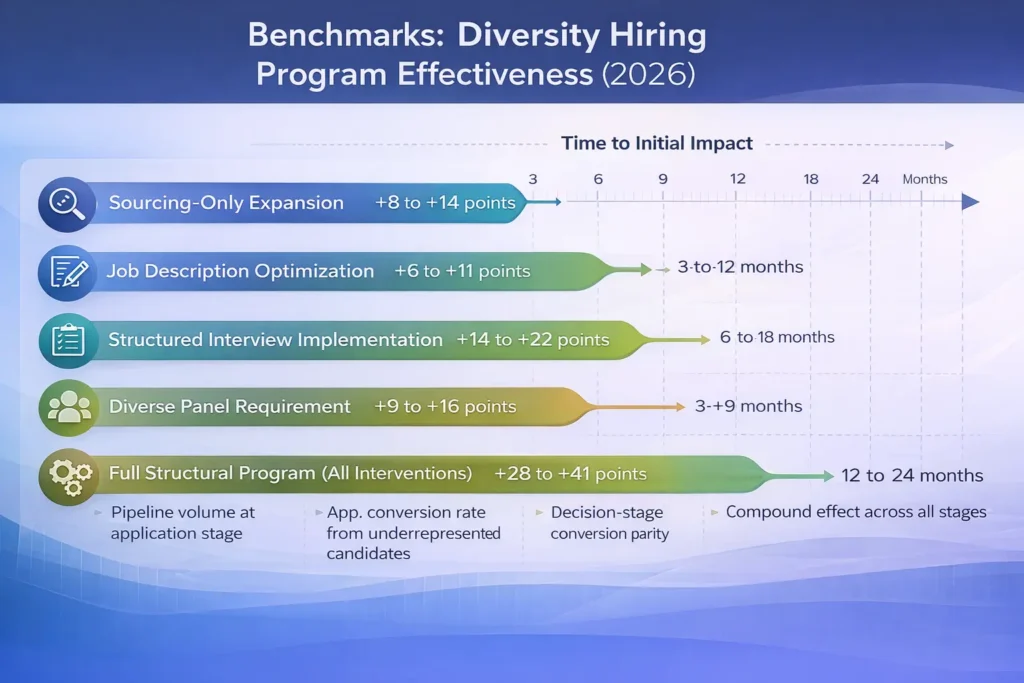
Benchmarks: Diversity Hiring Program Effectiveness (2026)
| Program Type | 3-Year DHI Improvement | Time to Initial Impact | Primary Mechanism |
|---|---|---|---|
| Sourcing-Only Expansion | +8 to +14 points | 6 to 12 months | Pipeline volume at application stage |
| Job Description Optimization | +6 to +11 points | 3 to 6 months | Application conversion rate from underrepresented candidates |
| Structured Interview Implementation | +14 to +22 points | 6 to 18 months | Assessment-stage conversion parity |
| Diverse Panel Requirement | +9 to +16 points | 3 to 9 months | Decision-stage bias reduction |
| Full Structural Program (All Interventions) | +28 to +41 points | 12 to 24 months | Compound effect across all stages |
The compound effect of a full structural program (all interventions implemented consistently) is substantially larger than the sum of individual interventions, because each intervention reduces the representation loss at a specific stage and the effects multiply across the funnel. An 8-point improvement at application, a 12-point improvement at screening, and a 10-point improvement at the interview-to-offer stage do not add to a 30-point overall improvement. They multiply: fewer candidates lost at each stage means more diverse candidates reaching subsequent stages where further intervention can operate.
Key Strategies for Diversity Hiring Programs
How AI Is Affecting Diversity Hiring?
AI in talent acquisition has a complex and consequential relationship with diversity hiring outcomes. It can perpetuate historical bias at scale, and it can systematically improve equity in ways that human-only processes cannot achieve consistently. The difference is entirely in how it is designed and audited.
The Risk: Automated Bias Amplification
AI sourcing and screening tools trained on historical hiring data reproduce the patterns in that data, including patterns produced by past bias. An AI resume screening tool that learns from historical hire data in a non-diverse organization will optimize toward candidate profiles that resemble historical hires, systematically disadvantaging candidates whose profiles differ from the majority. This risk is well-documented and has produced regulatory responses in several jurisdictions, including requirements for bias auditing of AI hiring tools in New York City and Illinois.
The Opportunity: Consistent Equitable Assessment
AI-assisted structured assessment tools that evaluate candidates against defined competency criteria consistently and without the variance introduced by individual assessor bias can improve diversity hiring outcomes by removing the human inconsistency that is the primary mechanism through which assessment-stage bias operates. The opportunity is not that AI is unbiased (it is not; all AI systems reflect their training data) but that AI-assisted structured assessment can be designed to reduce specific, identified bias mechanisms and can be audited for adverse impact at scale.
The Requirement: Mandatory Adverse Impact Auditing
Every AI tool used in a diversity-relevant hiring decision should be subject to annual adverse impact analysis: comparing the tool’s selection outputs by demographic group against the 80% rule and investigating any significant disparity. This requirement should be specified in vendor contracts, operationally implemented by the TA function, and reported to HR leadership alongside other diversity hiring metrics. Organizations that use AI hiring tools without this auditing discipline are accepting unknown diversity risk in exchange for efficiency gains.
Stop Juggling
10 Job Boards.
Search One
Your next role is already here. avua pulls opportunities from across the web into a single searchable feed; filtered by role, location, salary, and remote preference.
1.5 Million+
Active Jobs
380+
Job Categories
The Legal Context for Diversity Hiring in 2026
The legal environment for diversity hiring has evolved significantly following the Supreme Court’s 2023 Students for Fair Admissions decisions and subsequent regulatory and litigation activity. Several important clarifications for practitioners:
The prohibition on race-conscious hiring quotas under Title VII has not changed and has not been newly affected by the 2023 decisions, which addressed educational admissions. However, the downstream attention to race-conscious programs in employment contexts has intensified, and several states have enacted legislation affecting how organizations may design and describe their diversity hiring programs.
Practices that remain clearly permissible under current federal law include: targeted outreach and sourcing to reach underrepresented candidate populations; removal of credential requirements that are not job-related; implementation of structured assessment processes; collection of demographic data for adverse impact analysis and program evaluation; and setting of aspirational representation goals that are not implemented as quotas.
Practices that face legal risk include: use of race or gender as a determinative criterion in individual hiring decisions; formal quota systems with required minimum proportions of hires from specific demographic groups; and AI hiring tools that have been shown to produce adverse impact without correction.
Organizations should seek employment law counsel for guidance on the specific design of their diversity hiring programs in light of current law and applicable jurisdiction.
Common Challenges and Solutions
| Challenge | Solution |
|---|---|
| Diverse Pipeline Not Converting to Diverse Hires | Conduct stage-by-stage DHI analysis; identify assessment-stage gaps; implement structured interviews and rubrics |
| Hiring Manager Resistance to Diversity Hiring Goals | Present business case data; connect diversity hiring to team performance outcomes; make accountability explicit in performance expectations |
| Referral Program Producing Homogeneous Candidates | Add diversity referral incentives; educate employees on expanded network outreach; track referral pool demographics alongside overall program metrics |
| AI Tools Producing Adverse Impact | Commission independent bias audit; require vendor to provide demographic analysis; implement human review as determinative layer |
| Progress Plateauing After Initial Improvement | Conduct updated funnel analysis to identify where the next bottleneck has emerged; diversity hiring gaps shift as earlier-stage interventions succeed |
Real-World Case Studies
Case Study 1: The Technology Company
A 2,000-person technology company had been investing in diversity hiring for four years through sourcing partnerships, HBCU engagement, and job description updates. Black and Hispanic representation in applications had increased from 14% to 23% of the pool. But representation in hires had increased only from 12% to 15%.
Stage-by-stage DHI analysis identified two specific gaps. First, the screening-to-interview conversion rate for Black and Hispanic candidates was 19%, compared to 31% for white candidates. Second, the interview-to-offer rate for these groups was 28%, compared to 42% for white candidates.
The firm redesigned its engineering screening criteria to remove preferred company list requirements (which correlated strongly with demographic background), implemented structured behavioral interview rubrics for all engineering roles, and required a minimum of two diverse interviewers on every engineering panel.
Within three hiring cycles, the screen-to-interview DHI gap reduced from 38 points to 14 points. The interview-to-offer DHI gap reduced from 33 points to 11 points. Black and Hispanic representation in engineering hires reached 24%, approaching the application pool representation of 23% for the first time. The sourcing investment had been producing the pipeline for four years. The structural interventions converted it into hires.
Case Study 2: The Financial Services Firm
A financial services firm had implemented a diversity hiring program focused primarily on gender representation. Applications from women had increased significantly following job description updates and targeted outreach. But the proportion of women in senior manager and director hires had remained flat at 31% for two years despite a 44% women’s representation in the candidate pool.
Analysis identified the specific bottleneck: the final-round interview panel for senior roles consisted almost entirely of existing senior managers and directors, who were 69% male. Unstructured final-round interviews produced a 34% advancement rate for women candidates versus 51% for men candidates, a gap that had no correlation with prior-stage assessment scores.
The firm implemented two changes: standardized final-round interview questions with behavioral rubrics, and a requirement that at least two of five final-round interviewers identify as women. Within four hiring cycles, the final-round advancement rate gap closed from 17 percentage points to 4 percentage points. Women’s representation in senior manager and director hires improved from 31% to 41%, exceeding the 40% goal for the first time.
Case Study 3: The Healthcare Network
A regional healthcare network was attempting to build a more diverse nursing leadership pipeline. Applications from nurses of color for leadership roles were rare despite a workforce that was 38% nurses of color at the staff level. The network assumed the gap was a sourcing problem and launched targeted outreach to staff nurses from underrepresented backgrounds.
The outreach increased applications from nurses of color for leadership roles. But advancement through the leadership assessment process remained low, with DHI at the interview-to-offer stage at 61.
Qualitative investigation revealed a different root cause: nurses of color applying for leadership roles were disproportionately reporting that the interview process did not feel designed to assess their capabilities fairly, and many were withdrawing after initial screening. Exit survey data showed that the primary concerns were unfamiliarity with the formal behavioral interview format and a perception that the interview panel (predominantly white) was evaluating fit with existing leadership culture rather than leadership potential.
The network implemented three changes: pre-interview preparation resources explaining the behavioral interview format and what competencies would be assessed; diverse clinical leadership representation on all interview panels; and a post-interview feedback program offering all non-advancing candidates specific developmental feedback on their performance. Within two hiring cycles, the interview-to-offer DHI for nursing leadership candidates improved from 61 to 84, and first-year performance ratings for newly promoted nurse leaders showed no decline in quality despite the expanded diversity of the cohort.
Building a Diversity Hiring Dashboard: What to Track?
Diversity Hiring Across the Hiring Lifecycle
Job Design and Requirements
Diversity hiring begins before the job is posted, in the decisions about what credentials and experiences will be required, and what language will describe the role. These decisions determine the size and composition of the addressable candidate pool before a single outreach effort begins.
Sourcing and Pipeline Development
The diversity dimension of hiring is most directly addressed in sourcing: which channels the organization uses, which communities it builds relationships with, and which candidate populations its outreach actually reaches. Pipeline diversity at application sets the ceiling for diversity at hire.
Assessment and Selection
The equity dimension is addressed in assessment design. Pipeline diversity that is not sustained through equitable assessment produces the most common diversity hiring frustration: investment in sourcing without proportionate investment in assessment equity, producing diverse pipelines and non-diverse hiring cohorts.
Offer and Early Tenure
The inclusion dimension begins to materialize in the offer process and early onboarding. Whether diverse new hires receive equivalent compensation, equivalent support, and equivalent signals that they belong is determined here, and it is what distinguishes organizations where diversity hiring produces lasting workforce diversification from those where it produces diverse incoming cohorts with high early attrition.
Related Terms
| Term | Definition |
|---|---|
| DHI (Diversity Hiring Index) | A metric comparing the proportion of hires from underrepresented groups to their representation in the qualified external talent market |
| Adverse Impact | A substantially different selection rate for a demographic group that triggers analysis of whether a selection tool is job-related; the primary legal and analytical standard for identifying discriminatory assessment outcomes |
| Structured Interview | A standardized interview format with consistent questions and rubric-based scoring; the highest-evidence-supported structural intervention for improving diversity hiring outcomes |
| Skills-Based Hiring | A hiring approach that replaces credential proxies with direct assessment of job-relevant skills; a structural diversity intervention that expands the qualified candidate pool |
| Diverse Interview Panel | An interview panel with representation from multiple demographic backgrounds; reduces affinity bias in assessment decision-making |
| Representation | The proportional presence of demographic groups at each stage of the hiring funnel and in the workforce; the primary measurement variable for diversity hiring outcomes |
Frequently Asked Questions
What is the difference between diversity hiring and affirmative action?
Diversity hiring is a voluntary strategy to expand talent pools. Affirmative action is a legal obligation for federal contractors. Most private employers aren’t subject to it, but all must comply with EEO non-discrimination requirements.
Why do diverse candidates drop out of the hiring funnel at higher rates?
Key barriers include credential bias at screening, unstructured interviews that amplify assessor bias, homogeneous panels, below-market compensation offers, and slower offer processes for underrepresented candidates. Each is a structural problem with a structural solution.
How do you measure the business impact of diversity hiring?
Key metrics include team innovation output, problem-solving quality, customer segment performance, and offer acceptance rates tied to diversity commitment. Most organisations lack the longitudinal data to measure these internally, which is why most cite external research rather than their own performance evidence.
Should diversity hiring goals be public?
Public diversity hiring goals create external accountability and signal genuine commitment to candidates from underrepresented backgrounds who use publicly stated commitments as one signal of organizational authenticity. They also create reputational risk if not met, and in the current legal environment, require careful framing to avoid misrepresentation as quota commitments. Most leading practitioners recommend specific, time-bound, stage-level internal goals with aggregate representation aspirations communicated publicly, rather than specific numerical targets that can be interpreted as quota commitments.
What is skills-based hiring and how does it relate to diversity hiring?
A: Skills-based hiring replaces degree requirements with direct competency assessments, work samples, and portfolio reviews. It expands diverse talent pools by removing credential barriers not supported by actual performance evidence.
Conclusion
Diversity hiring is not a recruiting challenge that can be solved with more effort at the top of the funnel. It is an engineering challenge that requires precision at every stage of the process: designing jobs that do not contain unnecessary barriers, sourcing from channels that reach the full range of qualified candidates, assessing through processes that do not systematically disadvantage specific groups, and making offers equitably and promptly to candidates who have earned them.
The organizations that have built genuine diversity hiring capability did not get there by trying harder at the margin. They got there by looking honestly at their funnel data, identifying specifically where representation was declining, and making structural changes to those specific stages. They treated the gap between diverse pipelines and diverse hires not as evidence of a talent shortage but as evidence of a process failure, and they fixed the process.
That is what diversity hiring looks like when it is working. Not a sourcing program. Not a public commitment. A process that gives every qualified candidate the same realistic chance to demonstrate what they can do, regardless of what they look like, where they went to school, or who they know.
The candidates have always been there. The process is what has to change.