Recruiting often runs on autopilot. We look where we’ve always looked, relying on the same Campus Recruiting networks or employee referrals that mirror our current team. This isn’t usually intentional exclusion, but it does create a cycle of Bias in Hiring by keeping us within our own comfort zones. To build a truly representative Applicant Pool, we have to move beyond these default settings.
Diversity sourcing is the proactive disruption of those habits. It’s a specialized form of Active Sourcing that intentionally seeks out talent in underrepresented spaces. While AI Hiring platforms now make it easier to identify diverse talent at scale, the strategy only works if the top-of-funnel effort is met with an equitable assessment process later on.
Building a diverse Candidate Pipeline is foundational; without it, even the fairest interview process has nothing to work with. Modern talent teams don’t just wait for diversity to happen, they use data-driven outreach to ensure their search is as broad and inclusive as the talent they hope to find.
The primary metric governing diversity sourcing effectiveness is the Diverse Sourcing Yield Rate (DSYR): the proportion of candidates from underrepresented groups in the sourced pipeline relative to their representation in the qualified external talent market.
DSYR (%) = (Underrepresented Group % in Sourced Pipeline ÷ Underrepresented Group % in Qualified External Market) × 100
A DSYR of 100 indicates that the sourcing program is reaching underrepresented candidates at exact parity with their market availability. A DSYR above 100 indicates the sourcing program is overrepresented relative to market, which is a reasonable target during a deliberate pipeline diversification effort. Most organizations without active diversity sourcing programs operate at DSYR scores between 40 and 70, meaning they are reaching significantly fewer underrepresented candidates than the market contains.
What is Diversity Sourcing?
Diversity sourcing is a proactive talent acquisition practice in which recruiters and sourcers deliberately target and engage candidates from underrepresented groups through channels, platforms, and communities that are not reached by default recruitment pipelines, with the goal of building candidate pools that reflect the full range of qualified individuals available in the talent market.
The practice encompasses both reactive and proactive components. Reactive diversity sourcing improves the diversity of inbound applications by making existing job postings more accessible and visible to underrepresented candidates: inclusive job description language, posting on platforms used by diverse candidate communities, and removing credential barriers that disproportionately deter certain groups. Proactive diversity sourcing goes further: recruiters actively identify and contact specific individuals from underrepresented backgrounds who may not be actively searching but who meet the qualifications for open or anticipated roles.
Both components are necessary. Reactive sourcing improvements expand the addressable pool for candidates who are looking. Proactive outreach reaches the passive candidates who represent a significant proportion of the strongest available talent in most professional role categories.
Are You Sourcing Diversity or Just Documenting It?
There is a version of diversity sourcing that is primarily documentation: attending diversity career fairs and recording the attendance, posting roles on diversity-focused job boards and tracking the applications, reporting the number of diverse candidates in the pipeline without examining whether those candidates are sourced from channels that reach genuinely different talent populations than the default pipeline.
This is not diversity sourcing. It is diversity sourcing activity. The distinction matters because the output of the activity, the candidate pool it produces, is what determines whether diversity hiring outcomes change.
Effective diversity sourcing is defined by outcomes at the funnel stage it controls: a DSYR that approaches or exceeds 100 for the targeted groups, meaning the sourcing program is reaching underrepresented candidates at least proportionate to their availability in the qualified market. Everything before that outcome, the events attended, the boards used, the outreach volumes, is effort, not result.
The reason most diversity sourcing programs underperform is not lack of effort. It is concentration of effort in the lowest-yield channels. Attending diversity career fairs reaches candidates who are actively looking and who are willing to attend formal recruiting events: a subset of the available diverse talent pool that skews toward early-career candidates and away from the experienced passive talent that most significant roles require. Posting on niche diversity job boards reaches candidates who are actively searching and who have found those specific platforms: another subset that misses the majority of qualified passive candidates who are not actively looking for a new role.
Research on diversity sourcing channel effectiveness consistently finds that personalized, direct outreach to identified passive candidates from underrepresented backgrounds produces 3 to 4 times higher pipeline conversion rates than job posting-based approaches, because it reaches candidates who are not active on job boards and engages them with specific, relevant role information rather than asking them to self-select into a generic application process.
The scenario that makes the yield gap concrete: a financial services company has been attending three major diversity finance career fairs annually for four years, posting on two diversity-focused finance job boards, and including its diversity commitment prominently in all job postings. The DSYR for the sourcing program is 68: it is producing diverse candidates at 68% of market parity, meaning 32% of the diverse talent available in the market is not reaching the pipeline.
An audit of where the remaining 32% is concentrated reveals that experienced financial analysts and senior associates who are not attending career fairs, who are not actively searching on job boards, and who are not applying based on employer brand content represent the primary gap. These candidates are passive: they have stable positions, are not actively looking, and will only enter a company’s pipeline if directly contacted with a compelling, personalized reason to consider the opportunity.
Proactive outreach to identified diverse candidates in this segment, using talent intelligence tools to find and contact them through professional community engagement and personalized direct messaging, produces a 31% response rate and a 22% pipeline conversion rate among respondents. The career fair and job board channels produce a 4% response-equivalent rate (application volume) and a 7% screen advancement rate. The proactive outreach channel is producing more qualified diverse candidates per hour of recruiter investment than the passive channels combined.
Your Resume Isn’t Getting Read
Let’s Get That Fixed!
75% of resumes get auto-rejected. avua’s AI Resume Builder optimizes formatting, keywords, and scoring in under 3 minutes, so you land in the “yes” pile.
The Diversity Sourcing Channel Portfolio
Effective diversity sourcing requires a portfolio of channels calibrated to the candidate population, the role type, and the career stage being targeted. No single channel reaches all of the available diverse talent in most markets.
Institutional Partnerships
- HBCUs (Historically Black Colleges and Universities): The United States’ 101 HBCUs produce a significant proportion of Black graduates in engineering, business, STEM, and healthcare fields. Recruiting partnerships with HBCUs, which go beyond attendance at a single career fair to include ongoing faculty relationships, scholarship sponsorships, internship pipelines, and alumni network engagement, produce sustained diverse pipeline development that single-event attendance cannot replicate.
- HSIs (Hispanic-Serving Institutions): Over 500 institutions meet the federal HSI designation, serving a large proportion of Hispanic students in higher education. Equivalent partnership depth to HBCU engagement produces equivalent pipeline results for Hispanic candidate populations in relevant fields.
- Community Colleges and Non-Traditional Educational Pathways: For roles where a four-year degree is not required or where skills-based alternatives have been implemented, community colleges and vocational training programs produce graduates from more socioeconomically diverse backgrounds than most four-year institutions. Recruiting partnerships that engage these institutions expand the addressable candidate pool for roles appropriate to skills-based hiring.
- Graduate Programs at Diverse-Serving Institutions: For roles requiring graduate credentials, diversity sourcing should extend to graduate program partnerships at institutions with strong representation in the relevant field, not only the most prestigious programs.
Professional Community Engagement
- Affinity Organizations and Professional Associations: Industry-specific professional organizations serving underrepresented groups, including but not limited to the National Society of Black Engineers, the Hispanic IT Executive Council, the National Association of Black Accountants, Lesbians Who Tech, Disability:IN, and hundreds of field-specific equivalents, provide access to professional communities that are not primarily reached through mainstream job boards or LinkedIn recruiting. Active engagement, including event sponsorship, speaking participation, and content contribution, produces significantly better pipeline outcomes than simple job posting.
- Employee Resource Group Networks: Many organizations have established ERGs that maintain alumni networks and external community connections. Engaging ERG members as diversity sourcing partners, both for referrals and for community introductions, converts internal employee relationships into external sourcing reach.
- Online Professional Communities: Field-specific online communities (Slack workspaces, Discord servers, subreddits, GitHub communities) that are popular among practitioners from underrepresented backgrounds provide high-engagement touchpoints for proactive outreach that differ from the LinkedIn-dominated professional networking default.
Targeted Outreach and Direct Sourcing
- Boolean Search with Diversity Indicators: Advanced Boolean search techniques using professional databases and LinkedIn Recruiter can identify candidates who have participated in diversity-specific programs, organizations, or publications as a signal of underrepresented background, without relying on demographic self-identification. This approach requires careful design to target professional community engagement as a proxy for background rather than demographic characteristics directly, which raises legal and ethical considerations that should be reviewed with employment counsel.
- Alumni Network Mapping: Mapping alumni networks from HBCU, HSI, and diverse-serving institutions who are currently employed in the relevant industry produces a candidate universe for proactive outreach that is both qualified (their employment history is verifiable) and underrepresented in default sourcing channels.
- Referral Program Design for Diversity Default employee referral programs reproduce the demographic concentration of the existing workforce. Redesigned programs that offer specific incentives for referrals that expand demographic representation, that provide employees with tools for reaching beyond their immediate network, and that track referral pool demographics produce meaningfully different results.
Diversity Sourcing vs. Related Practices
| Practice | Scope | Candidate State | Primary Mechanism |
|---|---|---|---|
| Diversity Sourcing | Proactive pipeline development for underrepresented groups | Active and passive | Channel expansion plus direct outreach |
| Standard Sourcing | Proactive pipeline development (all backgrounds) | Active and passive | Network, LinkedIn, database search |
| Diversity Job Posting | Inbound applications from underrepresented groups | Active only | Job board and platform selection |
| Campus Recruiting (Diversity) | Early-career diverse pipeline development | Active | HBCU/HSI partnerships; career fair attendance |
| Diversity Referrals | Pipeline development through employee networks | Passive primarily | ERG and community network engagement |
| Talent Community (Diversity) | Long-term pipeline nurturing for underrepresented groups | Passive primarily | CRM engagement; content and relationship |
The critical distinction in this table is between practices that reach active candidates (those currently searching) and those that reach passive candidates (those not currently looking). Most diversity sourcing programs are weighted toward active candidate channels. Most of the available qualified diverse talent at the experienced professional level is in passive status. Programs calibrated to reach passive diverse candidates outperform those focused on active channels for senior and specialized roles.
What the Experts Say?
The talent has always been there. What has not always been there is a sourcer willing to go find it in places that are not the obvious first stop. Diversity sourcing is not complicated. It is disciplined. You have to decide you are going to look in different places, build relationships in different communities, and measure whether you are actually reaching the candidates you say you want to reach.
– Torin Ellis, Diversity Recruiting Strategist
How to Build a High-Yield Diversity Sourcing Program?
Step 1: Define the Target Candidate Market
Before selecting sourcing channels, define the qualified external market for each role type: what proportion of qualified candidates in the market represent each underrepresented group? This market benchmark is the denominator in the DSYR calculation and the standard against which sourcing effectiveness is measured. Without it, the organization cannot know whether its diversity sourcing is producing proportionate results or not.
Market benchmarks can be approximated using Bureau of Labor Statistics occupational data, industry compensation surveys that include demographic breakdowns, and talent intelligence platform data on candidate availability by demographic profile.
Step 2: Audit Current Sourcing Channel Demographics
For each current sourcing channel (employee referrals, LinkedIn Recruiter, specific job boards, university partnerships, agency relationships), calculate the proportion of candidates from underrepresented groups in the pipeline originating from each channel. This audit reveals which channels are and are not producing diverse candidates, providing the evidence base for channel investment decisions.
Most organizations conducting this audit for the first time find that a small number of channels (typically employee referrals and certain LinkedIn sourcing approaches) are producing a large proportion of the total pipeline but a below-average proportion of diverse candidates, while other channels (typically career fairs and diversity job boards) are producing above-average proportions of diverse candidates but very low total volumes.
Step 3: Build Channel Investment Strategy from the Data
The audit data should drive a rebalancing of sourcing investment toward channels that combine diversity yield with sufficient candidate volume and quality. This typically means: increasing proactive outreach investment in channels reaching passive diverse candidates (professional community engagement, alumni network mapping, direct outreach), maintaining and deepening institutional partnerships that have produced qualified diverse candidates in prior cycles, and reducing investment in low-yield active candidate channels that are producing high volume but low diverse representation.
Step 4: Build Relationships, Not Just Pipelines
The most effective diversity sourcing programs are built on sustained organizational presence in diverse talent communities rather than transactional event attendance. This means: contributing value to communities before and outside of active recruiting cycles (speaking, content, mentorship, sponsorship); maintaining relationships with community leaders and organizational partners over multiple years; and treating the organization’s presence in these communities as a reputation-building investment rather than a recruiting-event expense.
Organizations that attend the NSBE career fair once and wonder why they are not known in the Black engineering community have not made a relationship investment. They have made a transaction. Relationship investment produces pipeline outcomes over years. Transactions produce outcomes for that specific recruiting cycle and nothing more.
Step 5: Track DSYR and Adjust Quarterly
DSYR should be calculated quarterly for each role family and each targeted underrepresented group. Channels that are not producing DSYR improvement over two consecutive quarters warrant examination: is the channel reaching the candidate population in sufficient volume? Is the outreach messaging resonating? Is the role opportunity compelling to the specific candidate community? Each of these questions has a different answer and a different adjustment required.
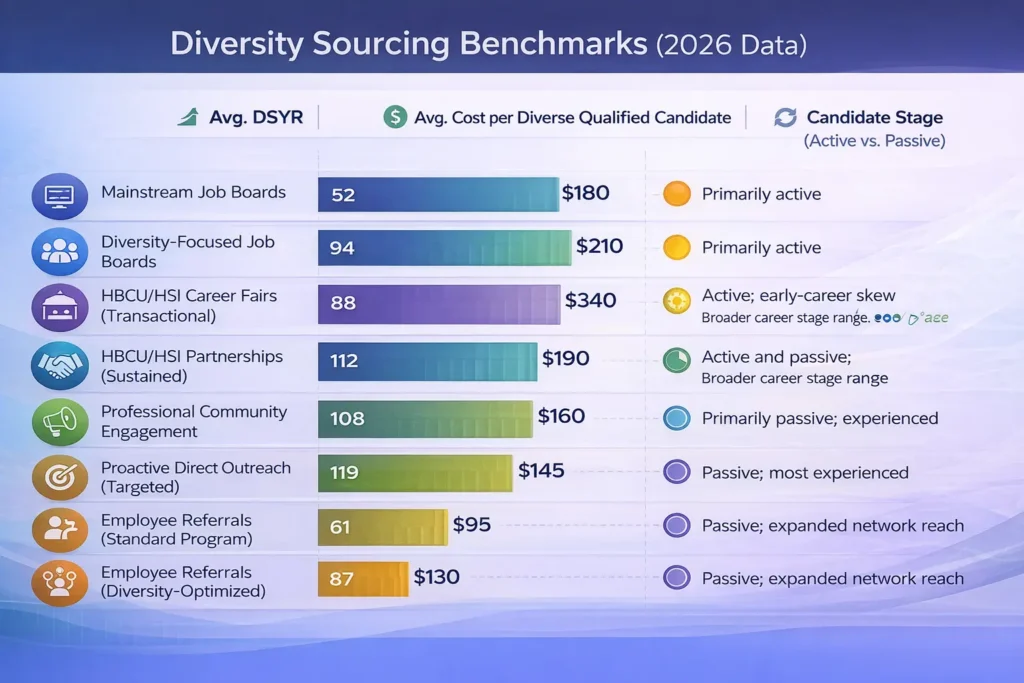
Diversity Sourcing Benchmarks (2026 Data)
| Sourcing Channel | Avg. DSYR | Avg. Cost per Diverse Qualified Candidate | Candidate Stage (Active vs. Passive) |
|---|---|---|---|
| Mainstream Job Boards | 52 | $180 | Primarily active |
| Diversity-Focused Job Boards | 94 | $210 | Primarily active |
| HBCU/HSI Career Fairs (Transactional) | 88 | $340 | Active; early-career skew |
| HBCU/HSI Partnerships (Sustained) | 112 | $190 | Active and passive; broader career stage range |
| Professional Community Engagement | 108 | $160 | Primarily passive; experienced |
| Proactive Direct Outreach (Targeted) | 119 | $145 | Passive; most experienced |
| Employee Referrals (Standard Program) | 61 | $95 | Passive primarily; network-concentrated |
| Employee Referrals (Diversity-Optimized) | 87 | $130 | Passive; expanded network reach |
The most striking pattern in this table is the relationship between cost per diverse qualified candidate and DSYR: proactive direct outreach to targeted passive candidates produces both the highest DSYR and the lowest cost per diverse qualified candidate among active-sourcing approaches. This counterintuitive result reflects the quality differential: passive candidates reached through targeted outreach are more likely to meet role qualifications than active candidates self-selecting into job board applications, reducing the volume of unqualified candidates per qualified diverse candidate sourced.
Key Strategies for High-Yield Diversity Sourcing
How AI Is Transforming Diversity Sourcing?
Expanded Candidate Identification
AI-powered talent intelligence platforms can identify qualified candidates from underrepresented backgrounds at a scale that manual research cannot match, using professional community memberships, published work, conference participation, and professional network data to surface candidates who are not highly visible in traditional sourcing searches. For diversity sourcing specifically, AI tools that can identify candidates with specific professional community affiliations that serve as proxies for underrepresented background provide scale that was not previously operationally feasible.
Personalization at Scale
AI writing assistance tools can generate personalized outreach messages for each identified candidate that reference specific aspects of their professional background and connect them to the specific opportunity, at the volume required for proactive diversity sourcing campaigns. This personalization at scale addresses the primary limitation of manual proactive outreach programs: the time cost of genuinely personalized messaging.
Job Description Optimization
NLP analysis of job description language against candidate response databases allows AI tools to identify specific language patterns that research shows deter applications from underrepresented candidates, and to suggest revisions that maintain the role’s specificity while removing the patterns most likely to reduce diverse application rates. This is one of the highest-ROI AI applications in diversity sourcing because it affects every candidate who encounters the job posting.
Bias Risk in AI Sourcing
AI sourcing tools that use demographic proxies (names, educational institutions, zip codes) to identify diverse candidates introduce legal risk and ethical concerns that require careful design review. The use of professional community affiliations and organizational memberships as diversity indicators is generally more defensible than demographic inference from personal characteristics, but all AI diversity sourcing approaches should be reviewed with employment counsel and subjected to regular auditing.
Stop Juggling
10 Job Boards.
Search One
Your next role is already here. avua pulls opportunities from across the web into a single searchable feed; filtered by role, location, salary, and remote preference.
1.5 Million+
Active Jobs
380+
Job Categories
Diversity Sourcing and the Legal Environment
Diversity sourcing is broadly permissible under current employment law in the United States and most comparable jurisdictions. Targeted outreach to underrepresented communities, partnerships with institutions serving underrepresented students, and sourcing programs designed to expand the diversity of the candidate pool are all consistent with equal employment opportunity law, which prohibits discrimination in hiring but does not prohibit proactive outreach to underrepresented groups.
The legal boundary is in the selection process: using race, gender, or other protected characteristics as a determinative criterion in individual hiring decisions is prohibited under Title VII. Diversity sourcing that produces a more diverse candidate pool from which hiring decisions are made on the basis of job-relevant criteria is both legally sound and operationally effective.
The use of demographic characteristics directly in AI sourcing tools is more legally complex and has drawn regulatory attention in multiple jurisdictions. Professional community affiliation as a diversity proxy is generally more defensible than demographic inference, but specific implementation approaches should be reviewed with employment counsel.
Common Challenges and Solutions
| Challenge | Solution |
|---|---|
| Diverse Candidates Not Applying After Sourcing Contact | Audit job description language for deterrents; review outreach personalization quality; examine whether role compensation is competitive for the targeted candidate segment |
| High Diverse Application Volume Not Converting to Diverse Hires | Conduct stage-by-stage DSYR analysis; identify assessment-stage gaps; implement structural equity interventions at screening and interview |
| HBCU/HSI Partnerships Not Producing Senior Candidates | Expand engagement to alumni networks beyond recent graduates; invest in sustained relationship building with faculty and career services over multiple years |
| Sourcing Team Not Engaged in Diversity Sourcing Practice | Provide training in community engagement and cultural intelligence; set DSYR goals alongside standard sourcing metrics; recognize and reward relationship-building activity |
| AI Sourcing Tools Not Reaching Diverse Candidates | Audit tool output for DSYR; switch to community-affiliation-based diversity indicators if demographic inference is the primary mechanism; add manual community engagement alongside automated outreach |
Real-World Case Studies
Case Study 1: The Technology Company
A technology company had been sourcing engineering candidates primarily through LinkedIn Recruiter and employee referrals. DSYR for underrepresented racial and ethnic groups was 48 on LinkedIn and 39 through referrals. Despite a stated commitment to diversity hiring, the engineering application pool was 14% Black and Hispanic combined, against a qualified market availability of approximately 27% for the specific role types.
A diversity sourcing redesign implemented three changes over six months: sustained partnerships with three HBCUs with strong computer science programs (including a sponsored capstone project and annual faculty engagement); active participation in NSBE and SHPE chapter events at the regional level, including speaking and workshop contributions rather than just recruiting attendance; and a proactive direct outreach campaign to Black and Hispanic software engineers identified through professional community databases.
Within three hiring cycles, DSYR for the engineering sourcing program improved from 46 (average across channels) to 84. Black and Hispanic representation in engineering applications reached 23%, approaching market parity. The HBCU partnerships produced a pipeline of early-career candidates; the professional community engagement and direct outreach produced experienced candidates at the mid-level that the career fair approach alone would not have reached.
Case Study 2: The Healthcare Network
A regional healthcare network needed to diversify its clinical leadership pipeline. Senior clinical leaders from underrepresented backgrounds were severely underrepresented in applications for director-level and above roles, with a DSYR of 31 at application for the targeted groups.
The network identified that experienced clinical leaders from underrepresented backgrounds were concentrated in specific professional associations and mentorship programs serving minority healthcare professionals. They built direct relationships with three of these organizations over 18 months: sponsoring annual conferences, providing speaking opportunities for their own diverse clinical leaders, and establishing a formal mentorship program connecting their existing diverse leaders with association members.
These relationships produced, in the second year, a warm referral pipeline of 14 qualified candidates for director-level clinical roles who had not previously applied to the network and who would not have been reached through standard sourcing. Four of these candidates were hired. DSYR at application for clinical leadership roles improved from 31 to 71 within two years of sustained community engagement.
Case Study 3: The Professional Services Firm
A consulting firm had been attending three diversity recruiting events annually and posting roles on two diversity-focused job boards with limited impact on DSYR (which remained at 58 despite three years of this investment). A channel analysis revealed that the events and job boards were reaching early-career candidates primarily, while the firm’s diversity gap was concentrated at the associate and manager levels.
They redesigned the program: reduced event attendance investment by 40% and reallocated to a proactive outreach program targeting experienced consultants from underrepresented backgrounds at competitor firms and client organizations. The outreach was personalized, referencing specific project experience and connecting it to the firm’s current practice needs. They also launched an alumni re-engagement program targeting former employees from underrepresented backgrounds who had left the firm, offering a structured return pathway.
Within two hiring cycles, DSYR for associate and manager-level sourcing improved from 58 to 93. The event and job board investment, reduced in absolute terms, was now producing early-career pipeline supplemented by the proactive mid-career outreach. Total spend on diversity sourcing was flat; the reallocation was what produced the DSYR improvement.
Building a Diversity Sourcing Dashboard: What to Track?
Diversity Sourcing Across the Hiring Lifecycle
Workforce Planning
Diversity sourcing strategy should be designed before roles are opened, not after. At the workforce planning stage, identifying which role families have the largest DSYR gaps informs where proactive community relationship investment should be concentrated in the months before those roles open.
Active Sourcing Campaigns
When roles are open, diversity sourcing campaigns activate the community relationships and candidate databases built proactively. Organizations that have invested in sustained community presence have a warm outreach context that cold-start organizations lack, producing faster diverse pipeline development when roles open.
Talent Community Maintenance
Between active hiring cycles, diversity sourcing investment shifts to talent community maintenance: nurturing relationships with identified diverse candidates through relevant content, community events, and periodic touchpoints that keep the organization visible and valued in professional communities it has invested in building relationships with.
Related Terms
| Term | Definition |
|---|---|
| Diverse Sourcing Yield Rate (DSYR) | The proportion of underrepresented group candidates in the sourced pipeline relative to their representation in the qualified external talent market |
| Diversity Hiring | The broader practice of which diversity sourcing is one component; includes equitable assessment design and funnel monitoring in addition to sourcing |
| HBCU (Historically Black College or University) | One of the 101 federally designated institutions founded with the primary mission of educating Black Americans; a key institutional partnership channel for diversity sourcing |
| HSI (Hispanic-Serving Institution) | An institution where at least 25% of total undergraduate enrollment is Hispanic; a key institutional partnership channel for diversity sourcing |
| Passive Candidate | A qualified individual who is not actively searching for a new role; the primary target population for proactive diversity outreach programs |
| Proactive Outreach | Direct, personalized contact with identified candidates who have not applied; the highest-yield diversity sourcing mechanism for experienced professional roles |
Frequently Asked Questions
What is the difference between diversity sourcing and diversity hiring?
Diversity sourcing is specifically the pipeline development component of diversity hiring: the practice of expanding candidate outreach to reach underrepresented groups. Diversity hiring encompasses the full process, including equitable assessment design, structured interviewing, offer equity, and funnel monitoring. Diversity sourcing is necessary for diversity hiring but not sufficient: the most effective diversity sourcing program cannot produce diverse hire outcomes if the assessment process filters the diverse pipeline back to baseline representation.
Is it legal to target outreach specifically to underrepresented candidates?
Targeted outreach to underrepresented communities, institutions, and professional organizations is broadly permissible under current employment law in most jurisdictions. The legal constraint is on selection decisions, not outreach. Conducting outreach through channels that serve underrepresented populations, attending events where underrepresented candidates are present, and engaging community organizations serving underrepresented professionals are all consistent with equal employment opportunity requirements. Using demographic characteristics as a determinative selection criterion in individual hiring decisions is not.
How do you source diverse candidates who are not on LinkedIn?
Many of the most experienced and sought-after candidates from underrepresented backgrounds are not highly visible on LinkedIn or not active on job boards. Reaching them requires community-based approaches: engagement with professional associations and affinity organizations, participation in field-specific online communities (GitHub, Slack workspaces, Discord servers), alumni network mapping from diverse-serving institutions, employee network activation through ERG members, and relationship cultivation with community leaders who can make introductions. These approaches require more sustained investment than database search but produce access to candidate segments that database sourcing cannot reach.
How long does it take for diversity sourcing investments to produce results?
Transactional diversity sourcing (single event attendance, one-time job board postings) produces results in the hiring cycle in which it occurs and rarely compounds over time. Relationship-based diversity sourcing (sustained community partnerships, multi-year institutional relationships, maintained talent communities) typically shows initial pipeline improvement within 6 to 12 months and compounding improvement over 2 to 3 years as organizational reputation in the community builds. The investment horizon for genuine diversity sourcing transformation is 18 to 36 months for experienced professional roles.
What role does employer brand play in diversity sourcing?
Employer brand is a prerequisite for diversity sourcing effectiveness, not a substitute for it. A sourcing program that reaches diverse candidates and brings them to a career site or brand experience that does not authentically represent diversity in the organization will produce low conversion from sourced candidate to application. Authentic employer brand, featuring diverse employees in real leadership and contribution roles with genuine testimonials about their experience, converts sourcing reach into applications. Generic “diversity and inclusion” branding that is not backed by authentic employee stories and observable workforce diversity has limited impact on conversion from diverse candidate pools.
Conclusion
Diversity sourcing is not about finding different candidates. It is about looking in different places for the same quality of candidates that already exist in the market but are not reaching the organization’s pipeline through its current habits and channels.
The qualified diverse talent is there. In every field, at every level, there are experienced professionals from underrepresented backgrounds who are good at their jobs, who are not actively searching, and who will not walk into an organization’s default recruiting funnel because the organization’s default recruiting funnel was not built to find them.
Diversity sourcing is the deliberate practice of building a recruiting operation that does find them: through intentional channel investment, sustained community presence, personalized direct outreach, and measurement at every stage of the funnel from sourced contact to hired employee.
It requires investment before the hiring cycle starts. It requires relationships that are not transactional. It requires measurement that is honest about whether the effort is producing the outcomes it intends.
When those elements are in place, diversity sourcing does not compete with quality sourcing. It is quality sourcing, applied to the full range of candidates available in the market rather than the subset that the default pipeline was built to reach.