Before discussing brand strategy or diversity goals, every organization must meet the federal baseline: Equal Employment Opportunity (EEO). It is not a optional values-based initiative; it is a legal requirement designed to eliminate Bias in Hiring. EEO ensures that every Applicant Pool is treated fairly, regardless of race, sex, disability, or age.
Title VII of the Civil Rights Act prohibits discrimination, and current enforcement is strictly focused on the Candidate Journey. Recent data shows the scale of this obligation: in a single year, the EEOC has handled over 81,000 new charges, with Retaliation (56.1%), Disability (44.5%), and Race (36.4%) being the most frequent claims.
As organizations shift toward AI Hiring, regulatory scrutiny has turned to Automated Screening algorithms to ensure they don’t produce a “disparate impact.” EEO doesn’t mandate specific demographic outcomes, but it guarantees that the process, from application to offer, is built on a foundation of verified legal fairness.
The primary compliance metric in EEO context is the Adverse Impact Ratio (AIR), calculated using the EEOC’s four-fifths rule:
AIR = Selection Rate for Protected Group ÷ Selection Rate for Highest-Selected Group
An AIR below 0.80 (80%) at any hiring stage indicates potential adverse impact, triggering analysis of whether the selection procedure producing that ratio is job-related and consistent with business necessity.
What is Equal Employment Opportunity?
Equal Employment Opportunity is a federal legal framework prohibiting employment discrimination on the basis of specified protected characteristics, administered primarily by the Equal Employment Opportunity Commission (EEOC), and enforceable through administrative charges, mediation, and federal litigation, that applies to all phases of employment including the recruiting and hiring process.
The framework is built on several federal statutes, each addressing specific protected categories:
Title VII of the Civil Rights Act of 1964 prohibits discrimination based on race, color, religion, sex, and national origin. It applies to employers with 15 or more employees.
The Age Discrimination in Employment Act (ADEA) of 1967 prohibits discrimination against individuals age 40 and over. It applies to employers with 20 or more employees.
The Americans with Disabilities Act (ADA) of 1990 prohibits discrimination against qualified individuals with disabilities and requires employers to provide reasonable accommodations. It applies to employers with 15 or more employees.
The Genetic Information Nondiscrimination Act (GINA) of 2008 prohibits discrimination based on genetic information in employment. It applies to employers with 15 or more employees.
The Pregnancy Discrimination Act (PDA) of 1978 prohibits discrimination based on pregnancy, childbirth, and related medical conditions as a form of sex discrimination under Title VII.
The Equal Pay Act of 1963 prohibits pay differentials based on sex for substantially equal work.
State and local laws frequently extend EEO protections beyond federal minimums: many states and municipalities have added protections for sexual orientation, gender identity, marital status, source of income, and other characteristics not covered by federal law. Employers must comply with all applicable laws in each jurisdiction where they operate.
Does EEO Compliance Mean Your Hiring Is Actually Fair?
This is one of the most important questions in talent acquisition compliance, and the answer is more nuanced than most compliance trainings suggest.
EEO compliance establishes a legal floor. It prohibits the most obvious and direct forms of discrimination: refusing to interview a candidate because of their race, making hiring decisions based on a candidate’s religion, or paying women less than men for the same work. The compliance framework exists to prevent these violations and to provide recourse when they occur.
What EEO compliance does not guarantee is that the hiring process is actually equitable in practice. An employer can be fully EEO compliant and still operate a hiring process that systematically disadvantages candidates from protected groups through mechanisms that are not deliberate discrimination but that produce discriminatory effects. This is the concept of disparate impact: selection procedures that appear neutral on their face but produce significantly different selection rates across demographic groups.
The landmark case establishing disparate impact theory under Title VII, Griggs v. Duke Power Co. (1971), held that an employer’s requirement for a high school diploma and a passing score on an intelligence test for certain positions violated Title VII because the requirements had no demonstrable relationship to job performance and disproportionately excluded Black applicants. The ruling established that intent to discriminate is not required for a Title VII violation: a facially neutral selection procedure that produces significant disparate impact violates the law unless the employer can demonstrate that it is job-related and consistent with business necessity.
This principle, now over fifty years old, has direct implications for modern hiring practices. An interview process that produces significantly lower advancement rates for candidates from protected groups, a screening algorithm that filters out candidates from underrepresented backgrounds at higher rates than majority-group candidates, or a credential requirement that is not supported by job performance evidence and that correlates with protected characteristics are all potential disparate impact violations, regardless of whether any individual in the hiring process intended to discriminate.
EEO compliance requires not just the absence of intentional discrimination but the absence of unjustified discriminatory effects from any selection procedure used in the hiring process.
The scenario that illustrates the gap between technical compliance and genuine equity: a mid-size employer uses an ATS screening algorithm trained on historical hiring data to filter resumes before human review. The employer’s recruiters have no discriminatory intent and are not aware that the algorithm is producing disparate results. A subsequent adverse impact analysis reveals that the algorithm is selecting white applicants at a rate 2.3 times higher than Black applicants for the same role, with no demonstrable correlation between the algorithm’s selection criteria and actual job performance. The employer’s intent was lawful. The outcome may not be.
This scenario is not hypothetical. It is the specific concern underlying the EEOC’s 2023 technical assistance guidance on AI and automated systems in hiring, which explicitly states that the use of AI tools does not insulate employers from Title VII liability when those tools produce discriminatory effects.
Your Resume Isn’t Getting Read
Let’s Get That Fixed!
75% of resumes get auto-rejected. avua’s AI Resume Builder optimizes formatting, keywords, and scoring in under 3 minutes, so you land in the “yes” pile.
The EEO Framework in the Hiring Process: Stage-by-Stage Implications
Job Posting and Requirements
EEO law applies to job postings and requirements before a single application is received. Job requirements that disproportionately exclude protected groups without business necessity justification are potentially unlawful under disparate impact theory. Requirements that have been specifically challenged and have shaped current employer practice include:
- Credential requirements: Blanket degree requirements for roles where degree attainment has no demonstrated relationship to job performance have been challenged as producing adverse impact based on race and socioeconomic background. The EEOC has noted that degree requirements for certain positions warrant scrutiny under disparate impact analysis.
- Criminal history inquiries: Many states and municipalities have enacted “ban-the-box” laws restricting when and how criminal history can be inquired into during the application process. The EEOC has issued guidance stating that blanket exclusion of individuals with criminal records may violate Title VII when it produces disparate impact based on race or national origin.
- Physical requirements: Physical requirements for jobs that are not directly related to the essential functions of the position may violate the ADA or produce disparate impact based on sex, age, or disability.
- Job Posting Language: While not directly regulated under EEO law, job posting language that signals preference for candidates of specific age groups (“digital native,” “recent graduate”), gender (“aggressive salesperson”), or other protected characteristics can create documentation of discriminatory intent and should be reviewed and removed.
Application and Screening
The application and screening stage presents the highest volume EEO compliance risk because it involves the most candidates and the highest concentration of selection tool use.
- Application Form Inquiries: Employers may not inquire about protected characteristics on application forms unless the inquiry is for a lawful purpose (such as OFCCP affirmative action data collection) or the characteristic is a genuine occupational qualification (a narrow exception). Age, disability status, race, religion, national origin, and genetic information should not appear as application form fields used in hiring decisions.
- Pre-Employment Tests and Assessments: Any test or assessment used to select candidates must be validated as job-related and must be monitored for adverse impact. The EEOC’s Uniform Guidelines on Employee Selection Procedures (UGESP), issued in 1978 and still operative, establish the technical standards for test validation and adverse impact analysis applicable to all selection procedures.
- AI and Automated Screening Tools: The EEOC’s 2023 technical assistance document on AI in hiring makes clear that algorithmic screening tools are subject to the same EEO requirements as any other selection procedure. Employers bear responsibility for adverse impact produced by AI tools they use, regardless of whether the tool was developed internally or purchased from a vendor.
Interview Process
The interview stage has specific EEO compliance requirements and common risk areas:
- Prohibited Interview Questions: Direct questions about protected characteristics are prohibited in most employment contexts. Interviewers may not ask about a candidate’s religion, national origin, age, disability status, pregnancy status, marital status, or similar protected characteristics. Questions that indirectly elicit the same information (“Are you planning to start a family?” “How old are you?”) are similarly prohibited.
- Reasonable Accommodations: Under the ADA, employers are required to provide reasonable accommodations to qualified applicants with disabilities for the hiring process itself, including accommodations for the interview, testing, and application process. Failing to provide requested accommodations that would not constitute undue hardship is an ADA violation.
- Consistent Treatment: EEO compliance requires that candidates in protected groups be treated consistently with similarly situated candidates who are not in those groups. An interviewer who probes aggressively on qualifications for candidates of one race while accepting equivalent qualifications from candidates of another race is engaging in disparate treatment, regardless of whether the overall selection decision is legitimate.
Reference Checks and Background Investigations
- Criminal Background Checks: As noted above, the EEOC has issued guidance on the use of criminal background checks in hiring, recommending individualized assessment rather than blanket exclusion policies, and noting that policies producing disparate impact based on race or national origin warrant scrutiny.
- Credit Checks: The use of credit checks in hiring is restricted in many states and jurisdictions, and the EEOC has indicated that blanket credit check policies that produce adverse impact based on race may violate Title VII in the absence of clear business necessity.
- Medical Examinations: Under the ADA, pre-employment medical examinations are prohibited before a conditional offer of employment is made. Post-offer medical examinations are permissible but must be conducted for all candidates in the same job category, and any withdrawal of a conditional offer based on medical examination results must be analyzed against ADA requirements.
Compensation and Offers
- Pay Equity: The Equal Pay Act prohibits pay differences based on sex for substantially equal work. Title VII and other EEO statutes extend pay equity protections to other protected characteristics. Offer-stage compensation decisions should be made based on job-related factors (experience, skills, performance data) rather than factors that correlate with protected characteristics (prior salary in jurisdictions where salary history inquiries are prohibited).
- Pay Transparency Laws: As of 2026, a significant and growing number of states and municipalities require employers to include salary ranges in job postings or to disclose them to applicants upon request. These requirements vary by jurisdiction and are subject to ongoing legislative development. EEO compliance in offer-making must be evaluated alongside applicable pay transparency requirements.
EEO vs. Related Legal and Compliance Frameworks
| Framework | Scope | Mechanism | Enforcer |
|---|---|---|---|
| EEO (Title VII, ADEA, ADA, GINA) | All covered employers; protected characteristics | Complaint, investigation, litigation | EEOC; private litigants |
| Affirmative Action (OFCCP) | Federal contractors and subcontractors | Compliance programs, utilization analysis, goals | OFCCP; contract debarment |
| State and Local EEO Laws | Jurisdiction-specific; often broader protected categories | State administrative agencies; civil litigation | State EEO agencies; courts |
| Pay Transparency Laws | Jurisdiction-specific | Disclosure requirements; penalties for non-compliance | State labor agencies |
| AI Hiring Tool Regulations | New York City, Illinois, others | Bias audit requirements; disclosure obligations | Municipal/state agencies |
| GDPR and Privacy Law (EU/UK) | Applicable to EU/UK operations | Candidate data rights; processing limitations | Data protection authorities |
What the Experts Say?
EEO compliance is not the ceiling of fair hiring. It is the floor. The employers who treat EEO as the maximum required are always one audit away from a problem, because the law is a minimum standard, not a best practice. The employers who treat EEO as the baseline and build genuine equity above it are producing better hiring outcomes and facing dramatically lower legal risk at the same time.
– Johnny C. Taylor Jr., President and CEO of SHRM and a leading voice on employment law and workforce equity
How to Build an EEO-Compliant Hiring Process
Step 1: Validate All Selection Procedures
Every selection procedure used in the hiring process, including application screening criteria, pre-employment tests, interview questions, and assessment tools, should be documented as job-related. Validation can be conducted through criterion validity studies (demonstrating statistical correlation between selection tool scores and job performance measures), content validity studies (demonstrating that the selection tool tests knowledge, skills, and abilities directly required by the job), or construct validity studies (demonstrating that the selection tool measures constructs that are job-relevant).
For most employers, the most accessible form of validation is content validity: documenting that each selection criterion corresponds to a specific, essential function of the job. This documentation should be maintained in a job analysis record that is updated when job requirements change.
Step 2: Implement Adverse Impact Monitoring
At a minimum, adverse impact analysis using the four-fifths rule should be conducted annually for each major selection procedure and each stage of the hiring funnel. The analysis should examine selection rates for each major demographic group (race, sex, national origin at minimum) compared to the highest-selected group. Results below the 0.80 threshold warrant investigation of whether the selection procedure is producing unjustified disparate impact.
For employers using AI screening tools, adverse impact monitoring should be conducted more frequently (quarterly) and should be contractually required from AI tool vendors in addition to internal analysis.
Step 3: Train Interviewers on Prohibited Questions and Consistent Conduct
Interviewer training should cover the specific questions prohibited under EEO law, the less obvious questions that indirectly elicit protected information, the reasonable accommodation process for applicants with disabilities, and the requirement for consistent treatment across candidate demographic groups. Training should be documented and refreshed annually.
Step 4: Establish a Reasonable Accommodation Process for the Hiring Process
A documented process for receiving, evaluating, and responding to reasonable accommodation requests from applicants with disabilities should be in place before recruiting begins. The process should include a designated contact for accommodation requests, a documented evaluation procedure, and a response timeline. Accommodation requests should be handled consistently and without penalizing the requesting candidate’s standing in the process.
Step 5: Audit AI and Technology Tools for EEO Compliance
Any AI-powered tool used in the hiring process, including ATS screening algorithms, chatbots, asynchronous video interview scoring tools, and candidate matching systems, should be evaluated for potential adverse impact before deployment and monitored on an ongoing basis. This includes reviewing vendor documentation of bias testing, conducting independent adverse impact analysis of tool outputs, and establishing contractual requirements for vendor cooperation with ongoing monitoring.
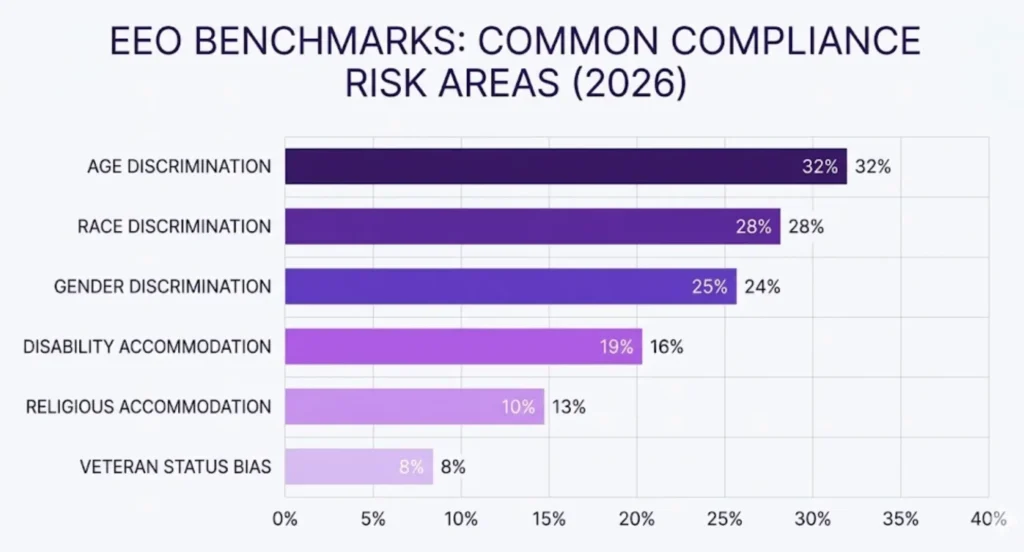
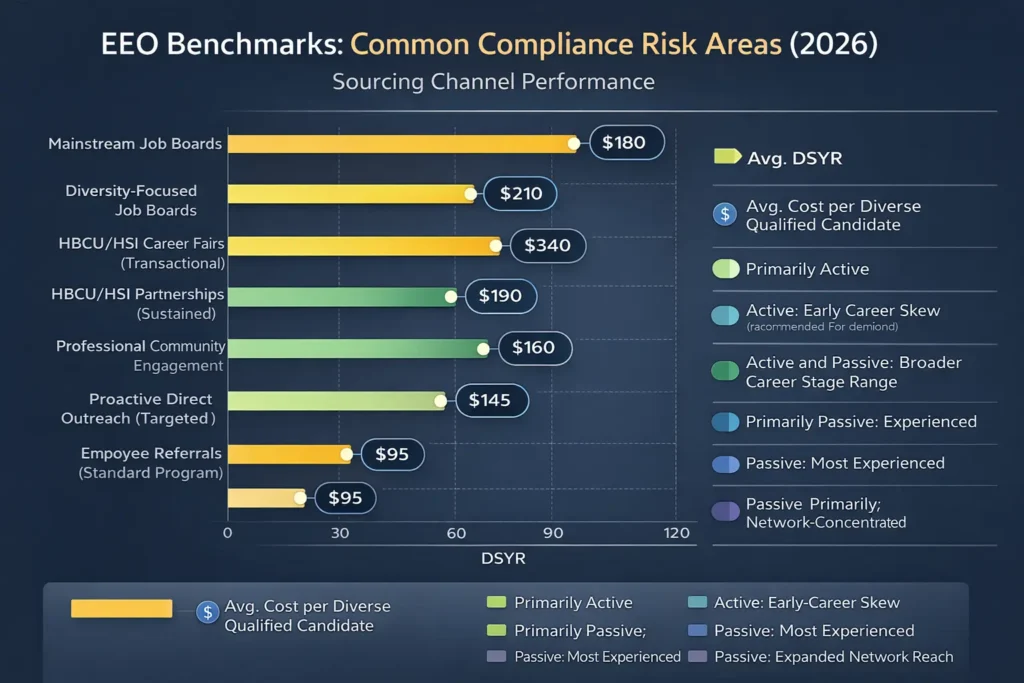
EEO Benchmarks: Common Compliance Risk Areas (2026)
| Risk Area | Frequency of EEOC Charges | Primary Statute | Common Employer Trigger |
|---|---|---|---|
| Race Discrimination | Highest (approximately 33% of all charges) | Title VII | Disparate treatment in screening and hiring; biased assessment tools |
| Sex Discrimination | Second highest (approximately 28%) | Title VII; PDA | Pay inequity at offer; pregnancy-based decisions; interview questions |
| Disability Discrimination | Third (approximately 22%) | ADA | Failure to accommodate; pre-offer medical inquiries |
| Age Discrimination | Fourth (approximately 21%) | ADEA | Age-coded job postings; credential preferences correlated with age |
| National Origin | Fifth (approximately 10%) | Title VII | Language requirements; citizenship status inquiries |
| Religion | Sixth (approximately 4%) | Title VII | Failure to accommodate religious observance |
Note: Percentages exceed 100% due to charges filed under multiple statutes.
Key Strategies for EEO Compliance in Talent Acquisition
How AI Is Creating New EEO Compliance Challenges?
The most significant EEO compliance development in 2026 is the intersection of AI-powered hiring tools with existing and emerging anti-discrimination law. Several dimensions of this intersection are worth specific attention:
The Employer Liability Principle
The EEOC’s 2023 technical assistance document makes explicit that employers bear liability for adverse impact produced by AI tools they use, regardless of vendor claims. This principle requires employers to treat AI tool EEO compliance as an active ongoing obligation, not a vendor certification.
Explainability Requirements
AI tools that make or influence hiring decisions must be explainable to the degree required to mount a business necessity defense if adverse impact is identified. “Black box” AI systems that cannot explain why a candidate was screened out or ranked a certain way are difficult to defend against disparate impact claims because the employer cannot articulate the job-related rationale for the system’s output.
Emerging Regulatory Requirements
New York City Local Law 144 (effective 2023) requires employers using AI tools in hiring to conduct and publish annual bias audits. Illinois enacted similar requirements for asynchronous video interview AI tools. These regulations are a preview of a broader regulatory trend, and employers should expect expanded AI hiring tool regulation in additional jurisdictions over the coming years.
Intersectional Analysis
Traditional adverse impact analysis examines each protected characteristic separately. Emerging research and regulatory attention is increasingly focused on intersectional adverse impact: the compounding effects that AI tools may have on candidates who are members of multiple protected groups simultaneously, which may not be visible in single-characteristic analysis.
Stop Juggling
10 Job Boards.
Search One
Your next role is already here. avua pulls opportunities from across the web into a single searchable feed; filtered by role, location, salary, and remote preference.
1.5 Million+
Active Jobs
380+
Job Categories
Common EEO Compliance Challenges and Solutions
| Challenge | Solution |
|---|---|
| Hiring Managers Asking Prohibited Interview Questions | Provide prohibited question training with specific examples; use structured interview guides with approved questions; conduct post-interview debriefs that identify prohibited question exposure |
| AI Screening Tool Producing Adverse Impact | Commission independent bias audit; require vendor to provide demographic analysis; adjust or replace tool; implement human review as determinative layer |
| Criminal Background Check Policy Producing Disparate Impact | Transition to individualized assessment approach; document business necessity analysis for each exclusion; comply with applicable ban-the-box requirements |
| Disability Accommodation Requests Handled Inconsistently | Establish documented accommodation process with designated contact and response timeline; train HR coordinators on ADA interactive process requirements |
| Pay Inequity at Offer Stage | Conduct pay equity analysis before recruiting season; establish offer parameters based on role and experience; prohibit use of prior salary history where applicable |
Real-World Case Studies
Case Study 1: The Retail Chain
A national retail chain was using an automated resume screening tool to manage high-volume hourly hiring. The tool had been implemented by the IT department based on vendor efficiency claims, with minimal HR or legal review. An internal audit conducted as part of an EEOC investigation revealed that the tool was selecting white applicants at a rate 2.6 times higher than Black applicants (AIR of 0.38) for the same positions. No business necessity analysis had been conducted, and the tool’s selection criteria could not be explained by the vendor in terms that connected to job performance.
The chain settled the EEOC matter, replaced the automated screening tool, conducted a retrospective analysis of the affected hiring periods, and implemented a structured job analysis and validation program for all selection procedures. The settlement included a commitment to annual adverse impact monitoring for all selection tools and a designated EEO compliance officer for the talent acquisition function.
The lesson was not that AI screening tools are impermissible. It is that AI screening tools require the same job-relatedness documentation and adverse impact monitoring as any other selection procedure, and that vendor efficiency claims do not substitute for employer compliance obligations.
Case Study 2: The Professional Services Firm
A professional services firm was using a structured behavioral interview process for associate-level hiring that had been designed internally over several years. An adverse impact analysis conducted as part of a DEI program evaluation revealed that one specific interview question was producing significantly different scores by gender (AIR of 0.71 for female candidates). The question asked candidates to describe a time they had “taken charge” of a situation and driven a result through others.
Review of the scoring rubric revealed that interviewers were applying the rubric in ways that reflected gender-stereotyped expectations about what “taking charge” looked like: male candidates who described assertive, directive leadership behaviors received higher scores; female candidates who described collaborative, facilitative leadership behaviors received lower scores, even when the outcomes described were equivalent or superior. The question itself was not unlawful. The rubric application pattern was producing a disparate impact that was not supported by performance evidence.
The firm revised the question to specify that all approaches to leadership were valid assessment targets, revised the rubric to include collaborative and facilitative leadership behaviors explicitly at the higher performance levels, and conducted a calibration session with all interviewers using the revised rubric. Within two hiring cycles, the gender-based AIR for the relevant question improved from 0.71 to 0.94.
Case Study 3: The Technology Startup
A technology startup with 85 employees had been operating without a formal EEO compliance program, treating EEO as a large-employer concern. An employment law review prompted by a funding round revealed three compliance gaps: the company had no written EEO policy (required for most covered employers); its offer letter template asked candidates to list their current salary (prohibited by salary history ban in their state); and its hiring manager team was conducting unstructured interviews with no training on prohibited questions, with documented instances of interviewers asking about candidates’ marital status and family plans.
The company implemented a comprehensive EEO compliance program: a written EEO policy published to the company handbook and communicated to all employees; offer letter revision removing the salary history inquiry; interviewer training with structured question guides developed for each role family; and an annual adverse impact monitoring process. None of these changes required significant resource investment. All of them addressed genuine legal exposure that had been creating liability without organizational awareness.
Building an EEO Compliance Dashboard: What to Track?
EEO Across the Hiring Lifecycle
Pre-Recruiting: Policy and Process Design
EEO compliance begins in the design phase: ensuring that hiring policies, job requirements, and selection procedures are documented as job-related, that prohibited inquiry guidance is incorporated into all application and interview materials, and that accommodation processes are in place before recruiting begins.
Active Recruiting and Screening
EEO compliance during active recruiting requires consistent application of selection criteria across all candidates, prohibited question avoidance in all candidate interactions, and adverse impact monitoring of automated screening tools in real time where feasible.
Assessment and Offer
Assessment tool validation, consistent offer compensation, and pre-offer medical examination prohibition are the primary EEO requirements at the assessment and offer stage. Jurisdiction-specific pay transparency and salary history requirements apply at offer.
Post-Hire Documentation
EEO compliance requires retention of employment records, including application materials, interview notes, and selection decision documentation, for specified periods (EEOC regulations require retention of personnel records for one year; OFCCP requires two years for federal contractors). These records are the evidence base for responding to EEO charges and defending against litigation.
Related Terms
| Term | Definition |
|---|---|
| Adverse Impact | A substantially different rate of selection that disadvantages members of a protected group; the central concept in disparate impact theory under Title VII |
| EEOC (Equal Employment Opportunity Commission) | The federal agency responsible for enforcing federal EEO laws, including receiving and investigating charges of employment discrimination |
| Four-Fifths Rule | The EEOC guideline that a selection rate for any protected group below 80% of the highest-selected group’s rate indicates potential adverse impact |
| Disparate Treatment | Intentional discrimination against an individual or group based on a protected characteristic; one of the two primary theories of employment discrimination (alongside disparate impact) |
| Disparate Impact | Discrimination that results from a facially neutral policy or practice that produces significantly different outcomes for protected groups without business necessity justification |
| Uniform Guidelines on Employee Selection Procedures (UGESP) | Federal guidelines issued in 1978 by multiple agencies establishing standards for validation of selection procedures and adverse impact analysis |
| Business Necessity | The legal defense to a disparate impact claim; requires demonstrating that the challenged selection procedure is job-related and essential to the safe and efficient operation of the business |
Frequently Asked Questions
What is the difference between disparate treatment and disparate impact?
Disparate treatment is intentional discrimination: an employer treats a candidate differently because of their membership in a protected group. It requires showing that the employer’s decision was motivated, at least in part, by a protected characteristic. Disparate impact is unintentional discrimination: an employer uses a facially neutral selection procedure that produces significantly different outcomes for protected groups, without adequate business justification. Disparate impact claims do not require proof of discriminatory intent, only proof of the discriminatory statistical effect and the absence of business necessity.
Does EEO law require employers to hire diverse candidates?
No. EEO law prohibits discrimination against individuals based on protected characteristics. It does not require any specific hiring outcome, workforce composition, or representation ratio. Affirmative action obligations, which do include representation goals and outreach requirements, apply only to federal contractors and subcontractors subject to Executive Order 11246 and OFCCP regulations. Voluntary diversity hiring programs pursued by private employers are permissible under EEO law but are not required by it.
What should employers do when a candidate discloses a disability during the interview process?
Under the ADA, employers must engage in an interactive process with the candidate to identify whether a reasonable accommodation would enable them to perform the essential functions of the job. The disclosure should not be used as a basis for adverse action in the selection process. Employers should treat the information confidentially, document the interactive process, and make the hiring decision based on the candidate’s ability to perform the essential functions with or without reasonable accommodation.
How long must employers retain EEO-related hiring records?
The EEOC’s record retention regulations require employers to retain all personnel records, including application materials, interview records, and selection decision documentation, for a minimum of one year from the date the record was made or the personnel action taken, whichever is later. For federal contractors subject to OFCCP, the retention requirement is two years. If a charge of discrimination is filed, records relevant to the charge must be retained until the matter is fully resolved. State requirements may be longer; the applicable retention period is the longest applicable under all relevant laws.
Are EEO requirements the same in every state?
No. Federal EEO law establishes minimum protections applicable to covered employers nationwide. State and local laws frequently provide broader protections, covering additional characteristics (such as sexual orientation, gender identity, marital status, and source of income) not covered by federal law, applying to smaller employers, or providing additional remedies. Employers must comply with the requirements of every jurisdiction in which they operate. For remote-work roles, the applicable jurisdiction may include the candidate’s or employee’s location. Multi-state employers should maintain jurisdiction-specific compliance guidance for recruiting and hiring practices.
Conclusion
EEO law is the non-negotiable baseline of fair employment. It predates diversity hiring as a strategic concept, predates data-driven recruiting as a methodology, and predates the AI tools that are now reshaping the hiring process. It will still be governing employment decisions when the next generation of hiring technology arrives.
Understanding EEO is not optional for talent acquisition professionals. It is foundational. But it is also, properly understood, a floor rather than a ceiling: the minimum standard of non-discrimination that every employer must meet, below which the law does not permit descent, and above which genuinely equitable and effective hiring practice is built.
The organizations that treat EEO as the floor and build genuine equity practices above it are not just reducing their legal risk. They are building hiring processes that find better candidates, make better decisions, and produce workforces whose diversity reflects the full range of talent available in the market. The legal obligation and the operational excellence objective point in the same direction.
That alignment is not a coincidence. It reflects the fundamental purpose of EEO law: to ensure that employment decisions reflect what candidates can do, not who they are.