Most companies think branding is just a shiny career site and a slick Branded Job Posting. But in 2026, candidates see through the corporate polish. They don’t want the “legal-approved” version of your culture; they want the raw truth from the people actually doing the work.
This is the shift from corporate messaging to authentic employee branding. While marketing might design a Candidate Persona based on ideal traits, your current employees are the ones who validate that reality to the outside world. Their voices are the most powerful tool for Candidate Engagement, outperforming scripted testimonials on every metric of trust and specificity.
Authentic employee content has become a core part of the Candidate Journey. When your team speaks for itself, it creates a high-trust Candidate Experience that attracts talent more effectively than any stock photo ever could. Organizations that empower their people as brand contributors, rather than just subjects, hold the ultimate advantage in a market that prioritizes authenticity over production value.
The primary metric governing employee branding effectiveness is the Employee Brand Influence Rate (EBIR): the proportion of qualified applicants who cite employee-generated content or employee referrals as a significant factor in their decision to apply.
EBIR (%) = (Applicants Citing Employee Brand Content or Referrals ÷ Total Qualified Applicants Surveyed) × 100
An EBIR above 35% indicates that employee voices are genuinely influencing candidate pipeline development. Most organizations without active employee branding programs operate at EBIR scores between 12 and 22%.
What is Employee Branding?
Employee branding is a talent marketing strategy that uses authentic employee experiences and perspectives as the primary content for communicating the organization’s value as a place to work, typically through employee-generated content on professional and social platforms, employee testimonials in recruiting materials, employee participation in candidate engagement, and the amplification of genuine workplace culture signals that resonate with target candidate populations.
The strategy operates on a well-established trust principle: candidates trust what employees say about an organization more than what the organization says about itself. Research consistently shows that prospective employees weight peer-generated content significantly higher than corporate-produced content when evaluating employer attractiveness. An employee LinkedIn post about a project they are proud of, a team culture moment shared on social media, or a detailed Glassdoor review from a current employee carries more credibility with the average candidate than a carefully produced career site video featuring the same content as branded institutional output.
Employee branding is not about creating a communications program and calling it authentic. It is about creating the organizational conditions in which employees have genuine positive experiences they want to share, and then making it easy and safe for them to share those experiences with external audiences.
Is Your Employer Brand What Your Employees Would Actually Say About You?
This is the question that most employer branding audits avoid asking directly, and it is the most important one.
Most organizations have an employer value proposition that was crafted in a workshop, written by a communications team, approved by legal, and published to the careers page. It describes the organization’s culture as collaborative, innovative, and purpose-driven, with exceptional growth opportunities and a commitment to employee well-being. It is indistinguishable from the EVP of most of their competitors.
The candidates who matter most, the experienced professionals with options who are evaluating five potential employers simultaneously, do not make their decisions based on EVP statements. They make their decisions based on what they can find out about what it is actually like to work at each organization: the Glassdoor reviews, the LinkedIn posts from current employees, the conversations in industry communities, the experience of friends or colleagues who work there.
If the gap between the EVP statement and what employees are actually saying is large, the EVP statement is not just unhelpful. It is actively damaging, because candidates who encounter it and then discover the discrepancy through peer sources learn that the organization’s external communications are not trustworthy. And a candidate who does not trust the employer brand is a candidate who does not trust the offer.
Research on candidate decision-making consistently finds that 86% of candidates research an employer’s reputation before applying, and 65% cite employee reviews as the most trusted source of information about what it is like to work somewhere. The organizations whose employees are saying positive, specific, authentic things about their experience in publicly visible places are building brand capital that no marketing budget can replicate. The organizations whose employees are saying nothing, or saying things that contradict the corporate EVP, are facing a candidate trust gap that no amount of career site production quality can close.
The scenario that illustrates the gap: two technology companies are competing for the same software engineering talent pool. Company A has a sophisticated employer brand program: a dedicated career site with professional photography, a YouTube channel with employee spotlight videos, and a regular cadence of LinkedIn posts about company culture. Company B has no formal employer brand program: their career site is functional but not designed, their LinkedIn presence is minimal, and they have invested nothing in content production.
But Company B’s engineers are active on GitHub and in developer community forums, regularly sharing their work, discussing technical problems they are solving, and occasionally mentioning their employer in the context of interesting projects. Their Glassdoor reviews are specific, recent, and positive: candidates reading them learn specific things about the work environment, the technical challenges, and the team culture that the reviews’ specificity makes credible.
Company A’s employer brand content is professionally produced. Company B’s is not. But Company B is winning the trust competition because its employee voices are specific and authentic in ways that produced content cannot be. In a talent market where experienced engineers spend significant time researching before applying, that trust competition determines who applies.
Your Resume Isn’t Getting Read
Let’s Get That Fixed!
75% of resumes get auto-rejected. avua’s AI Resume Builder optimizes formatting, keywords, and scoring in under 3 minutes, so you land in the “yes” pile.
The Employee Branding Ecosystem: Where Employee Voices Live
Effective employee branding requires understanding where employee-generated content about workplace experience actually lives and how candidates engage with it.
Professional Networks (LinkedIn)
LinkedIn is the most significant platform for employee branding in professional contexts. Employee posts about their work, their projects, their professional development, and their organization reach both passive and active candidate audiences. LinkedIn’s algorithm privileges personal content over company page content, meaning an employee post about a challenging project they completed reaches a larger and more engaged audience than the equivalent company post would.
Employees who are active LinkedIn creators in their professional field produce brand value that extends far beyond their immediate networks: their content is shared, commented on, and saved by community members who are not directly connected, including candidates who may be evaluating the organization.
Employer Review Platforms (Glassdoor, Blind, Indeed Reviews)
Glassdoor, Blind, and Indeed’s review features are the research destination for candidates actively evaluating specific employers. The content on these platforms is entirely employee-generated and is treated as highly credible by candidate audiences precisely because it is not controlled by the organization. Organizations cannot prevent employees from posting reviews, but they can influence the content of those reviews by ensuring that the employee experience they are designed around is worth reviewing positively.
Organizations that monitor these platforms, respond to reviews (including critical ones) professionally and specifically, and take visible action on recurring themes in feedback demonstrate the organizational responsiveness that builds candidate trust and employee engagement simultaneously.
Technical and Professional Communities
For technical roles, GitHub contribution visibility, Stack Overflow participation, conference presentation by engineers and data scientists, and participation in field-specific online communities create a form of employee branding that is simultaneously authentic, technically credible, and visible to exactly the candidate audience most relevant to the organization’s hiring needs. An engineering organization whose engineers are publicly recognized contributors to open-source projects is communicating something about its engineering culture that no career site can replicate.
Social Media (Organization-Agnostic)
Employee social media posts that mention their employer, share workplace moments, or discuss their professional work in contexts that are not explicitly employer-branded have high authenticity signals because they are not produced in response to an employer communication campaign. An employee who shares a photo from a team offsite, discusses a problem they solved at work, or mentions their employer in the context of a professional achievement they are proud of is producing employer brand content that organizational programs cannot generate.
Building an Employee Branding Program: What It Actually Requires?
Employee branding programs that produce results are built on three foundations that organizational communication programs are not designed to provide.
Foundation 1: A Workplace Worth Describing
Employee branding does not fix a poor employee experience. It amplifies whatever experience employees are actually having. Organizations that attempt to build employee branding programs without first investing in the substance of the employee experience, the work quality, the management quality, the growth opportunities, the cultural environment, will produce employee content that is either fabricated (and recognizable as such) or that reveals the gap between brand aspiration and workplace reality.
The most effective employee branding programs are built in organizations where employees genuinely have things to say that they want to share: interesting work, strong teams, visible growth, recognition, and a culture that they find worth being associated with publicly. These organizations do not create employee branding. They create the conditions for it.
Foundation 2: Permission and Encouragement to Share
Many employees who have positive workplace experiences do not share them publicly because they are uncertain whether doing so is encouraged or appropriate. Organizations that want employee branding outcomes must make it explicitly clear that employees are encouraged to share their professional work and workplace experience, that social media engagement is supported rather than restricted, and that employee content creation is recognized as a contribution to the organization’s talent brand.
This requires a social media policy that is enabling rather than restrictive, explicit encouragement from management, and active recognition of employees who create content that builds the organization’s professional visibility. It also requires honesty: employees who are encouraged to share their genuine experience, including the honest positives and manageable challenges, produce more credible content than those who feel they are being asked to create promotional material.
Foundation 3: Structure and Amplification Without Scripting
Employee branding programs that provide employees with specific talking points, approved content templates, or scripted testimonials produce the type of content candidates can identify as orchestrated and discount accordingly. The organizational role in employee branding is not to script the content but to provide structure (making it easy to participate), amplification (sharing and promoting employee content through organizational channels), and recognition (acknowledging and rewarding employees who contribute to the talent brand).
Structure might mean providing employees with professional photography, coaching on LinkedIn content creation, or a format for sharing project work that makes it easy to produce without requiring significant time investment. Amplification means sharing employee content on company channels, featuring employee voices in recruiting materials, and making it easy for employees to share job postings with their networks. Recognition means treating employee brand contribution as a visible, valued activity rather than an informal extra.
Employee Branding vs. Related Concepts
| Concept | Origin | Control | Candidate Trust Level | Primary Channel |
|---|---|---|---|---|
| Employee Branding | Employee-generated | Employee; organization amplifies | High | LinkedIn; Glassdoor; professional communities |
| Employer Branding | Organization-generated | Organization | Moderate | Career site; LinkedIn company page; job postings |
| EVP (Employer Value Proposition) | Organization-crafted | Organization | Low to moderate | All official communications |
| Recruitment Marketing | Organization-generated | Organization; marketing team | Moderate | Job postings; paid advertising; career content |
| Employee Advocacy | Organization-facilitated employee sharing | Shared: organization provides content; employee shares | Moderate to high | Social media; professional networks |
| Glassdoor / Review Management | Employee-generated; org can respond | Uncontrolled content; controlled response | High | Review platforms |
The most important distinction in this table is between employee branding (employee-generated, high trust) and employer branding (organization-generated, moderate trust). Both are necessary components of a complete talent brand strategy. But in a candidate research environment where experienced professionals specifically seek out employee voices to validate organizational claims, the employee-generated content carries disproportionate weight in final application and offer acceptance decisions.
What the Experts Say?
The employer brand is what you say about yourself. The employee brand is what your people say about you. And I will tell you which one candidates believe every time. It is not even close. The organizations that understand this and invest in creating genuine employee experiences worth talking about are winning the talent competition in ways that no marketing budget can replicate.
– James Ellis, Author of “Employer Branding for Dummies”
Key Metrics for Employee Branding Effectiveness
Employee Brand Influence Rate (EBIR)
The proportion of qualified applicants who cite employee-generated content or employee referrals as a factor in their decision to apply. Tracked through application source surveys and post-process candidate interviews. An EBIR above 35% indicates meaningful employee brand influence; below 15% suggests the employee voice is not reaching the candidate audience.
Employee Content Reach and Engagement
Total reach and engagement (likes, comments, shares, saves) of employee-generated content that mentions the organization, tracked across LinkedIn, professional forums, and other platforms. Compared to equivalent metrics for organization-generated content to assess the relative reach of each source.
Glassdoor and Review Platform Score Trend
The trend in average rating on Glassdoor, Indeed Reviews, and comparable platforms over rolling 12-month periods. More relevant than the absolute score at any point in time; a consistent upward trend indicates improving employee experience and brand; a declining trend is an early warning signal of employee experience problems that will affect candidate pipeline quality.
Employer Brand Net Promoter Score (eNPS)
The proportion of current employees who would recommend the organization as a place to work (Promoters, 9 to 10 out of 10) minus the proportion who would not recommend it (Detractors, 0 to 6 out of 10). eNPS is the leading indicator of employee branding quality: high eNPS organizations have employees who are disposed to share positive content and refer candidates; low eNPS organizations are generating brand content that undermines the official EVP.
eNPS = % Promoters − % Detractors
Industry benchmarks for eNPS vary, but scores above 20 are generally considered positive; scores above 40 indicate a strong employee branding foundation.
Offer Acceptance Rate Trend
While influenced by compensation and process quality, offer acceptance rate trend is a downstream indicator of employer brand health. Sustained declining offer acceptance rates, unexplained by compensation positioning changes, often reflect deteriorating employer brand that candidates are discovering during their research process.
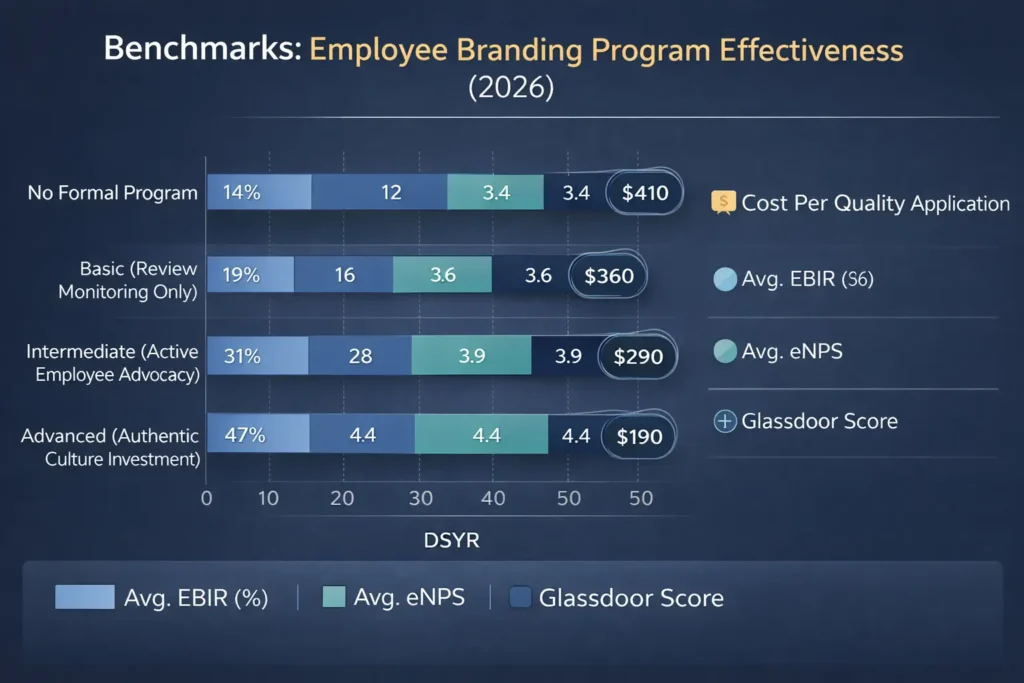
Benchmarks: Employee Branding Program Effectiveness (2026)
| Program Maturity Level | Avg. EBIR | Avg. eNPS | Glassdoor Score | Cost Per Quality Application |
|---|---|---|---|---|
| No Formal Program | 14% | 12 | 3.4 | $410 |
| Basic (Review Monitoring Only) | 19% | 16 | 3.6 | $360 |
| Intermediate (Active Employee Advocacy) | 31% | 28 | 3.9 | $290 |
| Advanced (Authentic Culture Investment) | 47% | 44 | 4.4 | $190 |
The most striking figure in this table is the cost per quality application differential between no formal program and an advanced employee branding program: $410 versus $190. This 54% cost reduction reflects the higher conversion rate of candidates who apply based on employee-brand-driven intent: they have done more research, have stronger pre-application intent, and require less convincing at each subsequent funnel stage. The advanced employee branding investment pays back in sourcing efficiency as much as in application volume.
Key Strategies for Building an Effective Employee Branding Program
How AI Is Changing Employee Branding
Content Discovery and Amplification
AI tools that monitor professional networks for employee-generated content mentioning the organization can surface content for amplification faster and more comprehensively than manual monitoring. Content that is performing well organically (high engagement, viral potential) can be identified quickly and amplified through organizational channels before its peak reach window closes.
Sentiment Analysis of Review Platform Data
AI-powered sentiment analysis of Glassdoor, Indeed, and similar review content can identify specific themes in employee feedback at scale, including the themes that are most influential in candidate decision-making. This analysis helps organizations identify which aspects of the employee experience are most positively differentiating in the candidate market and which are creating the most significant brand risk.
Personalized Career Content
AI-assisted content tools can help employees create personalized, role-specific career content that reflects their specific experience and expertise without requiring significant writing effort. This lowers the participation barrier for employees who have valuable perspectives but do not naturally gravitate toward content creation.
Predictive Brand Health Monitoring
Machine learning models trained on leading indicators of employer brand health (eNPS trends, review volume and sentiment, employee social media engagement patterns, application volume and quality trends) can provide early warning signals of brand deterioration before it becomes visible in lagging indicators like offer acceptance rate decline.
Stop Juggling
10 Job Boards.
Search One
Your next role is already here. avua pulls opportunities from across the web into a single searchable feed; filtered by role, location, salary, and remote preference.
1.5 Million+
Active Jobs
380+
Job Categories
Employee Branding and Diversity, Equity, and Inclusion
Employee branding has a specific and important relationship with DEI outcomes in talent acquisition.
Authentic Representation Matters More Than Diversity Imagery
Career site imagery featuring diverse employees is a ubiquitous employer brand element that candidates have learned to evaluate skeptically: it is the visual component of employer brand most easily manipulated and most often inconsistent with actual workforce composition. What builds candidate trust from underrepresented groups is not diverse imagery but authentic employee voices from those communities: genuine testimonials, real LinkedIn content from employees who identify as members of underrepresented groups, and specific descriptions of what their experience has been.
Organizations where underrepresented employees are willing to publicly advocate for the workplace as a good place for people like them are communicating something that stock photography cannot. Organizations where underrepresented employees are not visible as public advocates are communicating something too.
eNPS by Demographic Group
Measuring eNPS separately by demographic group is one of the most valuable diagnostics available for identifying inclusion gaps that may not be visible in aggregate satisfaction data. If overall eNPS is 38 but eNPS for women is 12 and eNPS for Black employees is 8, the aggregate figure is obscuring a significant problem. The employee branding program built on the overall eNPS will not resonate with the specific candidate populations the organization most needs to reach.
Employee Content Diversity as a Trust Signal
The demographic diversity of the employees who are creating and amplifying brand content is itself a brand signal to candidates from underrepresented backgrounds. A LinkedIn feed where all the employee content comes from a demographically homogeneous subset of the workforce tells candidates from underrepresented groups something about who the organization considers its spokespersons. Building an employee branding program that actively includes and supports content from employees across demographic backgrounds is both an equity initiative and a candidate trust investment.
Common Challenges and Solutions
| Challenge | Solution |
|---|---|
| Employees Reluctant to Post About Work | Review social media policy for restricting language; explicitly encourage sharing; provide content creation support (photography, coaching); recognize contributors |
| Glassdoor Reviews Negative or Declining | Address the underlying experience issues generating negative feedback; respond to critical reviews specifically; do not attempt to suppress or game the review system |
| Employee Brand Content Inconsistent with EVP | Investigate the gap between EVP aspiration and employee experience reality; prioritize experience improvement over brand messaging revision |
| Low eNPS Making Employee Advocacy Inauthentic | Fix the experience problem before building the advocacy program; an employee branding program built on a poor employee experience produces content that candidates correctly identify as inauthentic |
| Difficulty Attributing Hires to Employee Branding | Add source attribution questions to application surveys; track applicant self-reported research behavior; compare conversion rates for employee-brand-influenced applicants vs. other sources |
Real-World Case Studies
Case Study 1: The Engineering Firm
A mid-size engineering firm was struggling to attract software engineers in a competitive talent market. Their employer brand consisted of a functional career site and a LinkedIn company page with irregular posting. Glassdoor reviews were sparse and averaged 3.2 stars. eNPS from their annual engagement survey was 18.
A talent brand audit identified a significant asset they were not using: twelve of their senior engineers were highly active on GitHub and in developer communities, with substantial followings and visible contributions to open-source projects. None of these engineers had ever been identified as brand contributors or supported in connecting their technical community presence to the firm’s recruiting efforts.
The firm built a program around this asset: supported engineers in linking their GitHub activity to their professional profiles with firm attribution, provided speaking opportunity sponsorship for engineers who wanted to present at technical conferences, and created a firm-sponsored open-source contribution program that generated visible community content connected to the firm’s brand.
Within 18 months, qualified engineering application volume increased 43%. EBIR improved from 11% to 34%. The most impactful change was not anything the firm produced: it was the engineering community’s recognition of the firm’s technical talent as a signal of what working there was like.
Case Study 2: The Healthcare Network
A regional healthcare network had invested significantly in employer brand content: a professionally produced career site, an employer brand video series, and a robust social media presence. Despite this investment, offer acceptance rates for nursing roles had been declining for two years. Exit surveys from declined offers consistently cited “culture and work environment” as the primary concern.
Investigation revealed that the employer brand content was presenting a workplace experience that recent Glassdoor reviews, and word-of-mouth in the nursing community, described as significantly more positive than reality. The employer brand had become a trust problem: candidates who encountered the official content and then discovered the review platform reality were more deterred than they would have been by honest content.
The network made a counterintuitive decision: it reduced investment in produced employer brand content and redirected that budget toward specific work environment improvements (staffing ratios, scheduling flexibility, management training) and a Glassdoor engagement program that responded specifically to critical reviews and tracked whether described changes had been implemented.
Within 18 months, Glassdoor average rating improved from 2.9 to 3.7. New review volume increased 40% as more nurses shared experiences, and the content of new reviews was more specific and more positive. Offer acceptance rates for nursing roles improved from 61% to 74%. The brand improvement came not from better content but from a better experience producing more credible content.
Case Study 3: The Technology Startup
A 120-person technology startup had no formal employer brand program and no dedicated talent marketing budget. What they did have was a founding team with strong professional networks and a product team that was active on Twitter and LinkedIn sharing technical work they were proud of.
A talent acquisition review identified that 41% of the prior year’s hires had cited “learned about the company through an employee’s post or from someone who works there” as their initial point of awareness. The employee brand was producing nearly half the pipeline without any organizational investment or management.
Rather than building a formal program, the company identified the elements that were already working: the technical content sharing, the founding team’s visibility, the product team’s pride in their work. They made three lightweight investments: professional photography available to any employee who wanted it for LinkedIn content, a quarterly internal update on company news designed to be easily shared externally, and a formal recognition program that acknowledged employees who had made external contributions to the company’s visibility.
EBIR improved from 41% to 58% within two hiring cycles. Cost per quality application declined by 38%. The startup was not building an employee branding program. It was systematizing something its employees were already doing.
Building an Employee Branding Dashboard: What to Track?
Employee Branding Across the Hiring Lifecycle
Awareness and Attraction
Employee branding is most powerful at the awareness stage: before a candidate has any direct contact with the organization’s recruiting process. The employee LinkedIn post that surfaces in a candidate’s feed, the conference presentation by an engineer who mentions their employer, or the Glassdoor review read during a Sunday evening job search are the touchpoints that determine whether a candidate thinks of the organization as a place worth applying to. Organizations with strong employee brand presence at this stage have a pipeline advantage that marketing-driven awareness campaigns cannot replicate because they did not pay for it and candidates know it.
Application Decision
At the application decision stage, candidates who are considering whether to invest time in an application process typically conduct a research cycle: Glassdoor, LinkedIn, professional community discussions. The quality and authenticity of employee-generated content at this stage is the primary determinant of whether the application converts from consideration to submission.
Offer Acceptance
Employee brand influence extends through the offer stage: candidates who have received an offer from an organization they have researched thoroughly through employee voices have reduced uncertainty about what the job will actually be like, which reduces the offer decline rate driven by unknown risk. Organizations with strong, authentic employee brand content have an offer acceptance rate advantage over those where candidates reach the offer stage with significant unresolved uncertainty about the actual experience.
Retention
Employee branding and employee retention are bidirectionally connected. Employees who feel genuinely positive about their experience are more likely to create positive brand content, which attracts more candidates who are aligned with the actual culture, which produces better retention among the resulting hires. Employees who leave within 12 months having had experiences that contradict the brand content they encountered during recruiting are likely to produce review content that undermines the brand for future candidates.
Related Terms
| Term | Definition |
|---|---|
| Employer Branding | The organizational practice of managing and communicating the organization’s identity and value as a place to work; employee branding is the employee-generated component of employer branding |
| EVP (Employer Value Proposition) | The set of attributes and benefits that define why an employee would choose and continue to work for a specific organization |
| eNPS (Employee Net Promoter Score) | A measure of the proportion of employees who would recommend the organization as a place to work, minus those who would not; the primary leading indicator of employee branding health |
| Glassdoor | A platform where current and former employees post anonymous reviews of their workplace experience; one of the primary employee brand research channels for candidates |
| Employee Advocacy | A structured program in which organizations encourage and enable employees to share company content and positive workplace messages with their personal and professional networks |
| Talent Brand | The aggregate perception of an organization as a place to work, formed through both organizational and employee-generated content and communications |
Frequently Asked Questions
What is the difference between employer branding and employee branding?
Employer branding is what the organization says about itself as a place to work: the EVP, the career site content, the recruitment marketing. Employee branding is what employees say about it: their LinkedIn posts, their Glassdoor reviews, their recommendations to friends and colleagues. Both shape candidate perception, but employee-generated content carries higher credibility with candidate audiences because it is not controlled by the organization. The most effective talent brand strategies combine both, but in terms of candidate trust, employee-generated content is the more influential input.
Can an employer control or direct employee branding?
Employers cannot control what employees say publicly about their workplace experience, nor should they attempt to do so. What they can control is the experience employees are having, which is what shapes what they say. They can also create enabling conditions for positive content sharing: supportive social media policies, content creation resources, and recognition for employees who contribute to the organization’s professional visibility. Attempts to script or control employee brand content produce the type of content candidates recognize as inauthentic, which is counterproductive.
How should employers respond to negative Glassdoor reviews?
Specifically, professionally, and without defensiveness. A response that acknowledges the specific concern raised, describes a specific action taken or commitment to investigate, and thanks the reviewer for their candor communicates organizational responsiveness and takes the review seriously. Responses that dispute the reviewer’s experience, attribute the review to a disgruntled exception, or provide only generic assurances do more damage than no response. Candidates reading reviews also read responses, and the response quality is its own brand signal.
How do you measure the ROI of employee branding investment?
The most direct ROI measures for employee branding are: cost per quality application (which declines as employee brand influence on inbound applicants increases), offer acceptance rate (which improves as candidate uncertainty about the actual experience decreases), and first-year retention (which improves as the quality of pre-application research produces better candidate-culture alignment). The measurement approach is longitudinal: employee branding investment produces returns over 12 to 36 months, not immediately, which requires a long enough measurement horizon to distinguish program impact from noise.
Should employee branding be part of the recruiting team’s responsibilities?
Employee branding sits at the intersection of talent acquisition, HR, and organizational communications. The most effective programs involve all three functions: HR manages the employee experience that generates the content; communications manages the amplification and platform infrastructure; and TA manages the connection between employee brand activity and candidate pipeline outcomes. In smaller organizations where these functions overlap, the recruiter or TA leader who understands the connection between employee experience, employee voice, and candidate attraction is best positioned to drive the program.
Conclusion
Employee branding is not a marketing problem. It is a culture problem that manifests as a marketing opportunity.
The organizations with the strongest employee brands are not those with the largest content budgets or the most sophisticated career site technology. They are the organizations where employees are having experiences they want to talk about publicly: challenging work, strong teams, visible growth, and a culture that they are genuinely proud to be associated with. Those organizations did not build an employee brand. They built a workplace, and the brand followed.
For every other organization, the sequence is the same even if the starting point is different: the investment that produces employee branding outcomes is not in content creation. It is in the employee experience that generates the content, the organizational culture that makes employees willing to share it, and the systems that make sharing easy and recognized.
When that foundation is in place, the content creates itself. Candidates find it. Trust is built before a recruiter makes the first call. And the organization’s talent brand reflects something real rather than something produced.
That is the only kind of employee brand that works.