Employee experience isn’t a single event; it’s the cumulative perception of life inside an organization. It begins long before the first day, starting with the very first touchpoint in the Candidate Journey. If that journey is riddled with friction or broken promises, you’ve poisoned the well before the water even flows.
A seamless Candidate Experience sets the stage for long-term commitment. While many focus on Candidate Engagement as a simple output metric, savvy leaders recognize that “engagement” is just the signal, “experience” is the actual work. It is the difference between an employee who is merely satisfied with their perks and one who is genuinely invested in the mission.
When you get this right, you don’t just lower your Attrition Rate; you build a culture so compelling that it naturally attracts the Boomerang Employee, top talent who may leave for new horizons but eventually find their way back home. Designing an intentional end-to-end experience is the only way to build a sustainable talent brand.
The primary metric framework for employee experience is the Employee Experience Score (EXS), a composite across five lifecycle dimensions:
EXS = (Hiring + Onboarding + Development + Day-to-Day + Exit Experience) divided by 5
Where each dimension is assessed through lifecycle-stage surveys on a 0 to 100 scale. Best-in-class organizations achieve EXS above 75 across all dimensions. Most organizations score significantly higher on hiring experience (where investment is highest) than on day-to-day experience (where investment is lowest relative to its impact on engagement and retention).
What is Employee Experience?
Employee experience is a strategic HR and organizational design concept that defines the cumulative quality of all interactions, environments, and perceptions an employee encounters from recruitment through exit, and that provides the framework for designing those interactions intentionally to produce engagement, productivity, and retention outcomes aligned with organizational goals.
The concept draws explicitly from customer experience design: just as organizations map customer journeys to identify touchpoints, moments of friction, and opportunities to create distinctive value, employee experience frameworks map the employee journey to identify the same. The application is disciplined rather than metaphorical: identifying specific moments that matter most to employees at each lifecycle stage, measuring the quality of those moments, and designing interventions that improve them.
Three environments shape the employee experience simultaneously. The physical environment: the workspace design, tools, technology, and infrastructure that either support or impede the ability to do good work. The cultural environment: the norms, behaviors, values, and management practices that define what it feels like to be part of the organization. And the technological environment: the systems, platforms, and digital tools that mediate most daily work activity and whose friction or fluency significantly shapes the daily experience of employment.
Are You Designing Employee Experience or Just Describing It?
Most organizations that talk about employee experience are describing it rather than designing it. They have engaged employees produce testimonials. They have conducted surveys. They have reviewed Glassdoor ratings. They have a sense of what the experience is like.
What they have not done is the design work: mapping the actual journey employees travel from offer acceptance to exit interview, identifying the specific moments at each stage where perception is formed and where current delivery most significantly falls short of what employees need, and then systematically improving those moments with the same rigor applied to product or customer experience design.
The distinction between describing and designing is operational, not semantic. Describing produces knowledge. Designing produces change. And the organizations that consistently outperform on retention, engagement, and employer brand are those that have made employee experience design an ongoing operational discipline rather than a periodic measurement exercise.
Research from Gartner finds that employees who have a positive employee experience are 60% more likely to stay with the organization, 69% more likely to be high performers, and 52% more likely to go above and beyond in their roles. These are not marginal differences. They are the compounding outcomes of systematically better moments across the employee lifecycle.
The scenario that makes the design gap concrete: two healthcare organizations are hiring clinical staff in the same market. Both offer comparable compensation. Both run structured interview processes. At the point of offer, candidates would have difficulty choosing between them.
Six months later, the retention picture is completely different. Organization A has 74% of its new clinical hire cohort still employed. Organization B has 58%. The difference is not in compensation, role design, or management quality at the team level. It is in the onboarding experience: Organization A has a structured 90-day onboarding program with weekly manager check-ins, a peer buddy system, and a clear 30-60-90 day expectation framework. Organization B provides a two-day orientation and expects new hires to figure out the rest.
The experience gap at one lifecycle stage, onboarding, is producing a 16-percentage-point retention difference. Neither organization has changed its compensation or its talent pool. One has designed the experience that turns a hire into a retained employee. The other has not.
Your Resume Isn’t Getting Read
Let’s Get That Fixed!
75% of resumes get auto-rejected. avua’s AI Resume Builder optimizes formatting, keywords, and scoring in under 3 minutes, so you land in the “yes” pile.
The Employee Experience Lifecycle: Key Stages and Moments That Matter
Stage 1: Pre-Hire and Recruiting Experience
The employee experience begins before employment. The quality of the application process, the speed and clarity of recruiter communication, the professionalism of the interview experience, and the specificity and honesty of the offer all shape the initial perception of what working at the organization will be like. A recruiting experience that is slow, inconsistent, or opaque communicates something about organizational culture before the employee’s first day.
Moments that matter: Application acknowledgment speed; interviewer preparedness; post-interview communication timing; offer clarity and process; pre-boarding communication between offer and start date.
Stage 2: Onboarding
The onboarding stage is the highest-leverage employee experience investment available because it sets the trajectory for engagement, performance, and retention in the first year. Research consistently shows that structured onboarding programs improve new hire retention by 82% and productivity by over 70% compared to unstructured approaches.
Moments that matter: Day one logistics and welcome quality; clarity of role expectations at 30, 60, and 90 days; speed of productive contribution; manager availability and check-in quality; team integration; cultural immersion.
Stage 3: Day-to-Day Work Experience
The day-to-day experience is where most of the employee’s working life is spent and where most of the engagement determinants operate. Manager behavior, collaboration quality, tool and technology friction, recognition practice, and workload sustainability all accumulate into the daily experience that either sustains or erodes engagement over time.
Moments that matter: One-on-one quality and frequency; feedback specificity and timeliness; technology and tool reliability; meeting culture and time management; peer relationship quality; workload distribution and sustainability.
Stage 4: Development and Growth
The development experience, how visible career paths are, how accessible development resources are, and how much managers invest in growth conversations, is among the top two drivers of voluntary attrition when absent. Employees who see a credible development trajectory stay. Those who do not start looking.
Moments that matter: Development conversation quality; career path transparency; access to stretch assignments; training and learning investment; promotion process fairness and transparency; manager advocacy for career advancement.
Stage 5: Recognition and Milestones
How the organization acknowledges employee contributions and tenure milestones shapes the emotional dimension of experience. Recognition that is timely, specific, and sincere produces engagement-relevant outcomes. Generic or absent recognition produces the opposite.
Moments that matter: Performance review quality and fairness; anniversary and milestone acknowledgment; public recognition of significant contributions; compensation review transparency.
Stage 6: Offboarding and Exit
The exit experience shapes employer brand (the Glassdoor review written after an employee leaves), future alumni relationships (many organizations rehire from their alumni networks), and the insight available for experience improvement. Exits handled with dignity, genuine feedback collection, and respectful process produce better outcomes on all three dimensions than those handled perfunctorily.
Moments that matter: Exit conversation quality; transition support; final day experience; alumni network connection; off-boarding communication to remaining team.
Common Misconceptions About Employee Experience
| Misconception | Reality |
|---|---|
| Employee experience is the same as employee engagement | Engagement is an output. Experience is the design of the conditions that produce or undermine engagement. You cannot improve engagement without improving experience, but you can measure engagement while leaving experience entirely undesigned. |
| Employee experience is primarily about perks and benefits | Perks affect satisfaction. The strongest experience drivers are relational and developmental: manager quality, growth opportunity, recognition, and the clarity and meaning of the work itself. Ping-pong tables do not offset poor management. |
| Employee experience programs are HR programs | The most impactful employee experience interventions are changes to manager behavior, job design, and organizational processes, none of which HR can deliver alone. Experience design requires ownership across HR, operations, IT, and business leadership. |
| Remote employees have a worse experience by default | Remote experience quality is determined by intentional design of connection, clarity, and support, not by physical proximity. Well-designed remote experiences consistently outperform poorly designed in-office ones on engagement and satisfaction metrics. |
| Employee experience only matters for retention | Experience quality drives engagement, performance, productivity, customer satisfaction, and employer brand quality in addition to retention. The business case extends well beyond turnover reduction. |
| Annual surveys measure employee experience | Annual surveys capture a point-in-time snapshot of satisfaction. Experience measurement requires lifecycle-stage surveys at the moments that matter: post-onboarding, post-performance review, post-promotion decision. The timing of the measurement is as important as the measurement instrument. |
Employee Experience vs. Related Concepts
| Concept | Scope | Primary Focus | Measurement Approach | Organizational Owner |
|---|---|---|---|---|
| Employee Experience | Entire lifecycle; all touchpoints | Journey design and moment quality | Lifecycle-stage surveys; journey mapping | HR, Operations, IT, Leadership |
| Employee Engagement | Psychological investment in work | Motivation and connection | Pulse and annual surveys | HR; direct managers |
| Employee Satisfaction | Contentment with conditions | Transactional adequacy | Point-in-time surveys | HR; total rewards |
| Employee Wellbeing | Physical, mental, financial health | Health and sustainability | Health assessments; EAP utilization | HR; benefits; occupational health |
| Candidate Experience | Pre-hire touchpoints only | Application and interview quality | Post-process candidate surveys | Talent Acquisition |
| Customer Experience | Customer journey | Perception and loyalty at every touchpoint | NPS; CSAT; journey analytics | Customer success; product; marketing |
What the Experts Say?
The organizations that are winning on employee experience have stopped thinking about it as an HR initiative and started thinking about it the way the best product companies think about their users. They map the journey. They find the friction. They design for the moments that matter most. And they measure outcomes, not activities.
– Jacob Morgan, Author of “The Employee Experience Advantage”
How to Design a High-Quality Employee Experience Program?
Step 1: Map the Employee Journey
Before measuring anything, document the actual journey employees travel from offer acceptance to exit. Identify every significant touchpoint: every moment where an interaction with the organization shapes perception, for better or worse. The map should be created with employee input, not only from the HR team’s perspective, because the moments employees identify as significant frequently differ from those the organization has historically invested in.
Step 2: Identify Moments That Matter
Not all touchpoints are equal. Moments that matter are touchpoints where employee perception is most significantly shaped: the first day, the first performance conversation, the first development discussion, the first time the employee witnesses how the organization handles a difficult situation. These moments disproportionately influence the overall experience trajectory and should receive disproportionate design investment.
Research by Qualtrics and Gallup identifies consistent “moments that matter” across most professional workforces: Day 1 experience, 90-day check-in quality, first performance review, first promotion decision observed, and the exit conversation. These are the moments where experience investment produces the highest engagement and retention returns.
Step 3: Measure at the Moment, Not Annually
Experience surveys should be triggered by lifecycle events, not calendar cycles. A survey sent three days after an employee’s first month captures onboarding experience data while it is fresh and actionable. The same survey sent 11 months later captures distant memory, not current perception. Building a lifecycle-triggered survey cadence requires more operational infrastructure than annual surveys, but it produces dramatically more actionable data.
Step 4: Act on the Data and Close the Loop
Experience data that is collected and not acted on within a visible timeframe produces survey fatigue and organizational cynicism. Every lifecycle-stage survey result should be reviewed within two weeks of collection, acted on within the capabilities of the relevant organizational owner (manager, HR, IT, facilities), and communicated back to the employees surveyed in a form that demonstrates the data was received and considered.
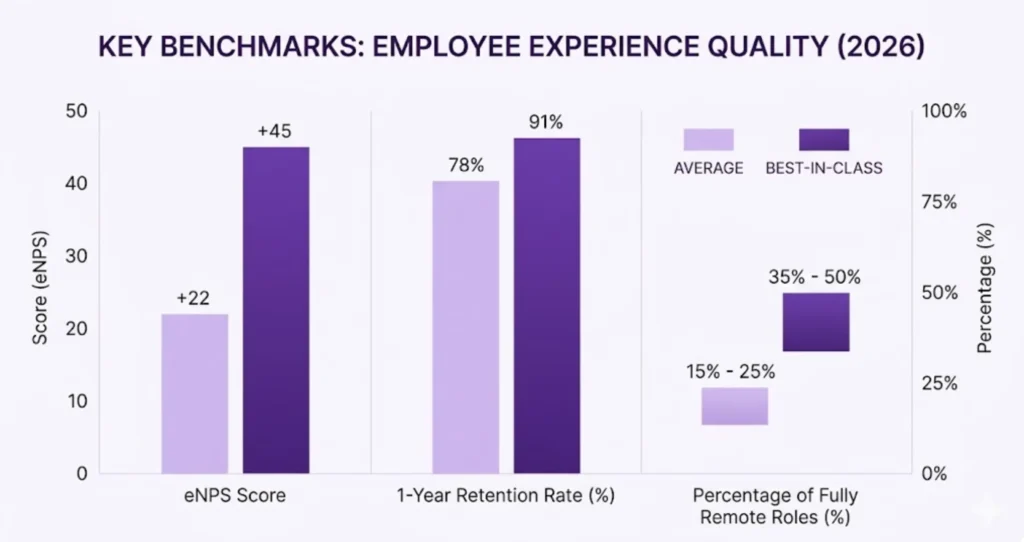
Key Benchmarks: Employee Experience Quality (2026)
| Lifecycle Stage | Best-in-Class EXS | Industry Average EXS | Most Common Gap Driver |
|---|---|---|---|
| Pre-Hire and Recruiting | 82 | 67 | Communication speed; offer process clarity |
| Onboarding (30 days) | 79 | 58 | Role clarity; manager availability |
| Day-to-Day (6 months) | 74 | 54 | Feedback quality; tool and technology friction |
| Development (12 months) | 71 | 49 | Growth path visibility; development conversation quality |
| Recognition and Milestones | 76 | 55 | Recognition frequency and specificity |
| Offboarding | 68 | 44 | Exit conversation quality; transition support |
The most significant pattern in this table is the consistent gap between recruiting experience scores (the highest across both best-in-class and average organizations) and development experience scores (the lowest). This pattern reflects the investment asymmetry common in most organizations: significant investment in pre-hire experience, significantly less investment in the development experience that determines long-term retention.
Key Strategies for Improving Employee Experience
How AI Is Transforming Employee Experience Design?
Here are a few parameters that one can consider:
Employee Experience and DEI
Employee experience quality is not uniform across demographic groups in most organizations, and treating aggregate EXS scores as representative of the full employee population obscures significant inequities.
Research consistently shows that employees from underrepresented racial and ethnic groups, women in male-dominated industries, employees with disabilities, and LGBTQ+ employees in organizations without explicit inclusion commitments report lower experience quality scores on the inclusion-relevant dimensions: sense of belonging, fairness of recognition and advancement decisions, and psychological safety in expressing their full perspective.
Disaggregating experience data by demographic group is the only way to identify these gaps. Organizations that do not disaggregate their experience data are making experience design decisions based on the majority experience, which systematically underinvests in the improvements most needed by the employees most likely to leave without them.
Common Challenges and Solutions
| Challenge | Solution |
|---|---|
| Experience Investment Concentrated at Onboarding | Audit lifecycle stage investment allocation; build development and day-to-day stage experience programs to match onboarding investment |
| Manager Behavior Not Aligned with Experience Goals | Build manager experience delivery into competency frameworks and performance assessment; provide specific behavioral coaching on experience-relevant practices |
| Survey Fatigue from Too Many Experience Surveys | Reduce survey length to 3 to 7 questions; ensure lifecycle-triggered timing so surveys are relevant to the employee’s current stage; demonstrate visible action from survey results |
| Technology Friction Not Recognized as Experience Driver | Include IT and digital workplace assessment in experience audits; track help desk ticket volume and resolution time as experience metrics alongside satisfaction data |
| Experience Improvements Not Sustained Over Time | Build experience accountability into manager performance assessment; establish quarterly experience review cycles; connect EXS trends to business outcome reporting |
Stop Juggling
10 Job Boards.
Search One
Your next role is already here. avua pulls opportunities from across the web into a single searchable feed; filtered by role, location, salary, and remote preference.
1.5 Million+
Active Jobs
380+
Job Categories
Real-World Case Studies
Case Study 1: The Professional Services Firm
A 3,800-person professional services firm had strong recruiting experience scores (EXS 79) and reasonable onboarding scores (EXS 63) but was experiencing 27% voluntary attrition at the 18-to-36-month tenure mark. Exit survey data consistently pointed to “lack of growth opportunity” and “inconsistent manager experience” as the primary drivers.
A lifecycle experience audit identified that the firm had no structured development conversation program: the only formal development touchpoint was the annual performance review, and 34% of employees reported never having had a meaningful development conversation with their manager outside of that context.
The firm implemented a structured development conversation program: quarterly 30-minute sessions specifically focused on growth planning, a manager preparation guide, and a tracking system that identified managers who were not conducting the sessions consistently. The firm also redesigned its performance review process to separate development conversations from performance evaluation, so development did not get crowded out by performance discussion in the one formal conversation managers had with direct reports.
Within 18 months, development experience EXS improved from 44 to 63. Voluntary attrition at the 18-to-36-month mark declined from 27% to 18%. The development experience improvement produced the retention outcome; no other significant program change had been made.
Case Study 2: The Technology Company
A technology company had invested significantly in its onboarding experience: a structured two-week onboarding program, a peer buddy system, and manager check-ins at 30, 60, and 90 days. Onboarding EXS was 81, among the highest in its industry peer group.
But six-month satisfaction scores were 52, and the day-to-day experience EXS was 48. Investigation revealed a specific bottleneck: the company’s internal tooling and collaboration systems were fragmented, with different teams using incompatible project management tools, and new employees spent an estimated 4.2 hours per week navigating tool friction in their first six months.
An internal tooling consolidation project, driven by an IT and operations initiative (not an HR program), reduced the tool fragmentation by 60% over eight months. Day-to-day experience EXS improved from 48 to 66. Six-month satisfaction scores improved from 52 to 67. The improvement did not come from a people program. It came from a technology infrastructure decision that was reframed as an employee experience investment.
Case Study 3: The Healthcare Network
A regional healthcare network was experiencing significant variation in employee experience quality across its 16 facilities, with facility-level EXS ranging from 42 to 78. The variation was not explained by differences in patient population, physical facilities, or compensation.
A manager effectiveness analysis identified that the variation was almost entirely driven by differences in manager behavior on three specific experience dimensions: one-on-one frequency, recognition practice, and the quality of development conversations. Facilities with managers who scored in the top quintile on these behaviors had EXS scores averaging 73. Facilities with managers in the bottom quintile averaged 48.
The network designed a manager experience delivery program targeting these three behaviors specifically, with observation-based coaching rather than classroom training. Managers in the bottom quintile received monthly coaching sessions for six months. Facility-level EXS variance reduced from 36 points to 19 points within 12 months. The lowest-scoring facility improved from EXS 42 to 61.
Quick-Reference Cheat Sheet
EXS = (Hiring + Onboarding + Development + Day-to-Day + Exit Experience) divided by 5
EXS Benchmark Ranges (0-100 scale):
- Above 75: Best-in-class
- 60 to 75: Competitive
- 45 to 60: Below average; intervention needed
- Below 45: At-risk; significant retention implications
The 6 Lifecycle Stages of Employee Experience:
- Pre-hire and recruiting
- Onboarding (first 90 days)
- Day-to-day work
- Development and growth
- Recognition and milestones
- Offboarding and exit
The 3 Experience Environments:
- Physical (workspace, tools, infrastructure)
- Cultural (norms, management, values in action)
- Technological (systems, platforms, digital workplace)
Dos:
Don’ts:
Related Terms
| Term | Definition |
|---|---|
| Employee Engagement | The psychological state of investment in work and organization that employee experience design is intended to produce |
| Employee Journey Mapping | The process of documenting and analyzing the full sequence of employee touchpoints across the employment lifecycle to identify design opportunities |
| Onboarding | The structured process of integrating new employees; the highest-leverage single employee experience investment for first-year retention |
| Employee Net Promoter Score (eNPS) | A measure of employee advocacy intent; a summary metric for overall experience quality |
| Candidate Experience | The experience quality of the pre-hire touchpoints; the first stage of the full employee experience lifecycle |
Frequently Asked Questions on Employee Experience
How is employee experience different from HR operations?
HR operations executes processes like payroll, benefits, and compliance. Employee experience is about how those processes feel to employees, whether they are clear, efficient, and respectful. The same system can feel frustrating or seamless depending on its design. Employee experience asks whether HR operations build or erode perception of the organization as a place worth working.
Who owns employee experience in an organization?
No single function owns it because it spans every touchpoint. HR owns people processes, IT owns technology, Facilities owns physical space, and leadership owns culture. The most effective programs have a dedicated owner (such as a Head of Employee Experience) who coordinates across functions and holds the full journey accountable.
What is the ROI of employee experience investment?
Gartner finds employees with high-quality experience are 60% more likely to stay and 69% more likely to be high performers. IBM estimates top-quartile organizations generate 3x the revenue per employee versus the bottom quartile. The most direct ROI calculation is reduced voluntary attrition multiplied by replacement cost per departure, which typically returns 3 to 8 times the investment.
How do you measure employee experience across the full lifecycle?
Use lifecycle-triggered pulse surveys of 5 to 10 questions at key moments: post-offer acceptance, end of first month, 90 days, six months, 12 months, and post-exit. This captures experience quality when it is fresh and actionable at the stages where it matters most, without relying on a single annual survey that cannot be acted on in a timely way.
Is employee experience design only relevant for large organizations?
No. Smaller organizations have natural advantages like closer manager relationships, higher leadership visibility, and faster feedback loops. The challenge is that experience quality depends more on individual manager behavior with fewer structural programs as backup. Small organizations that invest in manager development and key experience moments, especially onboarding, consistently outperform larger ones on the dimensions most predictive of retention.
Conclusion
Employee experience isn’t what you put in the brochure; it’s what happens at 9 AM on a Tuesday. This perception starts the moment someone enters your Candidate Journey. If the daily reality doesn’t match the initial pitch, your Attrition Rate will be the first thing to tell you.
Closing this gap is a design challenge, not just a survey problem. It requires mapping the lifecycle, identifying the friction, and making “the way we do things” actually work for the people doing them. When you design for the human experience, the business outcomes, from productivity to profit, tend to follow naturally.
Design the experience. The outcomes follow.