Most organizations spend a fortune getting talent in the door but far too little on what happens after they walk through it. This obsession with the “hire” over the “stay” is a strategic blind spot. The Employee Lifecycle is the framework that fixes this, mapping the entire arc from the first touchpoint in the Candidate Journey to the final exit interview.
When recruitment is treated as an isolated event, the resulting friction often leads to a spiked Attrition Rate. A truly seamless Candidate Experience must flow naturally into onboarding and development to keep your Candidate Pipeline healthy and high-performing.
Managing this lifecycle as an integrated system ensures your organization isn’t just a revolving door, but a place that fosters enough loyalty to eventually turn a departing high-performer into a Boomerang Employee. Designing this end-to-end coherence is the baseline for a resilient, sustainable workforce.
The primary metric framework for employee lifecycle performance is the Lifecycle Value Index (LVI), which measures the average productive tenure contributed by employees across the full arc:
LVI = Sum of (Tenure × Performance Rating) for All Employees / Total Number of Employees
A rising LVI indicates that the organization is both retaining employees longer and maintaining or improving their performance over tenure. A declining LVI indicates either shorter average tenure, declining performance over time, or both.
What is Employee Lifecycle?
The employee lifecycle is a sequential model of the stages through which an employee progresses in their relationship with an organization, typically structured across six to eight phases beginning with attraction and ending with separation and alumni relationship, that provides the framework for integrated people strategy, experience design, and HR function accountability.
The specific number of stages varies by model and organizational context, but the most widely used frameworks share a consistent core sequence: attract, hire, onboard, develop, retain, and separate. Some models add sub-stages (engage, perform, recognize) within the retain phase; others add a post-separation alumni or advocacy stage. The number of stages is less important than the principle: the relationship has a structure, and each stage in that structure requires specific organizational investment and specific measurement.
Are Your Lifecycle Stages Connected or Siloed?
The most common employee lifecycle failure is not weakness at any single stage. It is the absence of connection between stages: the promise made during recruiting that onboarding does not fulfill, the skills developed in learning programs that performance management does not recognize, the retention programs that run independently of the engagement data that should inform them.
Each disconnection reduces the compounding value that integrated lifecycle management can produce. And each disconnection is invisible when lifecycle stages are managed by separate functions with separate metrics and no shared accountability.
Research by Deloitte finds that organizations with integrated employee lifecycle management, defined as shared accountability for lifecycle outcomes across HR functions with common metrics and cross-functional governance, report 26% higher employee productivity, 31% lower voluntary attrition, and 19% higher revenue per employee than those managing lifecycle stages independently. The integration premium is not from any single stage performing better. It is from the stages performing better as a system.
The scenario that illustrates the disconnection cost: a software company recruits extensively on the basis of growth opportunity, an employer brand message that candidate surveys consistently identify as the primary reason for accepting offers. The recruiting process communicates development investment clearly and specifically. New hires arrive motivated in part by the growth expectation that the offer created.
Ninety days in, the typical new hire has had no development conversation. At six months, the typical new hire has had one performance check-in, which focused on current performance rather than growth planning. At 12 months, voluntary attrition in the first-year cohort is running at 24%, with exit interviews consistently citing “growth opportunity did not match what was described during recruiting” as the primary reason.
The promise was made at the recruiting stage. The delivery failed at the development stage. The cost was measured at the retention stage. Three different functions, three different owners, no shared accountability for the gap between the promise made and the reality delivered.
Your Resume Isn’t Getting Read
Let’s Get That Fixed!
75% of resumes get auto-rejected. avua’s AI Resume Builder optimizes formatting, keywords, and scoring in under 3 minutes, so you land in the “yes” pile.
The Employee Lifecycle: Stage-by-Stage Framework
Stage 1: Attract
The attraction stage encompasses all organizational activity that builds awareness and interest among potential candidates who have not yet applied. Employer branding, content marketing, employee advocacy, and social media presence all operate in this stage. The attraction stage’s primary output is a candidate pool that is large enough, diverse enough, and specifically enough aligned with the organization’s requirements to support the hiring stage.
Key Metrics: Employer brand reach; career site traffic; application conversion rate from career site; time to build qualified pipeline.
Stage 2: Recruit and Hire
The recruiting stage converts attraction into applications, advances qualified candidates through assessment, and produces hires. The quality of the assessment process, the speed of the hiring process, and the experience of the candidate through the process all shape both the hire quality and the initial employment impression.
Key Metrics: Time-to-fill; cost-per-hire; offer acceptance rate; quality of hire at 90 days.
Stage 3: Onboard
Onboarding converts a hire into a productive, connected, and engaged employee. The first 90 days are the highest-leverage retention intervention available. Research consistently shows that structured onboarding programs improve first-year retention by over 80% compared to unstructured approaches.
Key Metrics: 30/60/90-day productivity milestone achievement; 90-day retention rate; new hire Net Promoter Score at 30 days.
Stage 4: Develop and Engage
The development stage maintains and grows employee capability and engagement over the tenure. It encompasses formal learning, performance management, career development conversations, and the manager behaviors that sustain or erode engagement over time.
Key Metrics: Learning completion rates; internal mobility rate; engagement score trend; development conversation frequency.
Stage 5: Retain
The retention stage, while conceptually separate, is the output of every prior stage performing well. Specific retention programs (stay interviews, recognition programs, competitive compensation review) supplement the engagement and development work that is the primary retention driver.
Key Metrics: Voluntary attrition rate; regrettable attrition rate; stay interview insights; flight risk identification.
Stage 6: Separate and Offboard
Separation is inevitable for every employee; the question is whether it happens on the organization’s terms or the employee’s, and whether it is handled in ways that preserve employer brand, produce useful organizational learning, and maintain alumni relationships that can provide future value.
Key Metrics: Voluntary vs. involuntary attrition ratio; exit interview completion rate; rehire eligibility rate; alumni engagement rate.
Common Misconceptions About the Employee Lifecycle
| Misconception | Reality |
|---|---|
| The employee lifecycle ends at the exit interview | The most sophisticated lifecycle models extend to alumni: former employees who become customers, referral sources, brand advocates, or boomerang hires. The post-separation relationship has tangible value. |
| Lifecycle management is HR’s job | Each lifecycle stage requires ownership from multiple organizational functions. Managers own the day-to-day development and engagement stages. IT owns the technology experience. Business leaders own culture. HR orchestrates but cannot deliver the lifecycle alone. |
| All employees follow the same lifecycle | Individual employee lifecycle trajectories differ significantly: some employees grow through multiple roles and career changes within the same organization; others plateau in their initial role. Lifecycle management should accommodate multiple pathways, not assume a single arc. |
| The hiring stage is the most important | The development and engagement stages, because they span the majority of tenure, have more cumulative impact on LVI than the hiring stage, which produces an employee whose value is then shaped by everything that follows. |
| Lifecycle metrics are the same as engagement metrics | Engagement metrics measure a specific psychological state. Lifecycle metrics measure the progression through stages, the quality of transitions between them, and the total productive value generated across the arc. |
Employee Lifecycle vs. Related Frameworks
| Framework | Scope | Primary Use | Owner |
|---|---|---|---|
| Employee Lifecycle | Full arc from attraction to alumni | Integrated people strategy and HR function design | CHRO; HR leadership |
| Employee Experience | Quality of interactions at each touchpoint | Experience design and journey mapping | HR; operations; IT |
| Employee Journey Map | Visual representation of lifecycle touchpoints | Design thinking for experience improvement | HR; employee experience team |
| Talent Management | Identification and development of high-potential employees | Succession and leadership pipeline | HR; business leadership |
| People Analytics | Data-driven insight across lifecycle stages | Decision-making and performance measurement | HR analytics; people ops |
| HR Operating Model | Organizational design of HR functions | HR efficiency and service delivery | CHRO; HR operations |
What the Experts Say?
The employee lifecycle is the lens through which every HR function should be evaluated. The question is not whether recruiting is performing well or whether learning is performing well. The question is whether they are performing well together, in sequence, in ways that produce the kind of employment arc that retains great people and generates value for everyone in it.
– Josh Bersin
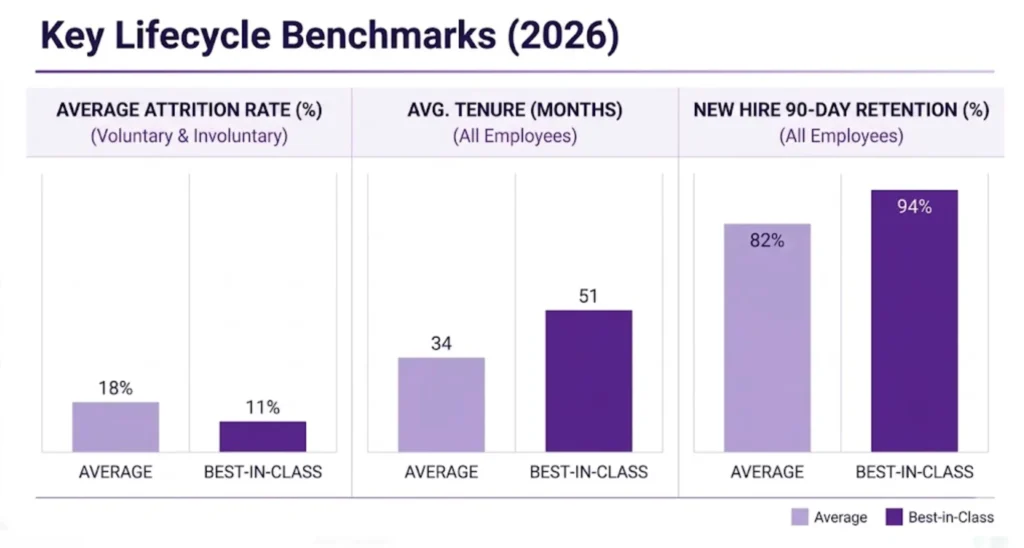
Key Lifecycle Benchmarks (2026)
| Lifecycle Stage | Industry Avg. Investment (per employee) | Avg. Stage Performance Score | Primary ROI Driver |
|---|---|---|---|
| Attract | $420 | 63 / 100 | Cost per quality application |
| Recruit and Hire | $4,700 | 67 / 100 | Offer acceptance rate; quality of hire |
| Onboard | $1,200 | 58 / 100 | 90-day retention; time-to-productivity |
| Develop and Engage | $1,800 | 52 / 100 | Voluntary attrition reduction; performance growth |
| Retain | $890 | 54 / 100 | Regrettable attrition reduction |
| Separate and Offboard | $210 | 44 / 100 | Employer brand; rehire eligibility |
The most striking pattern in this table is the investment asymmetry: organizations invest most at the recruiting stage and least at the offboarding stage, while the development and engagement stage, which spans the longest portion of the average tenure, receives less per-employee investment than the hiring stage. This distribution does not reflect where investment produces the highest return; it reflects where organizational attention has historically been concentrated.
Key Strategies for Integrated Lifecycle Management
How AI Is Enhancing Lifecycle Management?
Quick-Reference Cheat Sheet
LVI = Sum of (Tenure × Performance Rating) / Total Number of Employees
The 6 Core Lifecycle Stages:
- Attract
- Recruit and Hire
- Onboard
- Develop and Engage
- Retain
- Separate and Offboard (+ Alumni)
Critical Lifecycle Transition Points (Highest-Risk Handoffs):
- Offer acceptance to Day 1 (pre-boarding gap)
- Formal onboarding end to independent work (weeks 6 to 12)
- First-year mark (development conversation quality)
- 18 to 36-month mark (growth opportunity visibility)
Dos:
Don’ts:
Stop Juggling
10 Job Boards.
Search One
Your next role is already here. avua pulls opportunities from across the web into a single searchable feed; filtered by role, location, salary, and remote preference.
1.5 Million+
Active Jobs
380+
Job Categories
Common Challenges and Solutions
| Challenge | Solution |
|---|---|
| Lifecycle Stages Owned by Different Functions with No Coordination | Establish cross-functional lifecycle governance with shared LVI accountability; create regular cross-stage data reviews |
| Promise-Delivery Gap Producing First-Year Attrition | Audit recruiting communications against 90-day employee experience data; align what is promised with what is consistently delivered |
| Development Stage Under-Invested Relative to Recruiting | Reallocate people investment using lifecycle ROI analysis; connect development investment to attrition cost savings |
| Offboarding Stage Neglected | Formalize exit interview process; track rehire eligibility; build alumni engagement program |
| No Connection Between Hiring Criteria and Post-Hire Performance | Implement ATS-to-HRIS data integration; build validation cycle connecting assessment scores to 12-month performance ratings |
Related Terms
| Term | Definition |
|---|---|
| Employee Experience | The quality of interactions at each lifecycle touchpoint; the design discipline applied to the lifecycle framework |
| Talent Management | The identification, development, and retention of high-potential employees within the lifecycle framework |
| Onboarding | The structured integration stage that converts a hire into an engaged, productive employee; the highest-leverage lifecycle stage for first-year retention |
| Voluntary Attrition | Separation initiated by the employee; the primary retention metric measuring lifecycle stage performance |
| Quality of Hire | The composite measure of new hire performance and retention; the primary output quality metric of the recruiting and onboarding stages |
| People Analytics | The data infrastructure that makes lifecycle stage performance measurement and cross-stage analysis possible |
Frequently Asked Questions
How many stages should an employee lifecycle model have?
Six to eight stages is the range that most effectively balances specificity with operational manageability. Too few stages (three or four) merge distinct processes that require separate design and measurement. Too many (twelve or more) fragment the lifecycle into units too small for meaningful investment decisions. The specific number of stages should reflect the organization’s HR operating model and the natural handoff points between accountable functions.
Who should own the employee lifecycle?
No single department owns the entire lifecycle; it spans several functional boundaries. While the CHRO maintains executive accountability, specific ownership is distributed. Talent Acquisition handles recruitment, while L&D and managers drive engagement. Success depends on cross-functional coordination through leadership teams or people analytics, ensuring various stages operate as a cohesive system rather than isolated silos.
What is the most commonly neglected lifecycle stage?
Offboarding is consistently neglected, as most organizations focus heavily on recruitment while ignoring departures. This stage is critical for employer branding, alumni referrals, and organizational learning. Failing to invest in offboarding creates a misalignment where high recruitment costs are undermined by poor exit experiences, damaging long-term reputation and losing valuable insights into why talent leaves.
How do you measure the ROI of lifecycle management investment?
Calculate ROI by multiplying the reduction in voluntary attrition by the replacement cost per employee. For instance, reducing attrition from 22% to 16% in a 1,000-person firm saves 60 departures. At $30,000 each, that is $1.8 million recovered. Typically, the cost of improving onboarding or development is significantly lower than the massive attrition costs prevented.
Conclusion
The employee lifecycle is the organizational structure within which every people decision is made and every people outcome is produced. It connects the first impression a candidate forms of the employer to the last impression an exiting employee carries into the world. In between, it encompasses every manager interaction, every development investment, every recognition moment, and every day of productive work that constitutes the employment relationship.
Managing the lifecycle as an integrated system, rather than a collection of independent HR functions, is the difference between an organization that understands its people costs and outcomes and one that is repeatedly surprised by them.
The best organizations in 2026 have not discovered new lifecycle stages. They have built the governance, the measurement, and the cross-functional accountability to ensure that each stage delivers on what the previous one promised and sets up the next one to succeed. That integration is not sophisticated technology or innovative program design. It is organizational discipline applied to the most important system a company operates.