The hire is not the end of the talent acquisition process. It is the beginning of the test: whether the organization the candidate was recruited into matches the one they actually arrive at.
Most organizations treat onboarding as a logistics problem: getting the new hire’s laptop set up, completing their compliance training, and introducing them to a few colleagues. The paperwork gets signed. The first week passes. And the new employee is left to figure out the rest: the informal norms, the real decision-making dynamics, the unwritten expectations, the actual culture beneath the official one.
This approach produces predictable outcomes. Thirty percent of new hires leave within the first year. Twenty-three percent decide on their future with the organization within the first week. And the organizations that experience the highest first-year attrition are, overwhelmingly, those with the weakest employee onboarding programs.
Employee onboarding is a structured organizational process for integrating new employees into their role, team, and organizational culture in the period following hire, typically spanning the first 90 days to 12 months of employment, that encompasses role clarity, relationship building, cultural socialization, and the accelerated development of the capability and confidence required to contribute at the expected level within a defined timeframe.
It is not orientation. Orientation is the administrative component of the first days: forms, policy acknowledgments, facility tours, and system access. Onboarding is the sustained process that follows orientation and extends far beyond it: the structured experience that determines whether a new employee becomes an engaged, productive contributor or a regrettable early departure.
In 2026, onboarding has been recognized as the single highest-leverage employee experience investment available. Research by Brandon Hall Group finds that organizations with structured employee onboarding programs improve new hire retention by 82% and productivity by over 70%. The investment required to build and maintain a structured program is consistently lower than the replacement cost of the early attrition it prevents.
The primary metric is the Onboarding Effectiveness Score (OES), a composite of three sub-metrics:
OES = (90-Day Retention Rate + 90-Day Productivity Score + 30-Day New Hire NPS) ÷ 3
Where each sub-metric is normalized to a 0 to 100 scale. Best-in-class organizations achieve OES above 75. Most organizations without structured programs score below 55.
What is Employee Onboarding?
Employee onboarding is a structured integration process spanning the first 90 days to 12 months of employment that systematically builds new employee knowledge of the role, relationships with the team and organization, understanding of cultural norms and expectations, and the practical capability to perform at the required level, through a designed sequence of activities, conversations, and milestones.
The four dimensions of employee onboarding each address a distinct integration need. Organizational socialization provides the context of how the organization works, what it values, and how decisions are made. Role clarity establishes what the new employee is specifically responsible for, how their performance will be measured, and what success looks like at 30, 60, and 90 days.
Relationship building creates the network of colleagues, managers, and stakeholders whose collaboration and trust are required for effective performance. And capability development accelerates the growth of the specific skills and knowledge the role requires beyond what the hiring process confirmed the employee already possessed.
Is Your Onboarding Building Employees or Just Processing Them?
The difference between onboarding that retains and onboarding that does not is not in the sophistication of the program. It is in the substance of what the new employee experiences in their first 30 days.
An employee who completes two days of orientation, receives their laptop, and is then expected to independently figure out how to be effective in their new role is not being onboarded. They are being processed. The distinction matters because “processed” employees make the same calculation that consumers make when a product does not deliver on its promise: they look for a better option.
Processing produces the 30% first-year attrition rate that most organizations accept as normal. Onboarding produces the 82% first-year retention improvement that structured programs consistently deliver. The difference is not in the hiring decision. It is in what happens after it.
A study by the Society for Human Resource Management (SHRM) finds that it takes an average of eight months for a new employee to reach full productivity. Organizations with structured onboarding programs reduce this timeline to an average of five months, producing a three-month productivity acceleration that represents significant recoverable value for every hire. At a fully-loaded cost of $12,000 per month for a $144,000-per-year role, a three-month productivity acceleration is worth $36,000 per hire before accounting for retention improvement.
The scenario that makes the design distinction concrete: two candidates from the same hiring cohort at a technology company, both with equivalent backgrounds and assessment scores, join two different teams. Candidate A is assigned to a team where the manager has scheduled a 30-60-90 day plan, weekly one-on-ones for the first quarter, a peer buddy introduction, and three structured project assignments designed to build capability progressively. Candidate B joins a team where the manager is managing 11 other reports, has no structured employee onboarding framework, and tells the new hire to “just dive in and ask if you need anything.”
At month six, Candidate A has met all three performance milestones, has established functional working relationships with eight colleagues, and rates their experience 8 out of 10. Candidate B has reached adequate performance on two of three initial deliverables, has two close working relationships, and rates their experience 5 out of 10. The difference is entirely in the onboarding design, not the hire quality.
The Four Cs of Onboarding: A Framework
Common Misconceptions About Employee Onboarding
| Misconception | Reality |
|---|---|
| Onboarding is the same as orientation | Orientation is the first day or two of administrative processing. Onboarding is the structured 90-day to 12-month integration program that follows. Conflating them produces orientation programs that are called onboarding without delivering employee onboarding outcomes. |
| Onboarding ends after 30 days | Research on new hire productivity curves shows that meaningful performance ramp continues for six to twelve months in most professional roles. Structured onboarding that ends at 30 or 90 days leaves new employees unsupported through the period when they are most likely to question their fit and their decision. |
| HR is responsible for onboarding | HR designs and administers the compliance and structural components. The manager delivers the most impactful onboarding dimensions: role clarity, development investment, connection facilitation, and the weekly one-on-ones that make or break the early tenure experience. |
| Onboarding is primarily about paperwork and systems | The compliance and systems components take the most scheduled time in most onboarding programs, but they have the least impact on retention and productivity outcomes. The relationship and role clarity components have the most impact and receive the least structured attention. |
| Remote onboarding is inherently inferior to in-person | Well-designed remote onboarding programs produce equivalent retention and productivity outcomes to in-person programs when the connection and clarity dimensions are delivered with equal intentionality. The format is not the constraint; the design quality is. |
| Good hiring eliminates the need for structured onboarding | Even perfectly qualified hires need to learn how this specific organization works, build the specific relationships required for effective collaboration, and understand the specific expectations of this specific role. Hiring quality and onboarding quality are independent variables; both matter. |
Employee Onboarding vs. Related Processes
| Process | Timeline | Primary Focus | Owner | Success Metric |
|---|---|---|---|---|
| Pre-boarding | Offer acceptance to Day 1 | Logistics; first-day preparation; early relationship building | TA and HR Operations | Day 1 readiness; no-show rate |
| Orientation | Day 1 to 3 | Compliance; administrative; organizational overview | HR Operations | Form completion; system access |
| Onboarding | Days 1 to 90 (core); extended to 12 months | Role clarity; culture; connection; capability | HR + Manager | OES; 90-day retention; productivity milestone |
| Ramp-up | Months 1 to 6 | Performance acceleration; skill development | Manager; L&D | Time-to-full-productivity |
| Integration | Months 6 to 12 | Cultural embedding; network expansion | Manager; HR | 12-month retention; engagement score |
What the Experts Say?
The biggest mistake organizations make with onboarding is treating it as something that happens to new hires rather than something that is done with them. The best employee onboarding programs are designed around what new employees actually need to become effective, not around what is easiest for HR to administer.
– Talya Bauer, Portland State University professor and author of the SHRM Foundation’s “Onboarding New Employees: Maximizing Success
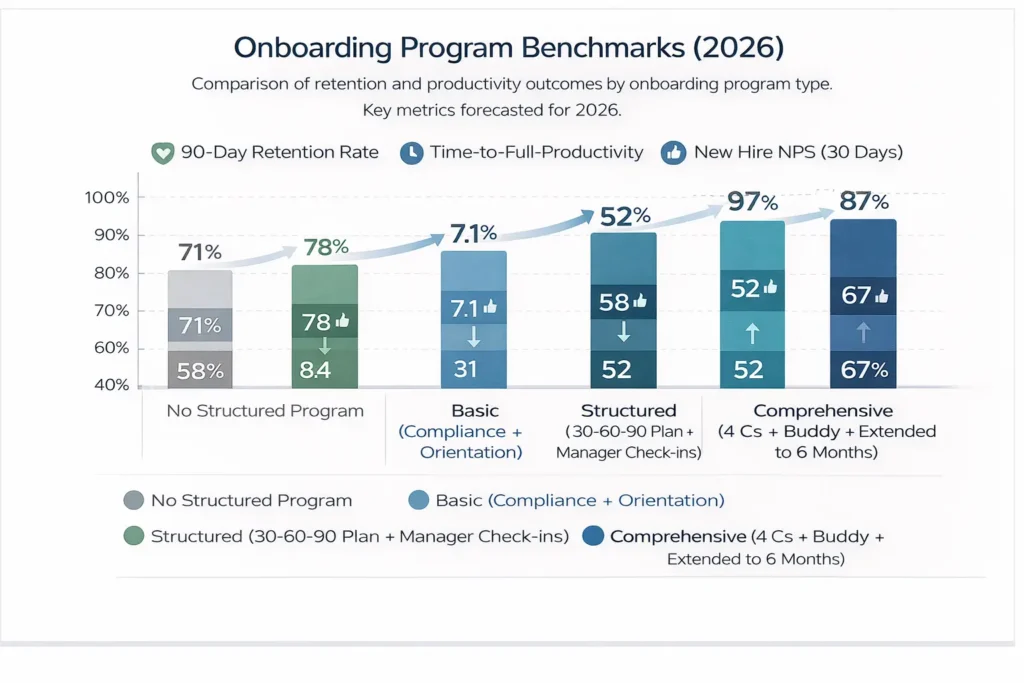
Onboarding Program Benchmarks (2026)
| Onboarding Program Type | 90-Day Retention Rate | Time-to-Full-Productivity | New Hire NPS (30 days) | First-Year Retention |
|---|---|---|---|---|
| No Structured Program | 71% | 8.4 months | 24 | 58% |
| Basic (Compliance + Orientation) | 78% | 7.1 months | 31 | 67% |
| Structured (30-60-90 Plan + Manager Check-ins) | 88% | 5.8 months | 52 | 79% |
| Comprehensive (4 Cs + Buddy + Extended to 6 Months) | 93% | 4.9 months | 67 | 87% |
The retention and productivity differences between no structured program and a comprehensive program are among the largest impact differentials in any HR investment category. A 29-percentage-point first-year retention improvement, from 58% to 87%, represents a recoverable replacement cost of $29,000 per hire (at $100,000 replacement cost) for every 100 hires, producing $2.9 million in annual recovered cost against a comprehensive employee onboarding program investment typically well below $500,000 for a 100-hire annual cohort.
Key Strategies for Onboarding Excellence
Stop Juggling
10 Job Boards.
Search One
Your next role is already here. avua pulls opportunities from across the web into a single searchable feed; filtered by role, location, salary, and remote preference.
1.5 Million+
Active Jobs
380+
Job Categories
How AI Is Transforming Employee Onboarding?
Personalized Onboarding Pathways
AI systems can generate role-specific onboarding plans tailored to the new hire’s background, the team’s context, and the specific capability gaps identified during assessment. A new hire with strong technical skills but limited organizational leadership experience receives a different 30-60-90 day plan from one with the inverse profile, delivering the specific development priorities most relevant to their successful integration.
Automated Check-In Scheduling and Reminders
AI-powered HR platforms can automate the scheduling of onboarding check-in surveys, manager one-on-one prompts, and milestone reminders, reducing the administrative burden of onboarding program management while ensuring that the structured touchpoints that most impact retention actually occur on schedule.
Early Attrition Risk Detection
Machine learning models trained on onboarding check-in data, system engagement patterns, and new hire communication activity can identify new employees at elevated early attrition risk within the first 30 to 60 days, enabling targeted manager intervention at the point where retention is still possible.
Quick-Reference Cheat Sheet
Key Formula
OES = (90-Day Retention Rate + 90-Day Productivity Score + 30-Day New Hire NPS) ÷ 3
The Four Cs of Onboarding:
- Compliance (administrative floor)
- Clarification (role and expectation clarity)
- Culture (organizational socialization)
- Connection (relationship building)
Critical Onboarding Milestones:
- Pre-boarding: Offer acceptance to Day 1 (logistics + relationship initiation)
- Day 1: First impression; team introduction; equipment and access
- Day 30: Role clarity check; manager relationship quality; cultural orientation
- Day 60: First performance milestone; peer relationships; tool proficiency
- Day 90: Productivity milestone; integration assessment; retention conversation
- Month 6: Extended integration; development planning; engagement baseline
Dos:
- Create 30-60-90 day plan before the hire’s first day
- Assign a peer buddy for the first 90 days
- Hold managers accountable for one-on-one frequency in Q1
- Survey new hires at 30 and 90 days and act on the results
- Extend structured onboarding to 6 months for complex roles
Don’ts:
- Treat compliance paperwork as the onboarding program
- End structured onboarding at 30 days
- Leave the pre-boarding period without communication
- Assume consistent manager delivery without monitoring
- Design onboarding around HR’s administrative convenience rather than new hire needs
Common Challenges and Solutions
| Challenge | Solution |
|---|---|
| Manager Inconsistency in Onboarding Delivery | Build manager onboarding checklist; monitor one-on-one frequency; tie manager performance assessment to onboarding completion metrics |
| Remote Onboarding Feeling Isolating | Increase check-in frequency; assign buddy from Day 1; schedule virtual social introductions; use video for all early-stage communication |
| New Hire Overwhelmed by Information Volume | Sequence onboarding content by relevance; deliver information in phases rather than all at once; prioritize role clarity and relationship building over organizational information load |
| Pre-Boarding Drop-Out | Increase communication frequency between offer and start; send team introduction before Day 1; provide first-day logistics clearly and early |
| Onboarding Quality Varies by Team | Standardize manager onboarding toolkit; provide manager training; HR reviews 30-day check-in data by team to identify outlier delivery quality |
Related Terms
| Term | Definition |
|---|---|
| Pre-boarding | The structured communication and preparation phase between offer acceptance and the first day of employment |
| 30-60-90 Day Plan | A structured employee onboarding roadmap specifying learning objectives, relationship goals, and performance milestones at each phase of the first quarter |
| Peer Buddy Program | A formal assignment of an experienced colleague to guide a new hire through the informal cultural and practical dimensions of the first 90 days |
| Time-to-Productivity | The elapsed time from hire date to full independent performance at the required level; the productivity ROI metric for onboarding investment |
| Employee Experience | The quality of all organizational touchpoints across the lifecycle; onboarding is the most leveraged early-stage experience investment |
| New Hire Net Promoter Score | New hire-specific advocacy measurement typically collected at 30 days; a leading indicator of first-year retention and onboarding quality |
Frequently Asked Questions
How long should onboarding last?
The core structured onboarding period, covering role clarity, cultural socialization, and relationship building, should run at least 90 days for most professional roles. For complex senior roles or those requiring significant cultural adaptation, extended employee onboarding to six or twelve months is both common and evidence-supported. The arbitrary 30-day onboarding cutoff common in many organizations is not aligned with the research on productivity ramp timelines, which average five to eight months. Onboarding should last as long as the new hire needs structured support to reach full effectiveness.
What is the difference between onboarding and training?
Training is a component of onboarding focused specifically on skill and knowledge development. Onboarding is the broader integration process encompassing compliance, role clarity, cultural socialization, relationship building, and capability development. Training addresses what the employee needs to know and be able to do. Onboarding addresses all of that plus what kind of organization they have joined, who they need to work with, what is expected of them, and whether they feel like they belong.
How do you measure onboarding effectiveness?
The OES framework (90-day retention, 90-day productivity, 30-day new hire NPS) captures the three most important onboarding outcomes. Supplementary metrics include: time-to-first-deliverable, manager satisfaction with new hire at 90 days, new hire confidence self-assessment at 30 and 60 days, and qualitative theme analysis from new hire check-in surveys. The combination of retention data (did they stay), productivity data (did they ramp), and satisfaction data (did they have a good experience) produces a complete onboarding effectiveness picture.
Who should own the onboarding process?
HR owns the design, structure, and compliance components. The direct manager owns the highest-impact onboarding dimensions: the 30-60-90 day plan, the weekly one-on-ones, and the daily relationship investment that shapes early-tenure engagement. The peer buddy owns the informal cultural guidance and practical knowledge transfer. Effective onboarding requires all three to perform their distinct roles; HR cannot substitute for the manager’s contribution, and the manager cannot substitute for HR’s structural scaffold.
Conclusion
Onboarding is the most leveraged investment in the employee lifecycle. No other single program can move first-year retention by 29 percentage points. No other single process can accelerate time-to-full-productivity by three months. No other organizational decision made after the hire is complete has more financial impact per dollar invested.
And yet most organizations treat it as a formality: two days of orientation, a stack of forms, and a laptop. The result is predictable. New employees who are not onboarded effectively become the early departures, the disengaged survivors, and the Glassdoor reviewers who undermine the next recruiting cycle.
The organizations that have built structured, thoughtful, sustained employee onboarding programs are not doing anything exotic. They are doing the obvious things consistently: setting clear expectations, building real relationships, investing in the manager behaviors that make new hires feel welcomed and supported, and sustaining that investment long enough for the new employee to become the productive, engaged contributor the hiring process identified them as.
That commitment, sustained through the first 90 days and beyond, is the difference between a hire and a retained employee. It is worth making.