Every employee who leaves voluntarily represents a failure of something: an unmet expectation, an unaddressed frustration, an opportunity for growth that did not materialize, or a better offer from an organization that valued them more visibly. The cost of that failure, in replacement expense, productivity loss, team disruption, and institutional knowledge drain, is rarely fully calculated. If it were, retention would be treated as the strategic imperative it is rather than the HR metric it usually becomes.
Employee retention is a talent management outcome and organizational capability describing an employer’s ability to sustain the employment of valued individuals over time, influenced by the cumulative quality of the employee experience across the lifecycle, and measured through voluntary attrition rate, regrettable attrition rate, and tenure distribution metrics that distinguish whether the organization is keeping the employees it most needs to keep.
The definition contains a critical qualifier: valued individuals. Retention in aggregate is not a goal; selective retention is. Organizations that retain all employees equally, including those who are underperforming, misaligned, or limiting team effectiveness, are not building a strong workforce. They are avoiding a difficult management conversation. The meaningful retention metric is not “who stayed” but “who stayed that we needed to keep.”
In 2026, voluntary attrition in professional roles has stabilized after the extreme volatility of the 2021 to 2023 period, but remains elevated relative to pre-pandemic norms in most industries. The drivers of voluntary attrition are well-researched and consistent: lack of growth opportunity, poor management quality, compensation misalignment, and a mismatch between the employment promise made during recruiting and the experience delivered after hire. None of these are mysteries. All of them are addressable.
The primary metric is the Regrettable Attrition Rate (RAR):
RAR (%) = (Voluntary Departures of High/Critical Performers ÷ Average Headcount) × 100
RAR distinguishes the departures that matter most (high performers and critical role incumbents leaving voluntarily) from total voluntary attrition, which includes both regrettable and non-regrettable departures. A low RAR with an average voluntary attrition rate indicates healthy selective retention. A high RAR regardless of total attrition rate indicates the organization is losing its best people while retaining its least effective.
What is Employee Retention?
Employee retention is the organizational capability and strategic outcome of sustaining the employment of valued individuals through the quality of the employee experience, the competitiveness of the employment proposition, and the proactive identification and remediation of the specific factors that predict voluntary departure before departure becomes inevitable.
The definition emphasizes capability and outcome equally. Retention is not a one-time intervention. It is a continuous organizational capability produced by the cumulative quality of management practice, development investment, compensation positioning, and workplace culture. Organizations that treat retention as a crisis response, launching programs after attrition spikes, are responding to symptoms rather than managing the conditions that produce them.
Are You Managing Retention or Reacting to Attrition?
Most organizations manage attrition. Very few manage retention. The difference is timing: attrition management happens after the departure. Retention management happens while the employee is still engaged, still invested, and still influencing who stays and who goes on the teams around them.
The exit interview is the emblematic instrument of attrition management. Conducted after the decision to leave has been made, after the counter-offer conversation (if any) has failed, and after the employee has already transitioned psychologically to their next chapter, exit interviews produce information about what the organization failed to do. They do not provide the opportunity to do it.
Stay interviews, conducted with currently-employed high-performers about what would make them more or less likely to remain, provide that opportunity while it still exists.
Gallup research estimates that 52% of voluntarily exiting employees say their manager or organization could have done something to prevent their departure, and 51% say that in the three months before they left, neither their manager nor any other organizational leader discussed their job satisfaction or future with them. The departure was preventable. The conversation that would have prevented it never happened.
The scenario that makes the timing gap concrete: a senior data scientist at a financial services firm has been performing at high levels for three years. She has been passed over for promotion once, given a rationale she found unconvincing, and has not had a development conversation with her manager since the performance cycle review six months ago. She has not started an active job search. But she has started accepting LinkedIn messages from recruiters, which she had been ignoring for two years.
At this moment, a stay interview would identify the specific concern (promotion process transparency, development investment) that a targeted manager action could address. Within three months, absent that conversation, she will be interviewing. Within five months, she will have accepted an offer. The attrition will be recorded. The exit interview will cite “growth opportunity.” And the organization will spend $180,000 replacing her without ever knowing the conversation that would have cost nothing could have changed the outcome.
Your Resume Isn’t Getting Read
Let’s Get That Fixed!
75% of resumes get auto-rejected. avua’s AI Resume Builder optimizes formatting, keywords, and scoring in under 3 minutes, so you land in the “yes” pile.
The Retention Driver Framework
Research from Gallup, McKinsey, and Gartner consistently identifies the same primary voluntary attrition drivers, in order of frequency cited across industries:
| Retention Driver | % of Voluntary Departures Citing as Primary Reason | Organizational Lever |
|---|---|---|
| Lack of career development and growth | 41% | Manager behavior; L&D investment; internal mobility |
| Inadequate compensation and benefits | 36% | Total rewards benchmarking; pay equity; benefits design |
| Poor management / manager relationship | 34% | Manager selection; manager development; manager accountability |
| Work-life balance and flexibility | 28% | Flexible work policy; workload management; culture norms |
| Lack of recognition and appreciation | 24% | Recognition program design; manager behavior |
| Limited organizational purpose connection | 19% | Mission communication; role-to-impact visibility |
| Toxic team culture or workplace environment | 17% | Culture management; psychological safety; leadership behavior |
Note: Percentages exceed 100% as most departing employees cite multiple reasons.
Common Misconceptions About Employee Retention
| Misconception | Reality |
|---|---|
| Retention is primarily about compensation | Compensation is the second most cited departure driver, but it is rarely sufficient alone. Research consistently shows that employees who leave for compensation reasons at one company could often have been retained with a non-financial intervention if that intervention had been offered before the competing offer arrived. |
| High performers always leave | High performers leave when they are not developed, recognized, or compensated appropriately. Organizations with strong development programs and manager quality metrics retain high performers at rates significantly above industry averages. |
| You cannot retain employees who want to leave | You can retain employees who are considering leaving but have not yet decided. The decision to leave is typically made over weeks or months, not instantly. The stay interview exists specifically to intervene in that process. |
| Retention programs are the fix | Retention programs (bonuses, perks, benefits) address symptoms. The fix is the quality of the manager relationship, the visibility of career development, and the day-to-day experience of working at the organization. |
| Attrition is just a cost of doing business | In high-performing organizations, voluntary attrition rates are significantly below industry averages. The difference is not industry dynamics; it is management quality and organizational design. |
| Exit interviews tell you why people leave | Exit interviews tell you what departing employees are willing to say, after they have made the decision, about a process that has already concluded. Stay interviews tell you what still-employed employees need, while the organization can still act. |
Employee Retention vs. Related Concepts
| Concept | Focus | Timing | Primary Tool | Owner |
|---|---|---|---|---|
| Employee Retention | Sustaining employment of valued individuals | Ongoing; proactive | Stay interviews; development programs; manager quality | HR + Managers + Leadership |
| Voluntary Attrition Management | Measuring and responding to departures | Reactive; post-departure | Exit interviews; attrition analytics | HR |
| Employee Engagement | Building investment in work and organization | Ongoing | Engagement surveys; manager behavior | HR + Managers |
| Talent Management | Identifying and developing high-potential employees | Ongoing | Succession planning; development programs | HR + Leadership |
| Total Rewards | Competitive compensation and benefits positioning | Annual benchmarking | Compensation analysis; benefits design | Total Rewards; HR |
| Employee Experience | Quality of all organizational touchpoints | Lifecycle | Journey mapping; lifecycle surveys | HR; Operations; IT |
What the Experts Say?
The most reliable retention strategy is also the simplest: give people good work, good managers, and a credible path to somewhere they want to go. If you have those three things, you do not need a retention program. If you are missing one of them, no retention program will make up for it.
– Pat Wadors, Chief People Officer and widely cited HR executive known for her work on belonging and talent retention
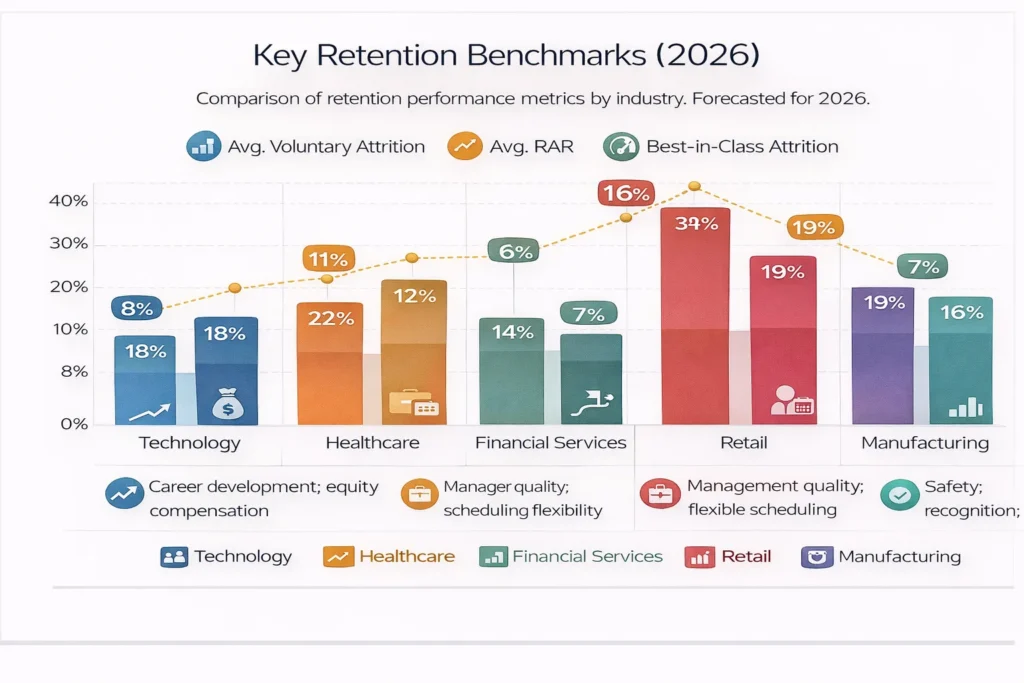
Key Retention Benchmarks (2026)
| Industry | Avg. Voluntary Attrition | Avg. RAR | Best-in-Class Voluntary Attrition | Primary Retention Lever |
|---|---|---|---|---|
| Technology | 18% | 8% | 9% | Career development; equity compensation |
| Healthcare | 22% | 11% | 12% | Manager quality; scheduling flexibility |
| Financial Services | 14% | 6% | 7% | Compensation; career path clarity |
| Retail | 34% | 16% | 19% | Management quality; flexible scheduling |
| Manufacturing | 19% | 9% | 10% | Safety; recognition; compensation |
| Professional Services | 16% | 7% | 8% | Growth opportunity; work quality |
Key Strategies for Employee Retention
Stop Juggling
10 Job Boards.
Search One
Your next role is already here. avua pulls opportunities from across the web into a single searchable feed; filtered by role, location, salary, and remote preference.
1.5 Million+
Active Jobs
380+
Job Categories
Quick-Reference Cheat Sheet
Key Formula
RAR (%) = (Voluntary Departures of High/Critical Performers ÷ Average Headcount) × 100
The Top 3 Retention Investments by ROI:
- Manager quality development (prevents 34% of cited departure reasons)
- Career development and internal mobility visibility (prevents 41% of cited departure reasons)
- Stay interview program for high-performers (converts departures into retained employees)
Retention Warning Signals (Leading Indicators):
- Decline in engagement score for a specific team or cohort
- Increase in LinkedIn activity among high-performers
- First time an employee disengages from optional meetings or initiatives
- eNPS drop in a specific business unit
- Compensation benchmark gap identified in annual review
Dos:
- Measure RAR separately from total voluntary attrition
- Conduct stay interviews with high performers at regular intervals
- Make internal mobility visible and frictionless
- Hold managers accountable for team RAR
- Act on retention risks before the competing offer arrives
Don’ts:
- Rely on exit interviews as the primary retention intelligence source
- Treat attrition as a uniform cost of doing business
- Use retention bonuses as a substitute for addressing root causes
- Allow compensation to fall significantly below market before benchmarking
- Wait for attrition to spike before implementing stay conversations
Remote and Hybrid Work’s Effect on Retention
The way people work has changed permanently, and retention strategies that don’t account for that are already running behind. Since 2020, flexibility has shifted from a perk to a baseline expectation for a large portion of the workforce. Organisations that ignored this early paid for it in turnover. Many are still paying.
The retention upside of remote and hybrid models is real. Employees with schedule flexibility consistently report higher job satisfaction, lower burnout, and stronger loyalty to their employer. Removing the daily commute, offering autonomy over working hours, and trusting employees to manage their output rather than their attendance sends a clear signal: we respect your time and your judgement. That signal retains people.
But flexibility without structure creates its own retention risks. Remote employees who feel isolated, excluded from key decisions, or invisible to leadership are quietly disengaging long before they hand in their notice. Out of sight can easily become out of mind, and that breeds resentment. Hybrid models introduce a different tension: if in-office employees get more visibility, mentorship access, and informal career opportunities, remote workers will notice the imbalance and draw conclusions.
The organisations getting this right are the ones treating remote and hybrid work as a design challenge, not a default setting. That means intentional communication rhythms, inclusive meeting practices, clear expectations around availability, and managers trained to lead distributed teams rather than just manage attendance.
Retention in a flexible work environment ultimately comes down to one question every employee is quietly asking: do I feel connected, valued, and fairly treated regardless of where I work? If the answer is consistently yes, flexibility becomes one of the strongest retention tools available. If the answer is uncertain, even the most generous remote policy won’t keep people around for long.
Retention Across Employee Lifecycle Stages
Not all turnover looks the same, and not all retention strategies should either. An employee who quits after three weeks has an entirely different story from one who leaves after five years. Treating them as the same problem leads to the same ineffective solutions. The smarter approach is to map retention risk across the employee lifecycle and intervene at the right moment, with the right tool.
Stage 1: The New Hire Window (0–90 Days)
This is the highest-risk period, full stop. Research consistently shows that a significant portion of new hires decide whether to stay long-term within their first 90 days, often within the first two weeks. The culprits are usually structural: a weak onboarding experience, unclear role expectations, or simply feeling invisible in a new environment.
The intervention here isn’t a ping-pong table. It’s a structured onboarding programme, an assigned buddy or mentor, early check-ins from the direct manager, and a clear 30-60-90 day plan that gives the employee a sense of direction. First impressions compound quickly in both directions.
Stage 2: The Mid-Tenure Plateau (1–4 Years)
Employees in this window are comfortable enough to do their job well, but that comfort can quietly turn into stagnation. This is when the “I wonder what else is out there” thought starts gaining traction. Growth opportunities dry up, recognition becomes routine rather than meaningful, and compensation hasn’t kept pace with expanded responsibilities.
The retention lever at this stage is development. Internal mobility, stretch assignments, mentorship programmes, and honest career conversations go a long way. Employees don’t always want to leave. They want to feel like staying is still the best move for their career.
Stage 3: The Long-Tenure Employee (5+ Years)
Losing a long-tenured employee is expensive in ways that don’t show up cleanly on a spreadsheet. Institutional knowledge, client relationships, team culture all walk out the door with them. The irony is that long-tenure employees are often the most overlooked when it comes to retention efforts, precisely because they seem settled.
What retains them is recognition of loyalty, continued challenge in their role, and a sense that their experience is genuinely valued, not just tolerated. Regular re-evaluation of compensation against market rates matters here more than at any other stage.
Retention isn’t a single initiative. It’s a series of well-timed conversations, investments, and signals delivered at the moment they’re most likely to land.
Related Terms
| Term | Definition |
|---|---|
| Voluntary Attrition Rate | The proportion of employees who leave the organization voluntarily; the inverse of retention |
| Regrettable Attrition Rate (RAR) | The proportion of voluntary departures that are high performers or critical role incumbents; the primary retention quality metric |
| Stay Interview | A structured conversation with a currently-employed high performer about what would make them more or less likely to remain; the proactive retention intelligence tool |
| Employee Engagement | The psychological investment in work and organization; the primary behavioral predictor of retention intent |
| Internal Mobility | Movement of employees between roles within the organization; a key retention lever for development-driven departure risk |
FAQs Related to Employee Retention
What are the most common reasons employees leave their jobs?
Employees most often leave due to poor management, limited growth opportunities, low compensation, or feeling undervalued. Lack of work-life balance and weak company culture are also frequent drivers of voluntary turnover.
How can companies calculate their employee retention rate?
Divide the number of employees who stayed throughout a period by the starting headcount, then multiply by 100. A rate above 90% is generally considered healthy across most industries.
What strategies are most effective for improving employee retention?
Effective strategies include competitive compensation, clear career development paths, recognition programs, and flexible work arrangements. Regular feedback loops and strong manager-employee relationships also significantly reduce voluntary turnover.
How does employee retention differ from employee engagement?
Retention measures whether employees stay; engagement measures how committed and motivated they are at work. Engaged employees are far less likely to leave — but retention is possible even without genuine engagement.
What role does onboarding play in long-term employee retention?
Strong onboarding helps new hires feel welcomed, informed, and aligned with company expectations. Employees who experience structured onboarding are significantly more likely to stay beyond their first year.
Conclusion
Retention is not the absence of attrition. It is the presence of the conditions that make employees choose to stay: good work, good managers, visible growth, and an experience that consistently delivers on what recruiting promised.
The organizations that win on retention have not discovered a secret. They have built the discipline to invest in manager quality, development opportunity, and honest employment propositions, and they have built the measurement system to know early enough when those conditions are eroding to do something about it before the exit interview confirms what a stay interview would have prevented.
That discipline is worth building. The math is unambiguous. And the employees worth keeping are watching whether you build it.