If you’ve ever stared at your resume and wondered, “Should I put my GPA on resume?”—you’re not alone. It’s one of those deceptively simple questions that doesn’t come with a one-size-fits-all answer.
The decision to include your grade point average (GPA) on your resume hinges on a few key elements, regardless of whether you’re a fresh graduate polishing your first job application or an experienced professional wondering if your GPA still matters.
In this guide, we’ll walk through exactly when it makes sense to add GPA to your resume, when you’re better off leaving it out, and how to format it properly so it works in your favor.
We’ll also tackle some of the trickier questions—like whether you should list your major GPA versus your cumulative GPA, whether rounding is acceptable, and what to do when your GPA is less than stellar.
Should I put my GPA on Resume?
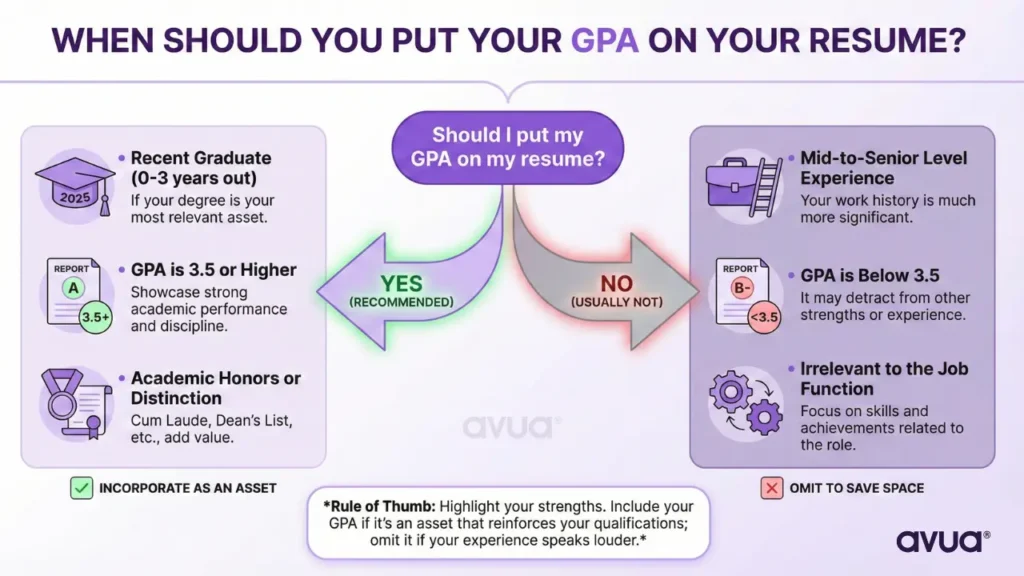
Include your GPA only if it’s 3.5 or higher and you are a student or recent graduate (less than three years of experience). Otherwise, professional achievements matter more. Once you’ve established a career, your GPA becomes irrelevant and takes up valuable space that’s better used for skills.
What Does GPA on Resume Actually Signal?
Before we get into the specifics, it helps to understand what recruiters and hiring managers are actually looking for when they see a GPA on your resume. Your grade point average is essentially a shorthand for academic performance. It tells a potential employer that you were able to manage coursework, meet deadlines, and perform consistently over time.
That said, a GPA is just one piece of the puzzle. Many employers value work experience, skills, and cultural fit just as much—if not more—than a number on a transcript. But in certain situations, especially early in your career, a strong GPA can be the thing that moves your resume from the “maybe” pile to the “definitely” pile.
📊 According to NACE, roughly 73% of employers screen candidates by GPA during campus recruiting, with 3.0 being the most common cutoff.
When Should You Put Your GPA on Your Resume?
There’s no universal rule that says you must include your GPA on every job application. But there are several scenarios where listing it is a smart move. Here’s when you should seriously consider it.
You’re a Recent Graduate or in Your Early Career
If you’ve just graduated from college or university and you’re applying for your first job or an internship, your resume probably doesn’t have a lot of professional experience on it yet. That’s completely normal. In this case, your education section becomes one of the strongest parts of your resume, and a good GPA can help fill the gap left by a shorter work history.
As a general rule, if you have less than three years of professional experience and your GPA is above 3.0, it’s worth including. Employers reviewing early career candidates often use GPA as a proxy for discipline and capability, especially when there isn’t much work experience to evaluate.
Your GPA Is Above 3.5
A GPA of 3.5 or higher on a 4.0 scale is widely considered strong across most industries. If your GPA falls in this range, it can actively strengthen your resume and signal to hiring managers that you performed well academically. A 3.8 GPA or higher is particularly impressive and could catch a recruiter’s eye instantly, especially at firms in consulting, finance, or tech.
If your GPA is above 3.5, you almost always want to include it on your resume. It communicates a level of dedication that hiring managers appreciate, particularly for roles that demand analytical rigor or attention to detail.
💡 Pro Tip: If the job you’re applying for asks for a minimum GPA and yours meets or exceeds it, make it easy for the recruiter to find by placing it prominently in the education section of your resume.
The Job Description Specifically Asks for It
Some job listings explicitly state a GPA requirement or preference. Government positions, graduate programs, large consulting firms, and certain financial institutions are known for this.
When the job description asks for your GPA, you should always include it—even if it’s not as high as you’d like. Omitting it when it’s been directly requested can look like you have something to hide, and that’s a worse signal than a modest number.
When to Leave Your GPA Off Your Resume?
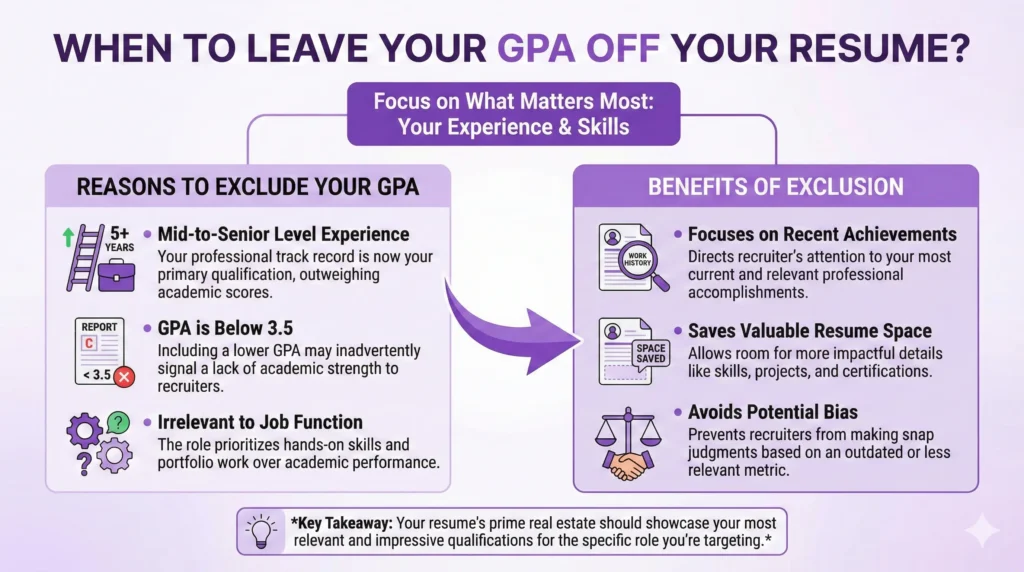
Just as there are good reasons to include your GPA, there are equally valid reasons to leave it off. Here’s when dropping it is the smarter choice.
You’ve Been Out of School for More Than Three Years
Once you’ve accumulated a few years of professional experience, your resume should be telling the story of what you’ve accomplished in the workplace—not the classroom. If you’ve been out of school for more than three years, most recruiters won’t expect to see your GPA, and including it can actually make your resume feel dated.
At this stage, your work history, measurable achievements, and skills carry far more weight. Consider leaving your GPA off your resume and letting your career trajectory speak for itself.
Your GPA Is Below 3.5
If your GPA is below 3.5, the decision becomes more nuanced. A GPA in the 3.0 to 3.4 range might still be worth including depending on the industry and the specific role. However, if your GPA is below 3.0, you’re generally better off leaving it out entirely.
Here’s the thing: not listing your GPA doesn’t automatically raise a red flag. Many successful professionals had average or below-average GPAs and went on to build incredible careers. Focus on highlighting relevant skills, internships, volunteer work, or projects that demonstrate your capabilities instead.
Check Out: Harvard Resume Templates for 2026 → 50+ Action Verbs Included
Your Work Experience Speaks Louder
If you have a solid track record of work experience that’s directly relevant to the job you’re targeting, your resume already tells a compelling story. Adding GPA at this point is unnecessary and takes up valuable real estate that could be used for more impactful information. Hiring managers care about what you can do for their organization—not what grade you got in a class five years ago.
📊 A LinkedIn survey found that only 35% of hiring managers consider GPA to be a significant factor once a candidate has more than 2 years of full-time job experience.
Cumulative GPA Versus Major GPA: Which Should You List?
This is one of the most common dilemmas job seekers face, and the answer is simpler than you might think. Your cumulative GPA reflects your overall performance across all courses, while your major GPA only accounts for classes within your field of study.
If your major GPA is higher than your overall GPA—and especially if it’s significantly higher—you may want to list it instead of (or in addition to) your cumulative GPA. For instance, if your overall GPA is 3.2 but your major GPA is 3.7, listing the major GPA makes a lot of sense, particularly when the role is closely tied to your area of study.
You could include both on your resume if you want to give a complete picture. Just make sure the labeling is clear, so there’s no confusion. Something like “GPA: 3.2 | Major GPA: 3.7” works perfectly.
🔍 Did You Know?
Many career advisors recommend listing your major GPA when it’s at least 0.3 points higher than your cumulative GPA and when the position is relevant to the job you’re applying for. It’s a perfectly acceptable practice.
How to Add GPA in the Education Section of Your Resume?
If you’ve decided to include your GPA, proper formatting matters. You want it to be easy to spot but not the focal point of your education section. Here’s what a clean, professional format looks like:
List your degree, school name, and graduation year first. Then add your GPA on the same line or directly beneath it. Express your GPA to two decimal places and always include the scale (e.g., 3.65/4.0). If you’re listing your major GPA alongside your cumulative GPA, label each clearly.
For Example:
Bachelor of Science in Computer Science
University of Michigan — May 2025GPA: 3.65/4.0 | Major GPA: 3.82/4.0 | Dean’s List (4 semesters)
Keep it simple. You don’t need to draw attention to it with bold text or a separate section—just make it part of the natural flow of your education details. If you’re also including academic achievements like Dean’s List or Latin honors, you can place those alongside your GPA for maximum impact.
Should You Round Up Your GPA on a Resume?
This comes up more often than you’d expect, and there’s an important line between acceptable rounding and misrepresentation. The general consensus among career professionals is that you can round your GPA to two decimal places using standard rounding rules. So a 3.47 becomes a 3.47 (not 3.5), and a 3.849 rounds to 3.85.
What you should never do is round up your GPA to create a misleading impression. For instance, rounding a 3.45 up to 3.5 might seem harmless, but if an employer requests your transcript and discovers a discrepancy, it could raise questions about your honesty. Misrepresenting your GPA—even slightly—is not worth the risk.
⚠️ Important Note
Misrepresenting your GPA on a resume can lead to serious consequences, including rescinded job offers. Always report your GPA accurately to two decimal places. If an employer cares about your GPA, they’ll likely verify it.
Pro Tips for Making Your GPA Work Harder on Your Resume
Including your GPA is just the starting point. Here are a few extra strategies to make it count:
- Pair GPA with academic achievements: Listing Dean’s List, academic scholarships, or relevant honors alongside your GPA creates a more complete picture of your academic performance than a number alone.
- Tailor your resume to the job application: If a role values academics, make your GPA prominent. If the emphasis is on practical experience, let your work experience take center stage and keep the GPA line subtle.
- Use a resume builder or resume templates for clean formatting: A well-organized education section makes a strong first impression. Poor formatting can distract from great content, so invest a few minutes in getting it right.
- Consider including your current GPA if you’re still in school: If you haven’t graduated yet, listing your current GPA shows transparency and gives employers a snapshot of where you stand academically.
- Don’t forget additional context: You might include your degree and school alongside GPA, plus any coursework relevant to the job. This gives hiring managers a clearer sense of how your academics connect to the position.
What Recruiters and Hiring Managers Actually Think About GPA?
Let’s be real: recruiters have a lot of resumes to get through, and GPA is often one of several filters they use during early screening—especially for internship and entry-level roles. But here’s what many job seekers don’t realize: most recruiters care far more about the story your resume tells than any single number on it.
Considering highly competitive fields like investment banking, management consulting, and some engineering disciplines, a high GPA (think 3.8 or above on a 4.0 scale) can be a hard requirement. In creative industries, startups, or roles that emphasize portfolio work, your GPA is almost irrelevant. The key is to research the norms for the industry and role you’re targeting and tailor your resume accordingly.
If a recruiter asks about your GPA in an interview and you didn’t include it on your resume, just be honest. A confident explanation of why you focused on other strengths—like relevant internships, leadership roles, or hands-on projects—can be just as persuasive as a perfect 4.0 GPA.
It’s also worth noting that different industries have very different relationships with GPA. In fields like tech, for instance, many companies have dropped GPA requirements entirely in favor of coding challenges and portfolio reviews.
Meanwhile, in law and medicine, your school GPA can follow you well into your career. Understanding where your target industry falls on this spectrum will help you make the right call about whether to include GPA on your resume.
📊 Industry Insight
A survey by the Society for Human Resource Management found that GPA requirements are declining across industries, with many employers focusing more on competency-based assessments than academic records.
Final Thoughts: Does Your GPA Really Matter in Your Job Search?
The honest answer? It depends. If you’re early in your career, your GPA can be a valuable addition to your resume that helps you stand out in a competitive job search. If you’ve been working for several years and have a robust work history, your GPA matters much less—and including it might actually work against you by making your resume look like it’s stuck in the past.
Here’s a quick framework to guide your decision: whether to include your GPA comes down to three things—where you are in your career, how strong your GPA is, and whether the job you’re applying for values it. If you can answer “yes” to at least two of these, go ahead and include it. If not, channel that resume space into something that better showcases what you bring to the table.
At the end of the day, your resume is a marketing document. Every line should serve a purpose. If your GPA strengthens your candidacy, put it front and center. If it doesn’t, leave it off and let the rest of your qualifications do the talking. Either way, own your story with confidence—because that’s what truly makes a lasting impression on any potential employer.
Remember, the question of whether to include your GPA on a resume isn’t really about the number itself—it’s about strategy. The best resumes are carefully curated to present the most compelling case for why you’re the right person for the role. Sometimes your GPA is part of that case, and sometimes it isn’t.
Either way, you’re in control of the narrative. Make every section of your resume intentional, and you’ll be well-positioned no matter where your job search takes you.