If you’ve ever sat staring at a job application portal, hovering your mouse over the “Upload” button and wondering if you really need to send both, you aren’t alone. It’s a classic career dilemma: “Don’t they just say the same thing?“
In reality, understanding the difference between cover letter and resume is the secret to moving past the AI filters and landing the interview, as each document plays a completely different role in your 2026 job search strategy.
Think of them as the “Dynamic Duo” of your professional brand. If your job search were a blockbuster movie, your resume would be the high-octane trailer showing off the best stunts and credits, while your cover letter would be the director’s commentary, explaining the “why” and “how” behind the scenes. One grabs their attention with facts; the other keeps it with a story.
Understanding how these two documents complement each other isn’t just a formatting exercise; it is the secret sauce to moving your application from the “maybe” pile to the “must-interview” list.
The 30-Second Snapshot: Cover Letter Vs Resume
Think of your resume as your professional “receipt“; it’s a data-driven, scannable list of where you’ve been and what you’ve achieved. It proves you have the skills. Your cover letter, however, is your “sales pitch.” It’s a personalised narrative that explains why you want the job and how you’ll solve the company’s specific problems.
While the resume focuses on your past, the cover letter focuses on your future with the employer. Use the resume to qualify and the cover letter to connect. Together, they are your ticket to the interview.
Decoding the Difference Between Cover Letter and Resume
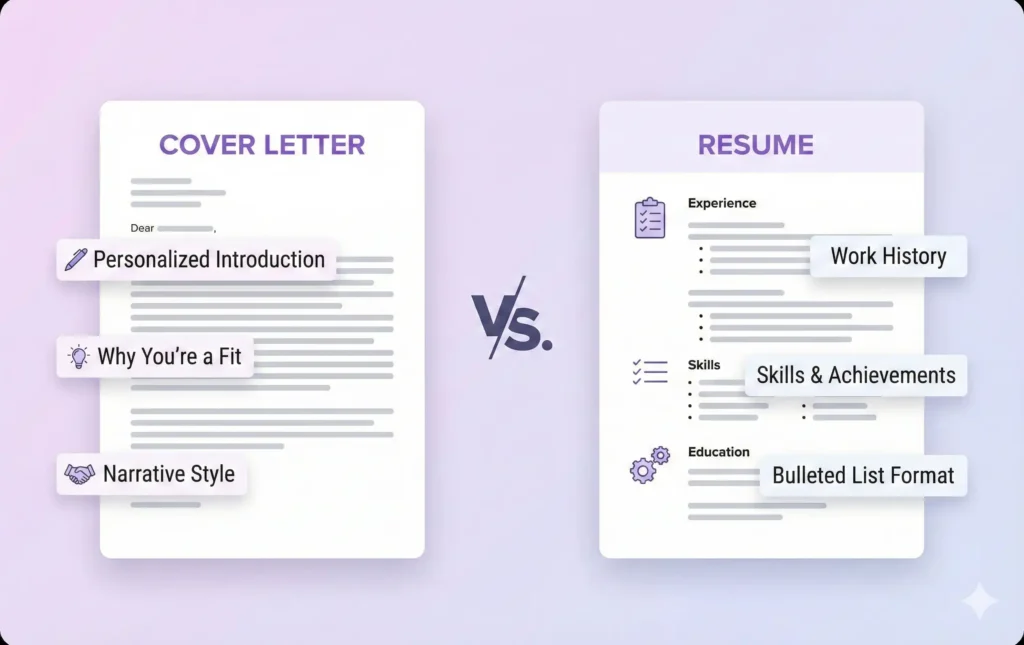
When it comes to the recruitment vertical, the resume and cover letter serve two distinct masters. The resume is your professional ledger; a cold, hard look at your history. The cover letter is your introductory handshake; a warm, personalized pitch.
When you use them effectively together, you provide a 360-degree view of who you are. The resume proves you can do the job; the cover letter proves you’re the person they actually want to spend 40 hours a week with.
What is a Resume? (The “What” and “Where”)
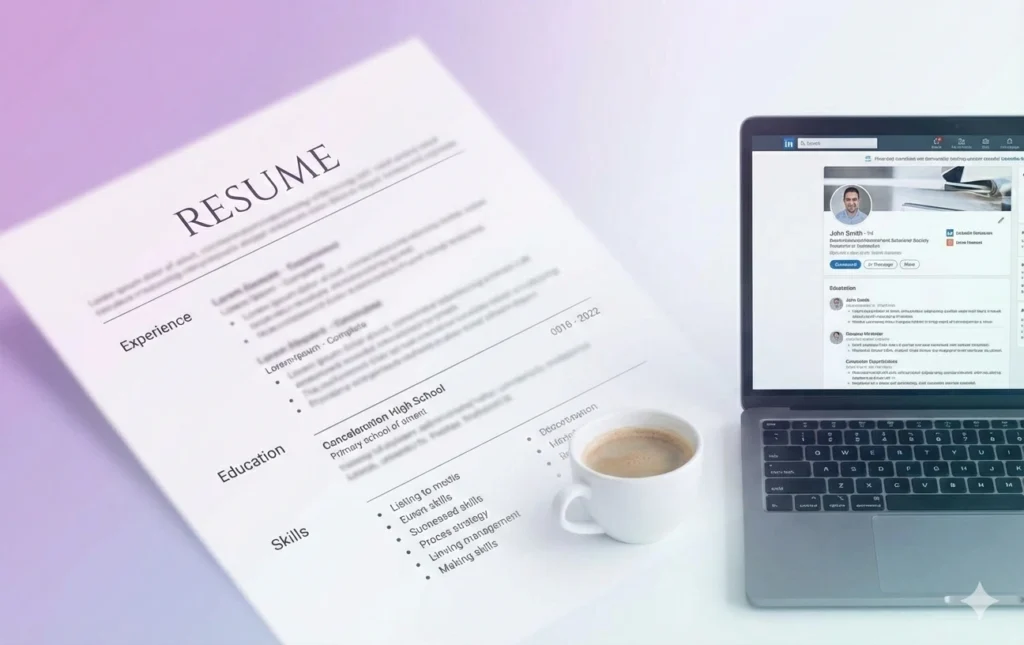
If we had to boil a resume down to its essence, it would be the “What” and “Where” of your career. It is a formal, structured document designed to give recruiters and Applicant Tracking Systems (ATS) a quick, scannable overview of your professional qualifications.
Definition and Core Purpose
At its heart, a resume is a data-driven summary. Its job is to provide evidence. It focuses heavily on facts, dates, and measurable achievements. Recruiters often spend less than ten seconds glancing at a resume, so its purpose is to be a high-speed highlight reel. It shouldn’t tell your whole life story; it should show that you have the specific “specs” required for the role.
Pro-Tip: Think of your resume as your professional “nutrition label.” It lists the ingredients (skills) and the percentages (results) that make up your career.
Standard Components of a Resume
To keep that “scannability” high, resumes follow a fairly rigid structure. Here’s what yours needs to include to pass the test:
- Contact Information: This sounds obvious, but it’s the most important bit. Include your name, a professional-sounding email, your phone number, and a link to your LinkedIn profile. (You can skip your physical street address these days—city and state are plenty).
- Professional Summary or Objective: This is your 2-3 sentence “elevator pitch.” A summary is best for experienced pros (focusing on what you’ve done), while an objective works for career changers or students (focusing on what you aim to do).
- Work Experience (Reverse-Chronological): This is the “meat” of the document. Start with your current or most recent role and work backward. Don’t just list tasks; list achievements. Instead of saying “Managed a team,” try “Led a team of 10 to increase sales by 15% in Q3.”
- Education and Certifications: List your degrees, the institutions you attended, and any relevant certifications. If you’ve been out of school for more than a few years, keep this section brief and place it below your experience.
- Hard and Soft Skills: This is a dedicated section for keywords. Hard skills are technical (like Python, SEO, or Financial Modeling), while soft skills are interpersonal (like Leadership, Conflict Resolution, or Adaptability).
What is a Cover Letter? (The “Why” and “How”)
If the resume is the skeleton of your application, the cover letter is the heart. This is your chance to step out from behind the dry facts and speak directly to the person making the hiring decision. It’s not just a formality; it’s a strategic narrative that explains why you’re applying and how you’re going to solve the company’s specific problems.
Definition and Core Purpose
Think of your cover letter as a personalized pitch. Unlike a resume, which is a broad record of your career, a cover letter is written for one specific person at one specific company.
Its core purpose is to provide context. While your resume says, “I have 5 years of experience in SEO,” your cover letter explains, “I’m passionate about SEO because I love the challenge of helping brands like yours dominate search rankings, and here is how I plan to do that for you.” It focuses on your motivation, narrative, and cultural fit. It’s the place to show that you’ve done your homework on the company and that you aren’t just looking for any job—you’re looking for this job.
Standard Components of a Cover Letter
A great cover letter isn’t a wall of text; it’s a carefully structured argument. To keep it professional yet engaging, stick to these key parts:
- Professional Salutation: Whenever possible, find a name. “Dear Hiring Manager” is fine, but “Dear Mr. Smith” or “Dear Sarah” (if the company culture is casual) shows you’ve put in the extra effort.
- The “Hook” (The Intro): Skip the boring “I am writing to apply for…” start. Instead, lead with a punchy sentence about why you admire the company or mention a major achievement that relates directly to the role.
- The “Body” (The Connection): This is usually one or two paragraphs. Don’t just repeat your resume! Instead, pick one or two standout experiences and explain how they specifically prepare you to tackle the challenges mentioned in the job description. This is where you connect the dots between your past wins and their future needs.
- The “Why Them?” (The Fit): Dedicate a few lines to the company’s mission or values. Showing that you align with their culture is often just as important as showing you have the technical skills.
- Call to Action (The Close): End with confidence. Thank them for their time, express your enthusiasm for an interview, and sign off professionally (e.g., “Best regards” or “Sincerely”).
Now that we’ve defined both players, let’s look at how they actually stack up against each other. Even though they travel together in the same application, they look, sound, and behave very differently.
Key Differences between Resume and a Cover Letter
If you were to lay a resume and a cover letter side-by-side on a desk, the visual difference would be immediate. But the differences go much deeper than just the layout; it’s about how you’re communicating your value to the hiring manager.
Format and Structure
The most obvious difference is the “vibe” of the page.
- The Resume is built for speed. It’s a highly structured, skeletal document. It relies on bullet points, fragments, and clear headings to help a recruiter (or an AI bot) find your years of experience or your proficiency in a specific tool—like SEO software or CMS platforms—in a matter of seconds. It’s the “menu” of your career.
- The Cover Letter is built for flow. It’s a traditional letter, which means full sentences and cohesive paragraphs. There are no bullet points here (usually). It’s meant to be read from top to bottom, like a story. If the resume is the menu, the cover letter is the “chef’s recommendation” that explains why a specific dish is perfect for your palate today.
Perspective and Tone
This is where many job seekers get tripped up. The “voice” you use in each document should be distinct.
- The Resume uses a formal, almost clinical tone. In fact, you usually leave out personal pronouns like “I” or “me” entirely. Instead of saying “I managed a team,” you simply say “Managed a team.” It’s objective and focused on the facts of the past.
- The Cover Letter is deeply personal. It’s the only place in your application where you get to say “I.” The tone is professional but conversational—like the way you’d speak to a respected mentor. It allows you to express enthusiasm, which is something a resume can’t do. You can say, “I’ve followed your company’s growth in the AI hiring space for years,” which adds a layer of human connection.
Content Focus
Finally, consider the “timeline” of the information you’re sharing.
- The Resume is the Archive. It is a historical record of everywhere you’ve been. It covers your entire relevant professional life, often going back 10 or 15 years. It’s broad and comprehensive.
- The Cover Letter is the Strategy. It is laser-focused on the future. While it might reference one or two past achievements, it does so only to prove that you can handle the specific responsibilities of the job you’re applying for right now. It doesn’t care about everything you’ve done; it only cares about what you can do for this employer starting Monday morning.
Comparative Analysis: Resume vs. Cover Letter
| Feature | Resume | Cover Letter |
| Primary Goal | To prove you are qualified for the role. | To prove you are the best fit for the team. |
| Focus | Historical: What you have done. | Future-focused: What you will do. |
| Tone | Formal, objective, and clinical. | Professional, personal, and conversational. |
| Structure | Bullet points and short fragments. | Narrative paragraphs and full sentences. |
| Length | Usually 1–2 pages. | Strictly 1 page (approx. 250–400 words). |
| Perspective | Third-person (no “I” or “me”). | First-person (“I” and “my”). |
| Customization | Moderate (tweaked for keywords). | High (written specifically for each company). |
| Key Question | “What can you do?” | “Who are you and why are you here?” |
Why the Balance Matters?
Think of this table as your quality control checklist. If your cover letter starts looking too much like the “Resume” column—full of bullet points and dry facts—you’re missing an opportunity to connect. Conversely, if your resume starts sounding too much like a “Cover Letter”—full of “I believe” and “I feel”—it might get tossed by an automated tracking system (ATS) looking for data.
By keeping these two documents in their own lanes, you ensure that the hiring manager gets the full picture: a candidate who has the hard skills to do the work and the soft skills to thrive in their specific environment.
Why You Need Both for a Successful Application?
Sending just a resume is like sending a blueprint without a pitch doesn’t work, well, almost 90% of the time. You might have the right dimensions, but the builder doesn’t know why they should choose your design over a hundred others.
The Resume Tells the Facts; The Cover Letter Tells the Story
Your resume is essentially a list of ingredients. It tells the recruiter you have the right “stuff”—the degrees, the years of experience, and the technical skills. But a list of ingredients doesn’t tell you how the meal tastes. The cover letter is where you add the flavor. It provides the context that makes those bullet points meaningful. It explains how you used those skills to solve a problem and why that experience makes you the perfect person for this specific team.
Filling in the Gaps
Resumes are notoriously bad at handling “gray areas.” If you have a six-month employment gap, a resume just shows a date jump. If you’re pivoting from marketing to UX design, a resume might look like a mismatch. Your cover letter is the only place where you can control the narrative. It allows you to say, “I took six months off to lead a volunteer project in India,” or “My background in marketing gives me a unique perspective on user psychology in design.” It turns potential “red flags” into unique selling points.
Common Myths Debunked
There’s a lot of outdated advice floating around the internet. Let’s set the record straight on a few common misconceptions.
- Myth 1: “Nobody reads cover letters anymore.”
- The Reality: While some high-volume recruiters might skim them, many hiring managers use them as a “tie-breaker.” If two candidates have identical resumes, the one with a compelling, personalized cover letter will almost always win the interview.
- Myth 2: “A cover letter should be a summary of your resume.”
- The Reality: This is the quickest way to bore a recruiter. If your cover letter just repeats your resume in paragraph form, you’ve wasted a page. Use it to expand on one specific achievement or to discuss your future goals.
- Myth 3: “One size fits all.”
- The Reality: A generic “To Whom It May Concern” letter that you send to 50 companies is often worse than no cover letter at all. Customization is the whole point. If it doesn’t mention the company’s name or specific needs, it’s going in the trash.
Answering Common Queries You Might Have
Should I send a cover letter even if the job posting says it’s optional?
Yes. An “optional” cover letter is a test of your interest; sending one proves you are willing to go the extra mile.
Can a cover letter be longer than one page?
Never. Hiring managers are busy; a concise, high-impact page shows you can communicate effectively and respect their time.
What is the best way to address a cover letter if I don’t know the hiring manager’s name?
Try “Dear [Department] Hiring Team” or “Dear [Job Title] Search Committee” to show you’ve researched the specific team.
Should my resume include my full physical address?
No. In the digital age, including your City, State, and LinkedIn profile is sufficient and protects your privacy.
Is it okay to use a template for my resume and cover letter?
Templates are great for structure, but ensure the content is 100% original and tailored to each specific application.
How many bullet points should I have per job entry on my resume?
Aim for 3–5 high-impact bullets focusing on measurable achievements rather than just a list of daily responsibilities.