An Active Candidate is a job seeker who is intentionally and currently searching for new employment, actively applying for roles, and engaging with recruiters or hiring platforms on a regular basis. Unlike passive candidates who may be casually open to opportunities, the active candidate has made a deliberate decision to pursue a career move and is investing time and effort into that search.
Managing the active candidate pipeline is mission-critical for modern talent acquisition teams, especially those taking advantage of AI-powered hiring platforms. When this pipeline is optimized, measurable hiring outcomes improve dramatically: time-to-fill shrinks, candidate quality rises, and cost-per-hire drops.
What is an Active Candidate?
An active candidate is an individual who is actively seeking new employment opportunities, submitting job applications, attending interviews, and engaging with recruiters. This person has made a conscious decision to leave their current role or re-enter the workforce and is dedicating time to the job search process.
When a company sees a high volume of active candidates flooding its pipeline, it usually signals two things simultaneously. First, the employer brand is doing its job and attracting attention. Second, and this is where the trouble starts, the screening phase may be bottlenecked. Without intelligent filtering, a surge of active candidates can overwhelm recruiters, burying qualified applicants under a mountain of mismatched resumes. That is exactly the gap that AI-driven recruitment tools were designed to close.
Formula for Active Candidate Ratio
Active Candidate Ratio (%) = (Actively Engaged Candidates ÷ Total Talent Pool) × 100
Are High-Volume Active Candidates Costing You More Than Passive Hires?
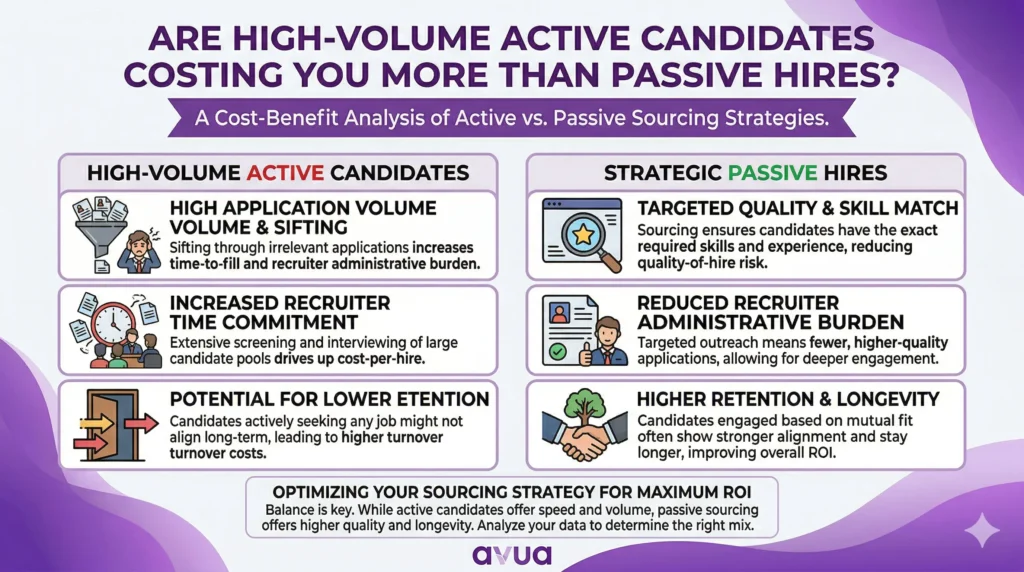
For decades, managing active candidates meant the same thing: recruiters sifting through towering stacks of resumes, one by one. A hiring manager would post a job on a major board, receive hundreds of applications within 48 hours, and then spend weeks manually reviewing each one. The process was linear, exhausting, and brutally inefficient. Recruiter burnout was not an edge case; it was the default operating condition.
AI has changed the equation entirely. Modern hiring platforms ingest applications in real time, parse resumes semantically rather than relying on keyword matches, and surface the top candidates within minutes. The visibility that AI provides into the active candidate pool is transformative. Instead of a recruiter guessing which 20 resumes to read first, an algorithm scores and ranks applicants against the actual requirements of the role.
Here is the uncomfortable data point that every talent acquisition leader needs to internalize: 73% of active candidate applications do not meet the core job requirements. That is not a minor inefficiency. That is nearly three out of every four applications consuming recruiter time with zero return. The signal this sends is clear. Filtering efficiency is not a nice-to-have. It is the single largest lever TA leaders can pull to prevent top-tier active talent from being lost in a sea of unqualified noise.
Consider a real-world scenario. A senior backend engineer, currently employed but actively looking, finds a role that perfectly matches her skill set. She clicks apply. The Applicant Tracking System asks her to manually re-enter every detail already on her uploaded resume. The form crashes on mobile. She abandons the application at step four. Two weeks later, she accepts an offer from a competitor whose process took twelve minutes from start to finish. The company that lost her never even knew she existed in their pipeline.
Now let us talk ROI. If your organization currently takes an average of 14 days to screen active candidates and AI automation reduces that to 3 days, the downstream effects are measurable. Assume an average cost-per-hire of $4,700 and an average daily lost-productivity cost of $420 per unfilled role. Reducing screening time by 11 days saves roughly $4,620 in lost productivity per hire.
Scale that across 50 hires per year and you are looking at over $230,000 in recovered value, alongside a projected 40% reduction in cost-per-hire. That is not a theoretical benefit. That is budget you can reallocate to employer branding, retention programs, or strategic sourcing initiatives.
Your Resume Isn’t Getting Read
Let’s Get That Fixed!
75% of resumes get auto-rejected. avua’s AI Resume Builder optimizes formatting, keywords, and scoring in under 3 minutes, so you land in the “yes” pile.
The Psychology Behind the Active Candidate
What makes someone hit “apply” at 11pm on a Tuesday? Active candidates operate on emotion, urgency, and unmet needs. Decode their psychology, and you’ll stop chasing applicants; and start attracting the right ones.
Application Fatigue and Cognitive Load
Job hunting is cognitively expensive. Every application an active candidate submits requires parsing a new job description, tailoring a resume, writing or adjusting a cover letter, and navigating an unfamiliar ATS interface. After the fifth or sixth application in a single day, cognitive fatigue sets in. Decision-making quality deteriorates. Attention to detail drops. The candidate starts submitting generic, un-tailored applications, or worse, they abandon the process altogether when they encounter friction.
Research in behavioral economics calls this ego depletion: the more decisions you force someone to make in sequence, the worse each subsequent decision becomes. For employers, the practical implication is blunt. If your application process is longer or more complex than your competitors, you are not filtering for the best candidates. You are filtering for the most patient ones.
The Paradox of Choice in a Gig Economy
Modern job boards and easy-apply features have created an environment where active candidates have access to thousands of roles with a single click. Ironically, this abundance of choice does not empower candidates. It paralyzes them. Psychologist Barry Schwartz’s paradox of choice applies directly: when faced with too many options, people experience decision anxiety, commitment hesitation, and post-decision regret. In the hiring context, this manifests as candidate ghosting.
An active candidate applies to fifteen roles, receives callbacks from six, and then struggles to commit to any single process because something better might be one click away. For recruiters, the takeaway is that speed and clarity of communication are the most powerful antidotes to ghosting. The faster you engage, the less time a candidate has to second-guess.
Trust Asymmetry and Social Proof
Active candidates have been burned before. They have read corporate job descriptions that promised “dynamic, fast-paced environments” only to discover micromanagement and outdated tech stacks. This creates a persistent trust asymmetry: candidates inherently distrust the polished language of job postings and instead rely heavily on social proof.
Glassdoor reviews, LinkedIn posts from current employees, and Reddit threads carry more weight than any careers page. For employers, this means that a transparent, honest hiring process is not just an ethical choice. It is a strategic one. Active candidates who see consistency between a company’s external brand and the actual interview experience are significantly more likely to accept offers and refer peers.
Active Candidate vs. Other Recruitment Funnel Metrics
| Metric | What It Measures | Key Difference from Active Candidate |
|---|---|---|
| Passive Candidate Ratio | Percentage of hires sourced who were not actively looking | Represents the exact inverse in terms of intent and sourcing strategy |
| Conversion Rate | Percentage of candidates advancing from one stage to the next | Measures funnel efficiency rather than candidate intent status |
| Time to Fill | Days taken to fill an open requisition | A lagging indicator, whereas active candidate volume is a leading indicator |
| Quality of Hire | Long-term performance and retention of the new hire | Measures post-hire success rather than pre-hire search status |
| Cost Per Hire | Total recruiting costs divided by the number of hires made | A financial metric that is heavily influenced by active candidate volume |
Active candidate volume is a leading indicator that dictates the workload of the entire recruitment funnel. When active candidate volume spikes without proportional improvements in screening efficiency, both Cost Per Hire and Time to Fill increase. Treating active candidate metrics as an upstream signal rather than a downstream report allows TA teams to allocate resources proactively instead of reactively.
What the Experts Say on Active Candidates?
In an AI-driven recruitment domain the dichotomy between active and passive candidates is collapsing. The true competitive advantage isn’t just finding passive talent, but using automation to rapidly identify the passive-quality talent hiding within your active candidate avalanche.
Josh Bersin, Global Industry Analyst
How to Measure and Improve Active Candidate Quality?
Formula
Active Candidate Quality Yield (%) = (Active Candidates Advancing to Interview ÷ Total Active Applicants) × 100
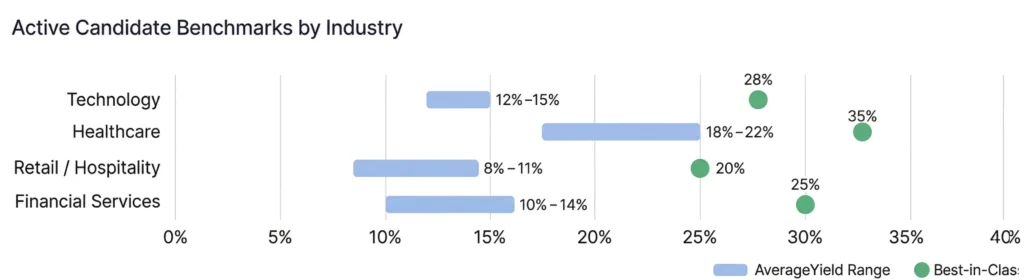
Benchmarks by Industry
| Industry | Average Active Candidate Yield | Best-in-Class |
|---|---|---|
| Technology | 12% – 15% | 28% |
| Healthcare | 18% – 22% | 35% |
| Retail / Hospitality | 8% – 11% | 20% |
| Financial Services | 10% – 14% | 25% |
These benchmarks reveal a consistent pattern: the gap between average and best-in-class performance is enormous, often double or more. Organizations that invest in AI-driven screening and streamlined application experiences consistently outperform their peers in active candidate quality yield.
Key Improvement Strategies
How Can AI and Automation Solve Active Candidate Overload?
Active candidate overload is real, hundreds of applications, dozens of follow-ups, and a hiring team stretched thin. AI and automation don’t just speed up the process; they bring structure, signal, and sanity back to high-volume recruiting.
Intelligent Parsing and Contextual Matching
Traditional ATS platforms rely on keyword matching, which is notoriously blunt. A candidate who describes their experience as “led cross-functional product launches” might be filtered out of a search for “project management.” AI-powered parsing goes beyond keywords to understand the semantic context of a resume.
Natural language processing models identify transferable skills, infer seniority levels from career trajectories, and reduce false positives in screening. The result is a dramatically smaller but higher-quality shortlist, freeing recruiters to spend their time on relationship-building rather than filtering.
Chatbot-Assisted Workflows
The moment an active candidate clicks “apply,” a clock starts ticking. Every hour without acknowledgment increases the probability of drop-off. NLP-driven chatbots handle the immediate FAQs that active candidates invariably ask: What is the salary range? Is remote work available?
What does the interview process look like? By providing instant, accurate responses 24/7, chatbots keep candidate engagement high without taxing HR resources. They also collect structured data during the conversation, pre-qualifying candidates before a human recruiter ever reviews their profile.
Predictive Intervention for Flight Risks
Not all active candidates signal their disengagement loudly. Some simply go quiet. AI systems can analyze behavioral signals, such as the time taken to reply to emails, patterns in portal logins, and assessment completion velocity, to flag high-value active candidates who are losing interest. These predictive alerts prompt recruiters to intervene with a personalized touchpoint before the candidate accepts another offer. It is the recruiting equivalent of churn prevention in SaaS.
Automated Follow-Ups and ML-Optimized Sequencing
One of the most common complaints from active candidates is the “black hole” experience: they apply, and then hear nothing for weeks. Machine learning determines the optimal time and channel, whether SMS, email, or in-app notification, to communicate with each active candidate based on their historical engagement patterns. Automated sequencing ensures that every candidate receives timely, relevant updates without requiring manual effort from the recruitment team. The result is a candidate experience that feels personal and responsive, even at scale.
Stop Juggling
10 Job Boards.
Search One
Your next role is already here. avua pulls opportunities from across the web into a single searchable feed; filtered by role, location, salary, and remote preference.
1.5 Million+
Active Jobs
380+
Job Categories
Active Candidate and Diversity & Inclusion
Active candidates are already raising their hands. The real question is: whose hands are you seeing? Connecting D&I principles to active candidate strategy ensures your pipeline is wide, fair, and built for long-term organizational strength.
Digital Access and Literacy Gaps
Over-reliance on complex ATS portals disproportionately screens out active candidates from lower-income or marginalized backgrounds. Candidates who lack reliable broadband access, up-to-date devices, or familiarity with multi-step digital application flows are systematically disadvantaged before they even have a chance to demonstrate their qualifications. A recent workforce survey found that nearly 40% of hourly workers in the United States do not have consistent access to a desktop computer, meaning they rely entirely on mobile devices for job searching.
When your ATS does not render properly on a smartphone, you are not just losing candidates. You are losing entire demographic segments. Simplifying the application UX and offering alternative pathways, such as WhatsApp-based or SMS-based applications, is not just a DE&I initiative. It is a talent acquisition strategy that meaningfully expands the addressable candidate pool and reflects the reality of how modern job seekers actually search.
Language and Accessibility Barriers
WCAG compliance and multilingual application processes are essential for ensuring that non-native speakers and neurodivergent active candidates are not filtered out by biased system design. Screen reader compatibility, clear visual hierarchy, plain-language instructions, and translated interfaces all contribute to a more inclusive experience. Companies that invest in accessibility often discover that the improvements benefit all candidates, not just those with specific needs.
Bias in Self-Selection
Research consistently shows that demographic groups respond differently to job descriptions. A widely cited finding indicates that women tend to apply only when they meet 100% of listed criteria, while men apply at around 60% match. This self-selection bias means that overly specific or aspirational job descriptions systematically narrow the active candidate pool along gender lines.
AI writing tools that analyze and neutralize gendered language, remove unnecessary requirements, and emphasize growth potential can meaningfully broaden the diversity of applicants without lowering quality standards.
Common Challenges & Solutions
| Challenge | Solution |
|---|---|
| High Volume, Low Quality: Recruiter inboxes are flooded with unqualified active candidates. | Implement AI-driven automated scoring to stack-rank applicants instantly based on core competencies and role-fit signals. |
| Candidate Ghosting: Active candidates abandon the process halfway through. | Audit the application UX and deploy SMS-based chatbot scheduling to reduce logistical friction and maintain candidate momentum. |
| Siloed Candidate Data: Past active candidates are forgotten in the ATS. | Use AI talent rediscovery tools to mine the existing ATS database for previous applicants before spending on new job advertising. |
Real-World Case Studies
Theory tells you what should work. Case studies show you what does. From high-volume hiring crunches to D&I pipeline gaps, these real-world examples reveal how teams turned active candidate pressure into measurable hiring wins.
Scaling Tech Support in FinTech
A mid-size financial services firm was experiencing a 90% drop-off rate from active candidates during its hiring process. The culprit was a mandatory 45-minute technical assessment positioned immediately after the initial application. Candidates who were applying to multiple roles simply did not have the bandwidth to invest that time upfront.
By switching to AI-driven micro-assessments, short, adaptive skill checks that took less than ten minutes, the firm improved active candidate retention by 60% and cut time-to-hire in half. The quality of hires did not decrease; in fact, hiring managers reported higher satisfaction with the caliber of shortlisted candidates because the micro-assessments measured applied competency rather than endurance.
Recovering the “Silver Medalists” in Healthcare
A regional hospital network was spending heavily on staffing agencies to fill nursing roles. Their ATS contained thousands of past active candidates, including runners-up from previous hiring cycles, who had never been re-engaged. By implementing an AI-powered talent pooling system, the hospital automatically identified and contacted past applicants whose profiles matched current openings.
The result was a $250,000 annual reduction in external agency spend and a 35% faster time-to-fill for nursing positions. The candidates, many of whom had improved their credentials since their last application, appreciated being proactively approached rather than forgotten.
The Mobile-First Retail Redesign
A national retail chain discovered through analytics that 78% of its hourly workforce candidates were attempting to apply via mobile devices, but its desktop-only ATS had a mobile completion rate of just 12%. The company migrated its application flow to a WhatsApp-based AI system where candidates could apply via conversational prompts.
The Results were Staggering: a 300% increase in completed applications, a significantly more diverse applicant pool reflecting the communities the stores served, and a 40% reduction in time-to-hire for hourly roles.
Building an Active Candidate Dashboard: What to Track?
If you’re serious about treating abandonment rate as a strategic KPI, you need a dedicated dashboard. Here’s what belongs on it.
Active Candidate Across the Candidate Lifecycle
Miss an active candidate at the wrong stage and you lose them; to a competitor, to frustration, or simply to silence. Tracking how active candidates evolve across the full lifecycle turns a one-time interaction into a repeatable, conversion-driven hiring strategy.
Pre-Application Active Candidate
Before an active candidate ever clicks “apply,” they are already evaluating your organization. This research phase involves browsing your careers page, reading employer reviews on Glassdoor and Indeed, scanning LinkedIn for current employee posts, and comparing your compensation range to competitors. The pre-application experience is the first filter, and it is entirely controlled by the employer.
According to talent branding research, 75% of active candidates consider an employer’s brand before even applying. Companies that invest in compelling, honest, and easily navigable career pages convert a significantly higher percentage of browsing active candidates into actual applicants. Conversely, a slow-loading careers page or a confusing job taxonomy can lose a candidate in under ten seconds.
Assessment Active Candidate
Skills tests, one-way video interviews, and personality assessments introduce meaningful friction into the candidate journey. While these tools provide valuable data to hiring teams, they also represent the point of highest drop-off for active candidates who are juggling multiple applications simultaneously. The key is calibration: assessments should be short, mobile-friendly, and directly relevant to the role.
Asking a customer service candidate to complete a 60-minute cognitive reasoning test is a guaranteed way to lose them. Best-in-class organizations are now deploying adaptive micro-assessments that take under ten minutes, dynamically adjusting difficulty based on the candidate’s responses. This approach captures meaningful signal without burning through the candidate’s limited patience and goodwill.
Interview Scheduling Active Candidate
Interview scheduling is the logistical bottleneck where high-intent active candidates are most often lost to competitors. The back-and-forth of email coordination, timezone confusion, and last-minute reschedules creates frustration that compounds with each exchange. AI-powered self-scheduling tools that allow candidates to book directly into interviewer calendars eliminate this friction entirely. The best organizations are moving from days of scheduling ping-pong to same-day interview confirmation.
Offer-Stage Active Candidate
Here is the uncomfortable truth that many hiring managers forget: an active candidate remains active until their first day on the job. Post-offer drop-off and counter-offers are real and increasing risks, particularly in competitive markets where candidates routinely hold two or three offers simultaneously. The offer stage requires just as much engagement and communication as the sourcing stage.
Personalized check-ins, transparent onboarding previews, introductions to future teammates, and proactive answers to the candidate’s lingering concerns can mean the difference between a signed contract and a last-minute reversal. Some forward-thinking companies now assign a “candidate concierge” during the offer-to-start window, ensuring the active candidate feels valued and informed throughout what is often the most anxiety-filled phase of a career transition.
The Real Cost of Active Candidate Mismanagement: By the Numbers
Financial impact model for a company hiring 100 roles per year:
| Scenario | Active Candidate Quality Yield | Applications Reviewed | Est. Wasted Spend |
|---|---|---|---|
| Current State (Manual) | 8% | 12,500 | $185,000 |
| Moderate Improvement (Light Automation) | 15% | 6,600 | $95,000 |
| Best-in-Class (AI-Powered) | 28% | 3,500 | $42,000 |
The difference between the manual baseline and best-in-class AI-powered operations is $143,000 per year for a 100-hire organization. More importantly, it recovers hundreds of administrative hours that TA teams can reallocate toward strategic employer branding, proactive sourcing, and candidate relationship management.
Related Terms
| Term | Definition |
|---|---|
| Passive Candidate | A professional who is currently employed and not actively looking for a new job but may be open to the right opportunity. |
| Talent Pool | A centralized database of candidate profiles, including past applicants, sourced leads, and alumni. |
| Applicant Tracking System (ATS) | Software used by recruiters to manage the hiring process and track candidate progress through each stage. |
| Candidate Experience | The sum of all interactions and perceptions a job seeker has with an employer during the hiring lifecycle. |
| AI Recruiting | The use of artificial intelligence to automate, streamline, and remove bias from the talent acquisition process. |
Frequently Asked Questions
What is the average active candidate ratio for a healthy pipeline?
A healthy talent pipeline typically maintains a 60/40 split between active and passive candidates, though this ratio shifts significantly based on role seniority. Entry-level and mid-level positions tend to attract a higher proportion of active candidates, while senior and executive roles lean more heavily toward passive sourcing. The goal is not to maximize active candidate volume but to maintain a balanced pipeline that supports both speed and quality.
Does employer branding improve active candidate quality?
Definitively, yes. Organizations with strong employer brands attract 50% more qualified active applicants and see measurable reductions in cost-per-hire. When candidates already understand and resonate with the company’s mission and culture before applying, they self-select more accurately, resulting in a higher-quality applicant pool that requires less aggressive filtering downstream.
How does AI resume parsing reduce active candidate drop-off?
AI-powered resume parsing auto-fills application fields from uploaded PDFs or LinkedIn profiles, reducing a 15-minute manual data entry process to approximately 30 seconds. This single improvement has an outsized impact on application completion rates because it removes the most tedious and time-consuming step at the exact moment when candidate motivation is highest.
Can a high active candidate ghosting rate be reversed?
Yes, and the most impactful lever is reducing time-to-first-contact to under 24 hours. Automated AI sequencing combined with SMS updates keeps the candidate engaged from the moment they apply. Organizations that implement this typically see ghosting rates drop by 30–45% within the first quarter. The key insight is that ghosting is almost never about disinterest. It is about friction and silence. When candidates feel seen and informed, they reciprocate with commitment. A simple automated text saying “We received your application and a recruiter will contact you within 24 hours” can cut early-stage ghosting by more than 20% on its own.
Does active candidate experience affect broader company revenue?
More than most leaders realize. Research indicates that up to 60% of spurned active candidates will boycott a consumer brand’s products after a negative hiring experience. For consumer-facing companies, every rejected candidate is also a customer. The financial multiplier of poor candidate experience extends far beyond recruiting costs into lost revenue and damaged brand equity.
Conclusion
The “Active Candidate” is not merely a status label or a pipeline metric. It is a living gauge of your employer brand’s market friction and your recruitment operation’s efficiency. Every active candidate who encounters a clunky application, waits two weeks for a response, or ghosts because a competitor moved faster is a data point telling you where your process is leaking value.
The fixes are not mysterious: reduce application friction, deploy AI for instant screening and engagement, and prioritize transparent, timely communication at every stage of the funnel.
Organizations that treat active candidate experience as a core strategic KPI, rather than an operational afterthought, will ultimately win the modern talent war. The technology exists. The benchmarks are clear. The playbook has been written by early adopters across fintech, healthcare, and retail. The only remaining variable is whether your organization chooses to act on what the data has already proven.
The companies that will dominate talent acquisition in the next decade are not the ones with the biggest recruiting budgets. They are the ones that recognized, earlier than their competitors, that every active candidate is simultaneously a potential employee, a brand ambassador, and a customer. Treat them accordingly, and the returns will compound far beyond the hiring funnel.