Active Sourcing is the proactive identification, engagement, and recruitment of talent who have not applied for a specific role. Instead of waiting for candidates to come to you, Active Sourcing flips the script, transforming the recruiter’s role from a passive “receiver” of applications into an active “hunter” of the best available talent. It encompasses everything from direct outreach on professional networks to sophisticated talent mapping using real-time market intelligence.
In 2026, Active Sourcing has become the backbone of elite talent acquisition. With AI-powered hiring platforms like avua enabling hyper-personalized outreach at scale, organizations are no longer limited by the volume of inbound applicants. Companies that have embraced Active Sourcing consistently report reduced Time-to-Hire and measurably higher Quality-of-Hire. The metric that matters most here? Sourcing Conversion Rate (SCR), the percentage of sourced candidates who ultimately become hires. It’s the single clearest indicator of whether your sourcing engine is running or rusting.
What is Active Sourcing?
At its simplest, Active Sourcing is the methodology of identifying and contacting passive candidates; professionals who are not actively looking for a new role, before they ever appear on the open market. Think of it as the opposite of posting a job ad and waiting. That traditional approach is often called “Passive Sourcing” or, less charitably, “Post and Pray.“
What Active Sourcing truly reveals about an organization is its ability or inability, to build a competitive talent pipeline. When you rely solely on job board applicants, you’re at the mercy of whoever happens to be looking. When you source actively, you control the quality and speed of your pipeline from the very first touchpoint.
Is the “Post and Pray” Era Dead? Why AI Has Turned Every Recruiter into a Headhunter?
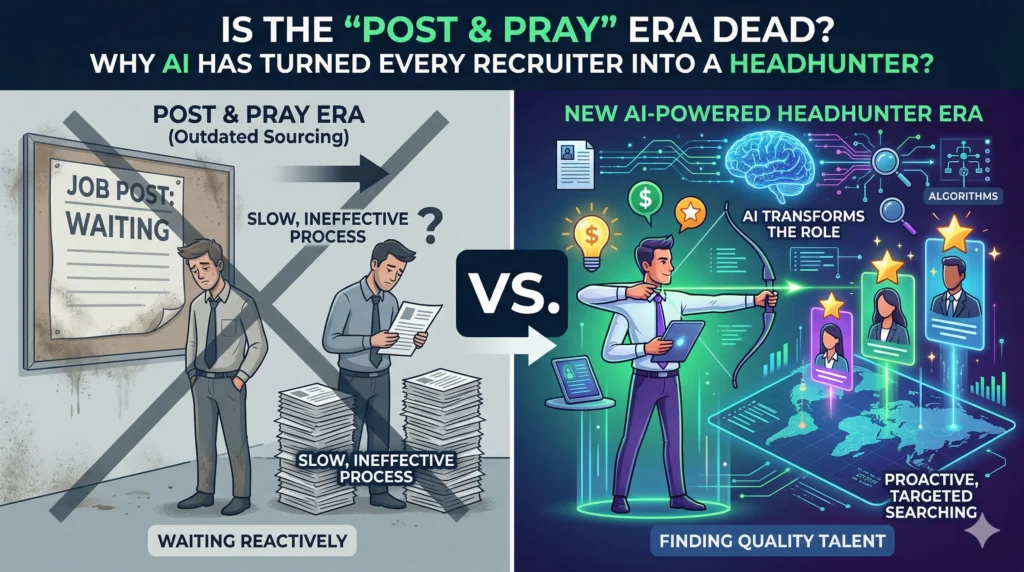
Cast your mind back to 2015. Active Sourcing, for most recruiters, meant one thing: the LinkedIn InMail grind. You’d spend hours scrolling through profiles, crafting semi-personalized messages, and hoping, genuinely hoping, that someone would reply. Response rates hovered around 10–15%, and most of those responses were polite declines. It was manual, repetitive, and brutally inefficient.
Fast forward to 2026, and the landscape is unrecognizable. AI-powered talent mapping tools can now predict a candidate’s “propensity to move” based on signals like company-level attrition patterns, public activity changes, role tenure, and industry hiring velocity. You’re no longer guessing who might be open to a conversation. You’re reaching the right candidate at the right moment, with the right message.
For talent acquisition leaders, this shift demands a hard look at budget allocation. The days of pouring 70% of your recruitment budget into job advertisements and praying for quality applicants are over. That budget needs to move toward sourcing intelligence tools, outreach automation, and recruiter enablement.
Let’s talk real numbers. Consider a mid-size tech company hiring for a senior backend engineer. Through traditional job board advertising, the average time-to-fill is 45 days. The position sits open, the team absorbs the workload, and project timelines slip. Now, contrast that with a targeted AI-sourced hire: a recruiter uses predictive signals to identify five high-fit candidates, launches a personalized sequence, and has a signed offer in 10 days. The difference isn’t just speed, it’s tens of thousands of dollars in lost productivity recovered.
And here’s the ROI that makes CFOs pay attention: if an organization reduces external agency spend by just 15% through building an internal Active Sourcing function, the annual savings for 100 hires equals approximately $225,000. That’s not a rounding error. That’s a strategic advantage.
Your Resume Isn’t Getting Read
Let’s Get That Fixed!
75% of resumes get auto-rejected. avua’s AI Resume Builder optimizes formatting, keywords, and scoring in under 3 minutes, so you land in the “yes” pile.
The Psychology Behind Active Sourcing
Active Sourcing isn’t just a tactical play, it’s a deeply psychological one. Understanding why candidates respond (or don’t) to cold outreach is the difference between a 5% response rate and a 35% one.
The Reciprocity Principle
When a recruiter takes the time to craft a genuinely personalized message, one that references a candidate’s specific project, a recent conference talk, or a career milestone, something powerful happens. The candidate feels seen. This triggers the reciprocity principle: they feel a subtle social obligation to respond in kind.
It’s the “compliment effect” in action. A generic InMail that says “I came across your profile and thought you’d be a great fit” is instantly forgettable. But a message that says “I read your write-up on event-driven architecture in distributed systems, our engineering team is tackling a similar challenge at scale, and I’d love to get your perspective“, that lands differently. The candidate doesn’t feel recruited. They feel respected.
In 2026, AI tools can surface these personalization hooks automatically, pulling from public repositories, published articles, patent filings, and conference appearances. Personalization at scale is no longer an oxymoron.
The Paradox of Choice in Talent
Elite candidates don’t suffer from a lack of options, they suffer from too many. When a top-performing data scientist has fifteen recruiter messages in their inbox every week, decision fatigue sets in. Most messages get ignored, not because they’re bad, but because evaluating them all is exhausting.
Active Sourcing, done well, cuts through this noise by reducing the cognitive burden. Instead of presenting a generic opportunity, great sourcers frame the conversation around a specific career gap or aspiration the candidate has. You’re not adding to the noise. You’re offering clarity.
Trust Asymmetry & Social Proof
The biggest psychological barrier in Active Sourcing is trust asymmetry. You’re asking someone to consider leaving a stable, known environment for an unknown one. The perceived risk is enormous, and it’s always higher for the candidate than for the recruiter.
This is where social proof becomes essential. Mentioning that a former colleague of the candidate recently joined your team, or that your company was recognized in a credible industry ranking, reduces the perceived risk. It shifts the question from “Why should I trust this stranger?” to “Maybe this is worth a conversation.“
Active Sourcing vs. Other Recruitment Funnel Metrics
Active Sourcing doesn’t exist in isolation. It feeds into, and is fed by a broader set of recruitment funnel metrics. Here’s how it compares:
| Metric | What It Measures | Key Difference from Active Sourcing |
|---|---|---|
| Time-to-Fill | Days from job opening to accepted offer | A lagging indicator; Active Sourcing directly reduces it |
| Cost-per-Hire | Total spend divided by hires | Includes advertising; Active Sourcing shifts the cost composition |
| Quality-of-Hire | Performance/retention of new hires | Active Sourcing targets higher-quality passive talent |
| Application Completion Rate | % of applicants who finish the process | Measures inbound funnel; Active Sourcing bypasses this entirely |
| Sourcing Conversion Rate | % of sourced candidates who become hires | The direct output metric of Active Sourcing effectiveness |
The key insight? Active Sourcing is a leading indicator of pipeline health. By the time Time-to-Fill or Cost-per-Hire numbers look bad, the damage is already done. A strong Active Sourcing engine gives you early warning and early control.
What the Experts Say?
By 2026, the distinction between ‘recruiter’ and ‘sourcer’ has vanished. If you aren’t actively mapping talent using AI signals, you aren’t recruiting — you’re just moderating an inbox.
Hung Lee, Editor of Recruiting Brainfood
How to Measure and Improve Active Sourcing?
Formula
The most useful calculation for evaluating your sourcing function isn’t response rate but it’s end-to-end efficiency, here is what I meant:
Active Sourcing ROI = (Total Value of Sourced Hires − Cost of Sourcing Tools/Labor) ÷ Cost of Sourcing Tools/Labor
For example, if your sourced hires generate $500,000 in estimated value (based on performance and retention benchmarks), and your total sourcing investment is $100,000, your ROI is 4x. That’s a number the C-suite understands.
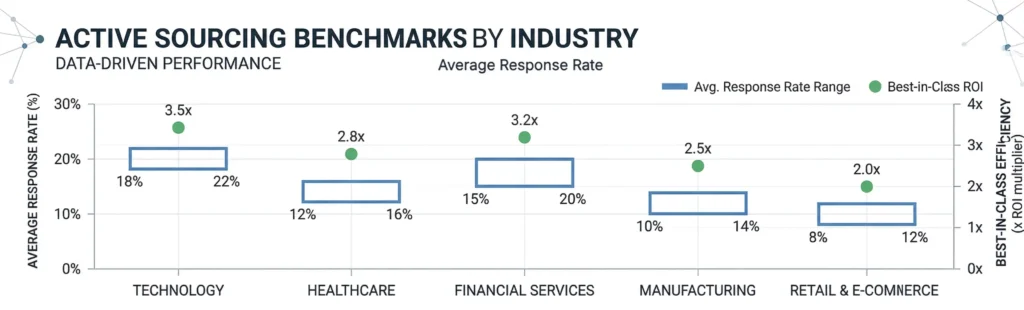
Benchmarks by Industry
| Industry | Average Response Rate | Best-in-Class Sourcing Efficiency |
|---|---|---|
| Technology | 18–22% | 3.5x ROI |
| Healthcare | 12–16% | 2.8x ROI |
| Financial Services | 15–20% | 3.2x ROI |
| Manufacturing | 10–14% | 2.5x ROI |
| Retail & E-Commerce | 8–12% | 2.0x ROI |
Key Improvement Strategies
How Can AI and Automation Solve Active Sourcing?
Let’s be honest: the reason Active Sourcing was historically underutilized wasn’t that recruiters didn’t see its value. It was that the effort required was enormous. AI has fundamentally changed that equation.
Intelligent Talent Mapping
AI-powered talent mapping goes far beyond keyword matching. Modern systems analyze career trajectories, skill adjacencies, project complexity, and organizational context to identify candidates who aren’t just qualified on paper, they’re genuinely high-fit. Instead of searching for “Python developer with 5 years of experience,” you’re finding “engineers who’ve built real-time data pipelines at scale in high-growth environments.” The difference in candidate quality is enormous.
What makes this particularly powerful is the ability to uncover non-obvious candidates, professionals whose LinkedIn titles don’t match your search string, but whose actual experience is a perfect fit. A “Solutions Architect” at a cloud infrastructure company may be exactly the senior backend engineer you need, but traditional keyword searches would never surface them. AI talent mapping closes that gap by understanding what people have actually done, not just what they call themselves.
Generative Outreach
Generative AI can now draft outreach messages that are contextually aware of a candidate’s background, recent work, and likely motivations. The recruiter’s role shifts from writing to reviewing and refining, reducing the time per candidate from 15 minutes to 2, without sacrificing personalization.
This is particularly transformative for sourcing teams handling high-volume roles. A recruiter sourcing 50 candidates per week can now produce genuinely personalized outreach for each one, something that was physically impossible in the manual era. The key is that AI handles the research and first draft, while the human ensures tone, accuracy, and authentic connection. It’s a partnership, not a replacement.
Automated Follow-Up Logic
Most sourced candidates don’t respond to the first message. That’s not failure, it’s reality. AI-driven follow-up sequences can adjust timing, channel, and messaging based on candidate behavior: did they open the email? Click a link? View the LinkedIn profile in return? Each signal informs the next step, creating an adaptive outreach experience.
Predictive Diversity Sourcing
One of the most powerful applications of AI in sourcing is its ability to surface diverse candidates who might otherwise be overlooked. By analyzing non-traditional career paths, educational backgrounds, and transferable skills, AI expands the aperture of who gets considered, without relying on biased search strings or network-dependent referrals.
Stop Juggling
10 Job Boards.
Search One
Your next role is already here. avua pulls opportunities from across the web into a single searchable feed; filtered by role, location, salary, and remote preference.
1.5 Million+
Active Jobs
380+
Job Categories
Active Sourcing and Diversity & Inclusion
Active Sourcing, when done thoughtfully, is one of the most powerful levers for improving diversity in hiring. Here’s why and how.
Breaking the “Network Gap“
Traditional hiring leans heavily on referrals and personal networks. The problem? Networks are inherently homogeneous. If your leadership team is predominantly from one background, their referral networks will largely mirror that. Active Sourcing breaks this cycle by going beyond existing networks to systematically discover candidates from underrepresented groups, geographies, and non-traditional backgrounds.
Anonymized Sourcing Workflows
Forward-thinking organizations are implementing anonymized sourcing stages, where candidate profiles are evaluated based on skills, experience, and potential before any demographic information is visible. This doesn’t mean ignoring diversity; it means ensuring that the initial sourcing filter is based purely on capability, while simultaneously broadening the top of the funnel.
Cognitive Bias in Search Strings
Here’s a subtle but critical issue: the search strings recruiters use can inadvertently introduce bias. Searching for graduates of “top 10 universities” or candidates from “Big Four consulting firms” creates a filter that disproportionately excludes candidates from underrepresented backgrounds. AI-driven sourcing tools can flag these biases and suggest alternative criteria like specific skills, project types, or certification equivalencies that achieve the same quality bar without the exclusionary effect.
Common Challenges & Solutions
| Challenge | AI-Driven Solution |
|---|---|
| Low response rates (<10%) | AI-personalized outreach with optimal send-time prediction |
| Candidate data decay (outdated profiles) | Real-time data enrichment and profile refresh |
| Sourcing for niche/rare skills | Skill adjacency mapping and transferable skill identification |
| Compliance with GDPR/CCPA | Automated consent management and audit trails |
| Measuring sourcing attribution | End-to-end tracking from first touch to hire |
| Recruiter burnout from repetitive tasks | Automation of research, sequencing, and follow-up |
Real-World Case Studies
Case Study 1: Scaling a Fintech Startup
A Series B fintech startup needed to hire 30 engineers in 90 days. Their careers page attracted fewer than 50 applicants per month, nowhere near enough. By implementing an AI-powered Active Sourcing strategy, they identified 400 high-fit passive candidates, launched personalized multi-channel sequences, and achieved a 28% response rate. Result: 32 hires in 85 days, with zero agency fees. The estimated savings compared to using external recruiters was over $320,000.
Case Study 2: The Healthcare Turnaround
A regional hospital network was losing nursing candidates to travel-nursing agencies offering premium rates. Their job postings were attracting experienced nurses at a rate of just 3 per month. They shifted to Active Sourcing, using predictive signals to identify nurses whose travel contracts were ending within 60 days and reaching out with competitive offers and relocation support. Within six months, they filled 45 nursing positions, a 3x improvement and reduced agency dependency by 40%.
Case Study 3: Mobile-First Outreach
A global retail brand discovered that 68% of their target warehouse and logistics candidates primarily used mobile devices. Traditional email-first outreach had a 6% response rate. They pivoted to a mobile-first Active Sourcing strategy: SMS-based initial outreach, followed by WhatsApp for deeper engagement, with a simplified mobile application process. Response rates jumped to 22%, and time-to-hire dropped from 30 days to 12.
Building an Active Sourcing Dashboard: What to Track?
A sourcing dashboard is only useful if it surfaces the metrics that drive decisions. Here are the three that matter most:
Active Sourcing Across the Candidate Lifecycle
Active Sourcing isn’t a single moment, it’s a thread that runs through the entire candidate lifecycle. Here’s how it plays out at each stage.
Pre-Engagement Mapping
Before you send a single message, you need to know who to contact and why. Pre-engagement mapping involves building a living talent map: identifying key talent pools, tracking market movements, and maintaining a prioritized list of high-value targets. This isn’t a one-time exercise it’s an ongoing intelligence function.
The best sourcing teams treat pre-engagement mapping like a sales pipeline. They segment candidates by readiness (likely to move now vs. in 6–12 months), by fit (exact match vs. adjacent skills), and by strategic value (critical roles vs. volume hiring). This segmentation drives everything downstream from messaging strategy to channel selection to follow-up cadence. Without this groundwork, Active Sourcing becomes spray-and-pray with extra steps.
The “First Touch” Experience
The first message a candidate receives from your company sets the tone for the entire relationship. A sloppy, templated outreach doesn’t just get ignored, it actively damages your employer brand with that candidate, potentially for years. The first touch should demonstrate that you’ve done your homework, that you understand the candidate’s context, and that you’re offering something genuinely worth their time.
Sourced Candidate Assessment
Sourced candidates require a different assessment approach than inbound applicants. They haven’t self-selected into your process, which means their motivations, expectations, and timeline may be entirely different. Assessment for sourced candidates should be faster, more respectful of their time, and more focused on mutual fit than on gatekeeping.
Long-term Nurture
The majority of sourced candidates won’t be ready to move when you first reach out. That doesn’t mean they’re lost. A well-designed nurture program keeps your organization in their peripheral vision sharing relevant content, team achievements, and industry insights, so that when they’re ready for a change, you’re already a trusted name in their mental shortlist.
Effective nurture isn’t about bombarding candidates with job alerts. It’s about building a relationship through value. Share a blog post your engineering team wrote about a technical challenge. Invite them to a webinar. Congratulate them on a work anniversary. These micro-interactions compound over time, creating familiarity and trust that no cold outreach can replicate. The companies that nurture best often find that their “passive” candidates come to them when the timing is right, which is the ultimate proof that Active Sourcing works.
The Real Cost of Inactive Sourcing: By the Numbers
What happens when you don’t invest in Active Sourcing? The numbers are sobering.
| Scenario | Sourcing Rate | Hires per Year | Estimated Wasted Agency Spend |
|---|---|---|---|
| No Active Sourcing | 0% | 50 (all inbound/agency) | $750,000 |
| Basic Active Sourcing | 30% | 50 (15 sourced, 35 other) | $525,000 |
| Advanced Active Sourcing | 60% | 50 (30 sourced, 20 other) | $300,000 |
| Best-in-Class | 80% | 50 (40 sourced, 10 other) | $150,000 |
The delta between “No Active Sourcing” and “Best-in-Class” is $600,000 per year, for a company making just 50 hires. Scale that to 200 or 500 hires, and you’re looking at millions.
Related Terms
| Term | Definition |
|---|---|
| Passive Candidate | A professional not actively seeking a new role but open to the right opportunity |
| Talent Pipeline | A pool of pre-qualified candidates maintained for current and future openings |
| Boolean Search | A search technique using operators (AND, OR, NOT) to refine candidate queries |
| Sourcing Conversion Rate | The percentage of sourced candidates who become hires |
| Employer Branding | The perception of a company as a desirable place to work |
| Talent Mapping | Strategic identification and categorization of talent within a market or industry |
Frequently Asked Questions
What is a good response rate for Active Sourcing?
A response rate of 20–30% is generally considered strong for most industries. However, “good” depends heavily on the seniority and scarcity of the role. For executive-level positions, even a 10–15% response rate can yield excellent results if the targeting is precise. The more important metric is the quality of responses, a 15% response rate where half convert to interviews outperforms a 30% rate where most are polite declines.
Does AI make sourcing feel “spammy”?
It can, if it’s implemented poorly. AI without a human feedback loop produces volume without quality. The best teams use AI to generate drafts, surface personalization hooks, and optimize timing, but a human recruiter reviews and adjusts before anything goes out. The goal of AI in sourcing is to make outreach feel more personal, not less.
Can I use Active Sourcing for entry-level roles?
Absolutely. While Active Sourcing is most associated with mid-to-senior hiring, it’s increasingly used for entry-level roles in competitive markets, especially in tech, healthcare, and skilled trades. The approach is different: instead of targeting individual candidates, you might source from specific bootcamps, university programs, or community organizations, using AI to identify the pools most likely to yield high-quality hires.
How do I find personal email addresses for sourcing?
There are several legitimate tools that help locate professional email addresses such as Hunter, Apollo, and Lusha; using publicly available data. However, it’s critical to use these tools ethically and in compliance with applicable privacy regulations. Always provide candidates with a clear opt-out mechanism, and never purchase or use email lists obtained through scraping or unauthorized means.
Is Active Sourcing legal under GDPR/CCPA?
Yes, Active Sourcing is legal under both GDPR and CCPA, provided you follow the rules. Under GDPR, the most common legal basis for processing candidate data during sourcing is “legitimate interest”; but this requires a documented balancing test. Under CCPA, candidates have the right to know what personal information is being collected and to request its deletion. The key is transparency: tell candidates where you found their information, why you’re contacting them, and how they can opt out.
Conclusion
Active Sourcing is no longer a competitive advantage, it’s a competitive requirement. In a labor market where the best candidates are rarely on the open market, organizations that rely solely on inbound applications are systematically selecting from a weaker talent pool. Every week spent waiting for the right candidate to apply is a week your competitor spends closing them.
The fix isn’t incremental. It requires a fundamental shift from reactive, manual candidate search to AI-powered talent intelligence. This means investing in sourcing tools, training recruiters in proactive engagement, and building the infrastructure to nurture relationships at scale. It also means changing how leadership thinks about recruitment, not as an administrative function, but as a strategic capability that directly impacts revenue, innovation, and growth.
The organizations that will win the talent wars of 2026 and beyond are those that don’t wait for talent to find them. They build systems, develop sourcing muscle, and use platforms like avua to find talent first, before the competition even knows to look. The question isn’t whether you can afford to invest in Active Sourcing. It’s whether you can afford not to.