AI Resume Screening is the use of artificial intelligence, including machine learning, natural language processing, and pattern recognition, to automatically evaluate, rank, and filter candidate resumes against the requirements of an open role. Instead of a recruiter spending six to ten seconds scanning each application, an AI system analyses hundreds of data points across every resume in seconds, producing a ranked shortlist grounded in evidence rather than gut instinct.
For talent acquisition teams running on AI-powered hiring platforms, AI resume screening is the single highest-leverage point in the hiring funnel. It determines who gets through the gate and who never gets seen. When screening accuracy improves, everything downstream follows: shorter time-to-fill, lower cost-per-hire, and stronger quality-of-hire scores.
The core efficiency metric tells the story:
Screening Throughput Rate = Resumes Processed ÷ Recruiter Hours Spent
AI systems routinely achieve 500–800 resumes per hour, compared to 20–40 with manual screening.
What is AI Resume Screening?
AI Resume Screening is the automated process of using artificial intelligence to analyse, score, and rank job applications based on predefined and learned criteria including skills, work experience, qualifications, and contextual relevance to a specific role.
Unlike basic keyword filters in traditional applicant tracking systems, AI screening understands context. It recognises that a candidate listing “customer success” likely possesses skills relevant to an “account management” role. It weighs career progression, not just title matches. And it reveals what manual screening cannot: the true quality-to-volume ratio hiding inside your applicant pool, the mismatches between your job descriptions and the candidates they actually attract, and the bandwidth limits that force recruiters to make fast, imperfect decisions.
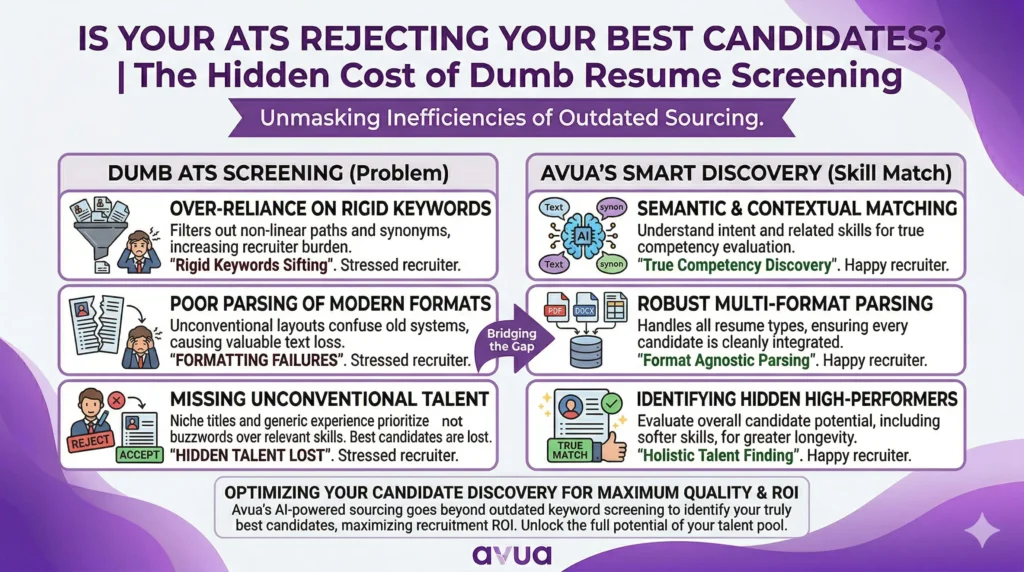
Is Your ATS Rejecting Your Best Candidates? The Hidden Cost of Dumb Resume Screening
Here’s an uncomfortable question for every talent acquisition leader: what if your hiring technology is actively working against you?
For most of the last two decades, resume screening meant keyword matching. A recruiter (or more often, an ATS filter) would scan for exact-match terms; “Python,” “MBA,” “Salesforce” and reject everything that didn’t hit enough checkboxes. The process was fast. It was also spectacularly blunt. A 2024 Harvard Business School and Accenture study on “Hidden Workers” found that 88% of employers acknowledge their automated filters reject qualified candidates. That’s not a rounding error. That’s a systemic failure baked into the infrastructure most companies rely on every single day.
AI-powered screening changes the game by introducing contextual intelligence. Instead of asking “Does this resume contain the word ‘project management’?”, an AI model asks “does this candidate’s experience demonstrate project management capability?” It parses career trajectories, infers transferable skills, and dynamically weights relevance based on what actually predicts success in the role not what a job description writer happened to type six months ago.
The downstream impact is enormous. AI resume screening sits at the very top of the hiring funnel. Every false negative here every qualified candidate rejected by a dumb filter cascades through the entire process. Your shortlists get weaker. Your hiring managers waste interview slots on mediocre fits. Your time-to-fill stretches. And your best candidates? They’ve already accepted offers somewhere else.
Consider a real scenario: a mid-size SaaS company receives 12,000 applications per year across 80 open roles. Their legacy ATS uses rigid keyword matching, rejecting candidates who list “customer success” instead of “account management.” The result? Three extra weeks to fill each role, and roughly $4,200 in incremental cost per hire from recruiter overtime and job re-postings.
Now run the math on a fix. If AI screening improves qualified-candidate pass-through from 25% to 60%, that same company saves approximately $336,000 per year in recruiter labour and reduces average time-to-fill by 18 days. At a blended recruiter cost of $45 per hour and six hours of manual screening per role, that’s 480 hours reclaimed annually hours that can be reinvested in candidate engagement, employer branding, and strategic workforce planning instead of resume triage.
Your Resume Isn’t Getting Read
Let’s Get That Fixed!
75% of resumes get auto-rejected. avua’s AI Resume Builder optimizes formatting, keywords, and scoring in under 3 minutes, so you land in the “yes” pile.
The Psychology Behind AI Resume Screening
AI resume screening doesn’t exist in a vacuum. It interacts with deep cognitive patterns on both sides of the hiring table, the recruiter evaluating candidates and the candidate crafting their application. Understanding these patterns is what separates organisations that deploy AI screening effectively from those that simply automate their existing biases at scale.
Anchoring Bias in First-Pass Screening
When a human recruiter picks up a resume, the first strong signal they encounter a prestigious university, a recognisable company logo, or conversely, an employment gap anchors the entire evaluation. Everything that follows gets filtered through that initial impression. It’s fast, it’s automatic, and it’s devastatingly hard to override.
AI screening can be designed to weight criteria uniformly, but here’s the nuance: poorly trained models replicate anchoring in a different form. If the training data over-represents hires from certain universities or companies, the model learns to anchor on those same signals. AI doesn’t eliminate anchoring. It shifts where the anchor is set. The critical question for TA leaders is whether they’re being intentional about which signals their system treats as anchors, or whether they’ve just inherited someone else’s biases in algorithmic form.
Decision Fatigue and Screening Volume
Research on sequential decision-making consistently shows that quality degrades after roughly 30 to 40 evaluations in a row. The famous Danziger et al. study on judicial parole decisions found that approval rates dropped from 65% to nearly zero over the course of a session, then reset after a break. Recruiters face the same dynamic. Screening 200-plus resumes in a day means the candidates reviewed in hour three get materially less attention than those in hour one.
AI eliminates this entirely. Resume number 500 receives the same analytical rigour as resume number one. But there’s a paradox worth noting: candidates sense this impersonality. The trade-off of fairer, more consistent screening is that it can feel less human, a tension that organisations need to address through transparent communication about their process.
Trust Asymmetry: Candidates vs. Algorithms
Here’s a counterintuitive finding: candidates distrust algorithmic screening more than human screening, even when the algorithm is demonstrably more accurate. Research by Dietvorst, Simmons, and Massey on algorithm aversion shows that people abandon algorithms after seeing them make even a single mistake, while tolerating far higher error rates from humans.
This creates a perception gap. Organisations adopt AI screening for efficiency and fairness. Candidates perceive it as cold and opaque. The fix is surprisingly simple: transparency. Candidate experience surveys suggest that companies disclosing AI involvement something as straightforward as “Your application will be reviewed by our AI system and a human recruiter” see a 34% increase in candidate trust scores. Designing for trust is not an afterthought. It’s a process design decision.
AI Resume Screening vs. Other Recruitment Funnel Metrics
AI resume screening doesn’t operate in isolation it’s one metric in a connected system. Understanding how it relates to other funnel metrics helps TA leaders diagnose where their process is leaking value.
| Metric | What It Measures | Key Difference from AI Resume Screening |
|---|---|---|
| Conversion Rate | % of applicants advancing past each stage | AI screening determines the initial conversion gate; conversion rate measures the output |
| Offer Acceptance Rate | % of offers accepted by candidates | Downstream metric; poor screening inflates offers to weaker-fit candidates |
| Time to Fill | Days from requisition opening to accepted offer | AI screening compresses the top of funnel, typically reducing TTF by 2–4 weeks |
| Source of Hire | Which channels produce hires | AI screening quality varies by source, revealing channel-level signal quality |
| Quality of Hire | Performance and retention of new hires | AI screening is the earliest predictor; quality of hire is the ultimate validation |
| Cost Per Hire | Total recruitment cost ÷ number of hires | AI screening directly reduces manual labour cost, the largest CPH component |
The key insight: AI resume screening is an upstream enabler and a leading indicator. Improvements here cascade across the entire funnel. Unlike lagging metrics such as quality of hire or offer acceptance rate, screening accuracy is something you can act on immediately, and see the effects within a single hiring cycle.
What the Experts Say?
We’re past the era of AI as keyword matching on steroids. The real shift is contextual talent intelligence, systems that understand what a career trajectory means, not just what words appear on a page. Organisations still screening resumes the way they did in 2015 are building their talent pipeline on a broken foundation.
Josh Bersin, Global Industry Analyst
How to Measure and Improve AI Resume Screening?
You cannot improve what you do not measure. Here are the formulas and benchmarks that matter.
Formulas
Screening Accuracy (%) = (True Positives + True Negatives) ÷ Total Resumes Screened × 100
Screening Efficiency Ratio = Resumes Processed per Recruiter Hour (AI-Assisted vs. Manual)
Pass-Through Quality Rate (%) = (Candidates Advancing to Interview ÷ Candidates Passed by Screening) × 100
The first formula tells you how often your system gets it right. The second tells you how fast it works. The third tells you whether the candidates it passes are actually worth interviewing. You need all three.
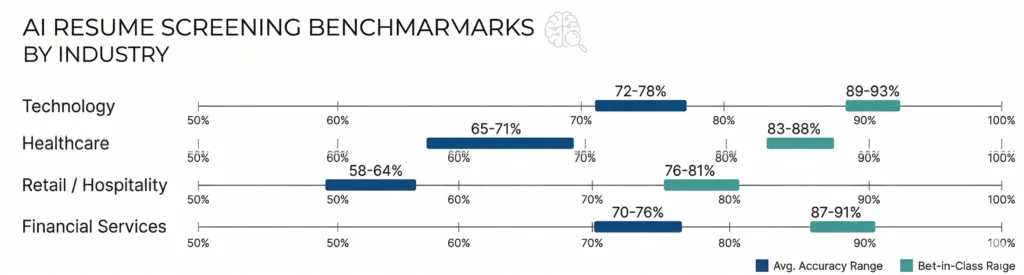
Benchmarks by Industry
| Industry | Average Screening Accuracy | Best-in-Class |
|---|---|---|
| Technology | 72–78% | 89–93% |
| Healthcare | 65–71% | 83–88% |
| Retail / Hospitality | 58–64% | 76–81% |
| Financial Services | 70–76% | 87–91% |
The gap between average and best-in-class typically ranges from 15 to 20 percentage points. That gap represents hundreds of qualified candidates your system is either catching or missing every year.
Key Improvement Strategies
Five strategies that move the needle on screening quality and efficiency:
How Can AI and Automation Solve AI Resume Screening Challenges?
Let’s get specific about the technology. Here are four AI capabilities that are transforming how organisations screen resumes, and the measurable impact of each.
Natural Language Processing (NLP) for Contextual Parsing
NLP goes beyond keyword extraction to understand what a resume actually says. It parses achievements (“led a team of 12 engineers” versus “member of an engineering team”), infers seniority from language patterns, and maps industry-specific jargon across sectors. A candidate with “revenue cycle management” experience in healthcare might be an excellent fit for a “billing operations” role in SaaS, but only an NLP-powered system would make that connection. The impact is significant: NLP-powered screening reduces false negatives by 35–45% compared to keyword-only systems.
Predictive Analytics for Candidate-Role Fit
Machine learning models trained on historical hiring outcomes, offer acceptance, 90-day retention, performance ratings, can predict candidate-role fit from resume signals alone. These models surface “non-obvious” fits: candidates whose resumes don’t pattern-match against traditional criteria but whose career trajectories strongly predict on-the-job success. Organisations using predictive resume analytics report 23% higher quality-of-hire scores at 12 months compared to those relying on traditional screening methods.
Automated Screening Workflows with Human-in-the-Loop
The most effective AI screening systems aren’t fully autonomous, they’re hybrid. AI handles first-pass screening and scoring, auto-advances clear passes, and flags borderline candidates for human review. This preserves efficiency while maintaining human judgment for the cases that need it most: career changers, non-linear career paths, and high-potential outliers who defy algorithmic patterns. Hybrid workflows process 10x the volume while maintaining 95%+ alignment with human reviewer decisions on the same candidate pool.
Continuous Learning and Model Calibration
AI screening systems that ingest downstream hiring outcomes, interview pass rates, offer acceptance, new-hire performance reviews, continuously refine their scoring models. Every hiring decision becomes a data point that sharpens the model’s understanding of what “good” looks like for each role family. But a warning: without diverse training data and regular recalibration, models can drift toward replicating historical biases. Best practice is quarterly recalibration with explicit fairness constraints built into the objective function.
Stop Juggling
10 Job Boards.
Search One
Your next role is already here. avua pulls opportunities from across the web into a single searchable feed; filtered by role, location, salary, and remote preference.
1.5 Million+
Active Jobs
380+
Job Categories
AI Resume Screening and Diversity & Inclusion
AI resume screening is simultaneously the biggest DEI risk and the biggest DEI opportunity in modern hiring. The difference comes down to design decisions.
Algorithmic Bias and Training Data Gaps
AI models trained on historical hiring data inherit historical biases. Amazon’s discontinued 2018 resume screening tool remains the canonical cautionary tale, trained on a decade of hiring data that skewed male, the system learned to penalise resumes containing the word “women’s.” The lesson isn’t that AI screening is inherently biased. It’s that AI faithfully learns whatever patterns you feed it, including the ones you’d rather not replicate. Fairness-aware ML techniques, representative training datasets, and mandatory disparate impact testing before deployment are non-negotiable safeguards.
Language and Accessibility Barriers
Non-native English speakers, neurodiverse candidates, and those using assistive technologies often format resumes in ways that trip up parsing engines. Most AI screening models are English-first, with significantly lower accuracy for multilingual resumes. WCAG compliance in screening interfaces remains inconsistent across the industry. Research indicates that candidates with non-Western name structures experience 12–18% lower callback rates in keyword-based systems. AI contextual models can normalise this disparity, but only if designed with that intent from the start.
Bias in Self-Selection and Application Behaviour
The widely cited Hewlett Packard internal study found that women typically apply to roles only when they meet 100% of listed criteria, while men apply at around 60%. AI screening that rigidly enforces every listed requirement amplifies this gender gap at scale. Candidates from underrepresented backgrounds are also more likely to self-screen out when AI screening is mentioned without transparency about criteria. The implication is clear: improving AI screening design, distinguishing “must-haves” from “nice-to-haves,” communicating criteria openly, is itself a meaningful DEI intervention.
Common Challenges & Solutions
| Challenge | Solution |
|---|---|
| High false-negative rate: Qualified candidates rejected due to non-standard resume formats, career gaps, or unconventional career paths. | Implement contextual NLP parsing that evaluates career trajectories and transferable skills rather than exact keyword matches. Add a “borderline review” queue for human escalation on candidates scoring within 10% of the pass threshold. |
| Black-box scoring: Recruiters and hiring managers cannot explain why a candidate was rejected, creating compliance and trust issues. | Deploy explainable AI (XAI) models that generate per-candidate score breakdowns showing which criteria contributed positively or negatively. Integrate score rationale into the recruiter dashboard. |
| Model drift and bias amplification: Screening models degrade over time as role requirements evolve and training data becomes stale. | Establish quarterly model recalibration cycles using recent hire performance data. Run automated disparate impact analyses before each deployment. Surface drift metrics on the screening dashboard. |
Real-World Case Studies
Case Study 1: Mid-Size SaaS Company (350 Employees, ~90 Hires/Year)
The Problem: A legacy ATS keyword filter rejected 68% of applicants on first pass. But when the TA team audited a sample of rejected candidates, they found that 40% had relevant transferable skills the system had missed. Average time-to-fill sat at 52 days.
What they Changed? The company implemented NLP-based contextual screening with skills-graph matching and a human-review queue for candidates scoring within 15% of the pass threshold.
The Result: Time-to-fill dropped to 34 days (−35%). False-negative rate fell from 40% to 12%. Recruiter screening time decreased by 60%, freeing 22 hours per week across the talent acquisition team.
Case Study 2: Regional Healthcare System (1,200 Employees, High-Volume Nursing Recruitment)
The Problem: Credentialing complexity meant manual screening took 15+ minutes per nursing application. With 300+ applications per posting, screening backlogs stretched to three to four weeks.
What they Changed? Deployed automated credential verification paired with AI screening that cross-referenced licensure databases, certifications, and experience requirements simultaneously.
The Result: Screening time per application dropped to under two minutes. Backlogs were eliminated within one hiring cycle. Offer-to-start time improved by 11 days, critical for filling urgent patient care positions.
Case Study 3: E-Commerce Startup (80 Employees, Mobile-First Candidate Base)
The Problem: Seventy-two percent of applicants applied via mobile, but the screening system was desktop-optimised. Resume parsing accuracy on mobile-uploaded files, photos of resumes, PDFs from phone storage, was just 54%.
What they Changed? Rebuilt the screening pipeline with mobile-first AI parsing: OCR for image-based resumes, adaptive formatting normalisation, and a progressive profiling flow for incomplete uploads.
The Result: Mobile screening accuracy jumped from 54% to 87%. Application completion rate increased by 41%. The applicant pool diversified significantly, mobile-first candidates skewed younger and more geographically distributed.
Building an AI Resume Screening Dashboard: What to Track?
A screening dashboard should give you real-time visibility into both efficiency and quality. Here are the seven metrics that matter most:
AI Resume Screening Across the Candidate Lifecycle
Most people think of resume screening as a single event, the moment an ATS decides thumbs-up or thumbs-down on an application. In reality, screening is a lifecycle concept. It manifests at every stage of the candidate journey, and each stage creates opportunities to lose (or find) great talent.
Pre-Application Screening
Before a candidate even clicks “Apply,” AI-powered job matching is already at work. Programmatic job ad targeting shows roles to likely-qualified candidates on job boards and talent marketplaces, reducing unqualified application volume by 20–30%. Platforms like avua use this approach, matching candidates to roles based on contextual fit signals before they’ve submitted a single document.
Assessment-Stage Screening
During skills tests, technical assessments, and video interviews, AI screening extends well beyond the resume. AI-evaluated coding challenges, NLP analysis of written responses, and video interview competency scoring all add layers of signal. The key tension here: assessment screening must be validated against actual job performance data, not just face validity.
Interview Scheduling Screening
This one is subtle but real. Friction in interview logistics creates passive screening, candidates who can’t navigate complex scheduling processes simply drop out. AI-assisted scheduling (automated availability matching, timezone detection, self-service rescheduling) reduces this accidental attrition. Companies using AI scheduling tools report 26% fewer interview no-shows and 15% higher candidate satisfaction scores.
Offer-Stage Screening Signals
Silence after offer delivery is a form of negative screening. AI can predict offer acceptance likelihood based on signals collected during the screening stage, response time patterns, engagement scores, competing-offer indicators. Predictive models flag at-risk offers before they’re formally declined, giving recruiters a window for proactive outreach. Ultimately, the quality of initial resume screening determines whether you’re extending offers to candidates who were the best fit in the first place.
The Real Cost of Poor AI Resume Screening: By the Numbers
Let’s model the financial impact for a company hiring roughly 100 roles per year, receiving an average of 150 applications per role (15,000 total), with an estimated 500 truly qualified candidates in the pool.
| Scenario | Screening Accuracy | Qualified Candidates Identified | Est. Wasted Spend |
|---|---|---|---|
| Current State (keyword-only ATS) | 55–62% | ~310 of 500 true fits | $185,000–$220,000/yr |
| Moderate Improvement (basic AI) | 74–80% | ~400 of 500 true fits | $85,000–$110,000/yr |
| Best-in-Class (contextual AI + human review) | 89–93% | ~465 of 500 true fits | $25,000–$40,000/yr |
The difference between the current state and best-in-class? Roughly $160,000–$180,000 per year in recoverable waste, not counting the strategic cost of weaker hires, longer vacancies, and lost productivity. For TA leaders building a business case for AI screening investment, these numbers make the ROI argument almost self-evident.
Related Terms
| Term | Definition |
|---|---|
| Applicant Tracking System (ATS) | Software that manages the recruitment workflow from job posting to hire, often including basic resume filtering capabilities. |
| Candidate Drop-Off Rate | The percentage of applicants who abandon the hiring process at any stage before completion. |
| Quality of Hire | A composite metric measuring the value a new hire brings, typically assessed through performance ratings, retention, and hiring manager satisfaction. |
| Time to Fill | The number of days between opening a job requisition and a candidate accepting the offer. |
| Blind Screening | The practice of removing identifying information (name, photo, university) from applications before evaluation to reduce unconscious bias. |
Frequently Asked Questions
What is a good AI resume screening accuracy rate?
A good accuracy rate is 80% or higher for general roles and 85%+ for specialised or technical positions. Best-in-class organisations achieve 89–93% by combining NLP-based contextual parsing with human-in-the-loop review for borderline candidates. If your screening accuracy is below 70%, you’re almost certainly losing qualified talent at scale.
Does AI resume screening improve quality of hire?
Yes. Organisations using AI-powered screening report 23% higher quality-of-hire scores at 12 months compared to keyword-only systems. AI identifies transferable skills and career trajectory signals that manual screening consistently misses, producing shortlists with stronger candidate-role alignment.
How does NLP reduce false negatives in resume screening?
NLP analyses context rather than just keywords. It understands that “customer success manager” and “account manager” share significant skill overlap, that “led a cross-functional initiative” implies project management capability, and that industry-specific terminology maps to transferable competencies across sectors. This contextual understanding reduces false negatives by 35–45%.
Can bias in AI resume screening be fixed?
Bias can be significantly reduced, but it requires ongoing, deliberate effort. The critical interventions are diverse and representative training datasets, fairness-constrained algorithm design, quarterly disparate impact audits, and mandatory human review for demographic-sensitive scoring ranges. No AI system is fully bias-free, but well-managed systems consistently outperform unchecked human screening on fairness metrics.
Does AI resume screening affect candidate experience?
Significantly and in both directions. On the positive side, faster screening means faster responses. Companies using AI screening respond to applicants 3.2x faster on average. On the risk side, opaque AI decisions erode trust. The net effect depends on transparency: candidates who understand the process and criteria report 34% higher satisfaction than those left in the dark.
Conclusion
AI resume screening isn’t just an efficiency tool, it’s the quality control layer that determines whether your entire hiring funnel operates on signal or noise. Every improvement here ripples downstream: stronger shortlists, faster fills, better hires, lower costs.
The most impactful fixes are straightforward in concept, even if they require discipline in execution: adopt contextual NLP parsing to replace keyword matching, implement human-in-the-loop workflows for borderline decisions, establish regular bias auditing cadences, and commit to continuous model calibration using real hiring outcomes.
The organisations that will build the best teams over the next decade are the ones treating AI screening accuracy as a strategic KPI, tracked on dashboards, discussed in leadership reviews, and invested in as seriously as pipeline or revenue. Everyone else will keep keyword-matching their way to mediocre hires and wondering why their talent strategy never quite delivers.