An applicant pool is the complete collection of candidates who have applied for, been sourced for, or been referred to an open position within a specific hiring cycle. It is the raw material of every hiring decision you will ever make; and yet, most talent acquisition teams treat it as an afterthought rather than a strategic asset.
In the current domain, AI-powered hiring platforms, the applicant pool has evolved from a static list of resumes into a dynamic, scorable, and continuously optimised talent ecosystem. The organisations that win the hiring game in 2026 are not the ones attracting the most applicants; they’re the ones building the smartest pools.
When your applicant pool is healthy, every downstream metric improves: time-to-fill shortens, cost-per-hire drops, offer acceptance rates climb, and quality of hire rises. The key metric to watch?
Applicant Pool Yield = (Qualified Candidates ÷ Total Applicants) × 100
What is Applicant Pool?
An applicant pool refers to the aggregate group of individuals who apply, are sourced, or are referred for a specific job opening or set of openings within an organisation during a defined period. It encompasses both active applicants who submitted applications directly and passive candidates who were identified through sourcing efforts and entered the recruitment pipeline.
The applicant pool is a foundational hiring metric because it reveals the breadth, diversity, and competitiveness of a company’s talent attraction strategy. A strong applicant pool does not just mean a large one, it means a well-composed one, with enough qualified, diverse, and engaged candidates to ensure confident hiring decisions.
Is Your Applicant Pool a Talent Goldmine or a Data Graveyard?
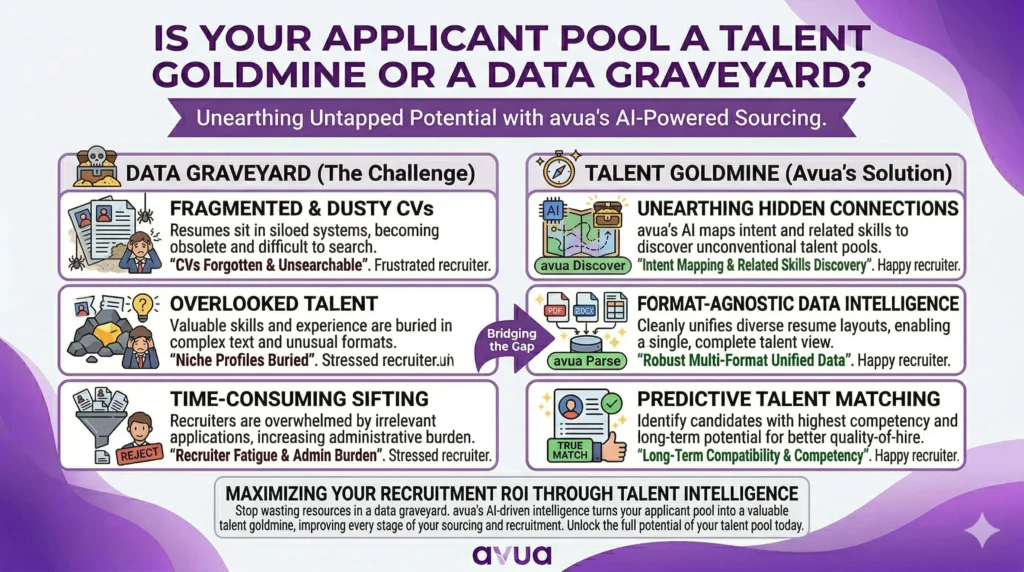
Here’s a question that most hiring teams avoid asking themselves: are you sitting on a mountain of talent, or are you drowning in a swamp of irrelevant resumes?
Traditional vs. AI Hiring: The Visibility Shift
Not so long ago, managing an applicant pool meant downloading a CSV from your ATS, sorting by date, and manually skimming resumes until your eyes glazed over. Recruiters relied on keyword searches, gut instinct, and whatever coffee-fuelled energy they could muster at 4 PM on a Friday. The pool existed, but nobody could really see into it. It was a black box with a headcount label on the outside.
AI has fundamentally changed this equation. Modern AI-powered hiring platforms dynamically score, rank, and resurface candidates in real time. That dusty pool of 300 applications from last quarter? An intelligent system can re-evaluate it against a new role’s requirements in seconds, identifying candidates that human reviewers overlooked or never reached. The pool is no longer static. It’s alive.
And the numbers make the problem painfully tangible. The average corporate job posting attracts roughly 250 applications, but only 4–6 candidates typically make it to the interview stage. That’s a yield of barely 2%. The rest? They sit in your ATS, unanswered, unscored, and slowly decaying into irrelevance.
Impact on Talent Acquisition Leaders
For TA leaders, the applicant pool is a diagnostic tool. A bloated, low-quality pool signals broken sourcing channels, vague job descriptions, or weak employer branding. A shrinking pool might indicate market competitiveness, compensation misalignment, or declining visibility. Either way, the applicant pool is telling you something, the question is whether you’re listening.
Consider this scenario: a mid-size SaaS company posting 15 engineering roles receives 3,750 total applications. With a 2% qualified yield, only 75 candidates are genuinely viable. Recruiters spend over 600 hours screening the other 3,675, costing approximately $30,000 in labour alone, and not a single interview has been scheduled yet.
The ROI Case
Now imagine AI-powered screening improves that yield from 2% to 12%. The same 3,750 applications now produce 450 qualified candidates instead of 75. Screening time drops by roughly 80%, saving approximately $24,000 per quarter. Better-quality pools also reduce offer rejections, improving cost-per-hire by an estimated 18–25%. That’s not a marginal improvement, that’s a structural transformation of your recruitment economics.
Your Resume Isn’t Getting Read
Let’s Get That Fixed!
75% of resumes get auto-rejected. avua’s AI Resume Builder optimizes formatting, keywords, and scoring in under 3 minutes, so you land in the “yes” pile.
The Psychology Behind Applicant Pool
Recruitment metrics tend to live in spreadsheets. But behind every applicant pool number is a cascade of human decisions, each shaped by cognitive biases, emotional fatigue, and psychological shortcuts that most hiring teams never consciously examine. Understanding the psychology behind your applicant pool is the difference between optimising a process and actually fixing it.
The Paradox of Choice; When More Applicants Mean Worse Hires?
Barry Schwartz’s famous Paradox of Choice applies to hiring with uncomfortable precision. When a recruiter faces a pool of 500 applicants, the sheer volume doesn’t empower better decisions, it paralyses them. Research on decision-making consistently shows that quality degrades after evaluating roughly 20–30 options. Beyond that threshold, reviewers start satisficing (picking “good enough”) rather than optimising (finding the best).
In practice, this means hiring managers in oversaturated pools begin anchoring on superficial signals, university prestige, recognisable employer names, or formatting aesthetics, rather than actual competency fit. AI-powered shortlisting is not just a speed tool here; it is a cognitive relief mechanism that restores quality to the decision process by presenting a curated, evidence-ranked subset of the pool.
Decision Fatigue and Recruiter Burnout
Decision fatigue is one of the most well-documented phenomena in behavioural psychology, and recruitment is a textbook breeding ground for it. Studies have shown that candidates reviewed later in the day consistently receive harsher evaluations than those reviewed in the morning, even when their qualifications are equivalent. The reviewer is not biased against the candidate, they are simply exhausted.
A pool of 500 applications does not just take ten times longer to process than a pool of 50; it exponentially increases error rates, inconsistency, and reviewer burnout. Reducing applicant pool noise, not just pool size, is simultaneously a quality strategy, an efficiency strategy, and a wellbeing strategy for your recruitment team.
Social Proof and the “Popularity Trap”
High-volume applicant pools create a deceptive signal. When candidates see that a role has attracted hundreds of applications (via platforms that display applicant counts), it triggers herd behaviour: people apply because others are applying, not because the role is a strong fit. This is the “popularity trap.”
The downstream consequence is an inflated pool filled with low-intent applicants who dilute quality, increase screening burden, and waste everyone’s time. Smart applicant pool management recognises this dynamic and filters for intent signals, completion rates, engagement patterns, personalised cover letters, rather than rewarding raw volume.
Applicant Pool vs. Other Recruitment Funnel Metrics
The applicant pool does not exist in isolation. It sits at the top of a funnel that feeds every other recruitment metric. Understanding how it relates to and differs from, its downstream cousins is essential for knowing where to intervene.
| Metric | What It Measures | Key Difference from Applicant Pool |
|---|---|---|
| Conversion Rate | Percentage of applicants advancing between funnel stages | Measures funnel efficiency; Applicant Pool measures funnel input volume and quality |
| Offer Acceptance Rate | Percentage of offers accepted by candidates | A downstream outcome; Applicant Pool quality is a leading predictor of acceptance likelihood |
| Time to Fill | Days from job posting to accepted offer | Heavily influenced by pool quality; a weak pool directly extends time to fill |
| Source of Hire | Which channels produce hires | Explains pool composition origins; Applicant Pool is the aggregate result of all sources |
| Quality of Hire | Post-hire performance, retention, and cultural fit | A lagging indicator; Applicant Pool quality is its upstream determinant |
| Cost Per Hire | Total recruitment cost divided by number of hires | A bloated, low-quality Applicant Pool directly inflates cost per hire |
Think of the applicant pool as the foundational layer of the entire recruitment funnel. It is a leading indicator that cascades into every downstream KPI. Unlike conversion rate or time to fill, which are process metrics, applicant pool health simultaneously reflects employer brand strength, sourcing strategy effectiveness, and labour market positioning. If the pool is broken, everything below it will be too.
What the Experts Say?
The quality of your applicant pool is not a recruiting metric, it’s a business intelligence metric. Organisations that treat their talent pipeline like a product backlog, continuously refined and prioritised, will outperform those still spraying and praying.
– Morgan Candano, HR Analyst
How to Measure and Improve Applicant Pool Quality?
You cannot improve what you do not measure. Before diving into strategies, let’s establish the formulas and benchmarks that define applicant pool performance.
Formula
Applicant Pool Size = Total applications received for a role within a defined hiring period.
Applicant Pool Yield (%) = (Qualified Candidates ÷ Total Applicants) × 100
Applicant Pool Diversity Index (%) = (Unique Demographic Segments Represented ÷ Total Segments Tracked) × 100
Benchmarks by Industry
Benchmark data helps you understand where your pool stands relative to industry norms. Here are realistic ranges based on 2024–2025 recruitment analytics:
| Industry | Avg. Pool Size (per role) | Avg. Yield (%) | Best-in-Class Yield (%) |
|---|---|---|---|
| Technology | 180–320 | 8–14% | 22–28% |
| Healthcare | 90–200 | 12–18% | 25–32% |
| Retail / Hospitality | 250–500 | 4–8% | 14–19% |
| Financial Services | 120–260 | 10–16% | 20–26% |
Key Applicant Pool Improvement Strategies
Improving your applicant pool is not about attracting more people. It is about attracting the right people, faster, with less friction. Here are five strategies that move the needle:
How Can AI and Automation Solve Applicant Pool Challenges?
AI is not replacing recruiters. It is giving them superpowers. Here is how specific AI capabilities transform applicant pool management from a manual slog into a strategic advantage.
Intelligent Resume Parsing & Semantic Matching
Traditional ATS keyword filters are blunt instruments. They miss candidates who describe skills differently or who have non-linear career paths. NLP-based resume parsers go deeper, they understand context, skills adjacencies, and career trajectory signals. A candidate who lists “cross-functional programme delivery” gets correctly matched to a “project management” requirement, even without the exact phrase. The result is a significant reduction in false negatives: qualified candidates that keyword filters would have buried. Studies show semantic matching reduces missed-fit rates by 40–60%.
Predictive Pool Analytics
What if you could forecast applicant pool quality before a role even goes live? ML models trained on historical hiring data, market conditions, and compensation benchmarks can predict the likely yield, diversity composition, and time-to-saturation of a pool based on the role profile and posting strategy. This gives TA leaders the power to adjust sourcing investment, JD language, and channel mix proactively, before the pool disappoints, not after.
Automated Candidate Nurturing Sequences
A candidate who applies on Monday and hears nothing until Thursday has already mentally moved on. AI-driven nurturing sequences, personalised emails, SMS updates, and progress notifications, keep warm candidates engaged inside the pool. This is especially critical for passive candidates who were sourced rather than self-applied. Companies using automated nurturing see 20–35% higher re-engagement rates from dormant pools, turning yesterday’s deadweight into today’s shortlist.
Bias-Aware Pool Composition Auditing
One of the most powerful applications of AI in applicant pool management is real-time demographic auditing. Instead of running diversity reports after a hire is made (when it is too late to change anything), AI tools analyse pool composition continuously. If an engineering pool is trending 85% male after the first week of applications, the system flags it immediately, enabling targeted outreach adjustments before the shortlisting stage. This shifts DEI from a retroactive report to a proactive intervention.
Stop Juggling
10 Job Boards.
Search One
Your next role is already here. avua pulls opportunities from across the web into a single searchable feed; filtered by role, location, salary, and remote preference.
1.5 Million+
Active Jobs
380+
Job Categories
Applicant Pool and Diversity & Inclusion
Diversity does not start at the interview stage. It starts at the applicant pool. If your pool is homogeneous, no amount of inclusive interviewing will fix the pipeline problem upstream. Let’s unpack the barriers.
Digital Access and Literacy Gaps
Complex, multi-step application processes disproportionately shrink applicant pools among underrepresented candidates, particularly those without high-speed internet access, modern devices, or familiarity with enterprise ATS platforms. Pew Research data consistently shows that lower-income and rural populations face significantly higher barriers to online application completion. If your application requires a desktop browser, a PDF upload, and a 20-minute form, you are silently excluding a segment of the talent market before they even begin.
Language and Accessibility Barriers
Application portals that lack WCAG compliance, multilingual support, or screen-reader compatibility create invisible walls around the applicant pool. Non-native English speakers are estimated to be 23% more likely to abandon complex application forms compared to native speakers. Offering multilingual JDs, simplified language, and accessible design is not a “nice to have”, it is a pool expansion strategy with direct yield implications.
Bias in Self-Selection
Perhaps the most cited finding in DEI hiring research is the HP/McKinsey insight: women tend to apply for roles only when they meet 100% of the listed qualifications, while men apply at around 60%. This creates a gendered applicant pool skew before a single recruiter even opens a resume. The fix is upstream: inclusive JD language, clear distinction between required and preferred qualifications, and simplified applications all widen the pool by reducing self-selection bias. Improving pool composition is not just a volume play. It is a DEI strategy at its most fundamental.
Common Challenges & Solutions
Every TA team faces applicant pool friction. The difference between high-performing and struggling teams often comes down to whether they recognise these challenges early and act on them decisively.
| Challenge | Solution |
|---|---|
| High volume, low quality, hundreds of unqualified applicants burying viable candidates in noise | Implement AI-powered pre-screening and knockout questions that filter before full application submission; use skills-based assessments early in the funnel to surface real competency |
| Pool stagnation, recycling the same candidate profiles across multiple openings without fresh pipeline growth | Diversify sourcing channels quarterly; launch targeted campaigns on niche platforms and activate employee referral bonuses specifically tied to underrepresented talent segments |
| Candidate ghosting and drop-off, applicants entering the pool but disengaging before completing assessments or responding to outreach | Deploy automated, personalised nurture sequences within 24 hours of application; reduce total application steps to under 5 minutes; enable mobile-first completion flows |
Real-World Case Studies
Theory is useful. Numbers are better. Here are three composite case studies showing how real organisations transformed their applicant pools.
Case Study 1: Mid-Size HealthTech Company (450 Employees)
The Problem: This HealthTech firm averaged 280 applicants per clinical role but suffered a dismal 3% qualified yield. Recruiters were spending 70% of their time manually screening unqualified candidates, leaving almost no bandwidth for proactive sourcing or candidate engagement.
What Changed: The company implemented AI-powered resume parsing combined with a pre-screening chatbot. Simultaneously, they rewrote every clinical JD using inclusive language analysis tools, clarifying must-have versus nice-to-have qualifications.
The Result: Qualified yield improved from 3% to 16% within four months. Time-to-fill dropped by 12 days per role. Recruiter satisfaction scores rose 34%, largely driven by reduced screening fatigue.
Case Study 2: National Retail Chain (2,000+ Locations)
The Problem: Seasonal hiring waves generated applicant pools exceeding 50,000 candidates, with extreme noise and almost zero re-engagement of previous-year applicants. Each cycle started from scratch.
What Changed: The TA team built a reactivation workflow that scored, segmented, and re-engaged prior applicants before new seasonal postings went live. High-scoring former candidates received priority outreach.
The Result: 22% of seasonal hires came from reactivated pools, reducing cost-per-hire by $340 per role and cutting sourcing ad spend by 18%. The company estimated annual savings of over $400,000.
Case Study 3: Series B Fintech Startup (120 Employees)
The Problem: Mobile application completion was at just 31%. A staggering 69% of candidates who started applications on mobile devices abandoned before submission, silently shrinking the pool.
What Changed: The team redesigned the application to mobile-first with progressive profiling — collecting basic information upfront and detailed data only after an initial match signal. They also integrated one-click apply via LinkedIn and Avua.
The Result: Mobile completion rate jumped from 31% to 74%. The overall applicant pool grew by 55% with zero additional sourcing spend. Diversity metrics improved meaningfully across gender and age dimensions.
Building an Applicant Pool Dashboard: What to Track?
A dashboard without the right metrics is just a pretty screen. Here are the seven numbers that give you genuine visibility into applicant pool health:
Applicant Pool Across the Candidate Lifecycle
The applicant pool is not a single-point metric. It is a lifecycle concept. Candidates enter, engage, stall, and exit at multiple stages — and each stage presents a different flavour of pool attrition. Understanding where you are losing people is just as important as knowing how many you attract.
Pre-Application Pool Building
The applicant pool begins forming before a candidate ever clicks “Apply.” It starts with employer branding, careers page UX, social media presence, and talent community engagement. A company with a weak Glassdoor rating, a clunky careers site, or no LinkedIn presence is shrinking its pool before a single job goes live. Pre-application pool building is about making your organisation visible, credible, and desirable to the passive talent market.
Assessment-Stage Pool Attrition
Once candidates enter the pool, skills tests, video interviews, and take-home assignments become the next friction point. High-quality candidates, the ones with options, are the first to exit when assessments are excessively long, poorly communicated, or technically broken. Research suggests that 58% of candidates abandon assessments exceeding 45 minutes. Your assessment design is not just a selection tool. It is a pool retention tool.
Interview Scheduling Friction
Scheduling is the silent pool killer. Timezone mismatches, multi-round coordination delays, and the absence of self-scheduling tools create logistical friction that pushes candidates toward faster-moving competitors. A candidate juggling three offer processes will penalise the company that takes five days to schedule a panel interview. The pool contracts even though applicants have not formally withdrawn, they have simply moved on mentally.
Offer-Stage Pool Erosion
Even after extending a verbal offer, silence is deadly. Candidates who experience radio silence between the verbal offer and the formal letter interpret it as disinterest or disorganisation. The best practice is to maintain structured engagement through the offer stage: check-in calls, onboarding previews, team introductions, and clear timeline communication. The pool does not close until the contract is signed.
The Real Cost of a Weak Applicant Pool: By the Numbers
Let’s make this concrete. Below is a financial impact model for a company hiring approximately 100 roles per year, assuming an average sourcing cost of $4,000 per role and 250 applications per posting:
| Scenario | Pool Yield | Qualified Candidates (per 250 apps) | Est. Annual Wasted Spend |
|---|---|---|---|
| Current State (weak pool) | 5% | 12–13 | $280,000–$320,000 |
| Moderate Improvement | 12% | 30 | $140,000–$170,000 |
| Best-in-Class | 22% | 55 | $60,000–$80,000 |
The gap between a 5% yield and a 22% yield is not just an operational inconvenience, it is a $200,000+ annual budget leak. For TA leaders building a business case for investment in AI-powered pool management, these numbers are among the most defensible arguments you can present to the C-suite.
Related Terms
| Term | Definition |
|---|---|
| Talent Pipeline | A proactive, ongoing pool of pre-qualified candidates maintained for current and future openings. |
| Candidate Experience | The overall perception a job seeker forms about an employer based on every touchpoint during the hiring process. |
| Application Drop-Off Rate | The percentage of candidates who start but do not complete a job application. |
| Source of Hire | The originating channel through which a hired candidate first entered the recruitment pipeline. |
| Quality of Hire | A composite metric evaluating new-hire performance, retention, and cultural fit within their first 12 months. |
Frequently Asked Questions
What is a good applicant pool size for a single role?
A healthy applicant pool typically ranges from 100 to 250 applicants per role, with a qualified yield of 10–15%. However, these numbers vary significantly by industry, seniority level, and geographic market. Quality matters far more than raw volume, a pool of 80 well-matched candidates is more valuable than a pool of 400 random applications.
Does improving job descriptions actually increase applicant pool quality?
Absolutely. Companies that optimise job descriptions with data-driven language see up to a 42% improvement in qualified applicant yield. The most impactful changes include using inclusive, non-gendered language, clearly separating required qualifications from nice-to-haves, and including salary transparency. These adjustments attract better-fit candidates while reducing low-relevance applications.
How does AI reduce applicant pool noise?
AI applies semantic matching and predictive scoring to rank every applicant by fit probability within seconds of submission. Instead of recruiters manually sifting through hundreds of resumes, AI surfaces the most promising candidates at the top of the pile. This reduces manual screening time by 60–80% and significantly improves shortlist accuracy by catching qualified candidates that keyword-based filters would miss.
Can a weak applicant pool be fixed mid-hiring cycle?
Yes, and often faster than teams expect. Effective mid-cycle interventions include activating secondary sourcing channels, rewriting and redistributing the job description, re-engaging past applicants from your ATS, and relaxing non-essential qualification requirements. Most pools can be meaningfully improved within two to three weeks with focused action.
Does applicant pool quality affect long-term employee retention?
It does and the effect is substantial. Organisations with top-quartile applicant pool quality report 23% higher 12-month retention rates compared to those with bottom-quartile pools. The mechanism is straightforward: a higher-quality pool produces better candidate-role fit, which is the single strongest predictor of early retention and job satisfaction.
Conclusion
The applicant pool is more than a number at the top of your recruitment funnel. It is the upstream determinant of every hiring outcome that follows, your time-to-fill, your cost-per-hire, your quality of hire, and your retention rates all trace back to how well you built, managed, and optimised this foundational layer.
The most impactful fixes are not complicated: write precision job descriptions, deploy AI-powered screening, diversify your sourcing channels, and reactivate dormant talent pools. These four strategies alone can transform a mediocre applicant pool into a genuine competitive advantage.
Organisations that treat applicant pool health as a strategic KPI, not an operational afterthought, will consistently out-hire, out-retain, and outperform their peers in the AI-driven talent economy of 2026 and beyond. The question is no longer whether your applicant pool matters. The question is: what are you going to do about it?