The offer is signed, but a late-stage background check discrepancy can instantly derail the Candidate Journey. Whether this flag causes chaos or leads to a defensible resolution depends on how well the process is integrated into your hiring strategy. More than just a formality, a background check is a critical verification of identity, history, and credentials.
By 2026, AI Hiring platforms have transformed this step, embedding checks directly into the workflow to minimize friction and improve the Candidate Experience. While Automated Screening now delivers results faster than ever, the strategic challenge remains: how to interpret data fairly and compliantly.
The goal is to move beyond a reactive “pass/fail” mindset toward a structured framework that protects the integrity of your Applicant Pool. When handled with precision, background checks serve as a final, vital layer of risk management that ensures your Candidate Pipeline is built on a foundation of verified trust.
The key metric governing this function is the Background Check Completion Rate (BCCR): the percentage of initiated background checks that are completed without expiry, abandonment, or technical failure before a hiring decision is required. Organizations with unstructured background check processes see BCCRs as low as 61%. Those with integrated, automated workflows consistently achieve BCCRs above 94%, which directly reduces the offer-stage attrition and delayed start dates that erode the value of every upstream recruiting investment.
What is a Background Check?
A background check is a pre-employment due diligence process in which an employer, or a third-party screening provider acting on their behalf, verifies candidate-provided information and reviews relevant records to assess fitness for a specific role.
The scope of a background check varies significantly by role type, industry, and jurisdiction. A standard commercial background check might include identity verification, a criminal record search, and employment history confirmation. A background check for a financial services role might additionally require a credit history review and a regulatory standing check. One for a healthcare role might require license verification and sanctions screening against federal databases. One for a role involving driving might require a motor vehicle record review.
What all background checks share is a common purpose: to give the hiring organization defensible, verified information about the person they are about to employ, so that hiring decisions are based on confirmed facts rather than unverified assertions. In 2026, this purpose has expanded slightly to include a second objective: conducting that verification in a way that is fast enough, transparent enough, and respectful enough of the candidate’s time that it does not itself become a source of offer-stage attrition.
Is the Background Check Process the Last Step in Hiring or the First Step Toward a Lawsuit?
Most organizations treat the background check as a procedural step at the end of the hiring process. A check is initiated, results arrive, someone glances at them, and either the hire proceeds or it does not. This approach works adequately when nothing interesting comes back. It fails, often expensively, when something does.
The legal landscape around background checks is genuinely complex and is becoming more so. In the United States, the Fair Credit Reporting Act (FCRA) governs how background checks must be conducted when using third-party consumer reporting agencies, including specific requirements around candidate consent, disclosure, and the adverse action process that must be followed before a hire is declined on the basis of check results.
Separate “ban the box” legislation in over 35 states and numerous municipalities restricts when in the hiring process criminal history can be inquired about, often prohibiting criminal history questions on initial applications and in some jurisdictions requiring a conditional offer before a criminal background check can be initiated. Internationally, the patchwork of applicable law across different countries creates a compliance matrix that organizations with global hiring programs must navigate carefully.
Organizations that are not following these requirements are not merely taking an administrative shortcut. They are accumulating legal exposure that can result in class action litigation, regulatory fines, and reputational damage that outlasts the particular hiring decisions that triggered it.
The cost of getting it wrong is well-documented. FCRA class action settlements in the United States have ranged from hundreds of thousands to tens of millions of dollars, frequently involving relatively straightforward procedural violations: the wrong consent form wording, a missing disclosure, an adverse action letter sent too early or in the wrong format. These are not complicated compliance failures. They are failures of process design and process governance, and they are almost entirely preventable with the right infrastructure.
Companies using structured, automated background check workflows report a 78% reduction in compliance-related incidents compared to those managing the process manually. The automation does not replace legal judgment; it ensures that the procedural steps required by applicable law are followed consistently, every time, regardless of how much pressure the hiring team is under to move quickly.
For TA leaders, the reframe is this: the background check is not the last step in hiring. It is the last step in an offer process that has legal structure. The organization that treats it as a formality until it becomes a crisis has not been lucky. It has been fortunate not to have been tested yet.
Consider the scenario that brings this into focus. A fast-growing retail company is managing 300 hires per month across 40 locations. Background checks are initiated by individual store managers using a mix of vendor portals and email chains, with no standardized consent collection, no tracked timelines, and no documented adverse action process. A candidate for a store manager role in a state with specific ban-the-box requirements is asked about criminal history during the initial interview.
The candidate, who has a ten-year-old conviction that would not have been relevant to the role under the state’s individualized assessment requirements, withdraws from the process and files a complaint. The investigation that follows reveals that the same non-compliant practice has been applied across hundreds of interviews over the prior 18 months. The remediation cost, across legal fees, settlement, and process redesign, exceeds $2.1 million. The original shortcut saved approximately 90 seconds per interview.
Your Resume Isn’t Getting Read
Let’s Get That Fixed!
75% of resumes get auto-rejected. avua’s AI Resume Builder optimizes formatting, keywords, and scoring in under 3 minutes, so you land in the “yes” pile.
The Components of a Background Check
A background check is rarely a single lookup. It is a package of verification components, each serving a distinct due diligence purpose, assembled based on the requirements of the role and the applicable legal framework.
Identity Verification
The foundational layer of any background check: confirming that the person being screened is who they claim to be. In 2026, digital identity verification tools using government database cross-referencing, biometric comparison against ID document photos, and liveness detection have become standard for remote hire identity confirmation. A background check that does not include reliable identity verification is not verifying the candidate’s history. It is verifying the history of whoever provided those details, which may or may not be the same person.
Criminal Record Search
The most sensitive and most legally regulated component of background screening. Criminal record searches vary significantly in scope: county-level, statewide, national database, and federal court searches each cover different jurisdictions with different data completeness. The critical compliance consideration is not only what is searched but what is done with the results.
Under individualized assessment requirements in multiple US jurisdictions and EEOC guidance, an employer who finds a criminal record must conduct a documented assessment of whether the nature of the offense, the time elapsed, and the nature of the role create a genuine, demonstrable risk for that specific position. Blanket policies declining all candidates with any criminal record are legally questionable in many jurisdictions and practically counterproductive, eliminating large portions of qualified candidate pools without proportionate risk reduction.
Employment History Verification
Confirming that a candidate actually held the positions they claim, at the organizations they name, for the periods they describe. Research published by background screening industry associations consistently finds that between 30% and 40% of resumes contain material inaccuracies in employment history. The verification process does not always reveal intentional misrepresentation; genuine memory errors, HR record inconsistencies, and how candidates describe consulting arrangements can all create apparent discrepancies requiring human judgment. What it does create is a documented factual baseline that protects the organization if a hiring decision is later questioned.
Education and Credential Verification
Confirming that degrees, certifications, and professional licenses claimed by the candidate were actually awarded. Degree fraud is a persistent issue across all levels of the workforce. For regulated roles (medical professionals, licensed engineers, certified financial advisors), credential verification is not a best practice but a legal prerequisite. An organization that employs a nurse who fabricated their nursing license is not merely the victim of fraud; it is potentially liable for every patient interaction that nurse has had.
Professional License and Regulatory Standing Checks
For roles in regulated industries, confirming that the candidate holds current, valid licenses and is in good standing with regulatory bodies. This includes industry-specific exclusion databases (such as the OIG exclusions list in US healthcare) that are not covered by standard criminal checks. Missing these checks in covered roles creates regulatory exposure that can include fines, exclusion from federal program participation, and in some cases criminal liability for the employer.
Credit History Review
Permissible only for specific role types in most jurisdictions (roles involving financial responsibility, access to sensitive financial data, or fiduciary duties), credit history review is restricted or prohibited for most roles in a growing number of US states. When used appropriately for the right role context, it provides relevant risk signal. Applied broadly to roles where financial responsibility is not a primary function, it creates legal exposure and adverse impact on demographic groups disproportionately represented in credit-challenged populations.
Background Check vs. Other Hiring Risk Management Tools
Background checks occupy a specific position within a broader hiring risk management framework:
| Tool | Primary Purpose | Relationship to Background Check |
|---|---|---|
| Resume Screening | Initial qualification filter | Identifies what candidates claim; background check verifies it |
| Reference Check | Behavioral and performance validation | Provides subjective colleague perspective; background check provides objective record |
| Structured Interview | Competency and fit assessment | Evaluates future potential; background check validates past facts |
| Drug Testing | Substance use screening | Often conducted alongside background checks; a separate legal and operational process |
| Social Media Screening | Online presence and conduct review | Informal; legally complex; not a substitute for formal background check components |
| Credit Check | Financial conduct history | A component of background checks for specific role types, not a universal screening tool |
The relationship between background checks and reference checks is worth particular attention. Many organizations treat them as alternatives, opting for one or the other based on time constraints. They measure different things. A reference check tells you how a former manager experienced working with this person. A background check tells you whether the facts this person has represented about themselves are accurate. Both are useful, and neither substitutes for the other.
What the Experts Say?
Background screening is the point in the hiring process where good intentions meet legal obligation. Organizations that treat it as a checkbox are one bad hire away from a headline.
– Lester Rosen, Founder and CEO of Employment Screening Resources and author of “The Safe Hiring Manual
How to Measure Background Check Process Efficiency?
A background check program that cannot be measured cannot be meaningfully improved. The core operational metrics:
Formula
Completion Rate = (Completed before decision ÷ Total initiated) × 100
A BCCR below 85% indicates a process problem: too much time between initiation and completion, too many candidates abandoning the consent and information submission step, or too many checks expiring before a hiring decision is reached. In each case, the consequences are the same: delayed start dates, scrambled onboarding schedules, and in the worst case, rescinded offers when a check returns results that cannot be acted on in time.
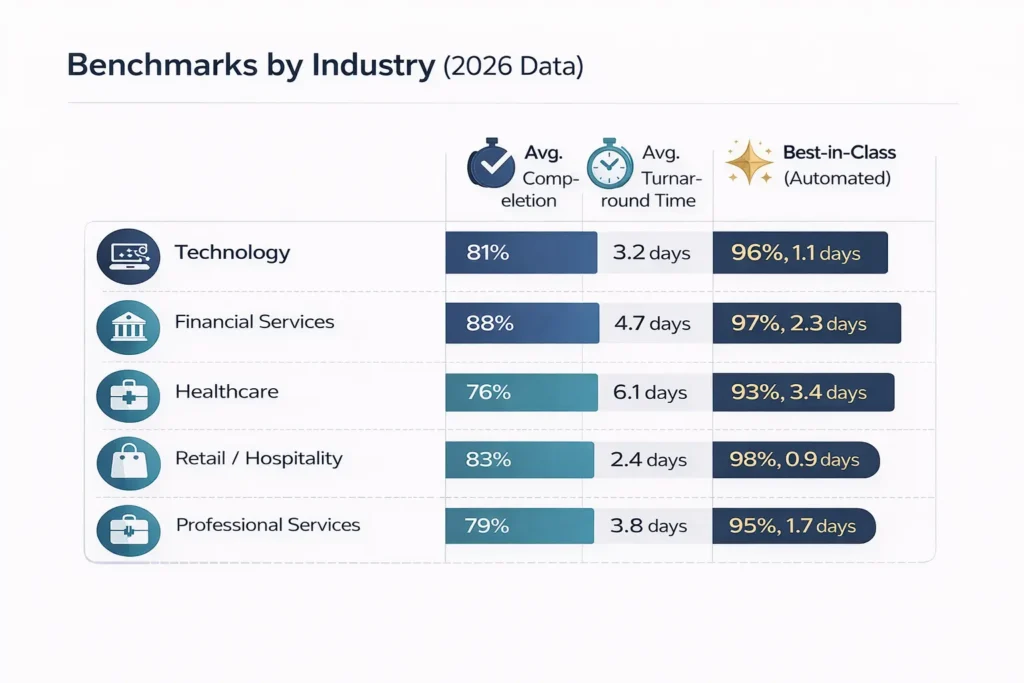
Benchmarks by Industry (2026 Data)
| Industry | Avg. Completion Rate | Avg. Turnaround Time | Best-in-Class (Automated) |
|---|---|---|---|
| Technology | 81% | 3.2 days | 96%, 1.1 days |
| Financial Services | 88% | 4.7 days | 97%, 2.3 days |
| Healthcare | 76% | 6.1 days | 93%, 3.4 days |
| Retail / Hospitality | 83% | 2.4 days | 98%, 0.9 days |
| Professional Services | 79% | 3.8 days | 95%, 1.7 days |
Healthcare’s lower completion rate and longer turnaround reflect the complexity of license verification and regulatory database checks required for clinical roles, not a difference in process quality. The best-in-class gap in every industry maps to automation: specifically, automated consent collection that initiates immediately at the offer stage, digital identity document submission that eliminates the postal and scanning friction of legacy processes, and real-time status tracking that allows proactive intervention when a check is stalling.
Key Strategies for Improving Background Check ROI
How AI and Automation Improve Background Check Processes?
The background check itself (the actual record searches and verifications) is conducted by humans and database systems that have not fundamentally changed in structure. What AI and automation have transformed is everything around the check: the workflow, the communication, the adjudication support, and the compliance governance.
Automated Consent and Information Collection
Legacy background check initiation required a recruiter to send a form, wait for it to be returned, verify the information, and submit the check request. This process took an average of 1.8 days in manual environments. Automated consent and collection workflows, triggered directly from the offer acceptance event in the hiring platform, complete the same process in an average of 3.4 hours. Candidates receive a mobile-optimized, step-by-step submission flow that guides them through identity document upload, consent authorization, and information confirmation without recruiter involvement.
AI-Assisted Adjudication Support
When a background check returns a record or a discrepancy, someone must decide what to do with it. Without a structured adjudication framework, this decision is made inconsistently, with different outcomes for similar findings depending on who reviews results on a given day. AI-assisted adjudication tools do not make the decision, but they structure the review: presenting relevant facts, surfacing applicable legal requirements for the role and jurisdiction, documenting the individualized assessment factors that must be considered, and creating an audit trail that demonstrates a consistent, defensible process regardless of which team member conducted the review.
Continuous Monitoring for High-Risk Roles
A one-time background check at hire captures a snapshot at a specific moment. For roles with ongoing regulatory compliance requirements, high fiduciary responsibility, or continued access to vulnerable populations, that snapshot becomes outdated immediately. Continuous background monitoring services provide automated alerts when an employee’s record changes in ways relevant to their role. This is not surveillance for its own sake; it is a risk management mechanism for roles where post-hire record changes create genuine organizational or public safety liability.
Cross-Jurisdictional Compliance Automation
For organizations hiring across multiple US states or internationally, compliance requirements vary enough that manual management of applicable rules across all jurisdictions is genuinely difficult. AI-powered compliance engines embedded within modern background check platforms automatically apply the correct consent language, disclosure requirements, permissible check components, and adverse action process for every hire based on their location. This automation ensures that standard procedural requirements are met consistently without requiring a compliance review on every individual hire.
Stop Juggling
10 Job Boards.
Search One
Your next role is already here. avua pulls opportunities from across the web into a single searchable feed; filtered by role, location, salary, and remote preference.
1.5 Million+
Active Jobs
380+
Job Categories
Background Checks and Diversity and Inclusion
The intersection of background checks and diversity and inclusion is one of the most legally and ethically significant areas in modern talent management. Handled poorly, background check practices can systematically exclude large populations of qualified candidates. Handled thoughtfully, they provide fair, documented, individualized assessments that are both legally defensible and genuinely equitable.
The Criminal History Equity Problem
Criminal record history disproportionately affects certain demographic groups, reflecting documented disparities in the criminal justice system rather than proportionate differences in job-relevant conduct. A blanket policy of declining all candidates with any criminal history therefore produces disparate impact, creating legal exposure under EEOC guidance and eliminating a substantial portion of the labor market based on a criterion not reliably correlated with job performance for most roles.
The EEOC’s guidance on criminal records in employment decisions establishes that employers must consider the nature of the crime, the time elapsed, and the relevance to the specific job before making an employment decision. The ban-the-box movement, now enacted in legislation across over 35 states and hundreds of municipalities, reflects the same principle codified into law. Organizations that have shifted from blanket exclusion policies to individualized assessment frameworks consistently report improved legal standing and access to a meaningfully larger qualified candidate pool, with no measurable increase in workplace incidents.
Consistency, Accessibility, and International Data Privacy
Inconsistency in how background check results are interpreted across different demographic groups is itself a legal and ethical problem. If an organization’s de facto practice applies more scrutiny to results for certain groups, even without explicit policy, that inconsistency creates adverse impact exposure. Documented adjudication frameworks, consistently applied and regularly audited for outcome consistency, are the structural solution.
For organizations hiring internationally, background check practices must navigate the data privacy frameworks of relevant jurisdictions, including the GDPR in the European Union, which places significant restrictions on what personal data can be collected and processed in employment screening. What is standard US practice may be impermissible in other jurisdictions. Global employers need jurisdiction-specific screening protocols, not a single template applied regardless of local law.
Common Challenges and Solutions
| Challenge | Solution |
|---|---|
| Candidate Abandonment at Consent Stage | Integrate consent collection into the offer acceptance workflow and provide mobile-optimized submission experience |
| Slow Turnaround Delaying Start Dates | Initiate checks immediately at conditional offer stage rather than waiting for formal acceptance; use automated status tracking to flag stalling checks proactively |
| Inconsistent Adverse Action Decisions | Implement a documented adjudication matrix with AI-assisted review tools; train all decision-makers on the applicable process |
| Compliance Exposure Across Jurisdictions | Use background check platforms with embedded compliance automation for consent language, disclosure requirements, and adverse action process by location |
| Candidate Experience Friction | Provide automated status updates at each stage of the check; give candidates a clear timeframe at initiation and a point of contact for questions |
Real-World Case Studies
Case Study 1: The Financial Services Firm
A regional financial services firm was managing background checks through a combination of email-based vendor requests, manual consent form collection, and an informal review process that varied by hiring manager. Their average turnaround time was 8.3 days, and approximately 22% of initiated checks were not completed before the planned start date, resulting in delayed onboardings, scrambled project assignments, and in several cases, start date rescissions that had to be communicated to candidates who had already given notice at their previous employer.
They implemented an automated background check workflow integrated into their offer management system, with role-based check packages, automated consent collection, and an AI-assisted adjudication tool for the results review step. Turnaround time dropped to 2.9 days. Check completion before start date reached 97%. Three compliance incidents that had been identified in the prior 18 months were not replicated in the following 12 months.
Case Study 2: The Healthcare Network
A healthcare network operating across 11 facilities was struggling with a specific problem: their background check process for clinical roles required verification of professional licenses across multiple state boards, credentialing checks against three separate regulatory exclusion databases, and employment history confirmation that in some cases required outreach to former employers in other countries. Their manual process was taking an average of 14 days for clinical hire background checks and occasionally running to 21 days, which was causing them to lose candidate offers to competing health systems with faster processes.
\They redesigned the check workflow with a vendor that specialized in healthcare screening, building automated parallel processing of all check components so that license verifications, exclusion checks, and employment verifications ran simultaneously rather than sequentially. Average turnaround for clinical background checks dropped from 14 days to 5.2 days, and offer acceptance to start date attrition in the clinical hiring pipeline reduced by 31%.
Case Study 3: The Retail Chain
A national retail chain with stores in 38 states had been operating with a uniform background check policy that included a blanket exclusion of candidates with any criminal history within the prior seven years. Analysis prompted by an EEOC inquiry revealed that this policy was resulting in the systematic exclusion of a disproportionate percentage of candidates from certain demographic groups in a way that was not justified by a documented assessment of job-relevant risk.
They worked with employment counsel to redesign their criminal history review process, replacing the blanket exclusion with a role-based individualized assessment framework that evaluated the nature of the offense, the time elapsed, and the specific requirements of the role being applied for. Within two hiring cycles, qualified candidate pool size for frontline retail roles increased by 24%, offer acceptance rates improved, and three active EEOC complaints were resolved without litigation.
Building a Background Check Process Dashboard: What to Track?
An AC without measurement infrastructure is a process masquerading as a system. Six metrics form the core of a useful performance dashboard:
Background Checks Across the Candidate Lifecycle
Pre-Offer Background Check Initiation
In jurisdictions that permit it, some organizations initiate components of the background check process before a formal offer is extended, typically for high-volume roles where the check is a standard part of the qualification process. This approach reduces time-to-start for qualified candidates but requires careful compliance management to ensure check results are not used in violation of applicable timing restrictions, particularly in ban-the-box jurisdictions.
Conditional Offer Stage
The most common and legally cleanest point for background check initiation in most jurisdictions: a conditional offer is extended, the candidate accepts, consent is collected, and the check is initiated. The hire proceeds to unconditional offer status upon satisfactory completion. This sequence protects the organization’s ability to conduct the check after the candidate has demonstrated genuine intent to accept the role, while maintaining the legal separation between the hiring decision and check results.
Post-Offer Rescission Management
When a background check returns results that lead to a decision not to proceed, the adverse action process must be followed carefully. Pre-adverse action notice, waiting period, opportunity for candidate response, and final adverse action notice are all legally required steps under FCRA and analogous legislation. Each step must be documented. The candidate’s response to the pre-adverse action notice must be genuinely considered, not treated as a formality. Organizations that cannot demonstrate these steps were followed consistently are exposed on every adverse hiring decision, not just those where a complaint is filed.
Continuous Post-Hire Monitoring
For roles with ongoing compliance requirements, the background check is not a one-time event. Continuous monitoring programs alert employers when an employee’s criminal record, license status, or regulatory standing changes in ways that may be relevant to their role. These programs are standard practice in regulated industries and are expanding into high-trust commercial roles where ongoing conduct assurance is a legitimate business interest.
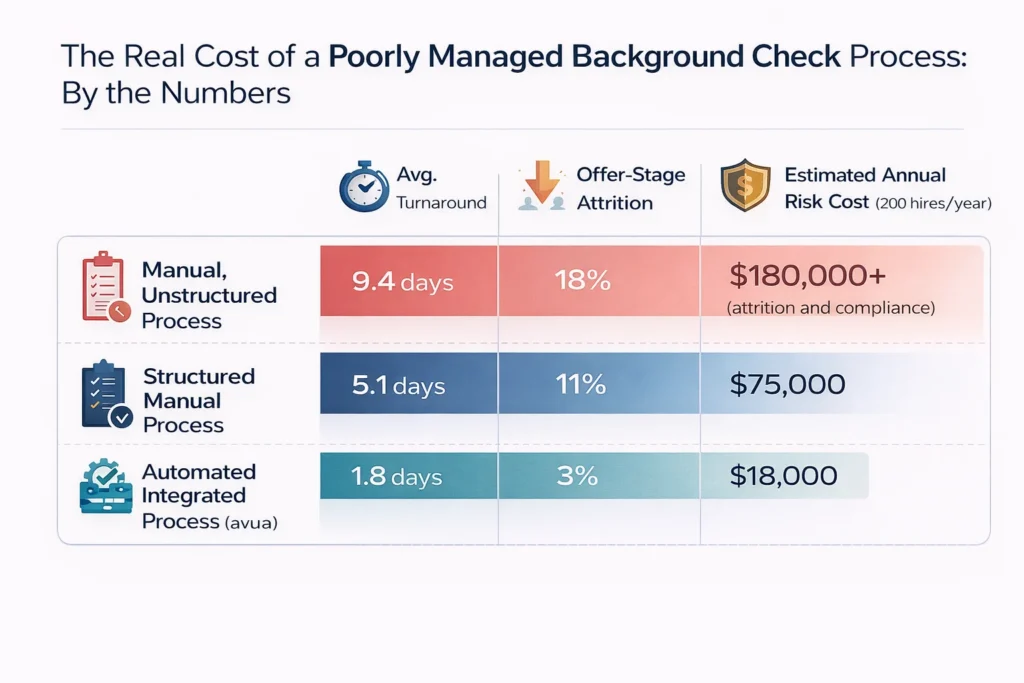
The Real Cost of a Poorly Managed Background Check Process: By the Numbers
| Scenario | Avg. Turnaround | Offer-Stage Attrition | Estimated Annual Risk Cost (200 hires/year) |
|---|---|---|---|
| Manual, Unstructured Process | 9.4 days | 18% | $180,000+ (attrition and compliance) |
| Structured Manual Process | 5.1 days | 11% | $75,000 |
| Automated Integrated Process (avua) | 1.8 days | 3% | $18,000 |
The risk cost in the manual unstructured scenario includes not just the direct cost of offer-stage attrition (estimated at $4,500 per lost candidate considering the full upstream recruiting investment) but a pro-rated allocation of the compliance incident risk that manual, inconsistent processes create. The $180,000 figure is conservative; organizations that have experienced FCRA class action exposure know that a single compliance failure can exceed this figure many times over.
Related Terms
| Term | Definition |
|---|---|
| Adverse Action | The legally defined process an employer must follow before declining a candidate based on background check results |
| FCRA (Fair Credit Reporting Act) | US federal legislation governing the use of consumer reports, including background checks, in employment decisions |
| Ban the Box | Legislation that restricts employers from asking about criminal history on initial job applications or before a conditional offer |
| Individualized Assessment | A documented, role-specific evaluation of whether a candidate’s criminal history creates a genuine, relevant risk for a particular position |
| Continuous Monitoring | An ongoing background screening service that alerts employers when an employee’s record changes post-hire |
| Conditional Offer | An employment offer extended subject to the satisfactory completion of background checks and other pre-employment requirements |
Frequently Asked Questions
When in the hiring process should a background check be initiated?
The safest approach in most jurisdictions is to initiate background checks after a conditional offer has been made and accepted. In ban-the-box jurisdictions, this sequence is often legally required for criminal history components. Initiating earlier creates legal exposure if results influence decisions before the candidate has been meaningfully evaluated on merit.
How long does a background check typically take?
Identity checks and national criminal searches typically complete within hours. County-level searches, employment and education verifications take 1 to 3 business days. International components and complex license verifications can extend this to 5 to 14 days. Running all components in parallel rather than sequentially reduces total turnaround significantly.
Can an employer decline a candidate solely because of a criminal record?
Under EEOC guidance, blanket policies rejecting all candidates with criminal records are legally problematic in most US jurisdictions. Employers are expected to assess each case individually, considering the nature of the offense, time elapsed, and relevance to the role. Requirements vary by location and are evolving, so legal counsel is recommended for organizations hiring at scale.
What happens if a background check returns inaccurate information?
Under FCRA and equivalent laws, candidates have the right to dispute inaccurate results before a final decision is made. Organizations must genuinely consider disputes, not treat the pre-adverse action notice as a formality. Background check providers are required to investigate and correct or remove unverifiable information within a defined timeframe.
Are background checks required by law?
Background checks are not legally required for most private sector roles, but are standard due diligence practice. Regulated roles (healthcare, financial services, childcare, security clearance positions) carry specific legal mandates. Which checks to conduct for which roles should be driven by a documented risk assessment, not a blanket policy applied uniformly.
Conclusion
The background check sits at the end of the hiring funnel, after the interviews and the negotiations and the offer letters. It is easy to treat it as a final formality, a procedural closing of the loop before the onboarding clock starts. That framing is the source of most of the problems organizations encounter with it.
A background check is not a formality. It is a legally governed, ethically significant process that verifies the factual foundation of a hiring decision, protects the organization and the people it serves, and, when designed and executed well, does so in a way that treats the candidate with the dignity and transparency that every step of the hiring process deserves.
The organizations that get this right in 2026 are the ones that have integrated background check processes into their broader hiring infrastructure rather than bolting them on at the end, invested in automation that makes compliance consistent rather than luck-dependent, and built adjudication frameworks that reflect the legal and ethical complexity of what they are actually doing. They move faster, incur less risk, and lose fewer candidates at the finish line.
In a hiring market where every day of delay costs something, and every compliance failure costs a great deal more, that combination is not just good practice. It is a competitive advantage.