In 1970, the Toronto Symphony Orchestra placed a screen between musicians and judges during auditions. Almost immediately, the number of women hired rose by 25%. The Applicant Pool hadn’t changed; the only difference was the removal of information that triggered subconscious Bias in Hiring.
Today, this logic defines blind hiring: it is an accuracy program, not a diversity program. By 2026, the practice has evolved into a high-tech standard for modern recruitment. Organizations now use AI Resume Screening to redact demographic markers and rely on Blind Resume Review to ensure candidates are judged solely on merit.
Furthermore, the use of an anonymized Aptitude Test or work sample allows for objective evaluation before any face-to-face meeting. This methodology doesn’t lower standards, it ensures they are applied fairly. By focusing on true capability and intentionally refining the Candidate Experience, companies realize that diversity is the inevitable byproduct of a much more accurate and equitable assessment process.
The primary metric governing blind hiring effectiveness is the Diversity-Corrected Prediction Accuracy (DCPA): the degree to which candidate selection decisions correlate with post-hire performance across all demographic groups, rather than just the majority group. A hiring process with high aggregate predictive validity but low DCPA is selecting accurately for some candidates and inaccurately for others, which is the signature of a bias-contaminated assessment, not a rigorous one.
What is Blind Hiring?
Blind hiring is a structured approach to candidate evaluation in which identifying information that has no bearing on job performance is withheld from evaluators during specified stages of the hiring process, reducing the influence of demographic factors, institutional prestige, and other bias-triggering signals on hiring decisions.
The scope of information removed depends on which bias mechanisms the organization is targeting and at which stage. A basic blind resume review removes candidate names and may additionally remove university names, graduation years, and home addresses. A more comprehensive blind hiring program removes those elements plus employment company names (to neutralize organizational prestige bias), employment gaps framing, and any other fields that research identifies as demographic-correlating proxies.
The underlying principle is consistent across all implementations: evaluators who cannot see a piece of information cannot be influenced by it. This is a more reliable bias-reduction mechanism than training evaluators to consciously suppress the information once they have seen it. Cognitive suppression of known biases is effortful, unreliable, and subject to exactly the kind of fatigue and distraction that characterizes high-volume hiring processes. Structural removal of the information is automatic, consistent, and does not degrade under volume or time pressure.
Is Blind Hiring a Radical Experiment or Simply Better Process Design?
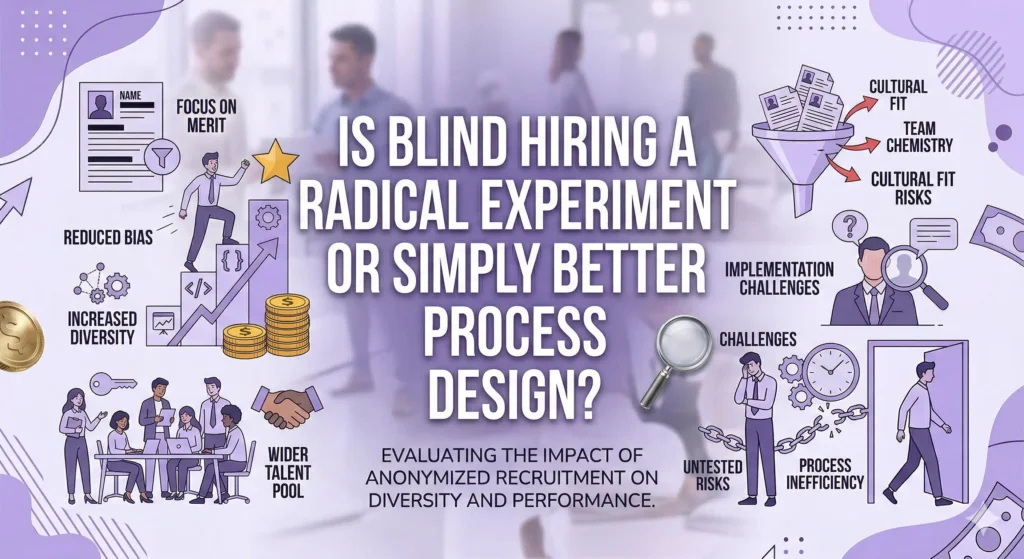
The framing of blind hiring as a radical or politically charged intervention is one of the most persistent and most counterproductive narratives surrounding it. Organizations that adopt blind hiring are not making a statement about diversity quotas or lowering their quality bar. They are making a technical decision about which information their evaluators need to assess candidate quality, and removing the information that does not contribute to that assessment and has a documented history of corrupting it.
Consider what the hiring process is attempting to do: predict which candidate will perform best in the role. The information required to make that prediction includes demonstrated skills, relevant experience, behavioral track record, and cognitive capability. The information that does not contribute to that prediction includes the candidate’s name, the prestige ranking of the university they attended, the prominence of the companies on their resume, the graduation year that encodes their approximate age, and the address that correlates with their socioeconomic background and in some geographies their ethnicity.
The hiring processes that include the second category of information alongside the first are not more rigorous than those that exclude it. They are less rigorous, because they are introducing variance that is unrelated to what they are trying to measure. Blind hiring, understood properly, is the pursuit of a cleaner signal, not a compromise of the signal for other purposes.
The research evidence is consistent and substantial. Studies applying blind evaluation methodology across orchestra auditions, resume screening experiments, grant review processes, academic journal peer review, and structured work sample assessment consistently find two things. First, removing identifying information changes the distribution of who advances, typically in the direction of greater demographic diversity. Second, the performance of those who advance under blind evaluation is equivalent to or better than the performance of those who advance under non-blind evaluation. The candidates who are filtered out by bias are not the marginal ones. They are often among the most qualified.
Organizations implementing structured blind hiring programs report an average 46% improvement in the representation of underrepresented groups at the shortlist stage, with no measurable reduction in post-hire performance ratings at 12 months. That combination, better representation without reduced quality, is not a trade-off. It is what accurate assessment looks like when you remove the noise.
For Talent Acquisition leaders, the strategic argument is straightforward: blind hiring is a quality investment, not a diversity concession. The pipeline of qualified candidates who are currently being filtered out by bias-contaminated evaluation processes represents recoverable talent. Accessing it does not require lowering any bar. It requires raising the accuracy of the measurement used to assess who clears it.
Consider the scenario that illustrates this at scale. A technology company conducts an internal audit of its resume screening data and finds that resumes with identical technical content, described in different language patterns that correlate with gender, are advancing at meaningfully different rates. The content of the applications is equivalent. The rate of advancement is not.
The company implements blind resume review, removing names, pronouns in cover letters, university names, and graduation years. In the following hiring cycle, the gender distribution of candidates reaching the technical interview stage moves from 71% male to 54% male. Post-hire performance ratings at 12 months for the new cohort are statistically indistinguishable from those of the prior cohort. The blind process did not produce a different quality of hire. It produced the same quality from a broader portion of the available talent pool.
The ROI case for blind hiring does not rest on diversity metrics alone. In markets where specific technical or professional skills are genuinely scarce, the organization that accesses more of the qualified candidate pool closes roles faster, pays less in offer inflation driven by competing for a narrow candidate set, and builds a more robust talent pipeline. If structured blind hiring expands the effective qualified candidate pool by 20%, and the average cost per hire in a constrained talent market is $12,000, the recovered efficiency across 100 hires is $240,000 in avoided extended search costs alone.
Your Resume Isn’t Getting Read
Let’s Get That Fixed!
75% of resumes get auto-rejected. avua’s AI Resume Builder optimizes formatting, keywords, and scoring in under 3 minutes, so you land in the “yes” pile.
Where Blind Hiring Works and Where It Has Limits?
Blind hiring is not a universal solution. Its effectiveness is bounded by what the removed information was actually doing in the evaluation.
Where It Works Best?
Blind hiring is most effective at early-funnel stages where evaluators have high information volume, limited time per application, and are most reliant on cognitive shortcuts. Resume screening is the canonical application: an evaluator reviewing 200 resumes in a single sitting is operating under exactly the conditions that produce the highest-impact bias, and blind review prevents demographic-correlating signals from entering that evaluation entirely.
Blind assessment of work samples is a second high-value application. When candidates complete a structured task (a written analysis, a code submission, a design brief) and those submissions are evaluated without knowledge of who produced them, the assessment is anchored to demonstrated output quality rather than to evaluator impressions of the candidate’s background. This is particularly valuable for roles where demonstrated output quality is the primary qualification.
Blind scoring of asynchronous interview responses, where evaluators rate the content of a candidate’s answers against a structured rubric without access to video or audio that would reveal demographic information, extends the principle to a stage traditionally susceptible to appearance-based and communication-style bias.
Where It Has Limits?
Blind hiring cannot eliminate bias from the live interview stage, where the candidate is physically or virtually present. At that stage, the question shifts from preventing the evaluator from seeing demographic characteristics to structuring the evaluation so those characteristics influence it as little as possible, through behavioral interviewing, anchored rubrics, and independent scoring.
Blind hiring also cannot address bias embedded in the requirements of the role itself. If a job description requires a credential that does not genuinely predict performance, removing the credential from the resume at the review stage does not fix the underlying structural exclusion. The requirement is the bias mechanism, not the resume field.
Finally, blind hiring cannot guarantee that the criteria being applied blindly are themselves valid predictors of performance. If an organization applies blind review to sort resumes based on years of experience for a role where years of experience is a poor predictor of performance, the blind process will produce more demographically representative shortlists selected by an inaccurate criterion. Blind hiring improves the accuracy with which valid criteria are applied. It does not substitute for having valid criteria in the first place.
The Psychology Behind Blind Hiring
Blind hiring is a structural response to well-documented limitations in human information processing. Understanding the psychological mechanisms it interrupts clarifies why structural intervention produces more reliable results than awareness-based approaches.
The Automaticity of Implicit Bias
The most extensively documented finding in implicit bias research is that demographic-based categorization happens automatically, in milliseconds, and precedes conscious evaluation. By the time a hiring manager forms their first conscious impression of a candidate’s qualifications, the implicit categorization based on name, appearance, or institutional affiliation has already occurred and has already influenced the cognitive frame through which the qualifications are being interpreted. Asking evaluators to suppress that categorization is asking them to override an automatic process with a deliberate one, under time pressure, across hundreds of applications. The failure rate is predictable.
Blind hiring short-circuits the automaticity by ensuring the automatic categorization never fires. If the name is not on the document, the name-based categorization does not occur. The structural removal of the trigger prevents the bias from operating, without requiring the evaluator to successfully override it.
The Paradox of Objectivity Claims
Evaluators who most strongly believe they are objective are most likely to exhibit bias, because confidence in their own objectivity reduces the vigilance they apply to their decisions. An evaluator who believes they have no biases is less likely to scrutinize their reactions than one who acknowledges that bias operates in all human judgment and structures their process accordingly. Blind hiring does not require evaluators to accurately assess their own objectivity. It removes the need for vigilance by removing the triggering information.
Consistency Under Volume
Even evaluators who successfully suppress bias-triggering information in their first few applications will experience fatigue-related performance degradation as volume increases. Blind hiring produces consistent evaluation quality across the entire application pool, not just the first dozen reviewed before cognitive resources deplete. This consistency advantage is particularly significant in high-volume hiring, where candidates reviewed later in a session systematically receive lower quality evaluation than those reviewed earlier, regardless of qualifications.
Blind Hiring vs. Related Approaches
Blind hiring is one tool within a broader set of bias-reduction interventions. Understanding its relationship to related approaches clarifies where it adds unique value and where other methods are more appropriate:
| Approach | Mechanism | Relationship to Blind Hiring |
|---|---|---|
| Blind Resume Review | Removes demographic-correlating fields from resumes before shortlisting | Core blind hiring application; most commonly implemented form |
| Structured Interviewing | Standardizes questions, sequencing, and rubric-based scoring | Complementary; reduces bias at stages where blind review is impractical |
| Diverse Interview Panels | Distributes bias-triggering templates across panel members | Complementary; addresses live interview stage that blind hiring cannot reach |
| Skills-Based Hiring | Evaluates demonstrated competency over credential proxies | Philosophically aligned; blind hiring improves the accuracy of skills-based assessment |
| Work Sample Assessment | Evaluates actual task output rather than credentials or interviews | Ideal candidate for blind evaluation; output quality assessed without author identity |
| Blind Salary Offers | Sets initial offers at standardized market-calibrated points without negotiation | Extends the blind principle to the offer stage; addresses compensation equity specifically |
The most effective bias-reduction programs combine blind hiring at early funnel stages with structured interviewing at mid-funnel stages and calibrated panel diversity at late-funnel stages, producing a layered intervention that addresses bias at each point where it operates most powerfully.
What the Experts Say?
Blind auditions showed us that the problem was never the talent pool. The problem was always the evaluation. Blind hiring is the recruitment sector catching up to a lesson the performing arts learned fifty years ago.
– Claudia Goldin, Nobel Prize-winning economist and Harvard professor whose research on orchestra auditions provided foundational evidence for structured blind evaluation in hiring
How to Measure Blind Hiring Effectiveness?
Measuring the impact of a blind hiring program requires tracking change at both the process level (are evaluation decisions changing?) and the outcome level (are they changing in ways that correlate with better hires?).
Formula: Diversity-Corrected Prediction Accuracy
DCPA = (r₁w₁ + r₂w₂ + … + rₙwₙ) ÷ (w₁ + w₂ + … + wₙ)
Where $r_g$ is the correlation between selection decisions and 12-month performance ratings within demographic group $g$, and $w_g$ is the proportional representation of that group in the evaluated candidate pool. A DCPA close to the overall predictive validity coefficient indicates that the process predicts performance equally well across demographic groups. A DCPA significantly below the overall coefficient indicates that the process predicts accurately for some groups and inaccurately for others.
Benchmarks by Implementation Stage (2026 Data)
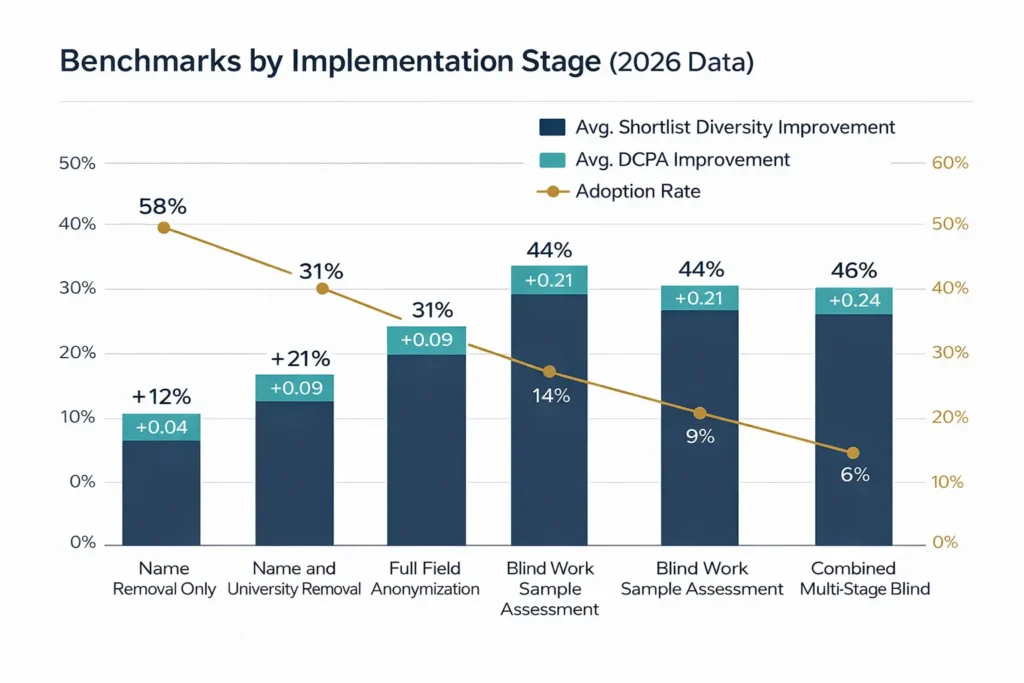
| Implementation Level | Avg. Shortlist Diversity Improvement | Avg. DCPA Improvement | Adoption Rate |
|---|---|---|---|
| Name Removal Only | +12% | +0.04 | 58% |
| Name and University Removal | +21% | +0.09 | 31% |
| Full Field Anonymization | +38% | +0.16 | 14% |
| Blind Work Sample Assessment | +44% | +0.21 | 9% |
| Combined Multi-Stage Blind | +46% | +0.24 | 6% |
The table reveals two important patterns. First, each additional layer of blind evaluation produces incremental improvement in both diversity and prediction accuracy, with the gains compounding as more bias-triggering information is removed. Second, adoption rates decline sharply as implementation complexity increases, suggesting that the most impactful forms of blind hiring are also the least commonly implemented, primarily due to operational friction rather than doubt about their effectiveness.
Key Strategies for Implementing Blind Hiring
How AI Enables and Challenges Blind Hiring?
AI has a complex and dual relationship with blind hiring in 2026. At the operational level, AI dramatically lowers the cost and friction of implementing blind evaluation by automating the redaction of demographic-correlating information. At the strategic level, the same AI systems that enable efficient blind hiring can, if incorrectly designed, undermine it by reintroducing the demographic signals they appear to have removed.
AI-Assisted Redaction
Manually reviewing and anonymizing resumes at volume is operationally intensive enough to deter most organizations from implementing comprehensive blind review. AI-powered redaction tools that automatically identify and remove specified fields (names, university names, graduation years, geographic indicators) from structured and unstructured application documents make blind review operationally feasible at any volume. These tools can process a pipeline of several hundred applications in the time it would take a human reviewer to manually anonymize a dozen, removing the operational cost barrier that has historically limited blind hiring to small-scale or pilot contexts.
The Proxy Signal Problem
Removing a demographic-correlating field from a resume does not necessarily remove the demographic information it carried, if that information is also encoded in other fields that remain visible. A candidate whose name has been removed but whose resume describes membership in a university-specific minority professional association has effectively disclosed the demographic information through a different field. A candidate whose graduation year has been removed but whose resume describes a career history that implies a specific age range has preserved the age signal through a different route.
Truly effective blind hiring requires not just the removal of specified fields but the identification and handling of all proxy signals through which the same demographic information can be inferred. AI systems with sufficient natural language capability can audit resumes for proxy signals and flag those that may inadvertently disclose the removed information, but this capability is more sophisticated than most currently deployed redaction tools offer.
AI Scoring Without Demographic Neutrality
When AI systems score blind-submitted work samples or anonymized application responses, the scoring model itself may contain embedded demographic bias even when the input it receives is demographically neutral. If the model was trained on historical evaluator ratings of non-blind submissions, it has learned to replicate whatever bias those evaluators applied.
The blind submission cannot remove bias that is baked into the scoring model rather than introduced through the evaluator’s direct perception of demographic information. For AI-assisted blind evaluation to actually be blind, the model must have been trained on outcome data that is itself demographically neutral, which typically means training on post-hire performance data rather than historical evaluation ratings.
Stop Juggling
10 Job Boards.
Search One
Your next role is already here. avua pulls opportunities from across the web into a single searchable feed; filtered by role, location, salary, and remote preference.
1.5 Million+
Active Jobs
380+
Job Categories
Blind Hiring and Diversity, Equity, and Inclusion
Blind Hiring Is Not Affirmative Action
Affirmative action involves deliberate preference for candidates from underrepresented groups to correct historical imbalance. Blind hiring is the structural removal of information that causes qualified candidates from all groups to be evaluated inaccurately. The mechanism and philosophical foundation are different. Blind hiring produces more diverse outcomes because it assesses candidates more accurately, not because it applies demographic preferences. Organizations that conflate the two create unnecessary internal opposition by framing a quality improvement as a values debate.
Blind Hiring and Socioeconomic Diversity
The diversity outcomes most commonly associated with blind hiring (gender and ethnic representation at the shortlist stage) are the most studied, but blind hiring also improves socioeconomic diversity in ways that receive less attention. Institutional prestige bias and address-based socioeconomic inference are significant early-funnel filters affecting candidates from lower socioeconomic backgrounds regardless of qualification. Removing university names and geographic indicators expands access for first-generation professionals and candidates from non-elite institutions in ways that purely demographic-focused diversity initiatives do not reach.
The Limits of Blind Hiring for Systemic Equity
Blind hiring addresses bias in the evaluation process but does not address the structural inequities in education and professional development pipelines that shape who applies in the first place. A candidate who could not afford an elite university education, who did not have access to professional networks that produce strong referrals, or whose early career was constrained by family economic circumstances may be underrepresented in the applicant pool regardless of how accurately that pool is evaluated. Blind hiring is a necessary but not sufficient component of a comprehensive equity strategy. It must be accompanied by sourcing practices that actively reach underrepresented talent pools and compensation practices that do not reproduce inequity at the offer stage.
Common Challenges and Solutions
| Challenge | Solution |
|---|---|
| Evaluator Resistance to Information Removal | Frame blind hiring as accuracy improvement, not diversity intervention; share post-hire performance data demonstrating equivalent or better outcomes |
| Proxy Signal Leakage Through Remaining Fields | Use AI-assisted proxy signal auditing on blind applications before evaluation; train evaluators to flag and escalate suspected proxy disclosures |
| Blind Process Impractical for Late Funnel Stages | Apply blind review to early stages and structure the late-funnel process with behavioral interviews, anchored rubrics, and independent scoring |
| Work Sample Evaluation Without Context | Provide standardized contextual briefs for work sample tasks that give all candidates equivalent background without identifying information |
| Building Internal Business Case | Run a controlled pilot with concurrent blind and non-blind shortlisting for the same roles; compare shortlist diversity and post-hire performance between the two approaches |
Real-World Case Studies
Case Study 1: The Public Service Commission
A national public service commission implemented name-blind and institution-blind application review for graduate-level entry roles after internal data showed that candidates from non-target universities were advancing at significantly lower rates than candidates from a small set of elite institutions, despite equivalent performance on standardized cognitive assessments included in the application process. The blind review was implemented for the initial shortlisting stage only.
In the first full hiring cycle under the blind system, the proportion of shortlisted candidates from non-target institutions increased from 31% to 58%, while the proportion from elite institutions decreased correspondingly. Follow-up analysis at 24 months found no statistically significant difference in performance ratings between the two groups within the new cohort. The commission extended blind review to the written assessment scoring stage in the following cycle. The 24-month retention rate for the first blind-hire cohort was 14% higher than the preceding cohort.
Case Study 2: The Law Firm
A large law firm was experiencing a consistent pattern: diverse candidates who advanced through early screening stages at near-parity rates with majority candidates were significantly underrepresented in final-round offers. The firm’s late-funnel interviews were conducted by senior partners who had not received structured interview training and who routinely described their assessment criteria in terms of “fit” and “polish.”
The firm implemented a two-part intervention: blind review of written legal analysis submissions for all candidates who passed the initial screening stage, and structured behavioral interviewing with rubric scoring for final-round interviews. In the two hiring cycles following implementation, the gap between diverse candidates’ interview pass rate and majority candidates’ interview pass rate closed from 21 percentage points to 4 percentage points. Partner satisfaction with the quality of new associate hires did not decline; it improved by 11% on the internal survey measure.
Case Study 3: The Technology Start-up
A series-A technology company with 40 employees recognized early that its informal, referral-heavy hiring process was producing a workforce that was demographically homogeneous and, more practically, that was missing a significant portion of the available technical talent pool because of who was and was not in the founding team’s network. They implemented blind technical assessment for all engineering roles: candidates submitted code solutions to standardized problems, and submissions were reviewed by a rotating panel of current engineers without attribution to a named candidate.
In the first year of the program, the proportion of female engineers hired rose from 8% to 29%. The 12-month performance ratings for engineering hires across all demographic groups were not statistically different. The time-to-hire for engineering roles decreased by 11 days because the blind assessment produced clearer quality differentiation within the candidate pool, reducing the number of late-stage interviews required to reach a hiring decision.
Building a Blind Hiring Program Dashboard: What to Track?
An AC without measurement infrastructure is a process masquerading as a system. Five metrics form the core of a useful performance dashboard:
Blind Hiring Across the Candidate Lifecycle
Application Stage
The earliest and most commonly implemented blind hiring stage. Name removal, university name removal, graduation year removal, and address removal prevent the most direct demographic signals from influencing the first evaluation decision. This stage has the most documented evidence for effectiveness and the lowest operational complexity of any blind hiring implementation.
Screening and Assessment Stage
Blind evaluation of pre-screening assessment responses and work sample tasks extends the principle to the stage where candidate quality is most meaningfully differentiated. Blind scoring of these submissions, before any identifying information is associated with the scores, produces assessments anchored to demonstrated competency rather than evaluator knowledge of who produced the work.
Interview Stage
Fully blind evaluation is not achievable in live interview settings. The focus shifts to structural bias reduction through behavioral interviewing, standardized rubrics, independent scoring, and diverse panels. Some organizations use audio-only or text-based early interview formats to prevent visual demographic cues from influencing initial assessments, though these formats have lower candidate experience scores and are not widely adopted.
Offer Stage
Blind offer construction extends the principle to compensation: initial salary offers established at documented, market-calibrated points within the role’s salary range without reference to the candidate’s disclosed compensation history or demographic characteristics. This prevents the negotiation-driven pay gaps that reproduce compensation inequity in organizations that have successfully reduced bias at earlier funnel stages. A candidate who advances through a blind process and then receives a biased offer has experienced a process that was half-fixed.
The Real Cost of Non-Blind Hiring: By the Numbers
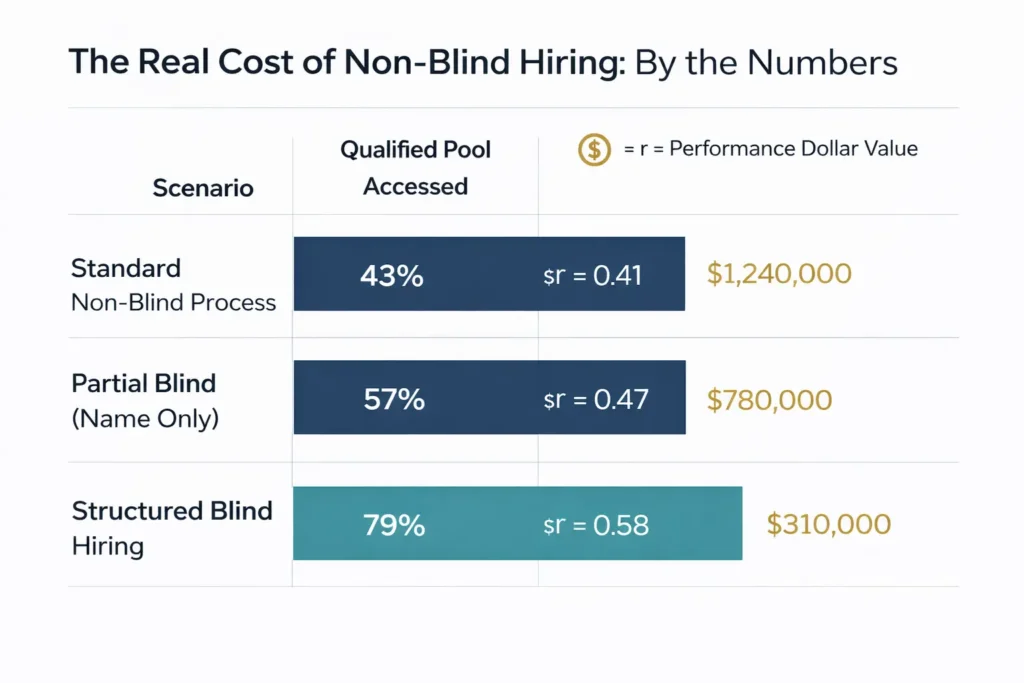
| Scenario | Qualified Pool Accessed | Post-Hire Performance ($r$) | Estimated Annual Cost of Bias (100 hires) |
|---|---|---|---|
| Standard Non-Blind Process | 43% of qualified pool | $r = 0.41$ | $1,240,000 |
| Partial Blind (Name Only) | 57% of qualified pool | $r = 0.47$ | $780,000 |
| Structured Blind Hiring | 79% of qualified pool | $r = 0.58$ | $310,000 |
The cost of bias is calculated as the combined impact of failed searches driven by an artificially constrained candidate pool, first-year attrition from candidates selected through inaccurate evaluation rather than genuine fit, and the pro-rated legal and reputational exposure from adverse impact patterns at sufficient scale to trigger investigation. The improvement from standard to structured blind hiring represents a recoverable cost of approximately $930,000 annually at 100 hires per year, from a process change that requires technology investment and training but no increase in headcount.
Related Terms
| Term | Definition |
|---|---|
| Resume Anonymization | The specific process of removing identifying fields from resume documents before evaluation |
| Adverse Impact | A statistically significant difference in selection rates between demographic groups, often the measured consequence of uncorrected bias |
| Skills-Based Hiring | An evaluation approach that prioritizes demonstrated competency over credential proxies; philosophically aligned with blind hiring |
| Structured Interview | A standardized interview format that reduces evaluator bias at stages where blind evaluation is not feasible |
| Work Sample Assessment | An evaluation method using actual task output rather than credentials or interviews; the most naturally suited format for blind evaluation |
| Diversity-Corrected Prediction Accuracy | The degree to which hiring decisions correlate with post-hire performance consistently across demographic groups |
Frequently Asked Questions
Does blind hiring mean the interviewer never learns the candidate’s identity?
No. Blind hiring applies to specific evaluation stages, most commonly initial resume review and structured assessment stages. By the time a candidate reaches live interviews, their identity is known. The value of blind evaluation at early stages is that the shortlisting decision was made without demographic-correlating information, producing a more accurately pre-selected interview pool. The live interview stage then relies on structural bias reduction through behavioral questions, anchored rubrics, and independent scoring.
Can blind hiring be applied to internal promotions?
Yes, and it is underutilized in this context. Blind evaluation of internal candidates using anonymized work samples or blind scoring of structured performance presentations reduces the familiarity bias and manager affinity bias that systematically disadvantage internal candidates from underrepresented groups. Organizations applying blind principles to promotion decisions, not just external hiring, see larger equity improvements than those limiting the approach to external recruitment.
How does blind hiring interact with requirements for diverse candidate slates?
The two approaches address different problems and are complementary. Diverse slate requirements ensure that underrepresented candidates reach the evaluation stage. Blind hiring ensures that early-funnel evaluation does not prevent them from getting there in the first place. Combined, they address both the pipeline and the evaluation quality dimensions of underrepresentation.
Does blind hiring disadvantage candidates who want credit for diversity-related experience?
No. Blind hiring removes demographic-identifying information, not experience-describing information. A candidate whose resume describes founding a diversity initiative or building inclusive community programs retains that experience on their blind resume, framed as professional accomplishment. What is removed is the name, the institution name, and demographic proxies. The experience itself remains fully available to the evaluator.
What technology is required to implement blind hiring at scale?
The minimum requirement for blind resume review is a redaction tool that reliably removes specified fields from structured documents. Most modern ATS platforms include configurable field masking as a standard feature. Blind work sample evaluation requires a submission and review platform that separates submission from attribution. The technology requirements are well within the capabilities of mid-market recruitment platforms in 2026, making the operational barrier lower than at any previous point in the methodology’s history.
Conclusion
The orchestra screen was not a gimmick. It was a solution to a measurement problem. The judges were not incompetent evaluators. They were human beings applying automatic categorization processes to a task that did not require those categorizations and was made worse by them. Removing their ability to see the performer made them better at hearing the music.
Blind hiring is the same intervention applied to a different measurement problem. Hiring managers and recruiters are not incompetent evaluators. They are human beings applying automatic categorization processes to a task that does not require those categorizations and is made worse by them. Removing their access to demographic-correlating information makes them better at evaluating the qualifications.
This is not a values argument, though it has values implications. It is a measurement argument. The hiring process is an attempt to predict job performance. Every piece of information that does not contribute to that prediction and has a documented history of corrupting it is noise, not signal. Blind hiring removes the noise. The signal that remains is more accurate. The decisions that follow from it are better. The workforce that results from those decisions is both more diverse and more capable, not despite each other but because of each other.
That is what accurate measurement looks like when you stop mistaking familiarity for quality.