Every recruiter has had this experience. You open a talent database with 2 million profiles, type in a job title, and get back 47,000 results. You refine the search. You get 31,000. You add another filter. You get 22,000. None of these numbers are useful. What you need is 40 candidates who specifically have the combination of skills, experience, and availability that makes them worth contacting. The gap between 22,000 and 40 is what Boolean search is designed to close.
Boolean search is the use of logical operators, specifically AND, OR, NOT, and their parenthetical combinations, to build precise search queries that retrieve candidates matching exact combinations of criteria from resume databases, applicant tracking systems, LinkedIn, and other talent data sources. It is the foundational technical skill of systematic candidate sourcing, and in 2026 it remains the most reliable method for translating a nuanced set of hiring requirements into a search that returns a manageable, highly relevant candidate set.
The technique takes its name from George Boole, the nineteenth-century mathematician whose algebraic system of logical relationships forms the mathematical basis for modern digital search. Every search query executed in a modern database, from Google to LinkedIn to an enterprise ATS, is evaluated against Boolean logic at some level. Recruiters who understand this logic can construct queries that behave predictably and can be systematically refined. Those who do not are effectively guessing at what the search engine will return.
In 2026, Boolean search sits at the intersection of human sourcing expertise and AI-assisted candidate discovery. AI sourcing platforms have automated many aspects of the search process, but the underlying Boolean logic that structures candidate queries remains essential: as a direct input method in many platforms, as the interpretive framework for understanding why an AI search returned what it did, and as the primary tool for sourcing in contexts where AI-assisted discovery is unavailable or insufficient.
The primary metric governing Boolean search quality is the Search Precision Rate (SPR): the proportion of candidates returned by a Boolean query who meet the actual requirements of the role when reviewed by a recruiter. A well-constructed Boolean string consistently achieves SPRs of 60 to 80%. A poorly constructed one may return thousands of results at an SPR below 10%, consuming review time without producing qualified candidates.
Search Precision = (Qualified Results ÷ Total Search Results) × 100
What is Boolean Search?
Boolean search is a structured query methodology that uses logical operators to combine, expand, or exclude search terms in talent databases and professional networks, enabling recruiters to retrieve candidates who match specific, defined combinations of skills, experience, location, and other role-relevant criteria.
The three core operators define the logic of the search:
Beyond the three core operators, Boolean search uses parentheses to group logical operations and control their order of evaluation, and quotation marks to search for exact phrases rather than individual terms. These tools, combined, allow a skilled recruiter to construct queries of significant precision from even the most complex sets of hiring requirements.
Is Boolean Search Still Relevant When AI Does the Sourcing?
This is the question that gets asked at every sourcing conference, and the answer requires nuance that the question itself rarely contains.
AI-assisted sourcing platforms in 2026 have genuinely transformed candidate discovery for many use cases. Platforms that use machine learning to match candidate profiles against role requirements, identify passive candidates based on behavioral signals, and rank results by predicted fit have reduced the time required to build an initial candidate pool for common role types.
For roles with well-defined, frequently filled profile types (software engineers at mid-level, sales representatives in established verticals, administrative professionals), AI sourcing surfaces a relevant starting pool faster than Boolean string construction for most recruiters.
Where Boolean search retains irreplaceable value is in the cases that AI sourcing handles least well: niche roles with unusual skill combinations, emerging competencies that AI models have not yet been trained on, roles that require precise negative filtering to exclude inappropriate backgrounds, and searches in databases where AI sourcing tools are not integrated or available. It also retains value as an interpretive framework: a recruiter who understands Boolean logic can understand why an AI-assisted search returned the results it did, can identify what the search missed, and can construct supplementary queries to fill the gaps.
The practical reality in 2026 is that the most effective sourcing approaches combine AI discovery for volume and efficiency with Boolean refinement for precision and edge-case coverage. A recruiter who can only use AI discovery tools is dependent on those tools’ training data and matching algorithms. A recruiter who can also construct Boolean strings can search any database, reach any platform, and find candidates that automated systems miss.
Recruiters with advanced Boolean proficiency identify qualified candidates 2.8 times faster than those relying on keyword search alone, according to sourcing efficiency benchmarks published by talent acquisition research organizations. The gap is widest in niche and senior role searches, where keyword search produces excessive noise and AI tools have less training data to work from.
For TA leaders, the workforce planning implication is that Boolean search is not a legacy skill being superseded by AI. It is a foundational skill that makes sourcing professionals more effective in AI-assisted environments, not less. The recruiter who understands Boolean logic is the one who gets the most out of AI sourcing tools because they understand what the tools are doing and where they fall short.
Consider the scenario that makes this concrete. A life sciences company needs to hire a regulatory affairs specialist with experience specifically in Class III medical device submissions to the FDA, combined with knowledge of the EU MDR framework that came into full effect in 2021. This is a niche combination that most AI sourcing tools will approximate rather than match precisely, because their training data does not include enough examples of this exact profile to distinguish it cleanly from adjacent regulatory roles.
A Boolean string constructed as “regulatory affairs” AND (“Class III” OR “PMA”) AND (“FDA” OR “510k“) AND (“EU MDR” OR “MDR 2017/745”) NOT (“pharma” OR “pharmaceutical”) returns a pool of 34 candidates from a database of 800,000 professionals. An AI search on the same database returns 412 candidates, of whom 29 meet the actual criteria on review. The Boolean search is more precise from the first query. For this role, in this context, it is the right tool.
Your Resume Isn’t Getting Read
Let’s Get That Fixed!
75% of resumes get auto-rejected. avua’s AI Resume Builder optimizes formatting, keywords, and scoring in under 3 minutes, so you land in the “yes” pile.
The Boolean Operator Toolkit
A working Boolean search vocabulary extends beyond the three core operators to include several additional constructs that significantly expand search precision and flexibility.
Parenthetical Grouping
Parentheses control the order of logical operations, exactly as in mathematical algebra. The query “Java AND (Spring OR Hibernate OR Maven)” instructs the search engine to first evaluate the OR group inside the parentheses, producing a set of candidates who have any of those three frameworks, and then apply the AND to require Java alongside that set. Without the parentheses, the search engine may evaluate the operators left to right, producing an unintended result. Complex Boolean strings typically contain multiple levels of parenthetical grouping and require systematic construction to ensure the logic is evaluated in the intended order.
Quotation Marks for Exact Phrase Matching
Without quotation marks, a multi-word term is typically evaluated as an AND search for the individual words, which may appear anywhere in the profile regardless of their relationship to each other. A search for project manager without quotation marks may return profiles containing the word “project” in one section and the word “manager” in another. A search for “project manager” with quotation marks returns only profiles where those two words appear in direct sequence. For role titles, credentials, and specific technical terms, exact phrase matching is almost always preferable to individual word matching.
Proximity Operators
Some search platforms support proximity operators (NEAR, WITHIN, or platform-specific variants) that return results where specified terms appear within a defined number of words of each other. These operators are more precise than simple AND combinations and less restrictive than exact phrase matching. A proximity search for “machine learning” NEAR “production” returns candidates who have both terms close to each other in their profile, which is a stronger signal than either term appearing anywhere in the document. Proximity operator availability varies by platform and is not universally supported.
Wildcard Characters
Wildcard characters (typically an asterisk) allow a search to match multiple variations of a root word. The query “manag*” returns results containing manager, management, managed, managing, and any other word beginning with “manag.” Wildcards are particularly useful for capturing spelling variations, plurals, and related forms of a term without requiring an OR chain listing each variant individually. As with proximity operators, wildcard support varies by platform.
Constructing an Effective Boolean String: A Practical Framework
Effective Boolean string construction follows a consistent process regardless of the role or platform.
Step 1: Identify the Must-Have Criteria. These are the requirements that are genuinely non-negotiable for the role. Every must-have criterion becomes an AND operator in the string, because all of them must be present in the candidate’s profile. Keep the must-have list tight: every AND narrows the results pool, and must-haves that are actually preferences will exclude qualified candidates unnecessarily.
Step 2: Identify the Skill Synonyms. For each must-have criterion, list all the ways a qualified candidate might describe that criterion in their profile. A candidate with “CRM” experience might describe it as Salesforce, HubSpot, Microsoft Dynamics, Zoho, or simply “customer relationship management.” Each synonym cluster becomes an OR group inside parentheses. Building comprehensive synonym lists is the highest-leverage skill in Boolean string construction: the most common sourcing failure is not that the search logic is wrong but that it uses terminology the target candidates do not use to describe themselves.
Step 3: Add NOT Exclusions. Identify the characteristics that would disqualify an otherwise matching candidate. Common NOT exclusions include inappropriate seniority levels (NOT “intern” or NOT “junior”), irrelevant industries where the same terms appear (a search for “Python” in engineering that should exclude Python instructors and educators), and company types that are structurally unsuitable for the role.
Step 4: Test and Iterate. Run the initial string and review the first 20 to 30 results for precision. If precision is low, add AND criteria or NOT exclusions. If the results pool is too small, remove AND criteria or add OR synonyms. Boolean string construction is an iterative process: the first version of a string is a hypothesis, and the results it returns are the data that informs the refinement.
Boolean Search vs. Other Sourcing Methods
| Method | Mechanism | Precision | Speed | Best Use Case |
|---|---|---|---|---|
| Boolean Search | Logical operator query construction | High | Moderate | Niche roles, complex skill combinations, precise exclusion needs |
| AI-Assisted Sourcing | Machine learning profile matching | Moderate | High | Common role types with established candidate profiles |
| Keyword Search | Single-term or unstructured multi-term | Low | High | Initial exploration, unfamiliar markets |
| Boolean + AI Hybrid | Boolean refinement of AI-surfaced results | Very High | High | Complex roles requiring both scale and precision |
| Referral Sourcing | Network-based candidate identification | Variable | Variable | Cultural fit, passive candidates in known networks |
| Job Board Posting | Inbound application generation | Variable | Low | Active candidates, employer-brand-driven attraction |
The Boolean plus AI hybrid approach, where AI discovery generates an initial candidate pool and Boolean refinement then filters and expands that pool for precision, consistently outperforms either method alone on both efficiency and result quality metrics. It is the operational approach that most skilled sourcers use in practice, though it requires proficiency in both disciplines to execute well.
What the Experts Say?
Boolean search is not about memorizing syntax. It is about understanding that a search engine is a logical machine and that giving it logical instructions produces better results than giving it hopes and approximations.
– Glen Cathey, Head of Sourcing and Recruiting Strategy at Randstad
How to Measure Boolean Search Effectiveness?
Formula: Search Precision Rate
Search Precision = (Qualified Results ÷ Total Search Results) × 100
Benchmarks by Sourcing Context (2026 Data)
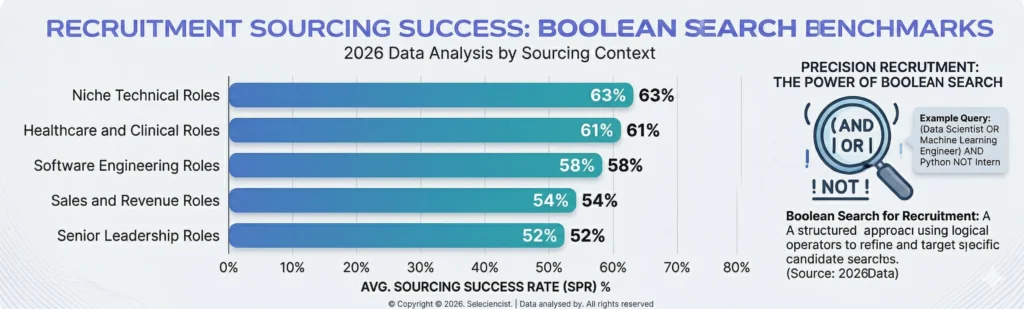
| Sourcing Context | Avg. SPR (Keyword Search) | Avg. SPR (Boolean Search) | Avg. SPR (Boolean + AI) |
|---|---|---|---|
| Software Engineering Roles | 18% | 58% | 71% |
| Sales and Revenue Roles | 22% | 54% | 68% |
| Healthcare and Clinical Roles | 14% | 61% | 74% |
| Niche Technical Roles | 8% | 63% | 76% |
| Senior Leadership Roles | 11% | 52% | 65% |
The SPR improvements from keyword search to Boolean search are consistent across role types, with the largest gains in niche technical roles where keyword search noise is highest. The additional gain from Boolean to Boolean-plus-AI reflects the AI layer’s ability to surface candidates whose profiles do not contain the exact terms in the Boolean string but who demonstrably have the relevant experience, capturing the tail of the qualified pool that pure Boolean searches miss.
Key Strategies for Improving Boolean Search Quality
- Build Role-Specific Synonym Libraries: The single highest-leverage investment a sourcing team can make in Boolean quality is a maintained library of synonyms for each skill, role title, and competency in their common hiring domains. This library converts the most time-consuming part of Boolean string construction (identifying all the ways candidates describe a given skill) into a reference task rather than a creative one, and ensures consistency across sourcers building strings for the same role type. Synonym libraries should be updated whenever a new term or technology becomes prevalent in candidate profiles.
- Use X-Ray Search for Platform-Specific Sourcing: X-ray search is the application of Boolean logic to general search engines (primarily Google) to search within the pages of specific platforms that do not expose their full database to external search tools. The query site:linkedin.com/in “software engineer” AND “Kubernetes” AND “Berlin” instructs Google to search only within LinkedIn profile pages for the specified criteria. X-ray search is particularly valuable for accessing LinkedIn at volume without LinkedIn Recruiter licenses, for searching GitHub, Stack Overflow, or professional association directories, and for finding candidates on platforms where the native search is less Boolean-capable than a general search engine.
- Test Strings Against Known Profiles Before Live Sourcing: Before deploying a new Boolean string against a live candidate database, test it against a set of profiles for candidates who are known to be qualified for the role. If the string does not return those profiles, it has a coverage gap that needs to be addressed before live deployment. If it returns them alongside many unqualified profiles, it needs additional precision. Known-profile testing catches structural errors before they consume review time on live sourcing.
- Document and Version-Control Boolean Strings: Effective Boolean strings for recurring role types are institutional knowledge. A team that does not document, version, and share its strings is rebuilding this knowledge from scratch with every new sourcing cycle. String libraries organized by role family, with iteration histories that show how strings were refined over time, are one of the most valuable and least commonly maintained assets in a sourcing function.
- Combine Boolean with Sourcing Outreach Analytics: Boolean search quality is not fully assessed at the point of the search result. It is assessed at the point of candidate response. If a Boolean string is returning profiles that look qualified on paper but who consistently fail to respond to outreach or who are consistently ruled out after initial contact, the string may be selecting on visible profile signals that do not accurately predict actual candidacy. Connecting outreach response data back to the Boolean strings that produced the candidate pool closes this feedback loop and informs ongoing string refinement.
How AI Is Changing Boolean Search in 2026?
The relationship between AI and Boolean search in 2026 is one of complementarity rather than replacement, though the nature of that complementarity is shifting as AI tools become more sophisticated.
Natural Language Query Translation
Some modern sourcing platforms now accept natural language queries (“find me a senior UX designer with fintech experience and a background in design systems“) and translate them into Boolean-equivalent logic under the hood. For recruiters without Boolean proficiency, this lowers the access barrier to precision sourcing.
For recruiters with Boolean proficiency, it provides a rapid starting point that they can then refine in Boolean syntax for greater control. The quality of the natural language translation varies significantly by platform, and understanding Boolean logic remains valuable for identifying and correcting translation errors.
AI-Augmented Synonym Generation
AI tools can significantly accelerate the synonym generation process by analyzing a role description and automatically producing a comprehensive list of alternative terms for key skills and qualifications.
A recruiter who previously spent 20 to 30 minutes constructing the OR synonym groups for a complex technical role can use AI to generate a first-draft synonym list in minutes, then review and refine it based on their domain knowledge. This reduces the time cost of Boolean string construction without reducing the precision that the resulting string achieves.
Semantic Search Layers on Boolean Foundations
The most advanced sourcing platforms in 2026 combine Boolean query logic with semantic search capability, so that a Boolean query anchors the results to the specified criteria while the semantic layer surfaces candidates whose profiles use related terminology that the Boolean string did not explicitly include. This hybrid architecture achieves higher recall (finding more of the qualified candidates in the database) without sacrificing the precision that Boolean logic provides.
Boolean Search and Diversity, Equity, and Inclusion
Boolean search interacts with diversity and inclusion goals in ways that can either support or undermine them, depending on how strings are constructed.
Expanding Access Through Synonym Inclusion
One of the most direct DEI applications of Boolean search technique is ensuring that synonym OR groups include the full range of terms used by candidates across different educational backgrounds, geographic markets, and career contexts. A search for project managers that includes only MBA-adjacent terminology and excludes the terms used by project managers trained in trades, nonprofit contexts, or non-English-speaking markets is structurally excluding qualified candidates through terminology gaps rather than through deliberate criteria.
Synonym libraries built with deliberate attention to linguistic diversity across demographic groups produce more inclusive candidate pools without changing the underlying qualification criteria.
NOT Operator Risks
NOT exclusions are the Boolean operator with the most DEI risk. A NOT exclusion that removes candidates with employment gaps systematically excludes candidates who have taken caregiving leave. A NOT exclusion based on specific company names or institution types may systematically exclude candidates from underrepresented backgrounds who were unable to access those institutions.
Every NOT exclusion in a Boolean string should be reviewed against its potential demographic impact before deployment, and NOT exclusions based on anything other than a genuinely disqualifying criterion should be removed.
Boolean Search for Diverse Talent Pools
Targeted Boolean searches on platforms and communities specifically associated with underrepresented talent groups (professional associations for women in technology, organizations for Black professionals in finance, networks for veterans transitioning to corporate roles) are one of the most effective sourcing strategies for building diverse candidate pipelines.
The Boolean logic remains identical; the database being searched changes to access the portion of the qualified candidate pool that generalist database searches consistently underrepresent.
Common Challenges and Solutions
| Challenge | Solution |
|---|---|
| Boolean String Returns Too Many Results | Add AND criteria for must-have specifics; add NOT exclusions for clear disqualifiers; tighten phrase matching with quotation marks |
| Boolean String Returns Too Few Results | Add OR synonym groups for each key term; remove non-essential AND criteria; check for platform-specific syntax requirements |
| Inconsistent Results Across Platforms | Boolean syntax varies by platform; verify operator syntax requirements for each platform individually |
| Synonym Gaps Causing Missed Candidates | Review profiles of known-qualified candidates who were not returned by the string; identify the terms they use that the string did not include |
| Candidate Profiles Outdated in Database | Supplement database Boolean searching with live platform sourcing (LinkedIn, GitHub) where profiles are more current |
Real-World Case Studies
Case Study 1: The Staffing Agency
A technical staffing agency sourcing candidates for a specialized semiconductor engineering role built an initial Boolean string that returned 127 candidates from their database. SPR review of the first 30 results revealed a precision rate of 23%. Analysis identified two problems: the string was using the job title “semiconductor engineer” which most relevant candidates did not use in their profiles, and the NOT exclusion for “student” was also excluding candidates who had described mentoring students as part of their professional activity.
After rebuilding the string with a comprehensive synonym OR group for relevant titles (“ASIC design,” “VLSI,” “RTL design,” “chip design,” “SoC“) and removing the imprecise NOT exclusion, the revised string returned 89 candidates with an SPR on the first 30 results of 67%. Time spent reviewing relevant candidates dropped by 61% despite the smaller total result pool.
Case Study 2: The In-House TA Team
An in-house TA team at a financial services firm was struggling to build an adequate candidate pipeline for a compliance analyst role. Their initial keyword search on LinkedIn returned over 4,000 results, of which preliminary review suggested fewer than 1 in 10 was genuinely relevant. Rather than attempting to filter 4,000 profiles, they constructed a Boolean string: (“compliance analyst” OR “regulatory compliance” OR “financial compliance”) AND (“FCA” OR “PRA” OR “Basel” OR “MiFID“) AND (“banking” OR “investment bank” OR “asset management”) NOT (“intern” OR “trainee”) NOT (“sales” OR “relationship manager”).
The string returned 312 results. SPR on the first 40 was 71%. Outreach to the top 25 produced 11 positive responses and 4 interviews, compared to the team’s previous approach of reaching out to 60 profiles from the keyword search to generate the same number of responses. Outreach-to-response rate improved from 7% to 44%.
Case Study 3: The Healthcare Recruiter
A healthcare recruiter using a national nurse staffing database was tasked with finding registered nurses with ICU experience who were available for travel assignments in the Mountain West region. Their initial platform search returned over 8,000 profiles. Building a Boolean string that combined the required clinical credentials, experience indicators, availability signals in the profile, and geographic location terms reduced the pool to 340 profiles.
Adding a NOT exclusion for profiles that had been contacted in the previous 90 days without a positive response reduced the working pool to 211 active prospects. The recruiter made their first placement from this refined pool in 6 days, compared to an average of 19 days for placements made through the platform’s native search tools. Time-to-placement improved by 68%.
Building a Boolean Search Performance Dashboard: What to Track?
Here is how you can get it done:
Boolean Search Across the Sourcing Workflow
Initial Pool Generation
The primary application of Boolean search: building the first candidate pool for a new role. At this stage, the Boolean string is a first-approximation hypothesis about where and how the target candidate describes themselves. The initial pool is large enough to identify string quality issues through SPR review and to begin outreach to the highest-probability candidates while the string is refined in parallel.
Pool Refinement
After initial pool generation, Boolean refinement adds precision through NOT exclusions, tighter phrase matching, and additional AND criteria identified from reviewing the false positives in the initial pool. This is the iteration stage where most of the precision improvement occurs and where domain knowledge about how specific types of candidates describe their experience is most valuable.
Database Expansion
When a refined Boolean string has been exhausted in one database, the same logical structure is adapted to the syntax requirements of additional databases and platforms. The skill set for cross-platform Boolean adaptation is distinct from string construction: it requires knowledge of each platform’s syntax idiosyncrasies, field structure, and search engine behavior.
Passive Candidate Identification
Advanced Boolean sourcing techniques (X-ray search on professional networks, GitHub repository searches, academic publication database queries) reach passive candidates who are not present in recruiter-accessible talent databases. These techniques require more platform-specific knowledge but access candidate populations that conventional sourcing entirely misses.
The Real Cost of Weak Boolean Search Skills: By the Numbers
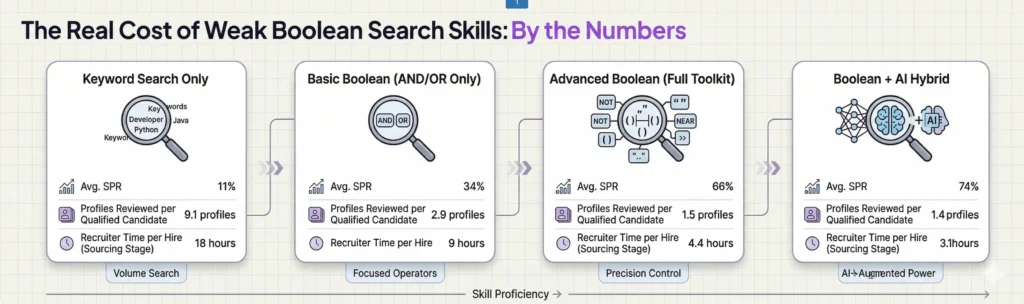
| Sourcing Approach | Avg. SPR | Profiles Reviewed per Qualified Candidate | Recruiter Time per Hire (Sourcing Stage) |
|---|---|---|---|
| Keyword Search Only | 11% | 9.1 profiles | 18 hours |
| Basic Boolean (AND/OR Only) | 34% | 2.9 profiles | 9 hours |
| Advanced Boolean (Full Toolkit) | 66% | 1.5 profiles | 4.4 hours |
| Boolean + AI Hybrid | 74% | 1.4 profiles | 3.1 hours |
At 100 hires per year, the difference between keyword-only sourcing and advanced Boolean sourcing represents approximately 1,360 hours of recruiter time per year spent reviewing irrelevant profiles. At a fully-loaded recruiter cost of $60 per hour, this is $81,600 in recoverable annual cost from a skill development investment, before accounting for the quality improvement that higher-precision sourcing produces in the candidate pools it delivers.
Related Terms
| Term | Definition |
|---|---|
| X-Ray Search | The use of search engine Boolean queries (typically on Google) to search within specific platforms such as LinkedIn or GitHub |
| Sourcing | The proactive identification and engagement of potential candidates, whether active or passive |
| Candidate Sourcing | The specific activity of finding and building a pool of candidates for a given role |
| ATS (Applicant Tracking System) | The software platform within which Boolean search is frequently applied to existing candidate databases |
| Search Precision Rate | The proportion of candidates returned by a query who meet the actual role requirements on review |
| Passive Candidate | A candidate who is not actively seeking a new role but who may be open to opportunities; the primary target of Boolean-driven proactive sourcing |
Frequently Asked Questions
Does Boolean search syntax differ across platforms?
Yes, significantly. LinkedIn Recruiter uses a Boolean syntax that differs from the syntax used in Google X-ray searches, which differs from the syntax accepted by most ATS platforms, which differs from the syntax supported by academic and professional databases. The core operators (AND, OR, NOT, parentheses, quotation marks) are broadly consistent, but capitalization requirements, supported proximity operators, wildcard character support, and field-specific search syntax vary by platform. Recruiters sourcing across multiple platforms need to know the specific syntax requirements of each one.
How long does it take to become proficient in Boolean search?
Basic Boolean proficiency (correct use of AND, OR, NOT, parentheses, and quotation marks for simple strings) can be developed in a few hours of structured practice. Intermediate proficiency (building comprehensive synonym groups, using proximity operators and wildcards, adapting strings across platforms) typically requires several weeks of applied practice on real sourcing tasks. Advanced proficiency (X-ray search techniques, database-specific optimization, cross-platform strategy, systematic string iteration and documentation) develops over months of deliberate practice and benefits significantly from mentorship by an experienced sourcer.
Can Boolean search be used on LinkedIn without a Recruiter license?
Boolean operators work within LinkedIn’s free and standard search interfaces, though with more limited field access than LinkedIn Recruiter. X-ray search (using Google to search within LinkedIn’s public profile pages) provides an alternative method for applying Boolean logic to LinkedIn’s profile database without a Recruiter license, accessing profiles that are publicly indexed by search engines. X-ray results are limited to publicly visible profile content and may not return profiles with restricted privacy settings.
How often should Boolean strings be updated for recurring roles?
Boolean strings for recurring role types should be reviewed at the start of each new sourcing cycle and updated whenever a new skill, tool, or credential becomes prevalent in the target candidate population. A string built two years ago for a data engineering role may not include terminology for frameworks and tools that have become industry-standard since the string was written. Annual comprehensive reviews of string libraries, supplemented by reactive updates when a string starts returning declining SPRs, maintain search quality for recurring searches.
Is Boolean search still taught in TA training programs?
Boolean search is included in most professional talent acquisition training programs and certifications, including those offered by the Society for Human Resource Management (SHRM), the Association of Talent Acquisition Professionals (ATAP), and specialist sourcing training providers. Its inclusion reflects the consistent view among TA practitioners and researchers that Boolean proficiency remains a foundational skill regardless of the automation tools layered on top of it. The training emphasis has shifted toward Boolean-plus-AI hybrid approaches rather than Boolean-only, reflecting the current operational reality of sourcing.
Conclusion
Boolean search is not a relic. It is a language. It is the language in which a recruiter communicates precise requirements to a search engine and receives back a candidate pool that reflects those requirements rather than the engine’s best guess at what was meant.
Every sourcing professional who has spent an afternoon reviewing irrelevant profiles from an imprecise search has experienced the cost of not speaking that language fluently. Every one who has built a string that returned exactly who they were looking for in a fraction of the time has experienced the value of it.
In 2026, AI has not made Boolean search obsolete. It has made Boolean search faster to initiate, easier to refine, and more powerful when combined with machine learning at scale. The recruiters who use AI tools most effectively are, in most cases, the ones who understand Boolean logic most deeply, because they know how to tell those tools precisely what they need and how to recognize when the tools are not delivering it.
The principles are simple. The application requires skill. The skill is teachable. And in a function where recruiter time is the constrained resource, the difference between a 11% precision rate and a 66% precision rate is the difference between a sustainable workload and an impossible one.