Two job postings go live on the same day for equivalent software engineering roles at two different companies. Both list competitive compensation. Both describe an interesting technical challenge. Both require five-plus years of experience in the same stack. One generates 340 applications in a week. The other generates 47.
The difference is not the role. The difference is not the salary. The difference is the brand that the role is being posted under, and more specifically, whether that brand has been deliberately applied to the posting itself or left as a generic template that could belong to anyone.
A branded job posting is a job advertisement that communicates not just the requirements of a role but the identity, culture, values, and employee experience of the organization posting it, using consistent visual identity, authentic employer voice, and specific proof points about what working there is actually like. It treats the job posting not as an administrative document but as a marketing asset, one designed to attract candidates who are the right fit for the organization as well as the right fit for the role.
In 2026, the distinction between a branded and an unbranded job posting has become one of the most impactful levers in early-funnel talent acquisition. Candidate behavior has shifted significantly: research indicates that more than 75% of active job seekers research a company’s employer brand before applying, and that the quality of the job posting itself is one of the primary signals they use to form an impression of what working at the organization is actually like. A generic, template-driven posting signals a generic, template-driven employee experience. A posting that communicates specific values, real people, and authentic culture signals an organization that has thought deliberately about what it is offering and to whom.
AI-powered hiring platforms like avua have extended the reach and precision of branded job postings significantly: enabling dynamic personalization of posting content based on candidate profile, tracking engagement and conversion metrics at the posting level, and using performance data to continuously optimize the language, format, and content of postings for both search visibility and candidate quality.
The primary metric governing branded job posting effectiveness is the Application Quality Rate (AQR): the proportion of applications generated by a posting that advance beyond initial screening. A high-volume posting with a low AQR is attracting candidates who are not a good fit, which wastes recruiter time and produces a misleading sense of pipeline health. A posting with a lower total application volume but a high AQR is attracting candidates who are genuinely aligned with the role and the organization, which is the outcome a well-branded posting is designed to produce.
Quality Rate = (Qualified Candidates ÷ Total Applicants) × 100
What is a Branded Job Posting?
A branded job posting is a role advertisement that integrates employer brand elements, including organizational values, culture signals, employee experience proof points, visual identity, and authentic voice, into the structure and content of the job description to attract candidates who are aligned with both the role requirements and the organizational identity.
The distinction from a standard job posting is not primarily cosmetic. A standard job posting describes what the organization needs from the candidate. A branded job posting additionally communicates what the organization offers the candidate, and why that offer is distinctive and worth considering. It answers the candidate’s primary evaluation question: not just “can I do this job?” but “is this the kind of organization I want to do it for?”
In practice, a branded job posting combines several elements that a generic posting omits: a values-anchored opening that communicates organizational purpose rather than a bureaucratic role summary, specific and honest descriptions of the working environment and team culture, employee voice elements that provide social proof from people who actually work there, visual design that reflects the organization’s brand identity, and a closing statement that makes the application feel like a mutual evaluation rather than a one-sided submission.
Is Your Job Posting Working as a Filter or as a First Impression?
Most organizations think about job postings as filters: documents that specify requirements that candidates must meet in order to be considered. This is not wrong, but it is incomplete in a way that costs real recruiting efficiency.
A job posting is the first point of contact between a candidate and an employer in the majority of hiring processes. Before a candidate speaks to a recruiter, before they learn anything specific about the team, before they form any opinion based on personal interaction, they read the job posting. That posting is the employer’s first impression, and it is largely unmanaged.
Generic job postings do not fail because they are incorrect. They fail because they are indistinguishable. In a job board environment where a candidate may be simultaneously evaluating postings from dozens of organizations, a posting that reads like every other posting for the same role type provides no information to help the candidate determine whether this particular organization, this particular team, or this particular opportunity is worth their application effort. The result is one of two failure modes: either the candidate applies regardless (generating an unfocused application pool) or the candidate does not apply because there was insufficient information to justify the effort (generating an unnecessarily narrow pool).
A branded job posting solves the indistinguishability problem by communicating specific information that only this organization can provide: what it is actually like to work here, what the team looks like, what the organization values in practice rather than in aspiration, and why someone who fits this culture would find this role genuinely compelling.
The performance difference is substantial. Branded job postings generate, on average, 23% more applications than generic postings for the same role, and the quality improvement is even more significant: the proportion of applicants who advance past initial screening is 34% higher for postings with strong employer brand content than for generic postings for equivalent roles. The explanation is straightforward: candidates who self-select into an application based on specific culture and values content are better qualified not just for the role but for the organization, which is the dimension of fit that most frequently determines whether a hire works out long-term.
For TA leaders, the implication is that the job posting is a design challenge, not an administrative task. The question is not “have we specified the right requirements?” but “have we communicated a compelling, accurate, specific reason for the right candidate to apply?” The second question is harder to answer but more consequential for recruiting outcomes.
Consider the scenario that illustrates this directly. A financial services firm is hiring for a risk analyst role. Their current posting is a standard template: role title, reporting line, responsibilities listed as ten bullet points, requirements listed as eight bullet points, a brief sentence about competitive compensation, and a boilerplate about being an equal opportunity employer. It generates 82 applications in two weeks, of which 11 advance past initial screening: an AQR of 13%.
A rewritten posting opens with a two-sentence description of the specific risk challenge the team is working on and why it matters to the business. It includes a paragraph from the hiring manager about what they look for in a strong team member and what the working environment is actually like. It describes the team composition, the growth trajectory of people in this role, and one specific project the successful candidate will own in their first quarter. The rewritten posting generates 94 applications in two weeks, of which 31 advance past initial screening: an AQR of 33%. Same role. Same requirements. Different result.
The ROI is not speculative. If an organization posts 200 roles per year and improving posting quality increases the average AQR from 13% to 33%, the recruiter time saved on reviewing unqualified applications, combined with the reduction in interview cycles needed to find suitable candidates, represents a recoverable operational efficiency of approximately $180,000 annually at a fully loaded recruiter cost of $60 per hour.
Your Resume Isn’t Getting Read
Let’s Get That Fixed!
75% of resumes get auto-rejected. avua’s AI Resume Builder optimizes formatting, keywords, and scoring in under 3 minutes, so you land in the “yes” pile.
The Anatomy of an Effective Branded Job Posting
A branded job posting is the sum of several deliberate choices about content, voice, structure, and visual presentation, each contributing to the overall impression of the organization as a place to work.
The Opening: Purpose Before Requirements
The first paragraph is the most-read section and the one that most frequently fails to do meaningful work. Generic postings open with the role title, reporting line, and a sentence confirming the organization is looking for a qualified professional. This communicates nothing a candidate did not already know.
A branded opening communicates the organizational purpose or the specific challenge this role exists to address, in language that makes the opportunity feel meaningful rather than bureaucratic. It answers: why does this role exist, and why does it matter? A candidate who finds the purpose compelling before reading a single requirement is already more engaged than one who encounters ten requirements before any reason to care.
Employee Value Proposition Elements
EVP elements in a branded posting are not listed generically but described specifically: not “competitive benefits” but the actual benefits and why they were designed that way; not “growth opportunities” but the specific development paths people in this role have followed; not “collaborative culture” but a specific description of how the team works together. Generic EVP claims (“we are innovative,” “we value work-life balance”) are present in virtually every posting and are therefore uninformative. Specific EVP claims (“our last three people in this role were promoted within 18 months”) provide differentiated information candidates can evaluate.
Employee Voice and Social Proof
A direct quote from someone currently in a similar role is one of the highest-impact additions available to a branded posting. Peer employee testimony is consistently rated more credible than organizational claims. The quote should be specific and focused on what distinguishes this organization from a comparable one. “I joined because of the technical challenge and stayed because of the people” is a warm generality. “What I was not expecting was how much autonomy I would have in designing solutions from scratch rather than maintaining existing systems” is specific, differentiating, and credible.
Visual Identity and Formatting
A branded posting in 2026 incorporates the organization’s visual identity through consistent brand colors, typography, and imagery. The formatting should reflect the actual organizational personality rather than defaulting to a platform template. Postings with embedded video elements (a short hiring manager message, a day-in-the-life clip) generate 34% higher engagement rates than text-only postings.
The Application Invitation
The closing section is the call to action, and it is routinely written as though the candidate’s decision to apply is assumed rather than earned. A closing that communicates what the application process looks like, how long it takes, and expresses genuine interest in hearing from candidates who see themselves in the description is a more respectful and more effective close than “Apply now.”
Branded Job Posting vs. Standard Job Posting
| Dimension | Standard Job Posting | Branded Job Posting |
|---|---|---|
| Opening | Role title and generic team description | Organizational purpose or specific challenge statement |
| Culture Description | “Collaborative environment” | Specific team structure, working norms, and day-in-the-life detail |
| Benefits | Listed without context or specificity | Described with rationale and specific terms |
| Social Proof | None | Employee or hiring manager voice element |
| Visual Design | Platform default template | Brand-consistent colors, typography, and imagery |
| Application Process | “Submit your CV” | Described timeline and what to expect at each stage |
| Tone | Formal and organizational | Authentic to the organizational personality |
| Application Quality Rate | 10 to 18% | 28 to 40% |
What the Experts Say?
A job posting is not a legal document. It is a sales pitch to the right person. The organizations that write it like a sales pitch, with honesty and specificity, win. The ones that write it like a procurement specification lose talent they never knew they were competing for.
– Lars Schmidt,Founder of Amplifycious
How to Measure Branded Job Posting Effectiveness?
Formula: Application Quality Rate
AQR = (Qualified Candidates ÷ Total Applicants) × 100
Benchmarks by Posting Type and Industry (2026 Data)
| Industry | Avg. AQR (Standard Posting) | Avg. AQR (Branded Posting) | Avg. Time on Posting Page |
|---|---|---|---|
| Technology | 14% | 36% | 2.1 min vs. 4.7 min |
| Financial Services | 12% | 31% | 1.8 min vs. 3.9 min |
| Healthcare | 16% | 38% | 2.4 min vs. 5.1 min |
| Professional Services | 11% | 29% | 1.6 min vs. 3.6 min |
| Retail / Hospitality | 19% | 41% | 1.3 min vs. 2.8 min |
The time-on-page metric is a strong leading indicator of AQR performance: candidates who spend more time reading a posting are self-qualifying more thoroughly before deciding to apply, which produces higher-quality applications regardless of the sector. The correlation between time-on-page and AQR is consistent across industries, making it a useful real-time proxy metric for posting quality before post-hoc AQR data is available.
Key Strategies for Improving Job Posting Brand Quality
How AI Is Transforming Branded Job Postings?
AI-Assisted Writing and Brand Voice Consistency: AI writing tools trained on an organization’s existing employer brand content generate posting drafts consistent with the established brand voice, incorporating relevant EVP elements and adapting the template structure to the specific role and team context. The AI draft is a starting point requiring review and enrichment from the hiring manager, but it eliminates the blank-page problem and the brand inconsistency that results when individual recruiters write postings without a structured starting point.
Dynamic Personalization: Advanced recruitment marketing platforms can serve different versions of a posting to different candidate segments based on profile data, browsing behavior, or sourcing channel. A candidate from a data science community forum might see a posting leading with technical depth. A candidate from a leadership development platform might see the same role described with greater emphasis on scope and strategic impact. Personalization consistently improves AQR by presenting the most relevant aspect of the opportunity to each candidate audience.
SEO Optimization at Scale: AI tools can analyze the search behavior of qualified candidates for a specific role type and automatically optimize posting language to match the terminology candidates actually use in searches, expanding organic reach without requiring additional paid distribution investment.
Performance Prediction and Optimization: Machine learning models trained on historical posting performance can predict the likely AQR and time-to-fill of a new posting before it is published, based on content quality across multiple dimensions. These predictions identify high-risk postings before they go live, enabling revision before deployment into active candidate markets.
Stop Juggling
10 Job Boards.
Search One
Your next role is already here. avua pulls opportunities from across the web into a single searchable feed; filtered by role, location, salary, and remote preference.
1.5 Million+
Active Jobs
380+
Job Categories
Branded Job Postings and Diversity, Equity, and Inclusion
The language and content of a job posting are significant determinants of who applies, and therefore of the demographic diversity of the candidate pool before any screening has occurred.
Inclusive Language in Branded Postings
Research on the language of job postings consistently finds that certain word choices differentially attract or deter candidates based on gender, cultural background, and socioeconomic experience. Terms associated with competitive, individualistic cultural norms (“dominate,” “aggressive growth,” “killer instinct“) are associated with lower application rates from women and candidates from collectivist cultural backgrounds. Terms associated with communal values (“collaborative,” “supporting,” “nurturing“) can, when overused, deter candidates from backgrounds where professional assertiveness is the expected norm.
A well-branded posting uses language that is specific and authentic to the organizational culture rather than defaulting to either stereotype. If the culture is genuinely competitive and high-stakes, describing it accurately attracts candidates who thrive in that environment and deters those who do not, which is the correct filtering outcome. If the culture is genuinely collaborative and supportive, describing it accurately has the same effect. The problem arises when posting language is not authentic to the actual culture, producing misaligned applications from candidates who were attracted by a description that does not match their subsequent experience.
Accessibility in Posting Design
Branded job postings that incorporate rich visual design, embedded video, and dynamic content must be designed with accessibility requirements in mind. Screen reader compatibility, alt text for images, captions for video content, and sufficient color contrast ratios are not optional add-ons for branded postings. They are baseline requirements for ensuring that the enhanced candidate experience a branded posting provides is accessible to candidates with disabilities. Organizations that invest in visual branding for their postings without investing in accessibility are inadvertently excluding a segment of the candidate population their brand is designed to attract.
Credential Requirements and Minimum Viable Qualification
Branded postings that include inflated or unrealistic credential requirements may be well-designed from a brand perspective but structurally exclusionary from a diversity perspective. A posting with sophisticated brand language and visual design wrapped around a requirements list that asks for a decade of experience for a mid-level role, a specific university credential for a role where demonstrated competence would suffice, or a driver’s license for a fully remote position is a well-packaged structural exclusion. The DEI review of a branded posting should include the requirements content as well as the language and design.
Common Challenges and Solutions
| Challenge | Solution |
|---|---|
| Postings Sound Generic Across the Organization | Develop role-family posting templates that incorporate specific team culture details; require hiring manager input before posting goes live |
| High Application Volume with Low AQR | Review posting for specificity of culture description; a posting that is vague attracts broadly; one that is specific attracts precisely |
| Brand Voice Inconsistency Across Recruiters | Develop a branded posting style guide with examples; use AI-assisted writing tools trained on the approved brand voice |
| Postings Not Appearing in Candidate Searches | Audit job titles and skill terms against candidate search behavior data; optimize posting language for search visibility |
| Candidates Arriving at Interview with Wrong Expectations | Review posting for accuracy; mismatched expectations are almost always a posting quality problem, not a candidate problem |
Real-World Case Studies
Case Study 1: The Software Company
A Series B software company was generating an average of 280 applications per engineering role but advancing fewer than 12% past initial screening, creating a bottleneck where two recruiters were spending the majority of their time reviewing unqualified applications. Analysis of rejected applications revealed that most candidates had strong general software engineering credentials but no specific experience with distributed systems at scale, which was the core technical requirement. The job posting had not made this requirement specific or prominent, and the culture description had not communicated the technical depth of the environment in a way that would self-select for the right profile.
A redesigned posting led with a two-paragraph description of the specific distributed systems challenge the team was building, included a technical blog post link for candidates who wanted to understand the depth of the work, and added a direct quote from a senior engineer describing what distinguishes technically strong candidates in their interview process. Applications dropped from 280 to 194 per role. The proportion advancing past initial screening rose from 12% to 41%. Recruiter time spent on initial screening dropped by 49%, and time-to-hire for engineering roles reduced from 47 days to 29 days.
Case Study 2: The Healthcare Provider
A regional hospital network was struggling to attract nurses to its intensive care unit roles despite a competitive compensation package that benchmarked at the 65th percentile of the local market. Exit survey data from candidates who had declined offers cited “did not feel like they understood the team environment” as a primary reason, suggesting the posting was not communicating enough about the work context to give candidates the confidence to commit. The existing posting was a standard template listing credentials required, shift patterns, responsibilities, and compensation.
The network redesigned the posting to include a 90-second video from the ICU nursing manager describing the team’s approach to patient care, a written account from a nurse who had been on the unit for three years describing what an atypical shift looked like, and specific information about the clinical support resources available to ICU nurses (rapid response protocols, clinical educator presence, patient ratio policies). Applications increased by 38% and offer acceptance rates for ICU roles improved from 61% to 79%. The investment in posting redesign was recovered in reduced vacancy days within the first quarter of implementation.
Case Study 3: The Professional Services Firm
A mid-size accounting and advisory firm was hiring for senior associate roles and finding that most applicants were coming from the Big Four, with little representation from mid-market or boutique firms despite the firm’s belief that its working culture was significantly more attractive than the Big Four environment for candidates at that level. The job posting was written in language that, on review, was indistinguishable from a Big Four posting: formal, credential-focused, and silent on the specific nature of the client relationships, autonomy, and career pace that distinguished the mid-market experience.
A redesigned posting explicitly contrasted the mid-market experience with the Big Four model (without naming competitors directly): specifically describing the scope of client access at the associate level, the proportion of engagement management responsibility carried by associates rather than passed up to directors, and the typical career timeline for promotion. Applications from mid-market and boutique firm candidates increased by 52% in the first hiring cycle, and the proportion of applicants who cited cultural fit as a primary reason for applying (measured by a post-application survey) rose from 23% to 61%.
Building a Branded Job Posting Performance Dashboard: What to Track?
Here are a few points that you need to consider:
Branded Job Postings Across the Candidate Journey
Journey for the branded job postings across the candidate journey usually works around 4 stages including discovery stage, engagement stage, application stage, and pre-offer and offer stage, here is a bit more detailed version of the stages to make you understand how it works:
Discovery Stage
A branded posting needs to be discoverable before it can be read. At the discovery stage, SEO, distribution channel selection, and job board metadata determine whether the right candidates encounter the posting at all. A beautifully branded posting that does not appear in candidate searches has not fulfilled its function. SEO and brand are complementary disciplines here, not competing ones.
Engagement Stage
The core branded posting experience occurs when a candidate reads it in detail. The posting’s purpose statement, EVP content, social proof elements, and visual identity do their work here. The quality of engagement determines whether the candidate self-qualifies positively (applies because they see themselves in the posting), self-qualifies negatively (decides the role is not a fit), or remains undecided. The first outcome is the design goal.
Application Stage
A branded posting creates expectations that the application process must honor. Candidates attracted by a posting communicating a respectful, efficient hiring process who then encounter a 45-minute application form experience a brand contradiction that damages both the candidate relationship and the organization’s employer reputation. The application design is part of the brand promise.
Pre-Offer and Offer Stage
Candidates who arrive at the offer stage through a well-branded posting have typically self-selected more deliberately than those attracted by generic postings. They are more likely to accept offers because they applied with specific cultural expectations that have been confirmed through the hiring process. The branded posting’s impact on offer acceptance rate is one of its most valuable and least tracked downstream effects.
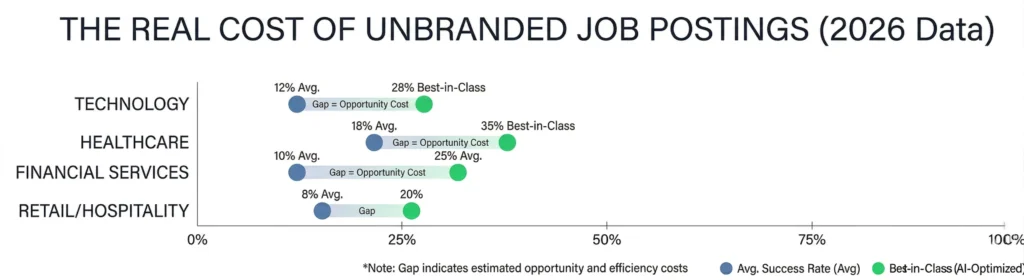
The Real Cost of Unbranded Job Postings: By the Numbers
| Scenario | Avg. AQR | Applications Reviewed per Qualified Candidate | Recruiter Hours per Hire (Screening Stage) | Est. Annual Cost (200 postings) |
|---|---|---|---|---|
| Generic Unbranded Postings | 12% | 8.3 profiles | 14.2 hours | $1,704,000 |
| Partially Branded Postings | 22% | 4.5 profiles | 7.7 hours | $924,000 |
| Fully Branded Postings | 37% | 2.7 profiles | 4.6 hours | $552,000 |
The cost calculation uses a fully loaded recruiter cost of $60 per hour and assumes 120 applications per posting on average. The difference between generic and fully branded postings represents $1,152,000 in annual recruiter time recoverable across 200 postings, from the reduction in unqualified applications requiring review. This is before accounting for the improvement in time-to-hire, offer acceptance rates, and first-year retention associated with better self-selection at the application stage.
Related Terms
| Term | Definition |
|---|---|
| Employer Brand | The reputation and identity of an organization as a place to work, as perceived by current, former, and prospective employees |
| Employee Value Proposition (EVP) | The full set of offerings an organization provides to employees in exchange for their work; the content backbone of a branded posting |
| Application Quality Rate (AQR) | The proportion of applications received that advance beyond initial screening; the primary effectiveness metric for job postings |
| Candidate Experience | The overall perception a candidate forms of an organization based on every interaction during the hiring process |
| Recruitment Marketing | The application of marketing principles and techniques to talent attraction, including job posting design and distribution |
| Job Aggregator | A platform that collects and displays job postings from multiple sources (LinkedIn, Indeed, Google for Jobs); a primary distribution channel for branded postings |
Frequently Asked Questions
How long should a branded job posting be?
The optimal length for a branded job posting varies by role complexity and candidate audience, but research on posting engagement suggests that postings between 400 and 700 words generate the highest engagement and conversion rates. Postings below 300 words are typically too thin to communicate sufficient culture and EVP content to support meaningful self-selection. Postings above 1,000 words show declining engagement as length increases. Within the 400 to 700 word range, every sentence should be earning its presence by either specifying a role requirement or communicating something specific and differentiating about the organization or opportunity.
Should job postings include salary ranges?
In jurisdictions with pay transparency legislation (now covering a majority of the US workforce and expanding in many international markets), including salary ranges in job postings is a legal requirement. Beyond compliance, the evidence on voluntary salary disclosure consistently favors transparency: postings with disclosed salary ranges generate 30 to 40% more applications than equivalent postings without, and they attract a higher proportion of candidates with matching compensation expectations, which reduces offer-stage declines driven by salary misalignment. The primary concern about range disclosure (that it will drive candidates to anchor at the top of the range) is real but manageable through clear communication about how salary within the range is determined.
Can branded job postings be effective on all platforms?
Branded posting effectiveness varies by platform, and the design choices that work well on one platform may not translate directly to another. LinkedIn’s posting format supports longer content, richer formatting, and employee testimonial elements. Indeed’s format is more text-focused and less supportive of visual design. Google for Jobs rewards semantic clarity and structured data. A branded posting strategy should adapt the core brand content to the formatting affordances and candidate behavior patterns of each platform rather than using a single design across all channels.
How often should branded job postings be updated?
Postings for regularly filled roles should be reviewed and updated at least quarterly to ensure the culture description, team composition, and EVP elements remain accurate. Postings that describe team characteristics, growth trajectories, or work environment details that have changed since the posting was written are actively misleading candidates, which produces misaligned applications and first-year attrition driven by unmet expectations. A calendar-based review schedule for evergreen postings prevents this drift.
Who owns the job posting in the hiring process?
Accountability for job posting quality is one of the most commonly unclear aspects of the hiring process. TA teams typically own posting logistics and distribution. Marketing or employer brand teams often own visual identity and language guidelines. Hiring managers own the accuracy of role-specific content. In practice, the best postings are collaborative products of all three: TA structures the content, hiring managers provide the specific team and role detail, and employer brand ensures consistency with organizational identity. Establishing this ownership model explicitly, rather than defaulting to recruiter-written generic templates, is the primary organizational design change required to sustain branded posting quality at scale.
Conclusion
A job posting is not a job specification. A job specification tells the organization what it needs. A job posting tells the candidate why this organization, this role, and this team are worth their consideration. The failure to treat these as different documents with different purposes is the root cause of most posting quality problems in recruiting today.
The organizations that have closed this gap are writing postings that function as their first meaningful employer brand interaction with the candidates they most want to reach. They are communicating specifically and authentically. They are providing the information a thoughtful candidate needs to make an informed self-selection decision. And they are generating application pools that are smaller, more focused, and substantially more likely to contain the person they are actually looking for.
The investment required is not large. A well-branded posting takes more time to write than a generic one but substantially less time to recruit from. The math is simple: spend more time on the front end, spend much less time on the back end. The organizations that have made that trade are winning the talent competition in ways that are not visible from the outside but are very visible in their recruiter workload, their time-to-hire, their offer acceptance rates, and their first-year attrition data.
The job posting is where the candidate’s decision process begins. It deserves to be treated accordingly.