Every year, a very specific category of hiring problem repeats itself in organizations across every industry: the pipeline of mid-level professionals has a gap, the senior leadership bench is thinner than it should be, and nobody can quite explain how it happened. The explanation, in most cases, is traceable to a decision made eight to twelve years earlier. The organization either invested in campus recruiting and built the entry-level pipeline that feeds every subsequent level, or it did not, and it is now sourcing externally at premium cost for every role that a deliberate early-career hiring program would have developed from within.
Campus recruiting is the systematic process of identifying, attracting, assessing, and hiring students and recent graduates from colleges, universities, and trade institutions as entry-level talent, with the explicit goal of building an early-career pipeline that develops into the organization’s future mid-level and senior workforce. It is one of the few talent acquisition activities that simultaneously solves an immediate staffing need and makes a long-term investment in organizational capability, which is what makes it both strategically significant and chronically underresourced in organizations that think only about the immediate hiring problem.
In 2026, campus recruiting has evolved significantly from the career fair model that defined it for decades. The physical career fair still exists and still has a role, but it is no longer the primary channel. AI-powered hiring platforms have made it possible to maintain year-round relationships with student talent, deliver targeted employer brand content at scale, assess candidates through digital tools before any campus visit occurs, and build early-career pipelines that are diversified across institution type, geography, and academic background in ways that the career fair circuit alone could never support.
What is Campus Recruiting?
Campus recruiting is a structured talent acquisition function that engages with educational institutions and their students to build relationships, assess potential, and hire entry-level talent through a variety of programs including internships, co-operative education programs, graduate schemes, and direct campus hiring events.
The function encompasses several distinct activities: employer brand building on campus through events, sponsorships, and faculty relationships; candidate identification and relationship management with students before they graduate; structured assessment and selection for internship and entry-level programs; internship and early-career program management including structured work assignments, mentorship, and evaluation; conversion of program participants to full-time hires; and ongoing relationship management with the institution network to sustain future pipeline access.
What distinguishes campus recruiting from other talent acquisition activities is the timeline. Most recruiting operates on a need-driven timeline: a role opens, sourcing begins. Campus recruiting operates on an academic calendar: engagement begins when students are in their second or third year, program selection occurs six to twelve months before the start date, and full-time offer decisions are made eighteen months or more before the hire’s first day in a permanent role. This extended timeline is both the challenge and the competitive advantage: organizations that engage early lock in the strongest talent before their competitors begin recruiting.
Your Resume Isn’t Getting Read
Let’s Get That Fixed!
75% of resumes get auto-rejected. avua’s AI Resume Builder optimizes formatting, keywords, and scoring in under 3 minutes, so you land in the “yes” pile.
Is Your Campus Recruiting Program Building a Pipeline or Just Filling Headcount?
There is a version of campus recruiting that amounts to attending two career fairs per year, interviewing fifty students, hiring twelve as interns, offering full-time roles to eight, and filling whatever headcount the entry-level budget permits. This produces hires. It does not produce a pipeline.
A campus recruiting program that is genuinely building organizational capability looks different. It has a multi-year institutional engagement strategy. It has year-round student touchpoints that build employer brand awareness before formal recruiting begins. It has a structured internship program with real work, real mentorship, real evaluation, and real conversion. It tracks the long-term career trajectories of its campus hires to understand where the pipeline is working and where it is producing attrition. And it has a diversity strategy that deliberately reaches institutions and student communities that the career fair circuit underrepresents.
The cost comparison between campus hiring and open-market hiring for entry-level roles makes the investment case clearly. The average cost to hire an entry-level professional through open-market sourcing in 2026, including recruiter time, job board spend, and onboarding investment, sits between $8,000 and $14,000 depending on role complexity.
The average cost to convert an intern to a full-time hire, in an organization with a well-run internship program, sits between $3,500 and $6,000. The intern conversion is faster (no sourcing required), cheaper (no job board spend, reduced recruiter time), higher-quality (twelve weeks of real work is a better predictor than any structured interview), and more predictive of retention (interns who convert report 28% higher two-year retention rates than open-market entry-level hires in equivalent roles).
Organizations with structured campus recruiting programs fill entry-level roles 41% faster than those relying exclusively on open-market sourcing, and report significantly higher hiring manager satisfaction with early-career hire quality. The speed advantage alone, measured in reduced vacancy days during the typically high-demand peak hiring periods, represents material operational value.
For TA leaders, the long-term strategic case is equally compelling. The professionals who will hold senior leadership roles in ten to fifteen years are currently completing their undergraduate or graduate programs. Organizations that engage with them now, invest in their early development, and create positive early-career experiences are building relationships that translate into talent loyalty and organizational knowledge depth that external sourcing cannot replicate at any price.
Consider the scenario that illustrates the compounding cost of not building this pipeline. A financial services firm has been experiencing a persistent shortage of qualified candidates for VP-level finance roles, which require eight to twelve years of relevant experience. They attribute the shortage to a competitive market for finance talent and respond by increasing recruiter budget for external sourcing and agreeing to salary premiums above their benchmark range.
What they have not examined is their entry-level pipeline: they eliminated their graduate training program during a cost-cutting cycle eleven years earlier and have been sourcing entry-level finance professionals from the open market ever since, with higher attrition rates and lower development investment than the program-era hires. The VP shortage is not a current market problem. It is the eleven-year consequence of a campus recruiting decision made during a budget cycle. Re-establishing a campus program addresses the root cause. No amount of external VP sourcing budget resolves it.
The ROI case for a structured campus program is long-horizon but substantial. An organization hiring 100 entry-level professionals per year, shifting 40% of those hires from open-market to intern conversion, recovers approximately $280,000 annually in sourcing cost at a conservative $7,000 per-hire differential, before factoring in the retention and productivity advantages that compound over the subsequent two to five years.
The Campus Recruiting Program Ecosystem
Campus recruiting is not a single activity. It is an ecosystem of interconnected programs and touchpoints that work together to build brand awareness, assess potential, and convert talent across different stages of the student lifecycle.
Internship Programs
The internship is the highest-conversion, highest-ROI element of the campus recruiting ecosystem. A well-designed internship program provides students with structured, meaningful work assignments that develop genuine professional capability rather than administrative support. It pairs each intern with a mentor who is responsible for their development, not just their task completion. It includes a mid-point evaluation that gives the intern honest feedback on their performance trajectory. And it makes a conversion decision at the end of the program based on performance evidence rather than social rapport.
Organizations that run internship programs as genuine development and assessment experiences rather than extended job shadowing consistently convert at rates 30 to 40 percentage points higher than those treating interns as temporary staff. The conversion decision is also more reliable: twelve weeks of observed work behavior is a significantly more predictive input than a set of structured interview responses, even good ones.
Co-operative Education Programs
Co-operative education (co-op) programs alternate academic terms with professional work terms across two or more semesters, creating longer, deeper relationships between organizations and early-career talent. Co-op students develop greater organizational knowledge, more substantive professional capabilities, and stronger conversion intent than interns in shorter programs.
For organizations in industries where the learning curve for entry-level roles is steep (engineering, healthcare, specialized financial services), co-op programs produce hires who are functionally closer to experienced professionals than to traditional new graduates at the point of full-time hire.
Graduate Schemes and Rotational Programs
Graduate schemes, common in UK and European markets and their equivalent in North American rotational programs, are structured multi-year development programs that move early-career hires through a series of rotations across business functions or geographies. These programs attract high-potential graduates seeking accelerated development and broad exposure, producing a cohort of generalist professionals with multi-functional organizational knowledge that is particularly valuable for general management and leadership development pipelines.
Campus Ambassadors and Student Brand Programs
Campus ambassador programs engage current students as peer representatives of the organization on their campus, increasing brand visibility, hosting recruiting events, and providing authentic peer-level employer brand content to their student networks. Ambassador programs are particularly effective at institutions where the organization does not have an established campus presence, and they reach student communities that formal recruiting events miss because they operate through peer channels rather than institutional ones.
Direct Campus Hiring Events
Career fairs, information sessions, coffee chats, hackathons, case competitions, and on-campus interview days are the event-based elements of campus recruiting. They generate candidate applications and maintain institutional relationships, but they are most effective as later-stage touchpoints for candidates who have already been exposed to the employer brand through year-round digital and community engagement rather than as primary sourcing mechanisms.
Campus Recruiting vs. Other Early-Career Sourcing Approaches
| Approach | Time to Full Productivity | Average Hire Cost | Conversion Predictability | DEI Reach Potential |
|---|---|---|---|---|
| Intern Conversion | 4 to 6 weeks | $3,500 to $6,000 | Very high (observed performance) | High if multi-institution |
| Open-Market Entry-Level | 10 to 14 weeks | $8,000 to $14,000 | Moderate (interview-based) | Moderate |
| Graduate Scheme | 8 to 12 weeks | $9,000 to $16,000 | High (program-assessed) | High if multi-institution |
| Referral (Entry-Level) | 8 to 12 weeks | $5,000 to $8,000 | Moderate | Low (replicates existing network) |
| Apprenticeship | 12 to 20 weeks | $4,000 to $7,000 | High (on-the-job assessed) | Very high |
The intern conversion model outperforms all alternatives on cost and predictability. The DEI reach of campus recruiting depends almost entirely on institutional diversification: an organization recruiting exclusively from five elite universities is not accessing the range of talent that a multi-institution strategy reaches.
Expanding the campus portfolio to include community colleges, historically Black colleges and universities (HBCUs), Hispanic-serving institutions (HSIs), and technical institutions dramatically improves the demographic diversity of the early-career pipeline without changing the quality criteria.
What the Experts Say?
Campus recruiting is the only talent acquisition activity that gives you real evidence of what someone can do before you hire them full-time. The internship is not a trial. It is the most accurate assessment tool the industry has, and most organizations are not treating it that way.
– Lindsey Pollak
How to Measure Campus Recruiting Program Effectiveness?
Formula: Campus Hire Conversion Rate
CHCR (%) = (Full-Time Offers Extended / Total Program Participants) x 100
Track alongside offer acceptance rate (full-time offers accepted divided by full-time offers extended) to capture the full conversion picture. A high CHCR with a low acceptance rate indicates that the program is identifying strong talent but failing to close them, typically a compensation or culture perception problem.
A low CHCR indicates that the internship program is not generating sufficient confidence in participants to warrant conversion offers, typically a program design or evaluation quality problem.
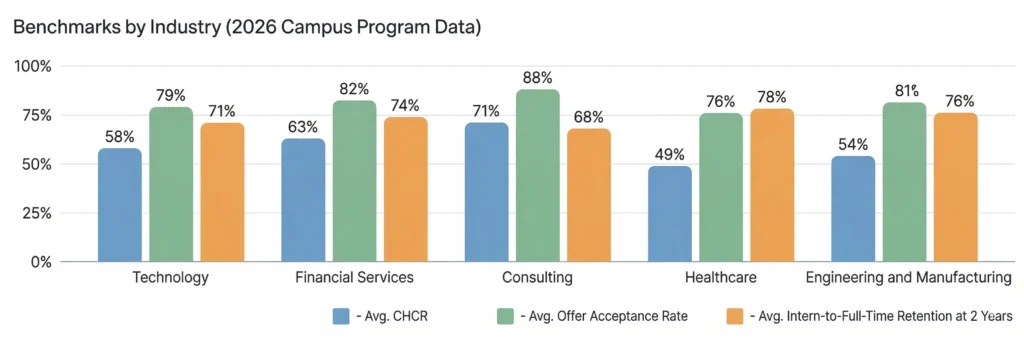
Benchmarks by Industry (2026 Campus Program Data)
| Industry | Avg. CHCR | Avg. Offer Acceptance Rate | Avg. Intern-to-Full-Time Retention at 2 Years |
|---|---|---|---|
| Technology | 58% | 79% | 71% |
| Financial Services | 63% | 82% | 74% |
| Consulting | 71% | 88% | 68% |
| Healthcare | 49% | 76% | 78% |
| Engineering and Manufacturing | 54% | 81% | 76% |
Consulting firms lead on CHCR because their internship programs are explicitly designed as extended assessment and conversion mechanisms, with structured performance evaluation and conversion decisions communicated before the internship ends.
Technology firms have lower CHCR partly because large technology organizations have more interns than full-time entry-level openings, creating competitive conversion dynamics even among strong performers.
Key Strategies for Building a High-Performance Campus Recruiting Program
How AI Is Transforming Campus Recruiting?
Stop Juggling
10 Job Boards.
Search One
Your next role is already here. avua pulls opportunities from across the web into a single searchable feed; filtered by role, location, salary, and remote preference.
1.5 Million+
Active Jobs
380+
Job Categories
Campus Recruiting and Diversity, Equity, and Inclusion
Campus recruiting is one of the highest-leverage points in the talent system for building a more demographically diverse workforce, and one of the most commonly executed in ways that replicate demographic homogeneity.
The Target School Problem
The dominant model of campus recruiting in professional services, finance, and technology has historically concentrated engagement and resources on a small set of elite universities. This concentration is economically rational in the narrow sense: these institutions have large, ambitious student populations, established campus recruiting infrastructure, and brand recognition that makes employer marketing more efficient. But it produces demographically narrow pipelines because the student populations of elite universities are themselves demographically skewed relative to the population of qualified candidates for most professional roles.
The economics of institution diversification have improved significantly as digital recruiting tools have reduced the per-institution cost of meaningful engagement. It is no longer necessary to station a team of campus recruiters at every target institution for weeks during recruiting season. A well-designed digital engagement strategy can maintain meaningful brand presence at 40 institutions for roughly the cost of intensive on-the-ground recruiting at five. The constraint is no longer economic. It is organizational will to redesign the target school list.
Removing First-Generation Friction
First-generation college students, students whose parents did not attend college, face structural disadvantages in campus recruiting that operate independently of their academic qualifications. They are less likely to be aware of competitive recruiting timelines. They are less likely to have informal networks that provide navigational information about the process. They are less likely to have had access to professional networking experiences that build the social fluency that traditional campus recruiting assesses.
Organizations serious about first-generation inclusion design campus programs with explicit outreach to first-generation student organizations, information sessions that explain the process rather than assuming prior knowledge, and interview preparation resources that reduce the advantage of informal coaching.
Apprenticeships as a Parallel Pipeline
In sectors where campus recruiting has historically been the exclusive entry path for professional talent, apprenticeship programs create a parallel pipeline that reaches candidates who did not take a four-year academic route but who have the capability to succeed in professional roles. Apprenticeship programs, particularly at organizations willing to invest in the training infrastructure they require, consistently produce diverse, high-retention early-career talent that the traditional campus model systematically misses.
Common Challenges and Solutions
| Challenge | Solution |
|---|---|
| Campus Recruiting Calendar Misaligned with Business Needs | Communicate business hiring timelines to HR earlier; align program structure to the academic calendar rather than the fiscal calendar |
| Internship Program Lacks Meaningful Work | Require hiring managers to submit real project briefs for intern assignments; tie program quality metrics to intern satisfaction scores |
| Low Conversion Rate Despite Strong Intern Pool | Audit the conversion decision process; low conversion often reflects evaluator indecision rather than performance quality |
| Limited DEI in Campus Pipeline | Expand institution list to include HBCUs, HSIs, and community colleges; partner with identity-based student organizations |
| Competing Offers Winning High-Potential Interns | Accelerate the offer timeline; extend conversion offers at end of internship rather than waiting for standard cycle |
Real-World Case Studies
Case Study 1: The Consulting Firm
A mid-tier management consulting firm was experiencing a persistent mid-level talent shortage despite a healthy entry-level hiring volume. Analysis revealed that its early-career hire retention rate was 41% at two years, compared to an industry benchmark of 68%, meaning the pipeline it was filling at the entry level was emptying faster than it could be sustained.
Investigation into the cause found that the firm’s internship program had become a loosely structured ten-week experience with no performance evaluation framework, no formal mentorship, and conversion decisions made by partners based on interpersonal rapport rather than demonstrated work quality.
The firm restructured its internship program with a competency-based evaluation framework, a formal mid-point feedback session, a dedicated mentor for each intern, and a structured conversion decision process. In the first post-restructure cohort, the CHCR improved from 44% to 73%.
More significantly, two-year retention among converted interns reached 79%, compared to 41% for the pre-restructure cohort. The firm attributed the retention improvement primarily to better fit assessment during the structured internship rather than to any post-hire change. The ROI of the program restructure, measured in reduced attrition cost at $35,000 per departure, exceeded the program investment cost within the first hiring cycle.
Case Study 2: The Technology Company
A technology company whose campus recruiting program was concentrated at eight elite universities was consistently building a pipeline that was 83% male and 91% from four demographic groups. An internal analysis found that among the firm’s highest-performing engineers (rated in the top quartile at three-year performance review), 47% had not attended a target school institution. The organization was building its pipeline from a set of institutions that, by their own performance data, were not the primary source of their strongest performers.
They redesigned the campus program to distribute 40% of internship offers to students from non-target institutions, including regional universities and HBCUs, while maintaining the same technical assessment criteria for all candidates. In the first cohort, CHCR for non-target institution interns was 59%, compared to 61% for target institution interns: statistically equivalent performance.
Two-year retention was 74% for non-target versus 69% for target institution hires. The demographic composition of the campus hire cohort improved significantly and the program’s net cost per intern conversion decreased by 22% because the lower competition for non-target institution talent reduced the premium required to win offers.
Case Study 3: The Financial Services Firm
A regional bank with a strong local employer brand was struggling to attract campus talent because its campus recruiting presence was limited to one annual career fair at the state university. The majority of its strongest early-career hire candidates were coming from the open market at significantly higher cost, because students were accepting offers from firms with earlier and more consistent campus engagement before the bank’s annual event.
The bank implemented a year-round digital engagement program targeting finance students at seven regional universities, including monthly career development content on LinkedIn, a virtual mentorship program connecting students with mid-level bank professionals, and a spring information session series that positioned the bank’s value proposition before the fall recruiting season began.
Applications to their summer analyst program increased by 61% in the first year. The proportion of applicants who cited the bank as a first-choice employer (measured by post-application survey) increased from 28% to 54%. The bank filled its summer program three weeks earlier than the previous year and offered full-time positions to 71% of participants, compared to 48% in the year prior.
Building a Campus Recruiting Program Dashboard: What to Track?
Here is how you can build a dashboard for campus recruiting program:
Campus Recruiting Across the Academic Calendar
Timing is everything in campus recruiting. The academic calendar dictates when students are open to opportunities, attending career fairs, or deep in finals. Aligning your outreach to these cycles is the difference between a full pipeline and a missed cohort.
Year-Round Brand Building
Campus recruiting does not begin in the fall. It begins continuously, through digital content that surfaces in student feeds, alumni networks that maintain peer credibility at target institutions, faculty relationships that generate curricular exposure, and ambassador programs that provide always-on peer-to-peer engagement. Organizations that invest in year-round brand building arrive at fall recruiting season as known quantities rather than competing for attention alongside dozens of unfamiliar employers.
Spring Application and Early Offer Season
Many of the strongest candidates for summer internship programs accept offers in the spring of their junior year. Organizations that run spring information sessions, extend early offers to exceptional candidates, and engage in relationship-building through spring semester position themselves to win the top candidates before competitors open formal recruiting processes in the fall.
Summer Internship Program
The core evaluation and conversion period. The internship program’s design quality determines conversion rates, retention outcomes, and the organization’s reputation among the student networks that will feed future recruiting pipelines. Every intern cohort is also a cohort of employer brand ambassadors who will share their experience with their peers when they return to campus.
Fall Recruiting Season
Career fairs, on-campus interviews, and formal application opening for the following summer. For organizations with strong year-round engagement, the fall recruiting season is a closing process rather than a sourcing process: the candidates are already familiar with the employer brand and are applying to confirm interest rather than to discover the organization for the first time.
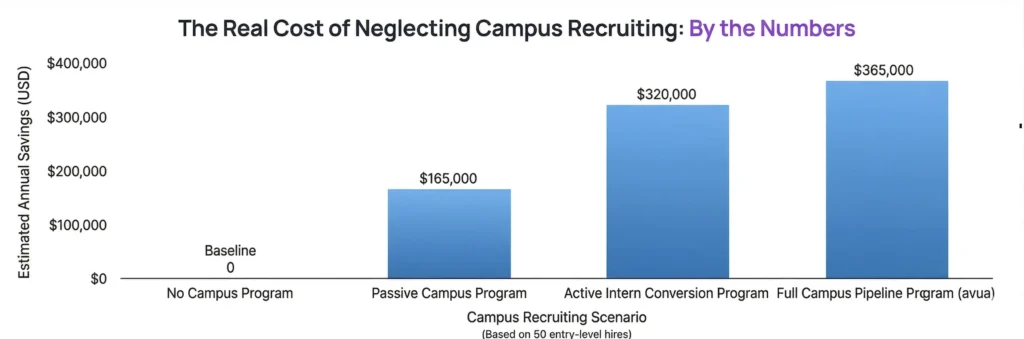
The Real Cost of Neglecting Campus Recruiting: By the Numbers
| Scenario | Entry-Level Hire Cost | Entry-Level 2-Year Retention | Estimated Annual Cost Differential (50 entry-level hires) |
|---|---|---|---|
| No Campus Program | $11,500 | 54% | Baseline |
| Passive Campus Program | $8,200 | 63% | $165,000 savings |
| Active Intern Conversion Program | $5,100 | 74% | $320,000 savings |
| Full Campus Pipeline Program (avua) | $4,300 | 79% | $365,000 savings |
The cost differential includes sourcing cost reduction from intern conversion versus open-market hiring and the attrition cost reduction from higher two-year retention, estimated at $30,000 per departure.
At 50 entry-level hires per year, the difference between no campus program and a full campus pipeline program represents $365,000 in annual value, compounding further as the pipeline matures and the development cost of externally sourced mid-level replacements is avoided.
Related Terms
| Term | Definition |
|---|---|
| Internship Program | A structured work experience for students, typically lasting 8 to 12 weeks, serving as the primary assessment and conversion mechanism in campus recruiting |
| Co-operative Education (Co-op) | An alternating academic and professional work program spanning multiple semesters, producing longer and deeper organizational relationships than standard internships |
| Graduate Scheme | A structured multi-year early-career development program that moves participants through rotations across business functions |
| Campus Ambassador | A current student representing an organization at their institution through peer-level brand building and recruiting activities |
| Early Offer | A full-time employment offer extended to a student during or immediately after their internship, before standard recruiting season timelines |
| HBCU (Historically Black College or University) | A US institution founded with the primary mission of educating Black Americans; a key institution type in campus DEI recruiting strategies |
Frequently Asked Questions
When should campus recruiting engagement start?
Sophomore or junior year, one to two years before full-time eligibility. Earlier engagement makes senior-year recruiting conversations significantly warmer and more effective.
How many institutions should be in your portfolio?
Roughly three to five institutions per 10 to 15 annual hires. Diversity across geography, institution type, and academic specialty matters more than sheer volume.
Should internship pay match entry-level salary rates?
Yes. Internship compensation should be prorated against the equivalent full-time rate. The strongest candidates are most sensitive to below-market pay signals.
How should underperforming interns be handled?
With honest, specific feedback at mid-point, and clear improvement expectations. Non-conversion decisions should be communicated directly and professionally to protect employer brand reputation.
Can smaller organizations compete in campus recruiting?
Often more effectively. Smaller employers can offer greater responsibility, visible impact, and faster progression than large rotation programs, especially at non-elite institutions.
Conclusion
Campus recruiting is the talent acquisition function with the longest payback horizon and the clearest compounding return. The organization that builds a well-designed campus program today is not just solving its current entry-level hiring problem. It is building the mid-level talent pool it will need in five years and the leadership bench it will need in ten. Every intern who converts to a full-time hire, every campus relationship that generates a cohort of informed, motivated early-career professionals, and every institution partnership that reaches talent the competition is not seeing is an investment in organizational capability that external sourcing cannot replicate.
The failure to invest is similarly compounding. The organization that ignores campus recruiting today will spend the next decade paying external sourcing premiums to fill roles that a deliberate early-career pipeline would have developed at a fraction of the cost. It will hire mid-level professionals without organizational knowledge and wonder why integration takes so long. It will build a leadership bench from executives who were developed elsewhere and wonder why institutional culture is hard to sustain.
Campus recruiting is not a cost center. It is a capability investment. The organizations that understand that distinction, and build accordingly, are the ones whose pipelines will be full when their competitors’ are dry.