There is a specific moment in most hiring processes when the candidate disappears. Not formally. They have not withdrawn, have not sent a declination, have not responded to a follow-up. They have simply stopped replying. Their application is still in the ATS. Their profile is still in the recruiter’s shortlist. But they are, for all practical purposes, gone.
Organizations tend to describe this as candidate ghosting and attribute it to candidate behavior. The more accurate description is candidate disengagement, and in the majority of cases it is caused not by candidate indifference but by organizational silence that preceded it. Candidates who stop responding have not lost interest in working. They have lost confidence that this particular organization is worth the continued effort of staying engaged.
Candidate engagement is the ongoing, deliberate management of the relationship between an organization and a job candidate throughout the hiring process, with the goal of maintaining the candidate’s interest, confidence, and active participation from first contact through offer acceptance. It encompasses every communication, every touchpoint, every experience, and every moment of information or silence that shapes the candidate’s perception of the organization and their desire to continue pursuing the opportunity.
In 2026, candidate engagement has become a strategic function rather than a courtesy extension of the recruiting process. The labor market in most professional sectors remains competitive enough that qualified candidates have multiple simultaneous options. The difference between an organization that closes its offers and one that loses candidates late in the process is frequently not compensation, role content, or even culture. It is whether the organization managed the relationship through the funnel with enough care, consistency, and communication to keep the candidate’s confidence intact until the offer arrived.
AI-powered hiring platforms have transformed candidate engagement from a manually intensive activity into a scalable, personalized, data-driven discipline. Automated communication sequences, behavioral engagement analytics, and AI-assisted personalization make it possible to maintain meaningful relationships with hundreds of active candidates simultaneously, while preserving the warmth and specificity that generic automation cannot produce on its own.
The primary metric governing candidate engagement effectiveness is the Candidate Engagement Score (CES): a composite measure of response rates, communication frequency, and behavioral engagement signals across the hiring funnel that predicts offer acceptance probability.
Candidate Engagement Score = (Response Rate + Frequency + Sentiment) - Response Time
Organizations that track CES proactively can identify disengagement before it becomes withdrawal and intervene with targeted outreach that recovers candidate interest before it is lost.
What is Candidate Engagement?
Candidate engagement is a continuous relationship management practice that treats every candidate as an active participant in a mutual evaluation process rather than a passive applicant awaiting decisions, and that invests in maintaining the candidate’s connection, interest, and trust through every stage of the hiring funnel.
The scope is broader than it is commonly understood. Candidate engagement begins before the application, in the employer brand content that a prospective candidate encounters and that shapes their initial interest. It continues through the application experience, the screening stage, every interview stage, the period between stages, the offer extension, and the post-offer period before start date. At each of these moments, the organization’s behavior either reinforces the candidate’s confidence in their decision to pursue the role or erodes it.
What makes engagement different from communication is intentionality. A recruiter who sends a confirmation email after an interview is communicating. A recruiter who sends a confirmation email, includes specific next steps with dates, notes something the candidate said that they found compelling, and follows up within 24 hours after the committed feedback window is engaging. The difference in candidate experience between these two approaches is significant, and the difference in offer acceptance rates between organizations that do the former and those that do the latter is measurable.
Is Your Hiring Process Engaging Candidates or Exhausting Them?
There is a well-documented paradox at the center of most hiring processes: the behaviors that make organizations feel rigorous and deliberate to the people inside them are often the behaviors that make the process feel disrespectful and uncertain to the candidates experiencing it.
A multi-week interview process with multiple rounds, delayed feedback, unexplained pauses, and vague timelines communicates organizational thoughtfulness to the hiring team. To the candidate, it communicates that the organization either does not know what it wants or does not value the candidate’s time enough to move efficiently. The candidate experiencing three weeks of silence between the second and third interview is not impressed by organizational diligence. They are composing their response to the competing recruiter who called while they were waiting.
The research on candidate behavior in 2026 is unambiguous. Candidates who do not receive communication within 48 hours of an interview are 37% more likely to continue pursuing alternative opportunities during the waiting period. Candidates who experience a total interview process longer than 21 days are 44% more likely to decline an eventual offer, even when the offer itself is competitive. And candidates who receive no proactive communication between funnel stages (who must initiate every follow-up themselves) report a 61% lower likelihood of recommending the organization as an employer, regardless of whether they ultimately received an offer.
Organizations that implement structured candidate engagement programs reduce offer decline rates by an average of 28% and improve candidate NPS scores by an average of 34 points compared to those managing engagement reactively. The mechanism is not mystery: candidates who feel informed, respected, and actively wanted throughout the process arrive at the offer stage in a fundamentally different psychological state than those who have spent weeks uncertain whether they are still under consideration.
For TA leaders, the strategic reframe is that candidate engagement is not a candidate experience initiative. It is an offer acceptance optimization strategy. Every disengagement that is allowed to develop into a withdrawal is a downstream loss for which the organization has already paid the upstream cost in recruiter time, hiring manager time, and interview infrastructure. The engagement investment, made consistently throughout the funnel, is the return on that upstream investment.
The scenario that makes this concrete: a technology company’s engineering team is interviewing three candidates for a senior role. All three are strong. Two are in advanced conversations elsewhere. The company’s standard process includes no proactive communication between interview stages, a feedback timeline that runs to ten business days, and no dedicated point of contact for candidate questions during the process. The two candidates with competing options accept other offers during the second-interview waiting period.
The third candidate, who has no competing options, accepts. The company congratulates itself on a successful hire. The two departures are not tracked. The offer decline rate for the quarter, if measured at all, is reported as within normal range. But the organization has just hired its third-choice candidate for a senior engineering role because its engagement process drove the first two choices out of the funnel before the offer was made.
The ROI of the engagement improvement required to have retained those two candidates: two proactive updates during the waiting period, one call from the hiring manager expressing continued enthusiasm, and a feedback timeline commitment honored rather than extended. Total recruiter time invested: approximately three hours. Cost avoided: the expense of re-opening the search, which takes an average of six additional weeks and $22,000 in recruiting resource for a senior engineering role.
Your Resume Isn’t Getting Read
Let’s Get That Fixed!
75% of resumes get auto-rejected. avua’s AI Resume Builder optimizes formatting, keywords, and scoring in under 3 minutes, so you land in the “yes” pile.
The Candidate Engagement Lifecycle
Candidate engagement is not a single activity. It is a sequence of deliberate touchpoints that span the entire relationship between the candidate and the organization, from initial awareness through post-offer commitment.
Pre-Application Engagement
The candidate’s engagement journey begins before they apply. The employer brand content they encounter, the job posting they read, the glassdoor reviews they check, and the LinkedIn content from current employees they review all shape the initial engagement level with which they approach the application. Organizations that invest in pre-application engagement produce applicants who arrive with higher initial motivation, better role understanding, and stronger self-selection alignment than those encountering the employer for the first time at application.
Application Stage Engagement
The application itself is an engagement touchpoint. An application process that is mobile-optimized, clearly structured, takes an appropriate amount of time (no longer than 20 minutes for standard roles), provides immediate confirmation of receipt, and sets clear expectations about next steps and timing is engaging by design. One that is lengthy, confusing, duplicative, or silent after submission is disengaging by default, and the candidates it loses at this stage are ones the organization will never know it had.
Screening and Interview Stage Engagement
This is where most organizations have the largest engagement gap. The period between a candidate completing an interview and receiving feedback is the highest-risk disengagement window in the process. Candidates are making active decisions about whether to continue investing in this opportunity during this period, and the organization’s behavior during it, specifically whether it communicates proactively or lets silence accumulate, is the primary variable determining whether the candidate remains engaged.
Best practice at this stage includes: communicating a specific feedback timeline at the conclusion of each interview, honoring that timeline, and if the timeline cannot be honored, reaching out proactively to explain why and provide a new commitment. Candidates who receive even a brief “we are still in the process, expect to hear from us by Thursday” message during a delay are significantly more likely to remain engaged than those who receive no communication while wondering whether they are still under consideration.
Between-Stage Engagement
The periods between formal interview stages are underinvested by most organizations. A candidate who has completed their first-round interview and is waiting for a second-round invitation is in an active evaluation period. If they hear nothing from the organization for two weeks while the hiring team coordinates schedules and makes shortlisting decisions, they have experienced two weeks of organizational silence during which their engagement has been declining daily. A single brief touchpoint during this period, “We are in the process of coordinating next steps and expect to be in touch by the end of this week,” costs minutes and has a measurable positive effect on continued engagement.
Post-Offer Engagement
Offer acceptance is not the end of the engagement challenge. The period between offer acceptance and start date, which may span several weeks or months, is a window of vulnerability where a candidate who has accepted can encounter competing approaches, develop concerns about their decision, or simply have their enthusiasm erode through a lack of ongoing connection to their future employer.
Organizations that maintain active, warm engagement through the post-offer period (sharing team updates, introducing the candidate to future colleagues, providing pre-start reading and preparation resources) convert accepted offers into first-day arrivals at significantly higher rates than those who consider the relationship closed at the point of signature.
Candidate Engagement vs. Candidate Experience
These two terms are closely related and frequently conflated, but they measure different things and drive different decisions:
| Dimension | Candidate Engagement | Candidate Experience |
|---|---|---|
| Definition | The active management of the candidate relationship through the hiring process | The overall perception the candidate forms of the organization as a result of the hiring process |
| Perspective | Organizational activity and behavior | Candidate perception and feeling |
| Measurement | Engagement rate, response rate, behavioral signals | Candidate NPS, satisfaction scores, qualitative feedback |
| Timeframe | Active, ongoing throughout the process | Cumulative, assessed in retrospect |
| Primary Driver | Communication quality and frequency | All aspects of the hiring experience |
| Optimization Target | Maintaining candidate interest and participation | Improving overall impression and satisfaction |
Candidate engagement is the input. Candidate experience is the output. An organization can have a positive candidate experience with low engagement if the passive experience is excellent (a beautiful application, clear communication, fast decisions, competitive offer). But an organization cannot have positive candidate experience with poor engagement, because silence, delays, and disorganized communication reliably produce negative perceptions regardless of how good the underlying opportunity is.
What the Experts Say?
Candidates are not applicants. They are evaluators. The moment organizations start treating them that way, everything about how they manage the hiring process changes.
– Gerry Crispin, Co-founder of CareerXroads and Pioneer of Candidate Experience Research
How to Measure Candidate Engagement?
Engagement Rate by Funnel Stage
Stage Engagement Rate = (Advancing / Invited) x 100
Tracked at each funnel stage, this metric identifies where disengagement is occurring. A drop in engagement rate between stage one and stage two that is larger than the drop between stage two and stage three indicates a specific stage-one-to-stage-two gap that warrants investigation.
Benchmarks by Engagement Practice (2026 Data)
| Engagement Practice | Avg. Offer Decline Rate | Avg. Candidate NPS | Avg. Time-to-Accept |
|---|---|---|---|
| No Structured Engagement | 34% | +12 | 5.8 days |
| Reactive Engagement (responds when asked) | 26% | +28 | 4.2 days |
| Proactive Structured Engagement | 18% | +51 | 2.9 days |
| AI-Personalized Engagement (avua) | 11% | +67 | 1.8 days |
The correlation between engagement quality and offer acceptance is among the most consistent findings in recruitment operations research. Each improvement in engagement maturity reduces offer decline rate by six to eight percentage points and improves time-to-accept by approximately one day, reflecting candidates who have maintained confidence through the process and are ready to commit when the offer arrives.
Key Strategies for Improving Candidate Engagement
How AI Transforms Candidate Engagement?
Stop Juggling
10 Job Boards.
Search One
Your next role is already here. avua pulls opportunities from across the web into a single searchable feed; filtered by role, location, salary, and remote preference.
1.5 Million+
Active Jobs
380+
Job Categories
Candidate Engagement and Diversity, Equity, and Inclusion
Candidate engagement practices interact with DEI outcomes in ways that are less immediately visible than screening or selection bias but are equally consequential for the diversity of who ultimately joins the organization.
Differential Disengagement Across Demographic Groups
Research on candidate behavior across demographic groups consistently finds that candidates from underrepresented backgrounds disengage from hiring processes at higher rates than majority-group candidates when faced with equivalent engagement failures (delayed feedback, unclear timelines, impersonal communication). The mechanism is not lower resilience or interest. It is a rational response to uncertainty: candidates who have less historical reason to trust that the process will resolve in their favor are more likely to interpret organizational silence as rejection and redirect their effort to processes that provide clearer signals.
This means that engagement failures are not demographically neutral in their impact. An organization that allows engagement quality to vary across its recruiter team, or that provides lower-quality engagement for candidates in less senior or less commercially prominent roles, is not applying engagement failures evenly. It is applying them in ways that are likely to produce differential disengagement across demographic groups, contributing to the diversity gap that appears at the offer stage without any individual decision-maker having made a biased selection decision.
Inclusive Engagement Design
Inclusive candidate engagement design considers the range of candidate circumstances that affect engagement behavior. Candidates who are currently employed have less available time to respond to engagement communications during business hours. Candidates from cultures where direct professional communication norms differ from the organizational default may interpret communication styles as more or less welcoming based on cultural framing. Candidates with disabilities may have communication format preferences that differ from the default.
Engagement processes designed with this range of circumstances in mind, offering flexible communication timing, multiple channel options, and explicit accommodation of candidate-specific needs, produce more equitable engagement outcomes across the full candidate population rather than optimizing for candidates whose circumstances most closely match the organizational default.
Common Challenges and Solutions
| Challenge | Solution |
|---|---|
| High Volume Making Personalization Impractical | Implement AI-assisted engagement tools that generate personalized content at scale; focus manual personalization on high-priority candidates |
| Hiring Managers Slow to Provide Feedback | Set feedback SLA expectations with hiring managers at role intake; use automated prompts that remind hiring managers of pending feedback obligations |
| Candidates Ghosting After Strong Interviews | Review between-stage communication frequency; most post-interview ghosting follows periods of organizational silence |
| Offer Decline Rate Higher Than Expected | Audit the post-offer engagement period; many declines occur after acceptance, not before, due to post-offer disengagement |
| Inconsistent Engagement Quality Across Recruiters | Implement structured engagement playbooks with defined touchpoint templates and timing requirements |
Real-World Case Studies
Case Study 1: The Financial Services Firm
A financial services firm was experiencing a 39% offer decline rate for mid-level analyst roles, significantly above the industry average of 21%. Exit interviews with declining candidates consistently cited feeling “out of the loop” during the process and uncertainty about whether they were genuinely competitive as reasons for their declining or accepting competing offers during the waiting period. The firm’s standard process included no proactive communication between interview stages and a feedback timeline that averaged 12 business days.
They implemented a structured engagement sequence: a same-day confirmation after each interview stage, a proactive update within three business days if the feedback timeline exceeded the commitment, a personal note from the hiring manager between the second and final interview, and a post-offer engagement sequence spanning the acceptance-to-start period. Offer decline rate dropped from 39% to 19% within two hiring cycles. Candidate NPS for the analyst recruiting process improved from +14 to +49. No changes were made to compensation, role content, or interview process structure.
Case Study 2: The Technology Company
A technology company running a high-volume graduate recruiting program was losing an estimated 22% of top-quartile candidates between application submission and the first interview stage, a window that averaged 18 business days with no candidate communication. AI-powered analysis of the drop-off revealed that 71% of withdrawals occurred within the first ten business days of silence, suggesting that candidates were interpreting the absence of communication as implicit rejection.
They implemented an AI-automated engagement sequence for all applicants: an application confirmation within two hours, a process overview communication within 24 hours, and a proactive status update every five business days until the first interview invitation was sent. Top-quartile candidate retention through to first interview improved from 78% to 94%. The AI system managed the engagement for 3,400 applicants in the first cycle with zero additional recruiter time investment. First-interview show rate improved from 81% to 91%.
Case Study 3: The Professional Services Firm
A professional services firm was losing a disproportionate number of candidates from underrepresented demographic backgrounds at the final interview stage. Candidate survey data revealed that these candidates were significantly more likely to have pursued and accepted competing offers during the firm’s extended final interview waiting period, which averaged 16 days for diverse candidates compared to 9 days for the general population (a gap driven by scheduling complexity within an over-subscribed final panel).
The firm implemented AI-assisted scheduling that compressed the final interview coordination window, plus a dedicated engagement sequence for candidates in the final stage that included a weekly proactive update, an informal video call with a current employee from a similar background, and a direct line to a recruiter for questions during the process. The demographic gap in final-stage withdrawal rates closed from 14 percentage points to 3 percentage points within three hiring cycles. The firm attributed the improvement specifically to the combination of faster scheduling and more intensive final-stage engagement.
Building a Candidate Engagement Dashboard: What to Track
Here is how you can get it done:
Candidate Engagement Across the Hiring Funnel
Candidate engagement isn’t a one-time event; it’s the pulse of your entire hiring funnel. By measuring how prospects interact from application to offer, you can pinpoint where talent loses interest and optimize every touchpoint to ensure your top choices stay excited, and ready to sign.
Awareness and Application Stage
Engagement at this stage is primarily passive: the quality of the job posting, the application experience, and the immediate post-application communication determines whether a candidate’s initial interest is confirmed or discouraged. The primary engagement investment here is design quality: a well-designed application experience that respects the candidate’s time and provides immediate, clear next-step information.
Screening Stage
The first active engagement stage, where two-way communication begins. Screening calls that are structured as genuine two-way conversations rather than one-sided information extraction, that provide candidates with useful information about the role and process, and that close with specific timeline commitments perform significantly better on subsequent engagement metrics than those conducted as pure assessment exercises.
Interview Stage
The highest-intensity engagement period. Every interview is an engagement event as well as an assessment event: the candidate is evaluating the organization with equal intensity to the organization’s evaluation of the candidate. Interviewers who acknowledge this explicitly (“We hope this is as useful for you as it is for us”) and who allocate meaningful time for the candidate’s own questions are performing engagement as well as assessment.
Post-Interview and Offer Stage
The highest-risk disengagement window. Structured proactive communication, honored timelines, and deliberate hiring manager engagement during this period are the primary determinants of whether candidates who were interested after their interview remain interested when the offer arrives. The engagement investment at this stage has the highest return of any stage in the funnel.
The Real Cost of Poor Candidate Engagement: By the Numbers
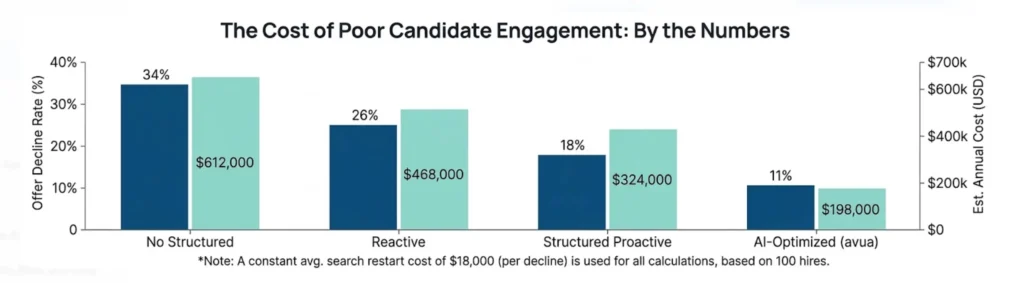
| Engagement Level | Offer Decline Rate | Avg. Search Restart Cost | Est. Annual Cost (100 hires) |
|---|---|---|---|
| No Structured Engagement | 34% | $18,000 per restart | $612,000 |
| Reactive Engagement | 26% | $18,000 per restart | $468,000 |
| Structured Proactive Engagement | 18% | $18,000 per restart | $324,000 |
| AI-Optimized Engagement (avua) | 11% | $18,000 per restart | $198,000 |
The cost calculation uses an average search restart cost of $18,000 per declined offer that requires re-sourcing, and assumes all declines result in a full search restart. At 100 hires per year, the difference between no structured engagement and AI-optimized engagement represents $414,000 in recoverable annual cost, from process changes that require engagement infrastructure investment but no increase in recruiter headcount.
Related Terms
| Term | Definition |
|---|---|
| Candidate Experience | The overall perception a candidate forms of an organization through the entirety of the hiring process |
| Candidate NPS | A metric measuring candidates’ likelihood to recommend the organization’s hiring process to others |
| Offer Decline Rate | The proportion of job offers extended that are declined by candidates; a key outcome metric for engagement quality |
| Talent Pool | A maintained database of candidates with whom the organization has an ongoing relationship; the foundation of proactive engagement |
| Candidate Nurturing | The practice of maintaining relationships with candidates who are not yet ready for a specific role but who represent future hiring potential |
| Recruiter Response Time | The elapsed time between a candidate communication and a recruiter reply; a primary driver of engagement perception |
Frequently Asked Questions
How often should recruiters update candidates?
At least once every five business days. During interviews or offer negotiations, daily check-ins may be appropriate to maintain momentum.
What’s the biggest candidate engagement mistake?
Missing promised feedback deadlines. When recruiters don’t follow through on timelines, candidates lose trust and that damage takes multiple positive interactions to repair.
Can candidate engagement be fully automated?
Partially. Status updates and confirmations can be automated, but personalized outreach and relationship-building still require human judgment at key moments.
How does engagement differ for passive candidates?
Passive candidates need more intensive early outreach. Unlike active applicants, they haven’t self-initiated interest, so the first two or three interactions are critical.
What happens to engagement after a declined offer?
It shouldn’t stop. Candidates who receive a warm, professional response post-decline are more likely to reapply, refer peers, and speak positively about your brand.
Conclusion
Candidate engagement is the discipline of treating the hiring process as a relationship rather than a transaction. Every communication, every touchpoint, every period of silence is either building the candidate’s confidence in the organization or eroding it. The organizations that manage this deliberately produce higher offer acceptance rates, lower offer decline rates, faster time-to-hire, and stronger employer brand reputations among the candidate populations they most want to reach.
The organizations that manage it reactively, responding only when candidates inquire and sending updates only when there is definitive news to share, are conducting the same process at significantly higher cost. They are paying the sourcing cost of finding the candidate, the assessment cost of evaluating them, the management cost of coordinating interviews, and then losing the candidate to an organization that communicated better during the waiting period.
Engagement is not a soft skill addition to the recruiting function. It is the discipline that converts the upstream investment in candidate identification and assessment into the downstream outcome of a hire. Without it, the investment frequently does not pay off. With it, the conversion rate from candidate to hire is measurably, consistently, and significantly higher.
The candidates in any active funnel are making ongoing decisions about this opportunity relative to their alternatives. The organization’s engagement behavior is one of the primary inputs into those decisions. The organizations that understand this are the ones whose funnels convert.