Ask a hiring manager to name the most important metric in their recruiting function and they will name time-to-fill, cost-per-hire, or quality-of-hire. Ask a candidate who declined an offer why they declined, and more than half the time they will not mention compensation, role content, or career opportunity at all. They will describe how they felt during the process.
That gap between what organizations measure and what candidates experience is where candidate experience lives, and it is one of the most consequential and most consistently underestimated variables in talent acquisition performance.
Candidate experience is the cumulative perception a job candidate forms of an organization based on every interaction, communication, and touchpoint throughout the hiring process, from the initial awareness of the employer brand through the application, assessment, interview, offer, and onboarding stages. It is not a single moment or a single interaction. It is the sum of everything a candidate sees, hears, waits for, and feels throughout the process, and it shapes not only their decision to accept or decline a role but their behavior as an employer brand advocate or detractor long after the hiring decision is made.
In 2026, candidate experience has become a business-critical function rather than an HR courtesy obligation. The convergence of three forces has elevated its strategic importance to unprecedented levels: the explosion of candidate review platforms where hiring experiences are publicly rated, the social media amplification that allows a single negative experience to reach thousands of prospective applicants, and a labor market that remains competitive enough in most professional sectors that candidates have genuine choice about which organizations are worth their time and goodwill.
AI-powered hiring platforms have transformed what is achievable in candidate experience: enabling real-time application status tracking, automated personalized communication, instant post-interview feedback, and seamless scheduling that eliminates the friction that accounts for the largest share of negative candidate experience. Organizations that have deployed these capabilities report measurable improvements in application completion rates, interview show rates, and offer acceptance rates that translate directly into hiring efficiency gains.
The foundational metric governing candidate experience is Candidate Net Promoter Score (cNPS): an adaptation of the standard NPS methodology that asks candidates, whether successful or unsuccessful, how likely they are to recommend the organization’s hiring process to others.
cNPS = % of candidates rating 9–10 minus % of candidates rating 1–6
A cNPS above +40 indicates a candidate experience that is actively building employer brand equity. A cNPS below 0 indicates a candidate experience that is actively damaging it, reaching a significantly wider audience than the candidates directly involved.
What is Candidate Experience?
Candidate experience is the holistic perception formed by a job applicant of an organization as a potential employer, built from every point of contact between the candidate and the organization throughout the hiring process, and extending into their behavior as a brand advocate or critic following the conclusion of that process.
The scope is broader than most organizations manage. It begins before the candidate applies, in the content they encounter about the organization on LinkedIn, Glassdoor, and the organization’s own career site. It continues through the job posting, the application process, the screening conversation, every interview round, the spaces between them, the offer, the negotiation, the acceptance, and the period before their start date. At every one of these moments, the candidate is forming an impression that either reinforces or undermines their confidence in their decision to pursue this opportunity.
What makes candidate experience distinct from related concepts is its cumulative and subjective nature. An active candidate who has an excellent interview but waits three weeks without feedback and receives a rejection via automated email has had a mixed experience in which one positive touchpoint was dramatically outweighed by two negative ones. Their overall perception of the organization is shaped not by the average of their interactions but by the emotional weight of the most significant ones, particularly the most recent and the most jarring.
Is Your Hiring Process Building Your Brand or Burning It?
Every organization with an active hiring program has a candidate experience, whether or not it is deliberately designed. The question is not whether a candidate experience exists. It is whether the organization is aware of what that experience is and accountable for improving it.
The stakes of not being aware are significant and asymmetric. A positive candidate experience produces three outcomes: an accepted offer, a positive employer brand impression, and an advocate who will recommend the organization to their professional network.
A negative candidate experience produces different outcomes depending on the severity: a declined offer, a negative impression that suppresses future applications from the candidate’s network, and in the worst cases, a public review on Glassdoor or a social media post that reaches a far wider audience than any single candidate’s network would suggest.
Research on the downstream effects of poor candidate experience is consistent and commercially significant. Candidates who have a poor hiring experience are twice as likely to share it publicly than those who have a positive one. In industries where the candidate pool and the customer base overlap significantly (retail, hospitality, financial services, consumer technology), a poor candidate experience directly reduces customer acquisition probability among the candidate’s network.
Virgin Media famously calculated that candidate-turned-detractors were costing the organization approximately £4.4 million annually in direct revenue impact from customers who withdrew their business after a family member or friend described a poor application experience.
Organizations rated in the top quartile for candidate experience generate 70% more applications per open role than those in the bottom quartile, a pipeline quality advantage that compounds across every stage of the hiring funnel. They also report 18% higher offer acceptance rates, 26% lower offer decline rates, and measurably stronger employer brand metrics on third-party review platforms.
For TA leaders, the business case reframe is this: candidate experience is not a satisfaction initiative. It is a talent supply chain issue. A poor candidate experience restricts the supply of qualified applicants, increases the cost of converting those who do apply, and creates negative externalities in the employer brand that compound over time. Investing in candidate experience is investing in the efficiency and sustainability of the entire talent acquisition function.
Consider the scenario that makes this concrete. A regional bank applies for a year to fill a commercial lending officer position. Their application process requires 45 minutes to complete, including fields that duplicate resume content already submitted. Their initial screen is conducted by an automated system that provides no human contact for three weeks after submission. Candidates who progress to interview receive feedback in an average of 12 business days. And unsuccessful candidates receive no communication at all after their interview, learning of their non-selection only through the absence of any further contact.
In that same year, four former applicants post reviews on employer rating platforms describing the experience as impersonal, disorganized, and disrespectful of their time. Two of those reviewers are current customers. Six prospective applicants for the same role, reading those reviews before deciding whether to apply, choose not to. The bank’s total applicant volume for the role over 12 months is 41. Industry benchmarks for equivalent roles average 140 applicants. The bank pays a premium recruiting fee to a search firm to locate a suitable candidate.
The candidate experience failures that drove this outcome did not require a large investment to fix. An application form audit taking one day of HR time. Automated acknowledgment communications taking one week of systems configuration. A feedback SLA agreed with hiring managers taking one team meeting. The upstream cost of the experience failures: twelve months of vacancy, a search fee that averaged $28,000, and ongoing review platform content that continues to suppress application volumes.
Your Resume Isn’t Getting Read
Let’s Get That Fixed!
75% of resumes get auto-rejected. avua’s AI Resume Builder optimizes formatting, keywords, and scoring in under 3 minutes, so you land in the “yes” pile.
The Five Dimensions of Candidate Experience
Candidate experience is not monolithic. It is composed of distinct dimensions that can be assessed, measured, and improved independently, each contributing to the overall perception candidates form of the organization as an employer.
Transparency and Communication
The dimension most consistently cited in candidate experience research as both the most impactful on overall satisfaction and the most commonly handled poorly. Transparency encompasses: communicating a clear timeline at the outset of the process, honoring the commitments made about when candidates will hear back, providing genuine feedback (not template rejections) to candidates who invest significantly in the process, and being honest about the status of the decision rather than leaving candidates in uncertainty.
The candidate’s standard of acceptable transparency has risen significantly in 2026. Candidates who applied for roles ten years ago expected a standard of communication that would be considered inadequate by today’s applicants, who are accustomed to real-time status updates in most other contexts of their digital lives. An application tracker that shows progress through the funnel the way a delivery tracker shows package location is no longer a premium feature. It is an expected baseline.
Speed and Efficiency
Every unnecessary day added to the hiring process is a day during which the candidate is available to receive and potentially accept a competing offer. The correlation between time-to-hire and offer decline rate is among the most documented relationships in talent acquisition research: processes exceeding 21 days from application to offer see significantly higher decline rates than those completing within 14 days. Speed is not only a candidate experience factor. It is a competitive imperative.
Efficiency is distinct from speed but related. An efficient process reaches a decision quickly because it has been designed well, with appropriate stage sequencing, interview panels of the right size, and decision criteria established before the process begins.
An inefficient process is slow because it is disorganized, with scheduling delays, repeated interview rounds covering the same ground, and decision authority spread across participants who are not aligned on criteria. Candidates experience the inefficiency directly and interpret it as information about the organizational culture.
Personalization and Respect
Candidates who feel treated as individuals rather than as one entry in a list of applications consistently report higher satisfaction across all other experience dimensions. Personalization does not require significant resource. It requires attention: using the candidate’s name, referencing specific aspects of their background or their interview responses, and acknowledging the effort they have invested in the process.
The opposite of personalization is not just impersonalism. It is invisibility, the experience of submitting an application and receiving no acknowledgment that it was received or that the person submitting it exists.
Process Design and Fairness
Candidates consistently report that a hiring process feels fair when it is structured, consistent, and clearly designed to assess them on criteria relevant to the role. Unstructured interviews, vague assessment criteria, and undisclosed process stages all contribute to a perception that the process is arbitrary or that the organization does not know what it is looking for.
Structured behavioral interviews, clearly communicated process stages, and consistent assessment criteria applied across all candidates produce significantly higher fairness perception scores than ad hoc processes, regardless of whether the ultimate decision favors or disfavors the individual candidate.
Outcome Communication
How a candidate learns the outcome of their application or interview is a disproportionately powerful determinant of their overall experience. Candidates who receive a rejection through a thoughtful communication that acknowledges their specific strengths, provides honest feedback about the decision, and invites them to apply for future suitable roles report significantly higher satisfaction than those who receive a generic automated template or no communication at all. The worst outcome, experienced by approximately 43% of candidates in unstructured hiring programs, is receiving no communication at all after investing time in an interview, and learning only from the absence of contact that they were not selected.
Candidate Experience vs. Related Concepts
| Concept | Definition | Relationship to Candidate Experience |
|---|---|---|
| Candidate Engagement | Active management of the candidate relationship through the process | Input: engagement quality is a primary driver of experience perception |
| Employer Brand | The organization’s reputation as a place to work | Bidirectional: experience shapes brand; brand shapes experience expectations |
| Candidate Journey | The sequential stages a candidate moves through from awareness to hire | The structural framework within which experience occurs |
| Candidate NPS | A metric measuring advocacy likelihood among candidates | The primary quantitative measure of experience quality |
| Recruiter Responsiveness | The speed and quality of recruiter communication | One of several experience dimension inputs |
| Onboarding Experience | The post-hire integration experience | The next stage of the experience continuum; often separated in measurement but connected in perception |
What the Experts Say?
Candidate experience is the company’s audition for the candidate. Most organizations forget that the candidate is also deciding. By the time you know you want to hire someone, they have already decided whether they want to work for you.
– Kevin Grossman, President of Talent Board and founder of the Candidate Experience Awards (CandE Awards)
How to Measure Candidate Experience?
Formula: Candidate Net Promoter Score
cNPS = % of candidates rating 9–10 minus % of candidates rating 1–6
Measured using the standard NPS question: “On a scale of 0 to 10, how likely are you to recommend our hiring process to a friend or colleague?” The cNPS should be measured separately for candidates at different stages of the funnel (applicants who were screened out, candidates who reached interview, candidates who received offers) to understand how experience perception varies across the process.
Benchmarks by Industry (2026 cNPS Data)
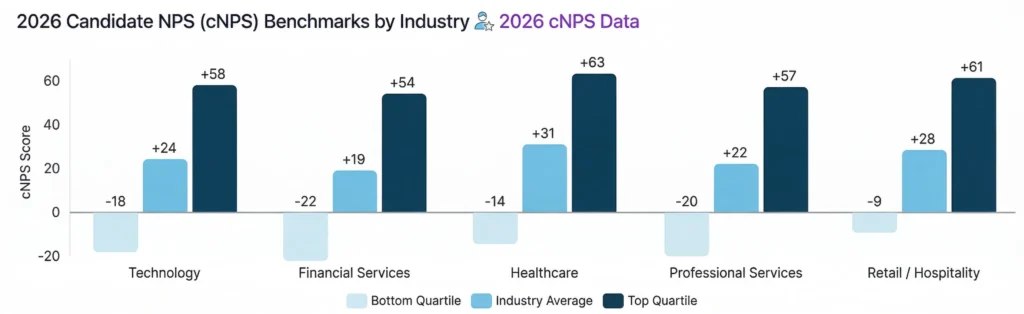
| Industry | Avg. cNPS (Bottom Quartile) | Avg. cNPS (Industry Average) | Avg. cNPS (Top Quartile) |
|---|---|---|---|
| Technology | -18 | +24 | +58 |
| Financial Services | -22 | +19 | +54 |
| Healthcare | -14 | +31 | +63 |
| Professional Services | -20 | +22 | +57 |
| Retail / Hospitality | -9 | +28 | +61 |
The wide spread between bottom and top quartile within each industry demonstrates that candidate experience quality is primarily a function of organizational practice, not a fixed constraint of industry context.
Healthcare’s higher average reflects the candidate-centered communication norms of a sector built around relationship and care. Technology’s lower average reflects the historically candidate-intensive process design in an industry that has prioritized assessment rigor over experience quality.
Key Strategies for Improving Candidate Experience
How AI Is Transforming Candidate Experience?
Stop Juggling
10 Job Boards.
Search One
Your next role is already here. avua pulls opportunities from across the web into a single searchable feed; filtered by role, location, salary, and remote preference.
1.5 Million+
Active Jobs
380+
Job Categories
Candidate Experience and Diversity, Equity, and Inclusion
Candidate experience quality is not demographically neutral. The dimensions of experience that are most commonly handled poorly, specifically transparency, personalization, and outcome communication, have differential impact across demographic groups in ways that compound the DEI challenges that begin at earlier stages of the funnel.
The Anxiety Premium for Underrepresented Candidates
Research on candidate psychology across demographic groups consistently finds that candidates from underrepresented backgrounds interpret experience ambiguity (silence, delayed feedback, vague responses) more negatively than majority-group candidates with equivalent objective experiences. The mechanism reflects a rational interpretation of uncertainty: candidates who have less historical reason to trust that the process will resolve in their favor are more likely to interpret organizational silence as implicit rejection, and more likely to withdraw their application or decline to advance rather than continuing to invest in a process they believe is unlikely to reward their investment.
This means that the communication failures, the broken timelines, the absent feedback, and the generic rejection emails that constitute poor candidate experience have a disproportionate impact on the diversity of who advances through the process and who ultimately accepts offers. Improving candidate experience is therefore a DEI strategy as well as an operational one, and the two motivations are inseparable in any honest analysis of what drives demographic attrition through the hiring funnel.
Inclusive Process Design
Inclusive candidate experience design considers the range of candidate circumstances that affect how the process is experienced: current employment status (which affects interview availability), disability (which affects format preferences), cultural background (which affects communication style interpretation), and socioeconomic context (which affects access to the technology, professional attire, and private space that some interview formats implicitly require). Processes designed without consideration of this range are not neutral. They are optimized for the median candidate’s circumstances, which means they systematically disadvantage candidates whose circumstances differ from the median.
Accessible Application Design
Application processes that are not accessible to candidates with disabilities are legally non-compliant in most jurisdictions and practically exclusionary in all of them. Screen reader compatibility, alternative text for visual content, time extension options for timed assessments, and multiple format options for submitted materials are not optional enhancements. They are baseline requirements for a candidate experience that is genuinely open to all qualified candidates.
Common Challenges and Solutions
| Challenge | Solution |
|---|---|
| Long Application Forms Reducing Completion | Audit fields against minimum necessary; target under 20 minutes total completion time |
| Delayed Feedback Damaging Trust | Set feedback SLAs with hiring managers at role intake; use automated prompts when SLAs are at risk |
| Rejected Candidates Becoming Detractors | Replace template rejections with structured personalized feedback; invest in the communication quality for the largest candidate audience |
| Inconsistent Experience Quality Across Recruiters | Develop experience standards and playbooks; measure cNPS by recruiter and create accountability for improvement |
| No Visibility into Experience Quality | Implement post-application and post-interview cNPS surveys; read and act on qualitative open-text feedback |
Real-World Case Studies
Case Study 1: The Telecommunications Company
A major telecommunications company discovered through its first candidate experience survey that its cNPS was -31, placing it in the bottom decile of its sector. Qualitative feedback identified three primary pain points: an application form averaging 52 minutes to complete, no communication between application submission and initial contact (averaging 23 days), and a rejection notification that consisted of an automated email containing no personalized content. The company was experiencing application volumes 60% below its industry peers for equivalent roles and a first-year attrition rate of 34% for customer service roles, partly attributed to early experience misalignment.
They redesigned the application process to reduce completion time to 14 minutes, implemented an AI-powered automated update system that provided candidates with status updates every seven days, and developed personalized rejection templates for each role family that included specific feedback elements. Within two hiring cycles, cNPS improved from -31 to +41. Application volumes increased by 52%. First-year attrition for customer service roles declined to 21%.
Case Study 2: The Professional Services Firm
A professional services firm with a strong market reputation was surprised to find that its candidate experience scores were significantly below its employer brand perception scores. Investigation revealed a disconnect: the firm’s brand was strong enough to attract high-quality applications, but the hiring process itself was undermining the brand for candidates who experienced it directly. Primary failure points included: interview scheduling that averaged 8 days per round due to manual coordinator involvement, feedback timelines of 14 to 21 days, and a final-round rejection communication that provided no feedback regardless of how far the candidate had advanced.
They implemented self-service interview scheduling reducing round scheduling to an average of 1.2 days, hired a dedicated feedback coordinator responsible for ensuring feedback was provided within five business days of any interview, and redesigned final-round rejection communications to include a personal call from the recruiter with structured feedback. cNPS for final-round candidates improved from -8 to +62. The firm’s Glassdoor rating for the hiring process improved from 3.1 to 4.2 over four hiring cycles.
Case Study 3: The Healthcare Provider
A healthcare provider with an acute nursing shortage was investing heavily in sourcing but struggling to convert applications into hires. Analytics revealed that 38% of candidates who completed an application were dropping out before the first interview, far above the 12% industry benchmark.
Candidate survey data collected at the drop-out point identified two primary causes: an application form that required clinical credential documentation not needed until the employment verification stage, and an automated scheduling system that required candidates to create an account, verify their email, and complete a profile before accessing interview times.
They removed the credential documentation request from the application form (moving it to the employment verification stage where it was actually needed), replaced the account-based scheduling system with a one-click calendar link requiring no registration, and added a human-written confirmation email after every scheduling action that included the name of the person the candidate would be meeting and a brief description of what to expect. Application-to-interview conversion improved from 62% to 89%. Time-to-fill for nursing roles reduced by 14 days. cNPS for the application and screening stages improved from +11 to +54.
Building a Candidate Experience Dashboard: What to Track
Here is how you can get it done:
Candidate Experience Across the Hiring Journey
Awareness and Discovery
The candidate experience begins before the application, in the employer brand impressions that shape whether a candidate believes the organization is worth their time and application effort. Glassdoor reviews, LinkedIn content from current employees, and the organization’s career page are the primary touchpoints at this stage.
Organizations that invest in authentic employer brand content at the awareness stage attract candidates who arrive with higher initial confidence and commitment, which improves experience quality at every subsequent stage.
Application Stage
The application itself is a candidate experience design challenge. The length, the clarity of instructions, the intuitiveness of the interface, the compatibility with mobile devices, and the quality of the confirmation communication all contribute to the first direct experience impression.
Application experiences that respect the candidate’s time, minimize unnecessary friction, and provide immediate clear confirmation set a positive tone for every subsequent interaction.
Screening and Assessment
The experience quality at this stage is primarily determined by communication quality and assessment design. Screening calls that are structured as genuine two-way conversations, that provide useful information as well as collecting it, and that close with specific timeline commitments perform significantly better on experience measures than those conducted as one-sided extractions.
Assessment stages that are clearly connected to role requirements and that provide practice or preparation resources consistently produce higher fairness perception scores.
Interview Stage
The highest-intensity experience period. Every interviewer is an employer brand representative as well as an assessor. Interviewers who are prepared, who have read the candidate’s materials, who allocate meaningful time for candidate questions, and who are warm and professionally present are performing employer brand work at the same time as assessment. Those who are visibly unprepared, distracted, or dismissive are creating negative experience impressions that no amount of subsequent positive communication can fully recover.
Offer and Post-Offer Stage
The offer stage is the emotional peak of the hiring process and the point at which experience quality most directly determines accept or decline behavior. An offer that is presented personally, with warmth and specificity about why this candidate is the chosen one, with a clear and reasonable deadline for response, and with genuine openness to conversation about the candidate’s questions, produces significantly higher acceptance rates than one transmitted through a digital form with a 48-hour deadline.
The post-offer period, from acceptance to start date, is a frequently overlooked experience stage where organizations that maintain active engagement retain accepted candidates and those that go silent lose them.
The Real Cost of Poor Candidate Experience: By the Numbers
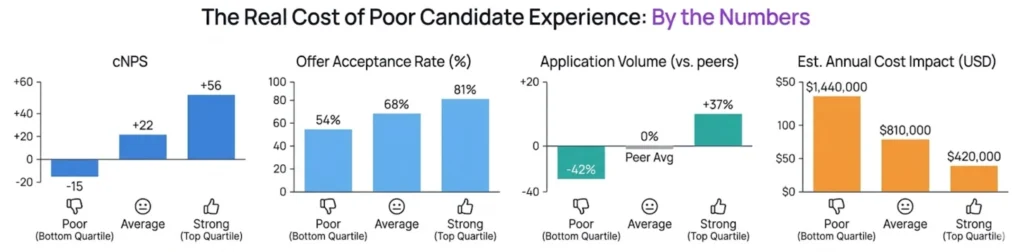
| Experience Level | cNPS | Offer Acceptance Rate | Application Volume (vs. peers) | Est. Annual Cost Impact (100 hires) |
|---|---|---|---|---|
| Poor (Bottom Quartile) | -15 | 54% | -42% below peers | $1,440,000 |
| Average | +22 | 68% | Peer average | $810,000 |
| Strong (Top Quartile) | +56 | 81% | +37% above peers | $420,000 |
The cost calculation includes application volume shortfall cost (additional sourcing spend required to compensate for below-market application rates), offer decline cost (search restart expenses at $18,000 per decline), and employer brand impact cost (reduced quality of future application pools from negative review platform content). The gap between poor and top-quartile experience represents $1,020,000 in recoverable annual cost at 100 hires per year.
Related Terms
| Term | Definition |
|---|---|
| Candidate NPS (cNPS) | A metric measuring the likelihood of candidates to recommend the organization’s hiring process |
| Candidate Engagement | The active management of the candidate relationship throughout the hiring process |
| Candidate Journey | The sequential stages and touchpoints a candidate moves through from awareness to hire |
| Employer Brand | The reputation and identity of an organization as a place to work |
| Application Completion Rate | The proportion of started applications that are completed and submitted |
| Talent Board | The non-profit research organization that produces the annual Candidate Experience Benchmark Research |
Frequently Asked Questions
Should candidate experience investment focus on finalists only?
Both. Finalists warrant the most investment, but screened-out candidates need prompt, personalised rejection — it’s low-cost and protects employer brand.
How does candidate experience affect employee retention?
Positive hiring experiences reduce early attrition. Candidates who accept despite a poor process already distrust the organisation before day one.
Can small organisations deliver strong candidate experience?
Yes, often more naturally. Shorter decision chains mean faster feedback. The key challenge is inconsistency; simple shared process standards fix this.
How should you respond to a candidate’s poor experience?
Listen fully, acknowledge specifically, apologise genuinely, and commit to change. Candidates who receive a real response often rate satisfaction higher than those with no issues.
How do you measure experience for agency-managed roles?
Extend measurement to all candidates regardless of who recruits. Agencies represent your brand, set clear experience SLAs and review cNPS regularly.
Conclusion
Candidate experience is the measure of whether an organization’s hiring process earns the candidates it needs or repels the candidates it wants. It is not a soft metric at the margin of recruiting performance. It is a core driver of application volume, pipeline quality, offer acceptance rate, and employer brand equity, all of which are inputs to the hiring outcomes that determine whether the talent function is meeting the organization’s strategic needs.
The organizations that deliver exceptional candidate experience are not delivering it because they have more resource, more technology, or more sophistication. They are delivering it because they have made a decision to treat every candidate as a person whose time and professional investment deserve respect, and to design their processes around that decision rather than around their own internal convenience.
That decision does not require a large investment. It requires attention to the moments that matter, consistency in the commitments that are made, and accountability for the experience that results. The organizations that make those investments are the ones whose pipelines are full, whose offers are accepted, and whose employer brand is growing rather than eroding with every hiring cycle that passes.
The candidates in your funnel are deciding right now. The experience your process delivers is the evidence they are using to make that decision.