The word “funnel” has dominated talent acquisition language for two decades, and it has done real damage. A funnel is a passive container. Things fall into it. Things fall through it. The narrowing that happens inside it is mechanical, not relational. The funnel metaphor treats candidates as volume flowing through a system designed for the organization’s convenience, filtered at each stage until only the compliant remainder reaches the bottom.
The candidate journey is a different frame entirely. A journey is active. It has stages with distinct emotional and informational characteristics. It has decision points where the traveler chooses whether to continue. It is experienced from a specific perspective, by a specific person, with specific needs that change as the journey progresses. And critically, it can be designed, not just managed.
The candidate journey is the complete sequence of stages, touchpoints, decisions, and experiences a candidate moves through from their first awareness of an organization as a potential employer through to their acceptance of an employment offer and integration into the role. It encompasses what happens before the application (awareness, research, and consideration), during the hiring process (application, assessment, interview, and evaluation), at the offer stage (decision-making and negotiation), and after acceptance (pre-boarding and early employment integration).
In 2026, mapping and designing the candidate journey is a standard discipline in mature talent acquisition organizations. AI-powered hiring platforms have made it possible to track candidate behavior at every journey stage, identify the moments where engagement drops, personalize the experience at each touchpoint based on candidate profile and behavior, and continuously improve the journey design based on outcome data. The organizations doing this systematically consistently outperform those treating the hiring process as an internally-designed administrative flow rather than an externally-experienced human journey.
The core metric governing candidate journey effectiveness is the Journey Conversion Rate (JCR): the proportion of candidates who enter the journey at the awareness stage and ultimately accept an employment offer. Most organizations track stage-to-stage conversion without measuring the full-journey rate, which conceals the compounding effect of small conversion losses at each stage on the overall funnel yield.
Journey Conversion Rate (%) = (Offers Accepted / Total Candidates Entering Awareness Stage) x 100
A typical unmanaged candidate journey yields a JCR between 0.3% and 0.8%. A deliberately designed and continuously optimized candidate journey consistently achieves JCRs above 2.1%, representing a three-to-seven-fold improvement in the yield from the same candidate pool.
What is the Candidate Journey?
The candidate journey is the structured sequence of experiences, interactions, and decisions that a candidate moves through from their first encounter with an employer brand to their integration into the organization as a new employee, viewed from the candidate’s perspective and designed with the candidate’s needs, information requirements, and decision-making process in mind.
The defining feature of the candidate journey framework, what distinguishes it from the hiring process as traditionally understood, is the perspective from which it is designed. A hiring process is designed from the organization’s perspective: what do we need to know, what steps must we take, what approvals are required, how do we reach a decision? A candidate journey is designed from the candidate’s perspective: what does this person need to know at this stage, what are they deciding, what information would help them decide, and what experience would make them more or less likely to continue?
These two perspectives produce significantly different process designs. The hiring process optimized for organizational convenience tends toward long timelines, multiple approval stages, and communication gaps where the organization is focused internally. The candidate journey optimized for candidate decision-making tends toward faster feedback loops, proactive information sharing, and continuous engagement that maintains candidate confidence through each transition.
Are You Running a Hiring Process or Designing a Candidate Journey?
Most organizations run hiring processes. A smaller number design candidate journeys. The distinction matters more than the terminology suggests.
A hiring process is a sequence of activities that must occur before an offer can be extended: sourcing, screening, interviewing, assessing, reference checking, offer approval, extending. The activities are defined by what the organization needs to do. The candidate’s experience of those activities is a byproduct, managed reactively when it produces problems (high decline rates, ghosting, negative reviews) rather than designed proactively as a source of competitive advantage.
A candidate journey is a sequence of experiences that the candidate moves through, each designed to meet the candidate’s information needs at that stage, maintain their engagement and confidence, and progress their decision-making toward an informed, enthusiastic yes. The organization’s assessment activities still occur within this journey, but they are nested within an experience design that treats the candidate as a co-participant in a mutual evaluation rather than a subject of an organizational selection process.
The performance difference between these two orientations is significant and measurable. Research on candidate decision-making consistently finds that the quality of the journey experience is a primary determinant of offer acceptance, independent of the quality of the offer itself. Candidates who experience a well-designed journey arrive at the offer stage already largely decided: they have been engaged, informed, and respected throughout, and the offer is the confirmation of a decision they have effectively made. Candidates who experience a poorly designed process arrive at the offer stage uncertain, potentially comparing alternatives they pursued during the periods of organizational silence, and making a fresh decision under conditions that favor whoever communicated best rather than whoever offered best.
Organizations that have deliberately mapped and redesigned their candidate journey report offer acceptance rates averaging 23% higher than those managing the process reactively. They also report 31% lower time-to-offer, because a journey designed from the candidate’s perspective eliminates the internal coordination delays that have no value for the candidate and only cost. And they report significantly higher early-tenure retention, because candidates whose journey included accurate and specific information about the role, team, and culture arrive at work with calibrated expectations rather than the mismatch expectations that drive early attrition.
For TA leaders, the practical shift is a change of design perspective rather than a change of process. The first step is mapping the journey as it currently exists, from the candidate’s viewpoint, stage by stage and touchpoint by touchpoint. The typical output of that mapping exercise is a recognition that the process as experienced by candidates bears only partial resemblance to the process as described by the organization. The gaps between the two are the design opportunities.
The scenario that makes this concrete: a technology company maps its candidate journey for the first time and discovers that between the submission of a technical assessment and the invitation to a first technical interview, candidates experience an average of 14 days of complete silence. The internal narrative is that this is a review period when assessors evaluate results. The candidate narrative, captured through surveys at the drop-off point, is that 34% of candidates who do not progress assume they have been rejected during this period and begin withdrawing their investment from the opportunity.
The 14-day gap costs the organization an estimated one-in-three qualified candidates at a stage where they have already invested significant time in a technical assessment. The fix is a single automated communication on day three of the review period confirming that the assessment is under review and providing an estimated timeline for next contact. The candidate experience cost: near zero. The yield improvement: significant.
Your Resume Isn’t Getting Read
Let’s Get That Fixed!
75% of resumes get auto-rejected. avua’s AI Resume Builder optimizes formatting, keywords, and scoring in under 3 minutes, so you land in the “yes” pile.
The Stages of the Candidate Journey
The candidate journey is a sequence of distinct stages, each with characteristic candidate psychology, information needs, and decision points. Effective journey design addresses each stage specifically.
Stage 1: Awareness
The candidate becomes aware of the organization as a potential employer through active search, passive exposure to employer brand content, or outbound recruiter contact. The candidate’s primary question: is this organization worth my further attention? Journey design imperative: first impression quality through authentic, specific employer brand content that earns continued investigation.
Stage 2: Consideration
The candidate has decided the organization warrants further research and is actively evaluating whether to apply. They are reviewing the career site, reading Glassdoor reviews, examining LinkedIn profiles of current employees, and weighing the role against competing opportunities. Primary question: is this specific opportunity a strong enough match with my goals to justify the effort of applying? Journey design imperative: specific, honest information that allows a thoughtful candidate to answer this question with confidence.
Stage 3: Application
The candidate commits to applying. Application-to-completion conversion is measurable and directly reflects application experience quality. Friction, length, and technical problems drive drop-off. Clarity, speed, and respectful design drive completion. Primary question: how much is this organization asking me to invest before giving me any signal of whether I am competitive?
Stage 4: Screening and Initial Assessment
The first direct interaction with the organization. Primary candidate questions: am I being evaluated fairly, am I being treated as an individual, and does this organization seem like a place where I would be valued? Journey design requirement: structured communication at entry (what to expect, how long, when they will hear back), during (professional and respectful assessment experience), and at exit (specific timeline commitment).
Stage 5: Interview and Evaluation
The deepest phase of the journey, potentially spanning weeks for senior roles. Primary questions: do I understand what this role actually involves, do I trust the people I would work with, and is my investment being reciprocated with genuine organizational interest? Journey design requirement: proactive inter-stage engagement, honored feedback timelines, genuine two-way information exchange, and progressive authenticity about the role and organization.
Stage 6: Offer and Decision
The candidate receives an offer and makes their employment decision. Primary questions: does this offer reflect how the organization values me, does it align with my financial and career expectations, and can I trust that the hiring process was representative of what it will be like to work here? Journey design requirement: personal offer presentation, appropriate decision timeline, genuine openness to the candidate’s questions and concerns.
Stage 7: Pre-Boarding
The period between offer acceptance and first day, routinely absent from organizational journey thinking. Primary candidate question: was the decision I made the right one? Journey design requirement: ongoing engagement, practical preparation content, colleague introductions, and clear communication of organizational readiness for the candidate’s arrival.
Candidate Journey vs. Related Concepts
| Concept | Scope | Perspective | Time Horizon | Primary Use |
|---|---|---|---|---|
| Candidate Journey | Awareness through integration | Candidate | Full hiring lifecycle | Journey design and optimization |
| Candidate Experience | Cumulative perception of the process | Candidate | Full hiring lifecycle | Satisfaction measurement and improvement |
| Hiring Process | Steps required to make a hire | Organization | Application through offer | Process efficiency and compliance |
| Recruiting Funnel | Volume flow from application to hire | Organization | Application through hire | Conversion rate tracking |
| Employee Journey | Full employment lifecycle from hire to exit | Employee | Post-hire | Retention and engagement |
| Talent Lifecycle | Complete talent relationship from prospect to alumni | Organization | Pre-hire through post-exit | Strategic workforce planning |
The candidate journey and the hiring process are not the same thing mapped at different scales. They are two different representations of the same activity from two different perspectives. The hiring process describes what the organization does. The candidate journey describes what the candidate experiences. Improving the hiring process makes it more efficient for the organization. Designing the candidate journey makes it more effective for both parties, because it aligns organizational activity with candidate needs rather than optimizing them independently.
What the Experts Say?
When organizations start mapping their process from the outside in, from the candidate’s first Google search to their first day at work, they almost always find the same thing: the map they drew from the inside looks nothing like the journey the candidate actually takes. The gap between those two maps is where recruiting is won and lost.
– Hung Lee, Curator of Recruiting Brainfood
How to Measure the Candidate Journey?
Formula: Stage-to-Stage Conversion Rate
Stage Conversion Rate (n to n+1) (%) = (Candidates Advancing to Stage n+1 / Candidates Entering Stage n) x 100
Track at every stage transition and compare to benchmark expectations for that role type and level. Conversion rates below benchmark at a specific stage transition identify journey design failures at that stage rather than pipeline quality issues.
Benchmarks by Journey Stage (2026 Data)
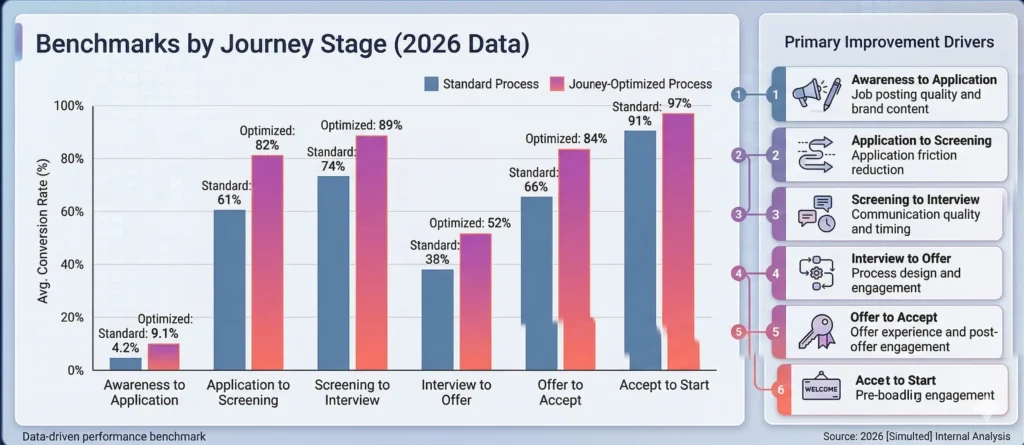
| Journey Stage | Avg. Conversion (Standard Process) | Avg. Conversion (Journey-Optimized) | Primary Improvement Driver |
|---|---|---|---|
| Awareness to Application | 4.2% | 9.1% | Job posting quality and brand content |
| Application to Screening | 61% | 82% | Application friction reduction |
| Screening to Interview | 74% | 89% | Communication quality and timing |
| Interview to Offer | 38% | 52% | Process design and engagement |
| Offer to Accept | 66% | 84% | Offer experience and post-offer engagement |
| Accept to Start | 91% | 97% | Pre-boarding engagement |
Reading this table across all stages reveals the compounding effect of journey optimization. A standard process with 1,000 awareness-stage candidates yields approximately 6 hires. An optimized journey with the same 1,000 candidates yields approximately 30. The fivefold yield improvement comes from eliminating conversion losses at each individual stage, none of which are dramatic in isolation but which compound dramatically across the full journey.
How AI Maps and Optimizes the Candidate Journey?
Key Strategies for Designing an Effective Candidate Journey
Stop Juggling
10 Job Boards.
Search One
Your next role is already here. avua pulls opportunities from across the web into a single searchable feed; filtered by role, location, salary, and remote preference.
1.5 Million+
Active Jobs
380+
Job Categories
The Candidate Journey and Diversity, Equity, and Inclusion
The candidate journey framework has significant implications for DEI outcomes that are often underappreciated in DEI strategy conversations, which tend to focus on sourcing diversity and selection bias rather than journey design as a DEI lever.
Stage-Level Demographic Attrition
Diversity data at the offer and hire stage rarely reveals the full picture of demographic attrition through the hiring process. When demographic representation is tracked only at the application and hire stages, the significant attrition of diverse candidates at intermediate journey stages is invisible in aggregate reporting. A journey that begins with a demographically diverse application pool but produces a homogeneous hire cohort has not solved its DEI problem at the sourcing stage. It has created it at the journey stage, through design failures that differentially affect specific candidate groups.
Journey-level demographic tracking, measuring representation at every stage transition rather than only at the beginning and end, surfaces these intermediate attrition patterns and enables stage-specific investigation of their causes. In most organizations that conduct this analysis for the first time, the result is the identification of two or three specific journey stages where demographic attrition is significantly higher than at others, providing a precise design target for DEI improvement rather than a diffuse systemic problem with no clear intervention point.
Equitable Information Access
The candidate journey is not experienced equally by all candidates. Candidates who have extensive professional networks, who have been coached on the hiring process, and who have familiarity with professional organizational norms arrive at every journey stage with information advantages over those who do not. This information asymmetry is a structural inequity that journey design can partially address: providing preparation resources before assessments, being explicit about what each stage involves and how it is evaluated, and removing the implicit requirement for prior knowledge of professional hiring norms that disadvantages first-generation professionals and candidates from non-traditional backgrounds.
Friction as a Demographic Filter
Journey friction disproportionately filters out candidates for whom the accommodations that reduce friction are less available. A scheduling system that requires candidates to be available during standard business hours filters out candidates in inflexible employment. An application system that requires a stable high-speed internet connection filters out candidates in lower-connectivity contexts. An assessment that requires a private, quiet environment filters out candidates in crowded households. None of these filters are intentional, but all of them produce demographic effects that are visible in journey-stage conversion data when disaggregated by demographic group.
Common Challenges and Solutions
| Challenge | Solution |
|---|---|
| No Visibility into Candidate Behavior Between Stages | Implement candidate-facing journey tracking portal; deploy behavioral analytics at all digital journey touchpoints |
| High Drop-off at Specific Stage Without Clear Cause | Survey candidates at drop-off point with a single-question exit survey; most candidates who withdraw will identify a specific cause |
| Journey Design Not Reflecting Candidate Perspective | Conduct periodic mystery applicant exercises; interview recent candidates and declined offer holders about their experience |
| Personalization Impractical at High Volume | Implement AI-powered journey management tools; focus human personalization on high-priority and high-stage candidates |
| Lack of Pre-Boarding Stage Design | Develop a structured pre-boarding content and contact sequence as a formal journey stage with assigned ownership and defined touchpoints |
Real-World Case Studies
Case Study 1: The Retail Bank
A retail bank mapped its candidate journey for graduate roles for the first time and discovered that the journey as experienced by candidates had six significant gaps that were invisible in the internal process documentation. The largest was an average 19-day period between the completion of a psychometric assessment and the receipt of a first-round interview invitation, during which candidates received no communication of any kind. Exit survey data from candidates who dropped out of the process during this period revealed that 47% had assumed they had been rejected based on the silence and had accepted competing offers or redirected their effort elsewhere.
The bank implemented a three-communication protocol for the assessment review period: an acknowledgment within 24 hours of assessment completion, a progress update on day seven confirming the assessment was under review, and a timeline confirmation on day twelve with the specific date of the interview invitation. Candidate retention through the assessment-to-interview transition improved from 63% to 88%. Graduate program application yield (offers accepted as a proportion of applicants) improved from 1.1% to 2.7%.
Case Study 2: The Technology Company
A technology company redesigned its candidate journey for senior engineering roles after discovering that its offer acceptance rate for final-round candidates was 54%, compared to an industry benchmark of 76%. Post-decline interviews with candidates who had rejected offers consistently identified two journey-stage failures: a period of three to four weeks between the final interview and the offer (during which candidates accepted competing offers), and an offer presentation delivered via a digital form with a 48-hour decision deadline.
They redesigned the final-stage journey to include a hiring manager check-in call within five days of the final interview, a verbal offer presentation by a senior leader before the written offer was sent, and a decision timeline of seven business days with an offer to discuss any questions or concerns. Offer acceptance rate improved from 54% to 79% within three hiring cycles. The average time between final interview and offer acceptance also reduced by eight days, reflecting the elimination of the late-stage waiting period that had been driving competing offer acceptance.
Case Study 3: The Healthcare System
A healthcare system conducting journey-level demographic analysis discovered that Black and Hispanic candidates were advancing from the application stage to the initial interview invitation at 0.61 of the rate of White candidates, despite equivalent scores on the structured pre-screening assessment included in the application. Investigation of the journey stage between assessment completion and interview invitation revealed that the decision to advance candidates for interview was being made by individual recruiters using a mix of assessment scores and informal resume review, introducing the recruiter judgment variability that the structured assessment had been designed to eliminate.
The healthcare system redesigned the transition from assessment to interview invitation to be driven exclusively by assessment score thresholds, removing the informal resume review step. Journey-level demographic conversion for the application-to-interview stage improved from 0.61 to 0.94 within two hiring cycles, with no measurable change in interview-stage or post-hire performance metrics.
Building a Candidate Journey Dashboard: What to Track?
Here is how you can get it done:
The Candidate Journey Across Talent Strategy
Employer Brand and Awareness Stage Design
The candidate journey does not begin when the candidate applies. It begins when they first encounter the organization’s employer brand content, and the quality of that content determines the quality of the awareness and consideration stages that precede the application.
Organizations that invest in authentic, specific employer brand content at the awareness stage create a pre-application journey that generates higher-quality, better-informed applicants than those relying on awareness-stage brand impression alone.
Recruiting Funnel and Journey Yield
The traditional recruiting funnel measures volume at each stage. The candidate journey framework measures experience quality at each stage transition, which drives the conversion rates that determine what the funnel yields.
An organization with a large top-of-funnel application volume and poor journey quality may achieve fewer hires from more candidates than one with a smaller but better-engaged pipeline. Journey quality is the multiplier that determines what any given level of sourcing investment actually produces in hire outcomes.
Onboarding as Journey Continuation
The candidate journey does not end at the offer acceptance. The pre-boarding and onboarding stages are a direct continuation of the journey that began at the awareness stage, and the quality of the onboarding experience either confirms or contradicts the expectations set by every prior journey stage.
Organizations that design their onboarding as a journey continuation, maintaining the warmth, specificity, and candidate-centered communication that characterized the hiring process, produce significantly lower early-tenure attrition than those treating the new hire relationship as beginning fresh on day one.
The Real Cost of an Undesigned Candidate Journey
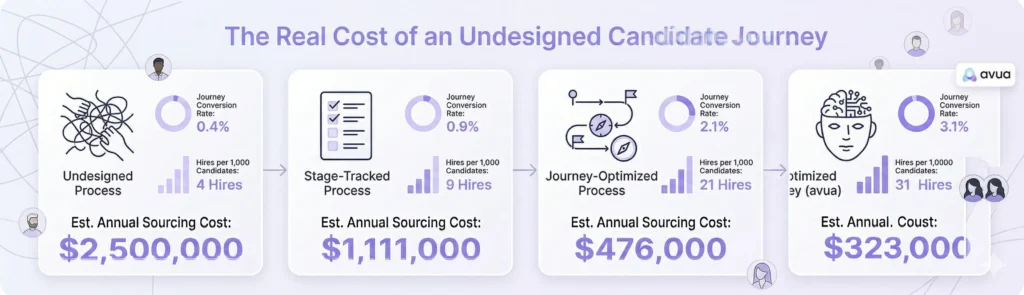
| Journey Design Level | Journey Conversion Rate | Hires per 1,000 Awareness Candidates | Est. Annual Sourcing Cost (100 hires) |
|---|---|---|---|
| Undesigned Process | 0.4% | 4 hires | $2,500,000 |
| Stage-Tracked Process | 0.9% | 9 hires | $1,111,000 |
| Journey-Optimized Process | 2.1% | 21 hires | $476,000 |
| AI-Optimized Journey (avua) | 3.1% | 31 hires | $323,000 |
The sourcing cost calculation assumes a fixed cost of $100 per awareness-stage candidate reached (including advertising, sourcing tool costs, and recruiter time). At the undesigned process JCR of 0.4%, producing 100 hires requires reaching 25,000 awareness-stage candidates at a total cost of $2.5 million. At the AI-optimized JCR of 3.1%, the same 100 hires require reaching only 3,225 awareness-stage candidates at a total cost of $323,000. The $2.177 million annual difference is entirely attributable to journey design quality, not sourcing investment or candidate quality.
Related Terms
| Term | Definition |
|---|---|
| Candidate Experience | The cumulative perception a candidate forms of an organization through every hiring process interaction |
| Recruiting Funnel | The volume-focused model of candidate flow from application through hire; the organizational complement to the candidate journey |
| Journey Conversion Rate | The proportion of awareness-stage candidates who ultimately accept an employment offer |
| Touchpoint | Any point of contact between the candidate and the organization during the hiring process |
| Pre-Boarding | The stage of the candidate journey between offer acceptance and first day of employment |
| Employer Brand | The reputation and identity of an organization as a place to work; the foundation of the awareness and consideration stages of the journey |
Frequently Asked Questions
How is the Candidate journey different from the Recruiting Funnel?
The recruiting funnel tracks candidate flow from the organization’s perspective: volumes, conversion rates, and hire yield. The candidate journey covers the same process from the candidate’s side: experiences, decisions, and emotional quality at each stage. The funnel optimizes for efficiency; the journey optimizes for experience quality, which ultimately drives funnel performance.
At what stage does the candidate journey begin?
At awareness: the first moment a candidate learns of the organization as a potential employer. This can precede an application by weeks or months. Organizations that invest in the awareness and consideration stages attract higher-quality, better-aligned applicants than those engaging candidates only from application onward.
What is the most commonly neglected stage of the candidate journey?
Pre-boarding. Most organizations treat offer acceptance as the finish line, leaving candidates with no structured engagement before day one. That silence creates doubt during a period of real vulnerability. Organizations that actively manage pre-boarding with content, introductions, and check-ins convert accepted offers into engaged first-day arrivals at significantly higher rates.
How should journey design differ for experienced hires versus early-career candidates?
Experienced hires move faster, juggle competing offers, and prioritize role scope, team quality, and career trajectory. Early-career candidates need more process guidance, culture context, and expectation-setting. Journey design that adapts content depth and pacing to candidate seniority consistently outperforms a one-size-fits-all approach.
Can the candidate journey framework be applied to internal mobility and promotion processes?
Yes, and it is underused. Internal candidates go through the same journey stages as external ones, with added complexity from their existing relationship with the organization. Poor internal journey design (opaque decisions, no feedback) tends to land harder than it does externally. Applying the same transparency and communication standards to internal processes measurably improves mobility rates and candidate satisfaction.
Conclusion
The candidate journey is the hiring process seen through the only perspective that ultimately determines whether it succeeds: the candidate’s. Every stage of the journey, from the first awareness of the employer brand to the first morning of work, is an experience being formed in real time by a person who is making continuous decisions about whether to continue investing their professional interest, time, and eventually their career commitment in this organization.
Organizations that design the candidate journey, that map it empirically from the candidate’s perspective, address each stage’s characteristic information needs, eliminate the inter-stage dead zones where disengagement accumulates, and measure conversion quality at every transition, are building a recruiting function that converts its candidate pipeline into hires at rates that organizations managing a hiring process cannot match.
The difference between the two is not resource. It is perspective. The shift from designing a hiring process to designing a candidate journey is a shift in whose needs are being centered in the design decisions. The organizations that have made that shift are not just improving their candidate experience scores. They are multiplying the yield of their sourcing investment, improving the quality of their hires through better self-selection, and building an employer brand reputation that compounds with every positive journey experience they deliver.
The hiring process runs for the organization. The candidate journey runs for the candidate. In a competitive talent market, the one that runs for the candidate is the one that wins.