Every recruiting team hits a wall eventually. Candidates are scattered across spreadsheets. Interview feedback is buried in email threads. A hiring manager asks where a candidate stands and nobody has a quick answer. That strong applicant from six months ago, the one who would be perfect for the role that just opened, is sitting forgotten in someone’s inbox.
A Candidate Management System (CMS) exists to fix exactly that.
A CMS is a centralised platform that organises, tracks, and manages candidate information across the entire hiring process, giving recruiting teams a single, structured, searchable record of every candidate relationship, from first contact to final decision and beyond.
What is a Candidate Management System?
A Candidate Management System is a purpose-built or ATS-integrated software platform that serves as the centralized operational hub for managing candidate data, pipeline workflow, communication history, and hiring activity across multiple roles, teams, and time periods.
The scope of a CMS includes several distinct functional domains. As a data repository, it stores candidate profiles, resumes, contact information, application history, assessment results, interview feedback, and communication records in a structured, searchable format. As a workflow engine, it tracks the progress of each candidate through defined pipeline stages, assigns tasks and reminders to recruiting team members, and enforces process consistency across different roles and hiring managers.
As a communication platform, it centralizes recruiter and hiring manager correspondence with candidates, ensuring that every interaction is logged and accessible to all relevant team members regardless of who initiated it. And as a reporting infrastructure, it generates the pipeline status, conversion rate, and recruiter activity data that TA leaders use to manage team performance and forecast hiring outcomes.
What distinguishes a CMS from a simple applicant tracking system is relational depth. An ATS manages applicants: people who have applied for a specific role and are being evaluated for it. A candidate management system manages candidates: people who have been identified as potentially valuable to the organization, whether or not they have applied for a current role, regardless of how long ago they were first contacted, and across all the roles and interactions they have had with the organization over time. The ATS is transactional. The CMS is relational.
Is Your Candidate Data a Strategic Asset or a Digital Filing Cabinet?
Every recruiting team accumulates candidate data. Resumes, assessment scores, interview notes, contact information, and interaction histories accumulate across every hiring cycle. The question is whether that accumulation is creating a strategic asset that makes future hiring more efficient, or a digital filing cabinet that is full but not searchable, complete but not usable.
Most candidate data in organizations without a properly implemented Candidate Management System is the latter. It exists in ATS systems that are not maintained, in recruiter email archives that are personal rather than organizational, in spreadsheets that are updated inconsistently, and in hiring manager notes that are never transferred to any system at all. The result is that every new role begins with sourcing from scratch, even when the organization has already identified and partially qualified dozens of candidates for similar roles in prior cycles. The investment made in those prior sourcing and assessment activities is not recoverable because the data was never organized in a way that makes it retrievable.
A well-implemented CMS converts that data accumulation into a searchable talent pool. Every candidate who has interacted with the organization, at any stage of any prior process, is a searchable record with a known profile, a documented interaction history, and a retrievable qualification assessment. When a new role opens, the first search is not on LinkedIn or Indeed. It is in the CMS, against the existing candidate pool, to identify candidates who have already been sourced, screened, and at least partially assessed, who are potentially suitable for the new role.
Organizations with mature CMS implementations fill an average of 22% of open roles from existing candidate pipeline rather than fresh sourcing, at a cost per hire that averages 67% lower than roles filled through external sourcing from scratch. The asset is not the technology. The asset is the data that accumulates in it, structured, maintained, and retrievable.
For TA leaders, the practical implication is that CMS implementation and discipline is a compound investment. The value of maintaining accurate candidate records is low in the first cycle when the pool is small and the memory of recent interactions is fresh. It grows with every subsequent cycle as the pool expands, the historical interaction data becomes more valuable, and the difference between organizations with structured candidate data and those without becomes an increasingly significant competitive advantage in hiring speed and cost efficiency.
The scenario that makes this concrete: a mid-size technology company is hiring for a product manager role. The role has been posted for three weeks with modest application volume, and the recruiting team is preparing to expand sourcing to additional channels. A Candidate Management System search against the existing candidate pool surfaces fourteen candidates who applied for similar product roles in the prior 18 months, of whom seven received strong interview scores but were not selected due to role-fit differences at the time rather than capability concerns.
Two of those seven, contacted within 24 hours of the search, express interest in the current role. One advances through the interview process and receives an offer in 19 days from the CMS search. The total sourcing cost for this hire: approximately $800. The average cost of a comparable hire through external sourcing for this organization: $14,500. The CMS search did not replace the recruiter. It replaced 18 days of sourcing activity.
The ROI compounds across hiring cycles. An organization hiring 80 professionals per year that fills 20% of roles from existing CMS pipeline, at a sourcing cost saving of $13,700 per role, recovers $219,200 annually from the candidate data asset it has built. This figure grows each year as the pool expands and the proportion of roles fillable from existing pipeline increases.
Your Resume Isn’t Getting Read
Let’s Get That Fixed!
75% of resumes get auto-rejected. avua’s AI Resume Builder optimizes formatting, keywords, and scoring in under 3 minutes, so you land in the “yes” pile.
Core Functions of a Candidate Management System
A CMS performs several distinct functions that together constitute the operational infrastructure of a talent acquisition team.
Candidate Profile Management
The foundation of Candidate Management System functionality: a centralized record aggregating all information about a candidate across every interaction with the organization. A complete profile includes contact information, resume and work history, application history across all roles, assessment results, interview feedback, communication history, stage history with timestamps, and recruiter notes.
Profile completeness determines the quality of the talent pool the system represents; profile accuracy determines the reliability of searches and reports generated from it. AI-powered profile enrichment through resume parsing, social profile import, and external data aggregation dramatically reduces the manual data entry required to maintain complete, current profiles.
Pipeline Stage Management
Every active candidate in the CMS is associated with a pipeline stage reflecting their current position in the evaluation process. Standard stages include new application, screened, phone interview, first-round interview, assessment, second-round interview, offer, hired, and rejected, with organization-specific stages as needed.
The pipeline stage is the primary mechanism through which the Candidate Management System provides real-time visibility into active hiring processes, and it is the data source for the conversion rate analytics that tell TA leaders where the funnel is performing and where it is losing candidates.
Communication Management
A Candidate Management System that centralizes all candidate communication across all recruiters and hiring managers eliminates the relationship history fragmentation that occurs when interactions live only in individual email inboxes. Any team member can understand the full context of the organization’s relationship with a candidate before making contact, regardless of who initiated prior interactions.
Modern CMS platforms integrate with email, SMS, and LinkedIn messaging to log outbound communications automatically and import candidate responses into the candidate record.
Task and Workflow Management
Beyond tracking candidates, a Candidate Management System manages the recruiter tasks that move them through the process: interview scheduling, feedback collection, offer preparation, and background check initiation. Automated workflow triggers that initiate the next task when the previous one is completed reduce manual coordination overhead, ensure consistent process timing, and prevent candidates from stalling due to missed actions.
Search and Talent Pool Access
Search functionality is what converts accumulated candidate data from a historical archive into an active talent asset. A well-implemented Candidate Management System allows recruiters to search across all candidate profiles by any combination of skills, experience, location, assessment scores, and interaction recency. AI-driven semantic search extends this to candidates who match the requirements of a role even when their profiles do not use the exact terminology of the search query, dramatically improving retrieval effectiveness for the existing pool.
Candidate Management System vs. Related Technologies
| Technology | Primary Function | Relationship to CMS |
|---|---|---|
| Applicant Tracking System (ATS) | Manages job requisitions and applicant workflows for active hiring | CMS extends this to manage candidate relationships across roles and time |
| Candidate Relationship Management (CRM) | Manages long-term relationships with passive candidates and talent pools | CRM is a specific Candidate Management System capability focused on nurturing rather than active pipeline management |
| Recruiting Automation Platform | Automates communication, scheduling, and workflow tasks | Augments Candidate Management System with automation; often integrated or overlapping |
| HR Information System (HRIS) | Manages employee records post-hire | Candidate Management System manages pre-hire candidate data; HRIS manages post-hire employee data |
| Sourcing Platform | Identifies and aggregates candidate profiles from external sources | Sourcing platform feeds profiles into Candidate Management System; the two are often integrated |
| Assessment Platform | Administers and scores candidate evaluations | Assessment results are stored in the Candidate Management System; the platforms integrate via API |
The relationship between ATS and Candidate Management System is the most frequently confused in talent technology discussions. An ATS is designed around the job requisition as the primary unit: it manages the flow of applicants through a specific hiring process for a specific role.
A CMS is designed around the candidate as the primary unit: it manages the totality of the organization’s relationship with a specific person across all roles, all interactions, and all time periods. Many modern talent platforms combine both functions in a single system, but organizations that distinguish the two conceptually make better technology decisions and build better data practices.
What the Experts Say?
The difference between a CMS that is a strategic asset and one that is a data graveyard is not the technology. It is the discipline of the team using it. A CMS is only as valuable as the data in it, and the data is only as good as the habits of the people who maintain it.
– Stacy Zapar, Founder, Founder of The Talent Agency
How to Measure CMS Effectiveness?
Formula: Pipeline Visibility Rate
PVR (%) = (Active Candidates with Accurate Stage and Contact Records / Total Active Candidates) x 100
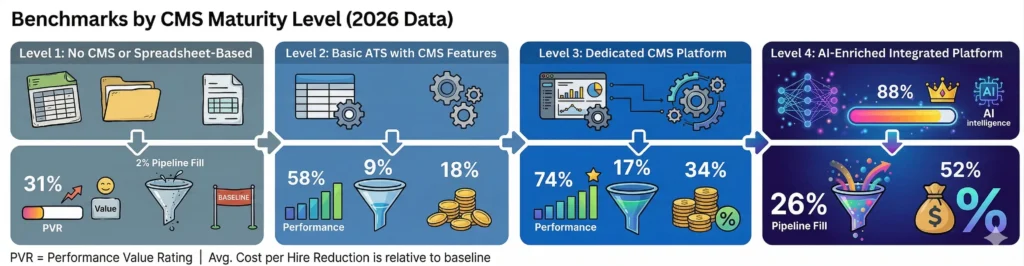
Benchmarks by CMS Maturity Level (2026 Data)
| CMS Maturity Level | Avg. PVR | Pipeline Fill Rate | Avg. Cost per Hire Reduction |
|---|---|---|---|
| No CMS or Spreadsheet-Based | 31% | 2% pipeline fill | Baseline |
| Basic ATS with CMS Features | 58% | 9% pipeline fill | 18% |
| Dedicated CMS Platform | 74% | 17% pipeline fill | 34% |
| AI-Enriched Integrated Platform | 88% | 26% pipeline fill | 52% |
Pipeline fill rate represents the proportion of open roles filled from existing Candidate Management System candidate pools rather than fresh external sourcing. The correlation between PVR and pipeline fill rate reflects a core principle: organizations cannot fill roles from existing pipeline data they cannot find, and they cannot find data that is not accurate.
Key Strategies for Building an Effective CMS Practice
How AI Is Transforming Candidate Management Systems?
Stop Juggling
10 Job Boards.
Search One
Your next role is already here. avua pulls opportunities from across the web into a single searchable feed; filtered by role, location, salary, and remote preference.
1.5 Million+
Active Jobs
380+
Job Categories
CMS and Diversity, Equity, and Inclusion
A well-maintained CMS creates infrastructure for DEI measurement and intervention that is simply not available to organizations managing candidate data informally.
Demographic Pipeline Analytics
When candidate demographic data is collected with candidate consent and stored in the Candidate Management System alongside pipeline stage history, the system becomes capable of producing stage-level adverse impact analysis: tracking the demographic composition of the candidate pool at every pipeline stage and identifying where specific groups are advancing at lower rates than others. This analysis, which requires the structured data infrastructure that only a Candidate Management System can provide, converts DEI from a program-level ambition to a data-driven operational discipline with specific, addressable stage-level targets.
Historical Diverse Candidate Rediscovery
Organizations with diverse historical candidate pools that are searchable in a mature Candidate Management System can target re-engagement outreach specifically at underrepresented candidates from prior cycles who were not selected for role-fit reasons rather than qualification concerns. This targeted rediscovery approach, available only when the Candidate Management System data is sufficient quality to support it, converts prior diversity sourcing investments into ongoing DEI pipeline assets rather than one-time events.
Bias Audit Trails
A Candidate Management System that logs the complete history of every candidate interaction, including stage movements, feedback records, and communication content, creates an auditable record that allows organizations to identify systematic bias patterns in their evaluation processes. When the same candidate profile characteristics consistently correlate with stage exits at specific points in the process, the data trail provides the diagnostic capability to investigate and address the cause.
Common Challenges and Solutions
| Challenge | Solution |
|---|---|
| Recruiter Resistance to CMS Data Entry | Reduce manual data entry burden through AI enrichment and automatic import; demonstrate the pipeline fill value the Candidate Management System generates to build adoption motivation |
| Data Quality Degradation Over Time | Implement quarterly Candidate Management System audits; set automated data staleness alerts for profiles not updated within defined periods |
| CMS and ATS Data Sync Failures | Invest in native integration or middleware; establish a single system of record for candidate stage data |
| Inability to Search Historical Pipeline Effectively | Invest in semantic search capability; establish profile completion standards that ensure searchable fields are consistently populated |
| Privacy and GDPR Compliance for Historical Data | Implement candidate consent management within the CMS; establish retention policies with automated deletion triggers for consent-expired records |
Real-World Case Studies
Case Study 1: The Management Consulting Firm
A management consulting firm with 200 annual hires had been managing candidate data across a combination of an ATS, individual recruiter spreadsheets, and email archives. Analysis of their sourcing activity revealed that approximately 40% of external sourcing effort each year was spent re-identifying candidates who had already been sourced and partially assessed in prior cycles. The duplicate effort was invisible in individual recruiter workflows but visible in aggregate when sourcing timelines were reviewed.
They implemented a dedicated Candidate Management System platform (like avua) with AI-enriched profiles, structured stage management, and semantic search capability. In the first year of operation, the Candidate Management System identified viable candidates from existing pipeline for 31% of new roles opened, at an average sourcing cost of $1,100 per CMS-sourced hire compared to $17,400 per externally sourced hire. Total annual sourcing cost savings in the first full year of operation were $1.03 million, from a CMS implementation investment that was recovered within the first six months.
Case Study 2: The Technology Scale-Up
A technology company scaling rapidly from 150 to 400 employees over 18 months found that its recruiting team was unable to maintain visibility into the hiring pipeline as hiring volume tripled. Hiring managers were making decisions based on information that was days or weeks out of date. Multiple recruiters were contacting the same candidates without awareness of each other’s outreach. And the recruiting team had no reliable way to forecast when specific roles would be filled.
They implemented a Candidate Management System with real-time pipeline visibility, centralized communication logging, and automated hiring manager reporting. Pipeline Visibility Rate improved from an estimated 34% to 81% within 90 days of implementation. Hiring manager satisfaction with pipeline communication improved from a survey score of 2.8 to 4.3 out of 5.0. Duplicate candidate contact incidents, which had been occurring at a rate of approximately 12 per month, reduced to fewer than 1 per month. Time-to-fill for engineering roles reduced by 11 days as the elimination of coordination friction accelerated stage transitions.
Case Study 3: The Healthcare Staffing Agency
A healthcare staffing agency maintaining relationships with several thousand registered nurses and allied health professionals across multiple regions had been managing candidate relationships through a fragmented combination of recruiter-specific Candidate Management System tools, shared spreadsheets, and paper-based records for candidates placed in long-term assignments. When candidate contact information changed, it was rarely updated across all records. When a nurse who had worked an assignment three years earlier was potentially suitable for a current opening, there was no reliable way to find them.
They implemented a unified Candidate Management System with AI-powered contact information enrichment, specialization tagging, and placement history integration. The first semantic search run against the unified pool for a group of open ICU nursing roles returned 47 candidates from the historical database who matched the requirements, of whom 19 were actively reachable with current contact information. Twelve expressed interest. Seven completed placements within 14 days. The total time from role opening to first placement: 6 days, compared to a previous average of 23 days for equivalent roles sourced through fresh outreach.
Building a CMS Performance Dashboard: What to Track?
Here is how you get it done:
Candidate Management System Across the Talent Lifecycle
Active Hiring Pipeline Management
The most immediate Candidate Management System function: tracking every candidate in every active role through every stage of the process in real time, maintaining a single source of truth for pipeline status that is accessible to all relevant stakeholders. At this stage, the Candidate Management System’s workflow management and communication logging capabilities are most actively in use, and the PVR is the primary health indicator.
Historical Talent Pool Building
Between active hiring cycles, the Candidate Management System is building the pool that will enable future hiring to be faster and cheaper. Every candidate processed through active hiring, regardless of outcome, is a potential future hire who should be maintained as a searchable record with an accurate profile and a documented interaction history.
Organizations that treat this pool-building as a passive byproduct of active hiring rather than a deliberate data asset investment produce pools that are large but not useful. Those that actively curate the pool, tagging candidates by specialty, availability signals, and prior performance, produce pools that are smaller but significantly more effective as sourcing tools.
Passive Candidate Nurturing
For candidates who are not suitable for current openings but represent strong future potential, the Candidate Management System supports a nurturing relationship that maintains engagement over time. Periodic communications, relevant content, and role visibility keep the organization top-of-mind for candidates who are not currently active in the market but who may become available or open to conversations in the future. The CMS provides the communication history and interaction tracking infrastructure that makes systematic nurturing feasible at scale.
Alumni and Boomerang Tracking
Former employees who leave the organization on good terms are a specific population in the Candidate Management System with a distinctive profile: documented performance history, verified cultural fit, and organizational knowledge that makes them significantly more efficient to re-engage than fresh candidates. A CMS that maintains former employee records with their departure context, post-departure career tracking, and re-engagement history provides the infrastructure for a structured boomerang hire program.
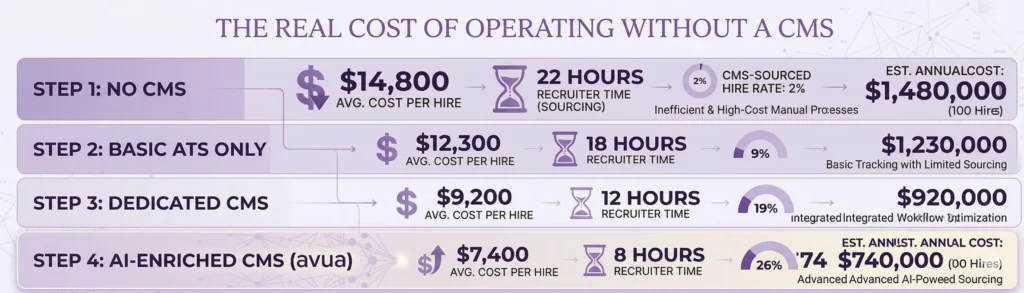
The Real Cost of Operating Without a CMS
| Scenario | CMS-Sourced Hire Rate | Avg. Cost per Hire | Recruiter Time per Hire (Sourcing) | Est. Annual Cost (100 hires) |
|---|---|---|---|---|
| No CMS | 2% | $14,800 | 22 hours | $1,480,000 |
| Basic ATS Only | 9% | $12,300 | 18 hours | $1,230,000 |
| Dedicated CMS | 19% | $9,200 | 12 hours | $920,000 |
| AI-Enriched CMS (avua) | 26% | $7,400 | 8 hours | $740,000 |
The cost calculation includes recruiter time at $60 per hour, external sourcing spend, and job board costs. The improvement from no Candidate Management System to an AI-enriched Candidate Management System represents $740,000 in annual recoverable cost at 100 hires per year, from the combination of higher pipeline fill rates (reducing external sourcing cost) and faster sourcing cycles (reducing recruiter time per hire).
Related Terms
| Term | Definition |
|---|---|
| Applicant Tracking System (ATS) | Software managing job requisitions and applicant workflows for active roles; the requisition-centric complement to the candidate-centric Candidate Management System |
| Candidate Relationship Management (CRM) | The specific Candidate Management System capability focused on managing long-term relationships with passive candidates and talent pools |
| Pipeline Visibility Rate (PVR) | The proportion of active candidates with current and accurate stage records in the CMS; the primary CMS health metric |
| Talent Pool | The accumulated database of candidate profiles maintained in the CMS and available for future hiring |
| AI Enrichment | Automated updating of candidate profiles from external data sources to maintain currency and completeness |
| Data Governance | The policies, standards, and practices that determine how candidate data in the CMS is collected, maintained, and retired |
Frequently Asked Questions
What is the difference between a CMS and an ATS?
An ATS tracks applicants through a specific open role. A CMS manages relationships with candidates across all roles and time periods. The key distinction is data strategy: ATS data expires when a role closes; CMS data accumulates as a long-term organizational asset.
How long should candidate data be retained in the CMS?
Most organizations default to two years from last interaction, with automated deletion triggers for expired profiles. GDPR requires this unless extended consent is obtained; US EEOC rules mandate a minimum of one year. Consent renewal processes cover high-priority profiles organizations want to retain longer.
Can a CMS be implemented without an ATS, or do they need to work together?
Most organizations run both. The ATS handles requisition workflow and compliance; the CMS manages candidate relationships. Integration quality between the two is critical: candidate data should flow from the ATS into the CMS automatically, without manual transfer.
How do you convince recruiters to maintain CMS data discipline?
Show them the value. Surface examples of CMS-sourced hires that saved time and cost. Recruiters who have seen the CMS surface a forgotten candidate from their own prior work become motivated adopters. Reducing manual entry through AI enrichment and ATS integration removes the main behavioral barrier.
What should organizations look for when selecting a CMS platform?
Lead with ATS integration quality, search depth, profile enrichment automation, mobile accessibility, and reporting flexibility. Add demographic analytics for diversity goals, and consent management features for GDPR or CCPA obligations. Price and feature breadth are secondary to adoption; a simpler platform used consistently beats a powerful one that gets ignored.
Conclusion
A Candidate Management System is the difference between a recruiting function that learns and one that repeats. Every candidate processed through every hiring cycle is a data point: a profile of a person who has been identified, qualified to some degree, and evaluated by the organization. The organizations that structure and maintain that data build a talent asset that makes every subsequent cycle faster, cheaper, and more successful than the last. The ones that let it accumulate without structure are paying the sourcing cost of finding candidates they have already found, repeatedly, across every hiring cycle that passes.
The Candidate Management System is not glamorous technology. It does not generate the enthusiasm of an AI sourcing tool or the visibility of a branded careers page. It is plumbing, and like all plumbing, its value is most obvious when it is absent. When a role opens and the first qualified candidate surfaces from existing pipeline data in four hours rather than four weeks, when every recruiter on the team can see the full context of every candidate relationship without asking anyone, when the TA leader can show leadership exactly where every active candidate is in the process without a spreadsheet exercise, the Candidate Management System is doing exactly what it was designed to do.
That capability is not built in one implementation cycle. It is built with every accurate stage update, every complete profile, every interaction logged, every cycle of discipline applied to maintaining the data as an asset rather than an archive. The organizations that build it consistently are the ones whose talent pipelines are full when they need to hire fast, and whose hiring costs are lowest because they are not paying to find people they have already found.