The best candidate for your next open role is probably already in your database. They applied months ago, made it deep into the process, and were narrowly passed over. Since then, they have had no contact from your organization.
This is the default state of most talent pipelines without a deliberate nurturing practice. Strong candidates who do not get hired continue developing elsewhere and eventually become available again. Whether they return to you or go to a competitor depends almost entirely on whether you maintained the relationship in the interim.
Candidate nurturing is the practice of maintaining ongoing, value-adding relationships with candidates not currently in an active process, keeping the organization top-of-mind so that when the right role opens, they are engaged and inclined to move forward. It applies content marketing and CRM principles to the pre-active phase of the candidate relationship.
The core metric governing candidate nurturing effectiveness is the Nurture-to-Pipeline Conversion Rate (NPCR): the proportion of candidates in an active nurturing program who, over a defined period, advance into an active hiring pipeline for a relevant open role.
NPCR (%) = (Nurtured Candidates Advancing into Active Pipeline / Total Candidates in Nurture Program) x 100
Organizations with structured nurturing programs achieve NPCRs of 8 to 14% across 12-month windows, compared to effective rates below 2% for organizations relying on candidates to self-initiate re-engagement through open applications.
What is Candidate Nurturing??
Candidate nurturing is a proactive relationship management discipline that maintains regular, relevant, value-adding contact with candidates in the talent pool who are not currently active in a hiring process, building organizational familiarity, trust, and engagement over time so that those candidates are ready and receptive when an appropriate role opens.
The defining characteristic of nurturing, what separates it from generic communication or bulk email, is relevance. A nurturing touchpoint provides the recipient with something genuinely useful or interesting: industry content relevant to their specialty, insight into an organizational development they would find compelling, visibility into the team or culture they showed interest in, or direct advance notice of a relevant role opening. Communication that is irrelevant to the recipient is not nurturing. It is noise, and noise damages the relationship it is attempting to maintain.
Candidate nurturing applies to several distinct populations in the talent pool. Silver medalist candidates, those who made it to late stages of a hiring process but were not selected, are the highest-priority nurturing population because their qualifications have already been partially assessed and their organizational interest has already been demonstrated.
Passive candidates who have been sourced and expressed initial interest but for whom no suitable current opening exists represent the second priority. And candidates who applied speculatively or for roles they were not immediately qualified for but who show strong longer-term potential represent the third tier, typically nurtured at lower frequency with broader organizational content rather than role-specific communication.
Are You Building a Talent Pipeline or Just a Talent Archive?
Most organizations believe they have a talent pipeline. What they actually have is a talent archive: a growing collection of candidate records sitting inside an Applicant Tracking System (ATS) with no structured engagement, no relationship maintenance, and no plan for reactivation. The high abandonment rate of candidates who never hear back after rejection is not just a missed courtesy. It is a measurable sourcing cost that compounds over time.
The difference shows up the moment a role opens. A talent archive requires you to restart active sourcing from scratch, compete for the same active candidates every other employer is chasing, and hope your applicant pool contains someone worth hiring. A talent pipeline means you are already in relationship with qualified people before the need is urgent.
Candidate nurturing is what converts an archive into a pipeline. It transforms static records into live relationships, reduces dependence on reactive sourcing, and ensures that when the right role opens, your best candidates are already warm, engaged, and ready to move forward without hesitation.
Your Resume Isn’t Getting Read
Let’s Get That Fixed!
75% of resumes get auto-rejected. avua’s AI Resume Builder optimizes formatting, keywords, and scoring in under 3 minutes, so you land in the “yes” pile.
The Candidate Nurturing Content Framework
Effective candidate nurturing requires a content strategy that provides genuine value to recipients at a frequency that maintains awareness without creating noise. The content types that perform best in nurturing programs share a common property: they are relevant to the candidate’s professional interests and career stage rather than to the organization’s immediate hiring needs.
Industry and Professional Content
Content that helps candidates develop professionally, understand industry trends, or navigate career decisions relevant to their specialty builds a perception of the organization as a knowledgeable, thoughtful entity worth maintaining a relationship with. A nurturing program that sends a monthly digest of relevant industry developments, curated research, or emerging practice in the candidate’s field provides genuine value that the candidate will appreciate regardless of whether they are currently interested in a new role.
Organizational Culture and Team Content
Content that gives candidates an authentic view into the organization’s team dynamics, culture, and work environment maintains the employer brand impression formed during the prior interaction and deepens it over time. A behind-the-scenes article about a project the team is working on, a profile of a team member the candidate met during their prior process, or a video from the hiring manager describing how the team has evolved since the candidate’s interview are all forms of content that build genuine familiarity rather than polished brand messaging.
Role Visibility and Career Path Content
For candidates who are potentially interested in a specific type of role, early visibility into relevant openings before they are publicly posted provides a genuine advantage and a demonstration of organizational trust. Similarly, content about career development paths within the organization, testimonials from employees who have grown through similar roles, and visibility into the competencies the organization develops in its people address the candidate’s career decision framework rather than just the immediate role opportunity.
Event and Community Invitations
Invitations to industry events, webinars, panel discussions, or informal networking opportunities hosted or co-hosted by the organization extend the relationship beyond digital communication into experiences that build genuine connection. Candidates who have attended an organization-hosted event during a nurturing period report significantly higher engagement intent and response rates to subsequent role communications than those whose nurturing relationship was entirely digital.
Candidate Nurturing vs. Related Concepts
| Concept | Primary Audience | Frequency | Content Focus | Goal |
|---|---|---|---|---|
| Candidate Nurturing | Passive candidates and silver medalists not in active process | Regular, low to medium frequency | Value-adding professional content | Pipeline readiness and engagement |
| Candidate Engagement | Active candidates in current hiring process | High frequency, process-driven | Process updates and relationship building | Offer acceptance |
| Alumni Engagement | Former employees | Periodic | Organizational updates and role visibility | Boomerang hire facilitation |
| Employer Branding | General candidate population | Broadcast, variable | Brand content and culture stories | Application volume and quality |
| Talent Community Management | Self-selected community members | Regular, community-driven | Mixed professional and organizational | Long-term pipeline development |
The relationship between candidate nurturing and employer branding is particularly important to clarify. Employer branding operates at the broadcast level: it creates general awareness and impression among a broad audience.
Candidate nurturing operates at the relationship level: it maintains and deepens a specific relationship with a specific candidate who has already entered the talent pipeline. Both are necessary, but they operate at different scales and with different content strategies, and confusing them produces branding that is too impersonal for nurturing and nurturing that is too specific for general brand communication.
What the Experts Say?
The pipeline you build between hires is more valuable than the sourcing you do when a role opens. Nurturing is what separates organizations that find great candidates and organizations that always have great candidates available.
– Hung Lee, Curator of Recruiting Brainfood
How to Measure Candidate Nurturing Effectiveness?
Formula: Nurture-to-Pipeline Conversion Rate
NPCR (%) = (Nurtured Candidates Entering Active Pipeline in Period / Total Candidates Actively Nurtured in Period) x 100
Track NPCR across rolling 90-day and 12-month windows. The 90-day window identifies near-term pipeline activation that reflects current market conditions and immediate nurturing quality. The 12-month window captures the full relationship development cycle that produces the most qualified nurtured candidates.
Benchmarks by Nurturing Maturity (2026 Data)
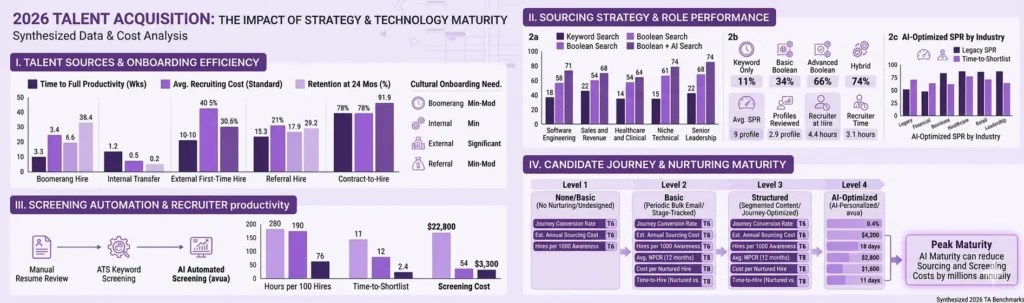
| Nurturing Program Maturity | Avg. NPCR (12 months) | Avg. Cost per Nurtured Hire | Avg. Time-to-Hire (Nurtured vs. External) |
|---|---|---|---|
| No Nurturing Program | Under 2% | Not applicable | 29 days (external only) |
| Basic (Periodic Bulk Email) | 3.8% | $4,200 | 24 days |
| Structured (Segmented Content) | 8.1% | $2,800 | 18 days |
| AI-Personalized (avua) | 13.4% | $1,600 | 11 days |
The cost-per-nurtured-hire figure declines with program maturity because the conversion rate improvement outpaces any increase in program operating cost. An AI-personalized program that achieves 13.4% NPCR at $1,600 per resulting hire is delivering candidates at roughly one-ninth the cost of external sourcing for equivalent roles, while simultaneously producing hires who are faster to full productivity because their organizational familiarity from the nurturing period reduces onboarding ramp time.
Key Strategies for Building an Effective Candidate Nurturing Program
How AI Transforms Candidate Nurturing?
Personalization at Scale: Before AI, meaningful personalization was limited by recruiter bandwidth. A recruiter can genuinely know 30 candidates; they cannot know 300. AI-powered nurturing resolves this by generating candidate-level communication drawn from profile data, interaction history, and behavioral signals. The recruiter’s role shifts from writing communications to reviewing them, which is a far more scalable workload.
Behavioral Engagement Scoring: AI systems monitor how candidates interact with nurturing content in real time, scoring each one based on open rates, click behavior, and response patterns. The output is a ranked engagement list that tells recruiters exactly who is most attentive and most ready for a direct conversation, converting nurturing from a broadcast activity into a targeting function.
Optimal Send-Time Personalization: Candidates have different communication habits. Some engage in the morning, some in the evening, some on weekends. AI systems trained on individual behavior data can time each communication to each candidate’s demonstrated responsiveness pattern, producing higher open and engagement rates without changing the content at all.
Role-Match Alerts and Pipeline Triggering: When a role opens, AI matching systems scan the entire nurturing pool simultaneously, identify the best-fit candidates, trigger a personalized role notification, and surface those candidates in the recruiter’s pipeline for priority follow-up. What was previously a multi-day manual search becomes an automated pipeline activation within minutes of a requisition opening.
Stop Juggling
10 Job Boards.
Search One
Your next role is already here. avua pulls opportunities from across the web into a single searchable feed; filtered by role, location, salary, and remote preference.
1.5 Million+
Active Jobs
380+
Job Categories
Candidate Nurturing and Diversity, Equity, and Inclusion
Candidate nurturing is an underappreciated DEI strategy lever, because it operates at a point in the talent cycle where the investment in diversity sourcing can be preserved and compounded rather than lost between hiring cycles.
Preserving Diverse Pipeline Investments
Many organizations invest significantly in sourcing diverse candidates through targeted outreach, partnerships with diversity-focused professional organizations, and attendance at underrepresented professional community events. These sourcing investments produce candidate contacts that, without a nurturing program, evaporate between hiring cycles: the candidate who was identified at a diversity tech conference in spring is no longer in the organization’s active awareness by fall when a relevant role opens. A nurturing program that maintains these candidate relationships between cycles converts a one-time sourcing investment into a sustainable diverse pipeline.
Reducing the Disadvantage of Passive Job Search
Candidates from underrepresented backgrounds who are not actively job searching are systematically less likely to be reached through conventional sourcing methods, because those methods tend to favor candidates who are visible in the networks that recruiters most frequently access. A nurturing program that proactively maintains relationships with diverse candidates from prior cycles provides an alternative pathway into consideration that does not require the candidate to be active in the market at exactly the moment a role opens.
Inclusion in Nurturing Content Design
Nurturing content that reflects the diversity of the organization’s workforce, featuring employee voices from underrepresented backgrounds, celebrating organizational DEI milestones, and demonstrating the development trajectories of diverse employees, is more effective at maintaining engagement among diverse candidates in the nurturing pool than generic organizational content. Inclusive content design is both ethically appropriate and operationally effective: it produces higher engagement rates among the candidate populations most important to DEI pipeline goals.
Common Challenges and Solutions
| Challenge | Solution |
|---|---|
| Content Creation Burden for Ongoing Nurturing | Develop a quarterly content calendar with reusable templates; use AI-assisted drafting; curate external industry content rather than creating all content internally |
| Candidate Unsubscribe Rates Depleting the Pool | Audit communication frequency against industry norms; implement preference management options; ensure content relevance through better segmentation |
| CMS Data Insufficiency for Meaningful Segmentation | Invest in profile enrichment and tagging before launching the nurturing program; a well-segmented pool of 200 candidates is more valuable than an undifferentiated pool of 2,000 |
| Recruiters Not Following Up on Engagement Signals | Build engagement signal alerts into CMS dashboards; make high-engagement candidates appear as priority actions in the daily recruiter workflow |
| Compliance with GDPR and Data Retention Requirements | Implement consent management within the nurturing platform; establish renewal cycles for consent from candidates who have been in the nurturing pool beyond defined retention periods |
Real-World Case Studies
Case Study 1: The Financial Services Firm
A financial services firm with a chronic shortage of qualified risk analysts in a competitive market had been spending an average of $16,800 per hire in sourcing costs for mid-level risk roles, with an average time-to-fill of 34 days. Analysis of their candidate database revealed 127 risk analyst candidates who had been contacted or assessed within the prior three years but not hired, none of whom had received any communication since their last hiring interaction.
The firm implemented a structured nurturing program for this population: a monthly regulatory and risk industry digest, quarterly organizational culture content from the risk team, and immediate role-match alerts when relevant positions opened. After six months of nurturing, 19 of the 127 candidates had engaged with multiple communications.
When three senior risk analyst roles opened, 11 of the engaged candidates were contacted with a direct role notification. Seven progressed to interview. Three received and accepted offers. Average sourcing cost for these three hires: $2,100. Average time-to-fill from role opening to offer acceptance: 9 days. The program’s six-month operating cost was recovered by the first placement alone.
Case Study 2: The Technology Company
A technology company that had conducted a major engineering hiring push 18 months earlier had engaged with approximately 340 engineering candidates, of whom 80 were hired and 260 were not selected, primarily due to headcount constraints and role-fit specifics rather than capability concerns. The 260 candidates received no post-process communication.
The company launched a retrospective nurturing program, beginning with a re-engagement message that acknowledged the prior interaction honestly, updated candidates on organizational developments since their process, and invited them to join a quarterly engineering community newsletter. Forty-seven percent responded positively, and 44% of those opted into the newsletter.
Over the following 12 months, 34 of the nurtured candidates entered active pipeline for new roles, and 22 were hired. The 22 hires from nurtured pipeline at an average sourcing cost of $1,900 per hire compared to $13,400 per externally sourced engineering hire in the same period produced a sourcing cost saving of $253,000 from a pool that had been built 18 months earlier and cost nothing additional to source.
Case Study 3: The Healthcare System
A healthcare system operating across multiple facilities had invested significantly in sourcing nurses from underrepresented backgrounds through partnerships with nursing programs at minority-serving institutions and targeted career fair participation. Despite this sourcing investment, the demographic diversity of their nursing cohort hire over hire remained relatively stable because the diverse candidates sourced in one cycle were not being maintained for the next.
The system implemented a targeted nurturing program for diverse candidates in the existing database: monthly clinical development content, bimonthly culture stories featuring nurses from similar backgrounds to the nurtured candidates, and early role-match alerts for critical care and specialty nursing positions.
Over 18 months, the proportion of nursing hires from underrepresented backgrounds increased from 19% to 31%, with the increase attributed primarily to the pipeline activation of previously sourced candidates who re-entered the active consideration pool through nurturing rather than to increased diversity sourcing spend. The program demonstrated that the diversity sourcing investment already made was being converted into hire outcomes for the first time.
Building a Candidate Nurturing Dashboard: What to Track?
Checkout the following to build it:
Candidate Nurturing Across the Talent Lifecycle
Post-Process Silver Medalist Nurturing
The highest-priority and highest-return nurturing population. Candidates who reached late hiring process stages but were not selected have already been assessed for qualification and demonstrated genuine organizational interest. They require minimal onboarding into the relationship and are typically the fastest to convert when a suitable role opens. Best practice is to initiate nurturing contact within two weeks of a non-selection decision, before the relationship warmth from the prior process has fully dissipated.
Passive Candidate Relationship Maintenance
Candidates who were sourced and expressed initial interest but for whom no immediate role fit existed. The nurturing relationship with this population is typically longer in development and lower in intensity: quarterly rather than monthly communication, with content that builds organizational familiarity and trust over time. The conversion timeline for this segment is typically six to eighteen months from initial contact to active pipeline entry.
Speculative and Long-Horizon Talent Development
For candidates who show strong potential but are not yet at the experience level required for current openings, a nurturing relationship that supports their professional development and maintains organizational awareness creates a pipeline of future-ready candidates. This is the longest-horizon nurturing relationship and produces its returns over multi-year timescales, making it most appropriate for organizations with defined succession planning and workforce development strategies.
Re-Engagement of Dormant Pool Members
Candidates who entered the talent pool in prior cycles but have had no contact in twelve months or more. Re-engagement requires a specific approach that acknowledges the gap in communication honestly, updates the candidate on relevant organizational developments, and invites them to re-enter the relationship on terms that make sense for their current circumstances. Effective re-engagement of dormant pool members recovers pipeline value from prior sourcing investments that would otherwise be permanently lost.
The Real Cost of Not Nurturing
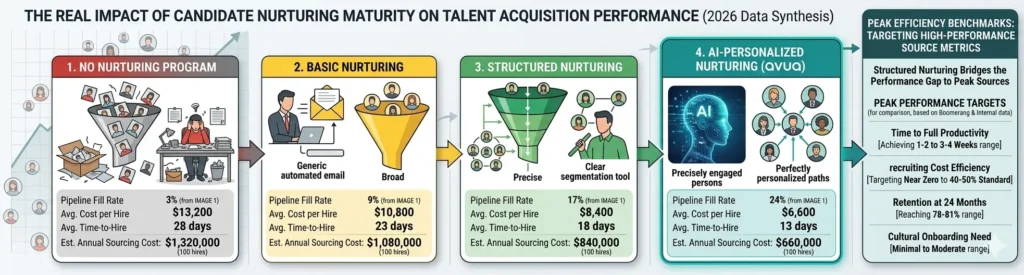
| Scenario | Pipeline Fill Rate | Avg. Cost per Hire | Avg. Time-to-Hire | Est. Annual Sourcing Cost (100 hires) |
|---|---|---|---|---|
| No Nurturing Program | 3% | $13,200 | 28 days | $1,320,000 |
| Basic Nurturing | 9% | $10,800 | 23 days | $1,080,000 |
| Structured Nurturing | 17% | $8,400 | 18 days | $840,000 |
| AI-Personalized Nurturing (avua) | 24% | $6,600 | 13 days | $660,000 |
The $660,000 difference in annual sourcing cost between no nurturing and AI-personalized nurturing at 100 hires per year reflects the compounding effect of higher pipeline fill rates (reducing expensive external sourcing), faster time-to-hire (reducing vacancy cost), and lower cost per nurtured hire (reflecting the efficiency of relationship-based versus transactional sourcing). This difference grows each year as the nurtured pool expands and the pipeline fill rate increases.
Related Terms
| Term | Definition |
|---|---|
| Silver Medalist | A candidate who reached late hiring process stages but was not selected; the highest-priority candidate nurturing population |
| Talent Pool | The maintained database of candidate profiles available for future hiring; the infrastructure within which candidate nurturing operates |
| Candidate Engagement | Active management of the candidate relationship during a current hiring process; distinct from nurturing which operates between active processes |
| Passive Candidate | A professional not actively seeking a new role; a primary target for candidate nurturing programs |
| Pipeline Fill Rate | The proportion of open roles filled from existing candidate pipeline rather than fresh external sourcing; the primary outcome metric for nurturing effectiveness |
| Candidate Relationship Management (CRM) | The platform infrastructure supporting candidate nurturing at scale; also used as a term for the broader strategic practice of maintaining candidate relationships |
Frequently Asked Questions
How is candidate nurturing different from spam?
The distinction is relevance, consent, and reciprocity. Nurturing goes to people who previously engaged with the organization, contains content relevant to their professional interests, and includes clear opt-out mechanisms. The practical test: if a meaningful proportion of recipients find the communication genuinely useful, it is nurturing. If most do not, it is noise regardless of what it is called.
How many candidates can be actively nurtured without AI support?
A skilled recruiter can sustain meaningful manual nurturing with roughly 40 to 60 candidates before communication becomes too infrequent or too templated to be effective. AI-powered platforms extend this capacity significantly, enabling a single recruiter to maintain personalized relationships with 500 to 1,000 candidates with AI handling drafting, timing, and engagement monitoring.
When should a candidate be transitioned from nurturing to active pipeline?
When two conditions intersect: a relevant role opens and the candidate shows signs of receptivity. Candidates actively engaging with recent nurturing content are contacted first. Those who have been silent for several months receive a re-engagement check before a direct role approach.
What is the right frequency for nurturing communications?
Silver medalists: monthly. Passively sourced candidates: every six to eight weeks. Speculative candidates: quarterly. These are guidelines, not rules. Candidates who consistently engage can sustain higher frequency; those who rarely engage are better served by less frequent, higher-relevance communication.
How should GDPR and other data privacy regulations affect a candidate nurturing program?
Most jurisdictions require explicit candidate consent for nurturing communications, defined retention periods, and clear mechanisms for withdrawal or deletion. Under GDPR, candidates must actively opt in rather than be enrolled by default. Most talent platforms in 2026 include consent management functionality. Legal review of consent language and retention processes is recommended before launch, as requirements vary by jurisdiction.
Conclusion
Candidate nurturing is the practice that converts talent acquisition from a series of isolated transactions into a continuous relationship-building discipline. Every strong candidate who enters the pipeline and leaves without an offer is either a future asset or a lost investment depending on what happens in the weeks and months after their departure. The organizations that manage this transition deliberately, maintaining genuine value-adding relationships through relevant content, thoughtful communication, and timely opportunity surfacing, are building a compounding advantage in their talent pipeline.
The advantage compounds because the pool grows with every hiring cycle and the nurturing relationships within it deepen with every relevant touchpoint. A nurturing program in year three is not three times more effective than in year one. It is substantially more effective, because the pool is larger, the relationships are warmer, and the data informing the personalization is richer. The organizations building this infrastructure now are creating a structural advantage in talent access that will be visible in their hiring speed, hiring cost, and hiring quality for years.
The candidates who did not get the last role are not failures. They are the pipeline for the next one. Treat them accordingly.