DEI is often discussed in high-level boardrooms, but its real impact is felt in the day-to-day mechanics of the Candidate Journey. Moving beyond performative reports requires a sharp shift from “intent” to “operations.”
Diversity starts with the Applicant Pool. If your team relies on a standard Boolean Search to find a familiar Candidate Persona, you aren’t diversifying; you’re just recycling the same profiles. Equity is where the process gets rigorous. It means replacing “gut feel” with objective tools like Blind Resume Review to ensure merit; not affinity, leads the way, followed by a structured Behavioral Interview that measures actual evidence of skill rather than “culture fit.”
Finally, inclusion is the anchor. You can use the most advanced tools to find talent, but if the daily workplace culture is exclusionary, your Attrition Rate will inevitably climb. You cannot solve for one dimension in isolation. Real progress means building a hiring engine where diversity is the input, equity is the filter, and inclusion is the reason people stay.
Effective DEI in recruiting requires attention to all three dimensions, measured separately and addressed with the specific interventions each requires.
In 2026, DEI in hiring operates in a legal and social environment that has shifted significantly from prior years. Several jurisdictions have placed new constraints on race-conscious admissions and hiring programs. The terminology and framing of DEI initiatives has become politically contested in ways that affect how organizations communicate their commitments publicly.
And at the same time, the business case for workforce diversity, grounded in research on team performance, innovation, and market intelligence, has continued to strengthen. Navigating this environment requires precision about what organizations are doing, why, and how it connects to both legal compliance and business outcomes.
The primary metric anchoring DEI recruiting performance is the Representation Pipeline Parity Index (RPPI): the ratio of underrepresented group representation at each hiring funnel stage to their representation in the qualified external talent market for the role.
RPPI = (Underrepresented Group % at Funnel Stage ÷ Underrepresented Group % in Qualified External Market) × 100
A score of 100 indicates exact parity with the available talent market. Scores below 100 indicate underrepresentation relative to market availability; scores above 100 indicate overrepresentation. Tracking RPPI at each funnel stage (application, screen, interview, offer, acceptance) identifies precisely where the pipeline is losing representation relative to market availability, enabling targeted intervention at the specific stage rather than diffuse effort across the entire process.
What is DEI in Recruiting?
DEI in recruiting is a framework of intentional practices, process design choices, and measurement systems that address three distinct dimensions of fair and effective talent acquisition: building candidate pipelines that reflect the full diversity of qualified talent in the market; designing assessment and selection processes that evaluate all candidates against job-relevant criteria without systematic disadvantage to any group; and developing employer brand and workplace culture signals that communicate to diverse candidates that they will be valued, supported, and able to succeed.
The three dimensions interact in important ways. Sourcing investment in underrepresented communities produces diverse pipelines that an inequitable screening process will immediately filter away. Equitable assessment that advances diverse candidates into a workforce where inclusion is absent produces diverse hiring that does not produce diverse retention. And an inclusive workplace culture that is not communicated authentically in the employer brand and candidate experience will not reach the candidates it needs to attract.
Progress requires working on all three dimensions simultaneously, measuring each separately, and being willing to diagnose and address the specific dimension where the gap is largest rather than defaulting to the most visible intervention.
Is Your Organization Pursuing DEI or Performing It?
This is the most important question in DEI recruiting, and it is one that most organizations have not asked themselves honestly enough.
DEI performance is recognizable by its characteristics: public commitments that exceed private investments, diversity reports that track representation at the point of hire without following candidates through their first two years, process interventions applied to sourcing (the most visible stage) without equivalent attention to screening and assessment (the stages where disparate impact research consistently shows the largest gaps), and DEI programs housed in HR with no mechanism for holding hiring managers accountable for outcomes.
DEI practice is recognizable by different characteristics: specific, measurable representation goals connected to specific process interventions; stage-by-stage funnel data that identifies where in the process representation is declining relative to market availability; assessment design that has been reviewed for adverse impact and validated against job-relevant performance criteria; hiring manager accountability that connects role-filling decisions to representation outcomes; and retention data that connects DEI in hiring to DEI in the workforce experience.
The research on which approach produces outcomes is unambiguous. Organizations that implement structural process interventions in their hiring, including structured interviews, standardized assessment rubrics, blind resume review, and diverse interview panels, show 2.3 times better diversity outcomes than those that rely on sourcing and awareness programs alone. Changing who you look at without changing how you evaluate them does not change who you hire.
The scenario that illustrates the gap between performance and practice: a technology company announces a public commitment to increasing the proportion of women in engineering roles from 24% to 40% within three years. They hire a diversity recruiting specialist, increase sourcing partnerships with organizations serving women in STEM, and feature diverse employees prominently in their employer brand content. At the end of year one, the proportion of women in the engineering application pool has increased from 18% to 26%. But the proportion of women hired has increased only from 24% to 26%, a 2-point improvement against a 16-point goal.
The gap is in the assessment process. The application-to-offer conversion rate for women applicants is 3.1% compared to 7.4% for men. The sourcing investment is producing the diverse pipeline the company wanted. The assessment process is filtering it away. And because the measurement system was tracking representation at hire rather than conversion rates at each stage, the problem was invisible for an entire year.
The structural intervention required was not more sourcing. It was an audit of screening criteria for proxies that correlated with gender rather than performance, standardized interview rubrics that reduced the variance between assessors, and diverse interview panels that reduced the degree to which individual assessor bias could determine outcomes. These interventions changed the assessment process, not just the candidate pool, and they are what produced the meaningful progress the company needed.
Your Resume Isn’t Getting Read
Let’s Get That Fixed!
75% of resumes get auto-rejected. avua’s AI Resume Builder optimizes formatting, keywords, and scoring in under 3 minutes, so you land in the “yes” pile.
The Three Dimensions of DEI in Recruiting: A Detailed Framework
Diversity: Building Representative Pipelines
Diversity in recruiting is about who is in the candidate pool at each stage of the hiring process. It is measured relative to the available talent market: the proportion of qualified candidates with specific background characteristics in the population the organization is sourcing from.
The diversity dimension addresses questions including: Are we sourcing from the full range of channels that reach qualified candidates from all backgrounds, or are we primarily sourcing from networks and channels that reflect the demographics of our existing workforce? Are our job descriptions written in ways that make the role accessible to the full range of qualified candidates, or do they use language patterns that research shows systematically deter applications from specific groups? Are we requiring credentials and experiences that are necessary for the role, or are we using credentials as proxies for background characteristics that are correlated with but not causally related to performance?
Diversity interventions at the sourcing stage include: partnerships with HBCUs, HSIs, and other institutions serving underrepresented communities; engagement with professional associations that serve specific demographic groups; job description audits for exclusionary language; removal of credentials and experience requirements that are not directly job-relevant; employee referral programs designed to reach beyond the existing network’s demographic concentration; and targeted outreach to passive candidates from underrepresented backgrounds.
Equity: Designing Fair Assessment Processes
Equity in recruiting is about how candidates are evaluated once they are in the pipeline. It is the most technically demanding dimension of DEI in hiring because it requires examining whether the assessment process is measuring genuine job-relevant qualifications or whether it is producing disparate outcomes through mechanisms that are not connected to job performance.
The equity dimension addresses questions including: Are our screening criteria producing disparate impact by demographic group, and if so, are those criteria demonstrably job-relevant? Are our interview processes structured enough to produce consistent evaluation across different assessors, or are they producing variance that amplifies individual assessor bias?
Are our assessment tools validated for the populations we are assessing, or are we using tools developed and normed on populations that do not represent our candidate pool? Are our interview panels diverse enough to reduce the impact of affinity bias on individual assessors?
Equity interventions in assessment design include: structured interview frameworks with standardized questions and rubrics that reduce assessor discretion; competency-based evaluation tied to job-relevant criteria rather than holistic impression; blind resume review at the initial screening stage to reduce name-based and institution-based bias; diverse interview panel composition requirements; regular adverse impact analysis of every selection tool in use; and assessor training in the specific bias patterns most common in interview and evaluation settings.
Inclusion: Communicating and Creating Belonging
Inclusion in the context of recruiting is about whether diverse candidates believe they will belong, succeed, and be valued at the organization if they accept an offer. This perception is formed before the candidate ever enters the building: through the employer brand, the career site content, the candidate experience during the hiring process, and the signals they receive from the assessment and communication style of the people they interact with.
The inclusion dimension addresses questions including: Does our employer brand show diverse employees in authentic leadership and contribution roles, or do diversity images appear only in the “about us” section? Does our candidate experience treat all candidates with equivalent respect and responsiveness regardless of background? Are the people candidates interact with during the hiring process representative of the organization’s stated commitment to diversity? Do candidates from underrepresented backgrounds receive explicit information about the organization’s inclusion programs, employee resource groups, and leadership commitment during the process?
Inclusion interventions in the candidate experience include: authentic employer brand content featuring diverse employees discussing their actual experience; candidate experience design that provides equivalent information and responsiveness to all candidates regardless of background; diverse representation in interviewer and hiring panel composition; explicit discussion of inclusion programs and support structures during the offer process; and post-hire onboarding design that creates early belonging experiences for new employees from all backgrounds.
DEI in Recruiting vs. Related Frameworks
| Framework | Primary Focus | Mechanism | Limitation |
|---|---|---|---|
| DEI (Diversity, Equity, Inclusion) | All three dimensions of fair talent acquisition and workforce experience | Structural process change plus culture development | Requires sustained commitment across all three dimensions |
| EEO (Equal Employment Opportunity) | Legal compliance with anti-discrimination law | Minimum standards compliance | Compliance floor, not excellence ceiling |
| Affirmative Action | Representation goals for specific protected groups in federal contractor contexts | Outreach and record-keeping requirements | Legally constrained; not applicable to most private employers |
| Diversity Sourcing | Expanding candidate pools to reach underrepresented groups | Sourcing channel and outreach expansion | Does not address assessment equity or workplace inclusion |
| Blind Hiring | Removing identifying information from early-stage assessment | Information restriction | Addresses one bias mechanism; does not eliminate all structural barriers |
| Belonging | Creating workplace environments where all employees feel valued | Culture and management practice | Post-hire focus; affects retention more than hiring directly |
What the Experts Say?
The organizations making real progress on diversity in hiring have stopped trying to fix the candidate and started fixing the process. The candidate pool has always been there. The barriers have always been in how we evaluate people, not in whether qualified people exist.
– Aubrey Blanche, former Global Head of Diversity and Belonging at Atlassian and widely cited DEI practitioner and researcher
How to Build an Equitable Recruiting Process: A Practical Framework?
Step 1: Audit Current Process for Disparate Impact
Before designing any DEI intervention, conduct a stage-by-stage adverse impact analysis of the current hiring process. For each selection tool and each stage transition, calculate conversion rates by demographic group and compare them to the 80% rule (a selection rate for any group that is less than 80% of the selection rate for the highest-selected group is considered evidence of potential adverse impact under EEOC guidelines).
This audit will identify where in the process the largest disparate impact gaps exist and provide the evidence base for prioritizing interventions. Without this data, DEI interventions are applied to the most visible stages rather than the most impactful ones.
Step 2: Audit Job Requirements for Unnecessary Barriers
Review all role requirements across the job description and screening criteria for credentials, experiences, and characteristics that are not directly job-relevant but that research suggests correlate with demographic background rather than performance. Common examples include: degree requirements for roles where research shows degree attainment does not predict performance (a growing list, with roles at companies including IBM, Apple, and Google now explicitly degree-optional); years-of-experience minimums that function as age proxies; and preferred experience at specific “prestigious” companies or institutions that are demographically concentrated.
For each requirement, ask whether it is necessary (performance evidence shows that candidates without it consistently underperform) or merely traditional (it has always been in the job description and nobody has tested whether it predicts anything). Remove requirements that cannot be justified by performance evidence.
Step 3: Implement Structured Assessment
Replace or supplement subjective assessment processes with structured alternatives: competency-based interview frameworks with standardized questions and rubrics; standardized scoring that requires assessors to document evidence for each competency rating; calibration sessions that align assessors on rubric application before the hiring process begins; and diverse panel composition that reduces the influence of any single assessor’s affinity bias.
Structured assessment is consistently the highest-impact single intervention in DEI recruiting research. Its mechanism is simple: it reduces the variance introduced by individual assessor judgment, which is where most of the demographic bias in hiring is introduced, by requiring all assessors to evaluate the same evidence against the same criteria.
Step 4: Measure at Every Funnel Stage, Not Just at Hire
Implement RPPI tracking at every stage of the funnel: application, screen, interview, offer, and acceptance. Review the data at each hiring cycle. When a stage shows a significant representation drop relative to the qualified external market, treat it as a process problem requiring diagnosis and intervention, not as an inevitable outcome.
The measurement cadence matters: reviewing representation data annually, at the level of aggregate hires, is too infrequent and too aggregate to enable timely intervention. Monthly funnel data, segmented by role family and business unit, provides the diagnostic granularity required for effective DEI process management.
Step 5: Connect Hiring to Retention
DEI in hiring is only meaningful if the diverse candidates hired are staying and advancing. Tracking first-year and two-year retention rates by demographic group, comparing them to overall retention, and investigating significant gaps connects the hiring process to the workplace experience in a way that identifies whether inclusion gaps are affecting retention. A workforce that is becoming more diverse at hire but not at two years of tenure has an inclusion problem, not a hiring problem, and the intervention required is different.
Benchmarks: DEI Funnel Performance (2026 Data)
| Stage | Best-in-Class RPPI | Typical RPPI | Common Failure Mode |
|---|---|---|---|
| Application | 95 to 105 | 72 to 88 | Sourcing channel concentration; exclusionary JD language |
| Screening | 90 to 105 | 65 to 82 | Proxy requirements; subjective screening criteria |
| Interview | 88 to 102 | 68 to 84 | Unstructured assessment; affinity bias in panel composition |
| Offer | 90 to 105 | 74 to 88 | Compensation inequity; affinity bias in final selection |
| Acceptance | 85 to 100 | 70 to 85 | Inclusion signals absent from candidate experience; offer timing disparities |
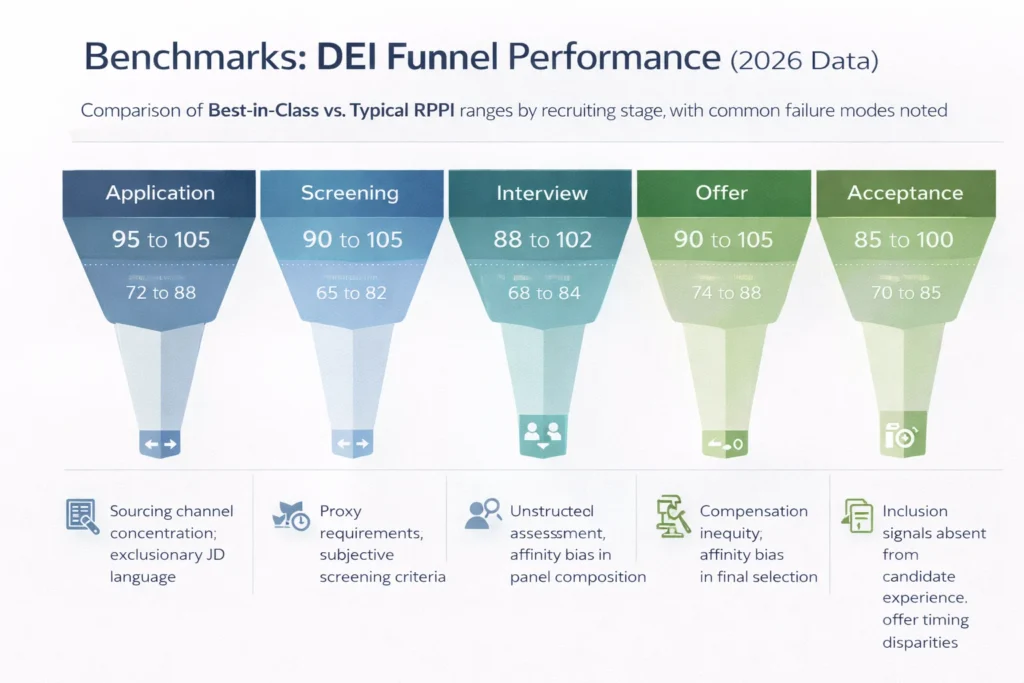
The screening stage consistently shows the largest RPPI gap in organizations that have invested in diverse sourcing but have not yet addressed assessment equity. This pattern is the empirical signature of the “we have the pipeline but not the hires” problem: sourcing investment has improved representation at application, but the assessment process is filtering it away before the offer stage.
Key Strategies for DEI in Recruiting
How AI Is Shaping DEI in Recruiting?
AI in recruiting has a complex and important relationship with DEI outcomes. It can amplify existing biases at scale, and it can systematically reduce bias in ways that human-only processes cannot reliably achieve. Which outcome it produces depends entirely on how the AI tools are designed and audited.
The Risk: Bias Amplification
AI screening and matching tools trained on historical hiring data reproduce the patterns in that data. In organizations with historical hiring patterns that reflect demographic concentration, AI tools trained on “what our successful hires looked like” will identify candidates who resemble historical hires rather than candidates who are genuinely job-qualified. This risk is most acute in AI resume screening, interview scoring, and candidate ranking tools that use historical hire or performance data as their training signal without adversarial debiasing.
The Opportunity: Structured Consistency
AI tools that replace subjective evaluation with structured, criteria-based assessment can reduce the variance introduced by individual assessor bias. An AI-assisted competency scoring tool that evaluates behavioral interview responses against a structured rubric is less susceptible to affinity bias than an unstructured human assessor, provided the rubric itself has been designed without proxy criteria and validated against job performance data rather than historical hiring patterns.
The Requirement: Regular Adverse Impact Auditing
Every AI tool used in a hiring process should be subject to regular adverse impact analysis: comparing the tool’s selection or scoring outputs by demographic group against the 80% rule, and investigating any significant disparity to determine whether it reflects genuine job-relevant performance differences or proxy bias in the tool’s design. This requirement should be contractually specified in vendor agreements and operationally implemented at least annually
Stop Juggling
10 Job Boards.
Search One
Your next role is already here. avua pulls opportunities from across the web into a single searchable feed; filtered by role, location, salary, and remote preference.
1.5 Million+
Active Jobs
380+
Job Categories
The Legal Landscape for DEI in Recruiting (2026)
The legal environment governing DEI in hiring has shifted materially in the United States since the Supreme Court’s 2023 decisions on race-conscious admissions, and the downstream effects on employer hiring practices have been the subject of significant legal and regulatory attention.
The current operative framework for most private employers includes: the prohibition on race-conscious hiring quotas under Title VII, which has been in place since the Civil Rights Act; the growing regulatory attention to AI screening tools and their potential for disparate impact under existing employment discrimination law; and the evolving interpretations of what constitutes permissible diversity outreach and employer consideration of candidate background in hiring decisions.
The broad operational guidance that remains consistent across this evolving landscape: hiring decisions must be made on the basis of job-relevant criteria; structural interventions that improve assessment equity (structured interviews, standardized rubrics, adverse impact monitoring) are both legally sound and operationally effective; targeted outreach to underrepresented communities is permissible and does not constitute impermissible discrimination; and AI tools used in hiring must be monitored for adverse impact and adjusted when significant disparities are identified.
Specific legal advice on DEI program design should be sought from qualified employment counsel in the relevant jurisdiction. This article describes operational practices rather than legal requirements.
Common Challenges and Solutions
| Challenge | Solution |
|---|---|
| Diverse Pipeline Not Converting to Diverse Hires | Conduct adverse impact analysis at screening stage; audit screening criteria for proxy requirements; implement structured assessment rubrics |
| Hiring Manager Resistance to Structured Assessment | Present data on predictive validity improvements; frame as improving decision quality for all candidates, not as DEI compliance |
| DEI Goals Without Accountable Owners | Assign representation goals to specific hiring managers for their specific roles; integrate DEI outcomes into hiring manager performance review |
| AI Tools Producing Adverse Impact | Commission bias audit from independent reviewer; require vendor to provide adverse impact analysis data; adjust or replace tools producing significant disparity |
| Diversity at Hire Not Translating to Diversity at Two Years | Investigate retention and advancement data by demographic group; identify whether inclusion or management practice gaps are driving attrition among diverse hires |
Real-World Case Studies
Case Study 1: The Technology Company
The scenario described in the article’s opening argument section resolved as follows. The technology company that had increased women’s representation in their engineering application pool from 18% to 26% but seen only a 2-point improvement in engineering hires conducted a stage-by-stage adverse impact analysis that identified a 3.1% vs. 7.4% application-to-offer conversion rate gap.
Audit of the screening process identified two primary drivers: screening criteria that included preferred experience at a list of “top engineering companies” that was 89% male in its overall workforce, and unstructured technical interviews conducted by panels that were 91% male with no standardized evaluation rubric.
The company removed the preferred company list from screening criteria, replacing it with a structured technical problem-solving assessment administered consistently to all candidates. They implemented a mixed-gender interview panel requirement for all engineering roles and introduced a standardized assessment rubric with calibration sessions before each hiring cycle.
Within three hiring cycles, the application-to-offer conversion rate for women applicants improved from 3.1% to 5.8%, representing a meaningful reduction in the gap. The proportion of women in engineering hires reached 31% by the end of year two, on track toward the 40% three-year goal. The technical performance ratings for the new hiring cohort improved across the board, because the structured assessment was producing better evaluation of all candidates, not just female ones.
Case Study 2: The Financial Services Firm
A financial services firm had been tracking overall representation data for five years and reporting steady progress: the proportion of employees from underrepresented racial and ethnic backgrounds had increased from 19% to 26% over the period. The report was presented to the board annually as evidence of a successful DEI program.
A more granular analysis, conducted as part of a workforce analytics initiative, revealed a different story. Representation at hire had increased from 19% to 28%, meaning the pipeline was producing better representation than the overall workforce number suggested. But two-year retention for employees from underrepresented backgrounds was 61%, compared to 84% for white employees. The diversity gains in hiring were being reversed by disproportionate attrition within the first two years.
The investigation identified three primary drivers of differential attrition: management assignment practices that placed a disproportionate share of employees from underrepresented backgrounds under a small number of managers with consistently low inclusion scores; performance review calibration practices that research showed produced lower ratings for employees from underrepresented groups at the same actual performance level; and a sponsorship gap where employees from underrepresented backgrounds were receiving mentorship but not the active advocacy that produces promotion consideration.
The intervention was primarily post-hire: manager assignment review, performance calibration process redesign, and a formal sponsorship program for high-potential employees from underrepresented backgrounds. Within 18 months, two-year retention for employees from underrepresented backgrounds improved from 61% to 74%, and the overall representation figure at two years of tenure began reflecting the improved hiring representation rather than reversing it.
The lesson was not that hiring DEI efforts had failed. It was that hiring DEI success was being undermined by inclusion gaps, and that measuring representation only at hire had made this invisible for five years.
Case Study 3: The Healthcare Provider
A large healthcare system was attempting to build a more diverse clinical leadership pipeline. They had implemented a diversity sourcing program and saw an improvement in the representation of candidates from underrepresented backgrounds in clinical leadership applications. But the proportion of diverse candidates advancing to final interviews remained unchanged.
Adverse impact analysis of the interview process revealed a specific pattern: the initial panel interview, conducted by a committee of current clinical leaders (85% white), showed a significantly lower advancement rate for candidates from underrepresented backgrounds compared to a structured clinical competency assessment administered separately. The competency assessment showed no significant demographic variance. The panel interview showed an RPPI of 61 at the interview-to-advancement stage.
The intervention was targeted: the panel interview was redesigned with standardized behavioral questions mapped to the clinical leadership competency framework, a structured scoring rubric with specific behavioral anchors, and a requirement for diverse panel composition. A calibration session was implemented before each hiring cycle to align panel members on rubric application.
Within two hiring cycles, the interview-to-advancement RPPI improved from 61 to 87. The diversity of the clinical leadership pipeline reaching the offer stage improved by 31% without any change to the sourcing program. The quality of interview data, measured by inter-rater reliability, improved simultaneously, confirming that the intervention was improving assessment quality for all candidates rather than producing a different kind of inconsistency.
Building a DEI Recruiting Dashboard: What to Track?
DEI Across the Talent Lifecycle
Job Design and Requirements
DEI considerations begin before the job is posted: in the design of role requirements that are genuinely job-relevant rather than credential-based, in the language of job descriptions that signals welcome versus exclusion to specific candidate groups, and in the compensation bands that will determine whether the organization can make equitable offers to the full range of qualified candidates.
Sourcing and Outreach
The diversity dimension is most directly addressed in sourcing: which channels the organization uses, which communities it engages, and which networks it builds relationships with over time. Diversity sourcing is necessary but not sufficient; its impact is fully realized only when the assessment process it feeds into is designed equitably.
Assessment and Selection
The equity dimension is most directly addressed in assessment design: structured interviews, standardized rubrics, adverse impact monitoring, diverse panels, and calibration processes. This is the highest-leverage stage for DEI outcomes because it is where the most bias is typically introduced and where structured interventions have the most consistent evidence of impact.
Offer and Onboarding
The inclusion dimension begins to materialize in the offer experience and the early onboarding period. How the offer is presented, who presents it, what information is provided about inclusion programs and support structures, and how the first 90 days are designed to create belonging all affect whether diverse new hires become long-tenure contributors or early departures.
The Business Case for DEI in Recruiting
The research connecting workforce diversity to business outcomes has accumulated over decades and shows consistent patterns across industry contexts:
Organizations in the top quartile for gender diversity on executive teams are 25% more likely to achieve above-average profitability than those in the fourth quartile. Those in the top quartile for ethnic and cultural diversity are 36% more likely to achieve above-average profitability. Teams with higher cognitive diversity, a dimension of diversity that includes educational background, functional experience, and problem-solving approach, consistently outperform homogeneous teams on complex, novel problems. Organizations with diverse leadership teams demonstrate higher innovation revenue (revenue from products and services introduced in the past three years) than those with homogeneous leadership.
These outcomes are not produced by diversity alone. They are produced by the combination of diverse perspectives with inclusive team environments where those perspectives are genuinely heard and integrated into decision-making. The recruiting function’s role is to build the diverse pipeline that makes these outcomes possible. Inclusion is what determines whether the investment in diverse hiring translates into the business outcomes the research describes.
Related Terms
| Term | Definition |
|---|---|
| EEO (Equal Employment Opportunity) | The legal framework prohibiting employment discrimination on the basis of race, color, religion, sex, national origin, age, disability, and genetic information under federal law |
| Adverse Impact | A substantially different rate of selection in hiring for any race, sex, or ethnic group, triggering analysis of whether a selection procedure is job-related and consistent with business necessity |
| Blind Hiring | A technique that removes identifying information from application materials before screening to reduce the influence of bias on early-stage evaluation |
| Structured Interview | An interview format using standardized questions and scoring rubrics for all candidates; the most evidence-supported single intervention for improving assessment equity |
| Affinity Bias | The tendency for evaluators to view candidates who are similar to themselves more favorably; a primary mechanism through which unstructured interview processes produce demographic bias in hiring outcomes |
| Representation | The proportional presence of different demographic groups at each level of the organization and at each stage of the hiring funnel; the diversity dimension’s primary measurement variable |
Frequently Asked Questions
What is the difference between diversity, equity, and inclusion in a hiring context?
Diversity is about who is in the candidate pool and workforce: the representation of people with different backgrounds, identities, and experiences. Equity is about how fairly the process works: whether candidates from all backgrounds have an equal opportunity to demonstrate their job-relevant qualifications. Inclusion is about whether people from all backgrounds feel they belong and can contribute fully once they are in the organization. All three matter because progress on one does not guarantee progress on the others, and because the recruitment process has a direct role in all three.
Is it legal to set diversity hiring goals?
The legal status of diversity hiring goals depends significantly on their design and the jurisdiction. In the United States, explicit racial or ethnic quotas in hiring are prohibited under Title VII. However, setting representation goals, conducting targeted outreach to underrepresented communities, and monitoring hiring outcomes for demographic patterns are all permissible practices under current law. The distinction is between aspirational goals informed by data and decisions that use race or ethnicity as a determinative hiring criterion. Employment counsel should advise on specific program design.
What is the 80% rule in DEI hiring analysis?
The 80% rule (also called the four-fifths rule) is an EEOC guideline for evaluating whether a selection procedure produces adverse impact. If the selection rate for any demographic group is less than 80% of the selection rate for the highest-selected group, this is considered a potential indicator of adverse impact, triggering analysis of whether the selection procedure is job-related and consistent with business necessity. It is a screening standard, not a legal bright line, but it is the most widely used operational benchmark for adverse impact detection in hiring.
How do you measure inclusion in the hiring process?
Inclusion in the hiring process is measured primarily through candidate experience data: post-process surveys that ask candidates whether they felt respected, whether the process felt fair, and whether they received consistent and timely information, segmented by demographic group to identify differential experiences. Offer acceptance rate gaps by demographic group are also an inclusion signal: if candidates from specific groups accept offers at significantly lower rates than others, the candidate experience during the process may be signaling an inclusion concern. Pre-join engagement data (time-to-accept, questions asked during the offer process) can also provide early signals of differential inclusion perceptions.
What should organizations do first if they want to improve DEI in hiring?
Conduct a stage-by-stage adverse impact analysis of the current process. Without this data, interventions are applied to the most visible stages rather than the most impactful ones, and resources are spent on programs whose effectiveness cannot be measured. The analysis typically takes two to four weeks for an organization with clean ATS data and identifies specifically where representation is declining relative to market availability. That specific diagnosis should drive everything that follows.
Conclusion
DEI in recruiting is not a values exercise that happens to have business implications. It is a quality improvement discipline that happens to produce more equitable outcomes.
Every barrier that prevents qualified candidates from underrepresented backgrounds from advancing through a hiring funnel is also a failure of the process to identify talent accurately. Every proxy requirement that screens out candidates whose credentials do not match historical patterns is also a failure of job design to specify what actually predicts performance. Every unstructured interview that produces demographic variance in evaluation outcomes is also a failure of assessment rigor that produces inconsistent results for all candidates.
The organizations that have made genuine progress on DEI in recruiting have done so by fixing their processes, not by trying harder at the margin. They have examined their screening criteria, standardized their assessments, diversified their panels, measured their outcomes at every funnel stage, and connected their hiring data to their retention data. They have treated the gap between diverse pipelines and diverse hires not as evidence of a talent shortage but as evidence of a process failure, and they have engineered their way out of it.
That is what equity in recruiting looks like in practice. Not a declaration, not a report, and not a promise. A process that works the same way for everyone it encounters, because it was designed to find the best person for the job, and that purpose does not change depending on who is applying.