Let’s be real about the IT job market right now: it’s a bit of a paradox!
On one hand, companies are practically begging for skilled talent; on the other, the competition for the best roles is absolutely relentless.
When a solid opening for a software engineer or data scientist pops up, it’s common to see hundreds of applications, many from people with backgrounds that look almost identical to yours. In a stack that deep, a generic, “one-size-fits-all” resume is essentially a 404 Not Found page. It doesn’t tell the recruiter anything meaningful, so they simply move on.
This guide is here to help you bridge the gap between being “good at your job” and “good at getting hired.” We’re going to look at how to package your technical expertise in a way that doesn’t just check the boxes for automated screening bots, but actually grabs the attention of a human hiring manager.
The goal is to show them you aren’t just another dev, you’re a strategic professional who knows how to communicate your value.
Resume Tips for IT Sector
| The Tip | What to Focus On | Why It’s a Game Changer |
| ATS-Friendly Formatting | Use standard file types (PDF or Docx) and avoid heavy graphics or complex layouts. | Most resumes hit a bot first. If the system can’t read your text, a human will never see it. |
| Lead with a Summary | Write a brief, punchy paragraph that highlights your years of experience and core expertise. | This is your elevator pitch. It gives recruiters a reason to keep reading. |
| Technical Skills Matrix | Create a dedicated section for tools and methodologies, categorized by your proficiency level. | It makes your “tech stack” incredibly easy to scan at a glance. |
| Industry-Specific Keywords | Sprinkle in the exact terms used in the job description (like “Kubernetes” or “Agile”). | This helps you rank higher in automated searches and proves you speak the language. |
| Highlight Certifications | List your relevant certs and any evidence of continuous learning. | In tech, things move fast. This shows you are keeping your skills current. |
| Quantify Your Impact | Use the STAR method (Situation, Task, Action, Result) and include percentages or data points. | Saying you “improved speed by 20%” is much more convincing than just saying you “optimized code.” |
| Share Your Links | Include clickable links to your GitHub, personal portfolio, or major projects. | For technical roles, your code is your best witness. Let them see what you’ve actually built. |
| Contextual Soft Skills | Show how your communication or leadership directly helped a technical project succeed. | Being a “team player” is vague; explaining how you led a sprint is a much better proof point. |
| Tailor Every Version | Adjust your bullet points to mirror the specific requirements of the role you are applying for. | One size fits none. A tailored resume shows you actually care about this specific job. |
| Technical Proofreading | Double check for typos in tool names and grammar mistakes. | A typo in a programming language name can make it look like you don’t actually know the tech. |
| Showcase Open Source | Mention your contributions to GitHub or Stack Overflow communities. | It proves you are passionate about the craft and active in the developer ecosystem. |
| LinkedIn Synergy | Ensure your LinkedIn profile is consistent with your resume and features social proof. | Recruiters will Google you. You want your online presence to back up what’s on the page. |
| Address Career Gaps | Frame gaps as periods of upskilling or learning new frameworks. | It turns a “silence” on your timeline into a proactive story of professional growth. |
Optimising the Technical Foundation
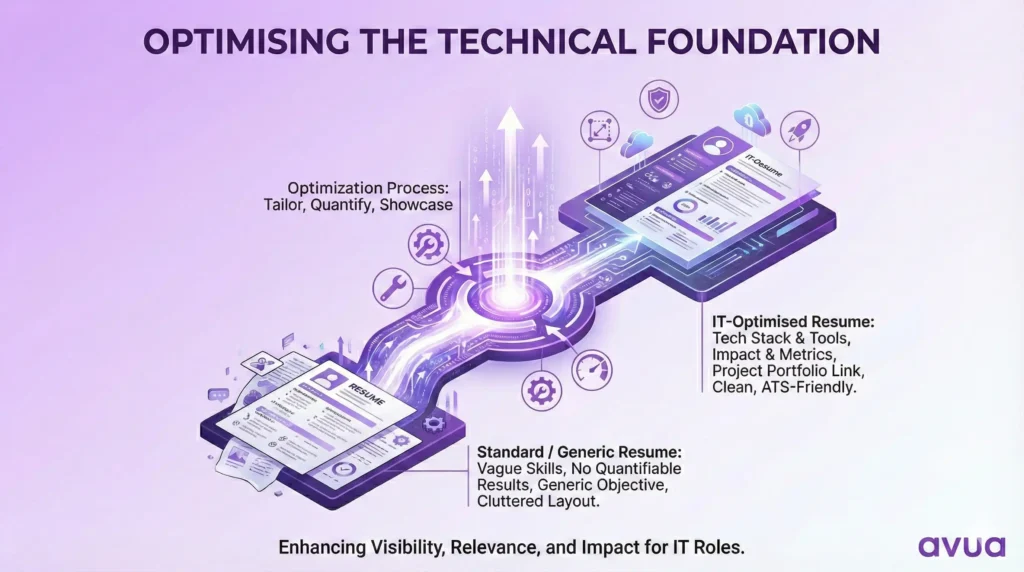
Before a human ever reads your resume, it will almost certainly be processed by software. This section focuses on structure, readability, and ensuring that Applicant Tracking Systems (ATS) can correctly parse your data. Think of it as writing clean, well-documented code: the underlying architecture matters just as much as the features.
Tip 1: Implement an ATS-Friendly Format

An Applicant Tracking System is the gatekeeper between you and the hiring manager. If your resume’s format confuses the parser, your qualifications may never be seen by a human. Prioritise clarity and simplicity in your layout.
Avoiding Graphic Overload
It is definitely tempting to make your resume look like a piece of art, but for IT roles, less is usually more. While heavy icons, infographics, and complex tables might look sleek, they often cause major headaches for ATS parsing software. These systems read your information linearly.
This means a skill bar rendered as a graphic might as well be invisible to the computer, and a two column layout can easily jumble your work history into your skills section. Your best bet is to stick to a clean, single column format with clear headers. Let your skills do the heavy lifting rather than the decoration.
Standardizing File Types: The PDF vs. Docx Debate
The choice between PDF and Docx is a bit of a classic tech debate. PDFs are great because they keep your formatting exactly where it should be for a human recruiter. That said, some older ATS platforms still struggle to parse them correctly. The safest strategy is to have both versions ready to go. Submit a .docx file when you are uploading to an online portal unless the job post explicitly asks for a PDF.
When you are emailing a human recruiter directly or hosting it on your personal site, a PDF is the way to go to keep things looking sharp. Just remember to test your resume with a free ATS simulator before you submit.
Tip 2: Lead with a Powerful Professional Summary
First things first, let’s officially retire the old school “Objective” statement. Phrases like “seeking a challenging role in a dynamic environment” are basically filler and don’t tell a recruiter anything about the value you actually bring to the table. Instead, you should swap it out for a tight, value driven professional summary that acts like an elevator pitch for your career.
A great summary should hit three key points in the first few sentences: your professional identity and years of experience, your core tech stack, and a quick mention of a measurable impact you have made.
For example, instead of a vague goal, try something like: “Results driven DevOps Engineer with over 8 years of experience building and automating CI/CD pipelines. Core expertise in AWS, Terraform, Docker, and Kubernetes with a proven track record of cutting deployment times by 40 percent and improving uptime to 99.99 percent for enterprise scale SaaS platforms.” This tells a recruiter exactly who you are, the tools you use, and the real world results you deliver right from the jump.
Tip 3: Create a Dedicated Technical Skills Matrix

For IT professionals, a dedicated skills section is not optional, it is essential. But a simple comma-separated list of technologies can be difficult to scan and provides no context about your proficiency. A well-organised technical skills matrix solves this.
Categorising by Proficiency
Think of your skills section like a well-organised directory rather than just a massive list of keywords. You should group your expertise into logical buckets like Programming Languages, Frameworks, Databases, and Cloud Platforms. Within those groups, it is a great idea to be clear about your proficiency levels. For instance, you could list the tools you use every single day as “Proficient” and the ones you have a solid working knowledge of as “Familiar.”
This kind of honesty is actually really highly valued by hiring teams. It helps you avoid those awkward, cringey moments in a technical interview where you might get grilled on a language you haven’t touched in years but still listed as a top skill. Beyond just keeping things honest, it also makes it much easier for recruiters to scan your resume and see exactly how your skills match up with what they need.
Tools and Methodologies
It is also vital to include the entire ecosystem surrounding your code. Methodologies like Agile and Scrum, DevOps tools like Jenkins and Terraform, and cloud environments like AWS or Azure are often just as important to a hiring manager as the actual programming languages you use.
Setting up a separate Tools and Methodologies subsection ensures those critical skills don’t get buried deep in your job descriptions where they might be missed. It makes it so much easier for a recruiter to see that you actually understand the full development lifecycle and how to function in a modern tech team instead of just knowing how to write code.
Tip 4: Use Industry-Specific Keywords

Think of keywords as the currency that gets you through those ATS filters. When a recruiter is hunting for a “Senior Full-Stack Developer with React and Node.js experience,” the system is literally scanning your resume for those specific phrases.
You should take a close look at the job description first to figure out which skills are considered non negotiable. Once you have that list, make sure those exact terms appear naturally throughout your resume, including your summary, your skills matrix, and your actual work history.
There is a big difference between being strategic and just stuffing keywords into your document though. If you simply paste a massive block of tech terms at the bottom or repeat “machine learning” a dozen times without any context, it is going to raise some red flags.
Sophisticated ATS platforms can flag that behaviour, and it definitely looks dishonest to a human recruiter. Every keyword you include needs to be backed up by a real example or a skill you actually have. Finding the right balance is everything, so try to weave those relevant terms into authentic descriptions of your past roles.
Tip 5: Highlight Certifications and Continuous Learning

The tech world moves faster than just about any other industry. While a certification you picked up five years ago is still a nice thing to have, it might not carry as much weight as something you just finished last month. Having a dedicated Certifications and Education section tells employers right away that you are focused on keeping your skills fresh.
You should prioritize those big vendor specific certs that everyone in the industry recognizes. Things like AWS Certified Solutions Architect, Azure Administrator, or CompTIA Security+ are always strong signals to send to a hiring manager.
Don’t feel like you have to stop at formal certifications either. Recently completed bootcamps or specialized online courses from places like Coursera or Udemy are definitely worth mentioning. In a field that is literally built on constant change, showing that you are actively growing your skillset is a huge way to stand out from the crowd.
Showcasing Impact and Experience
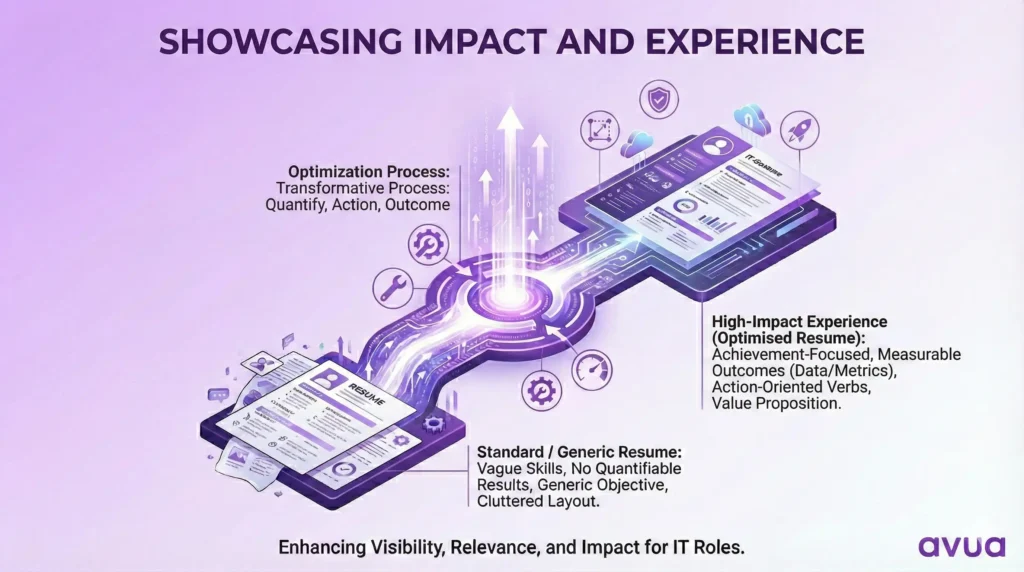
A technically sound resume gets you past the ATS. But it is the experience section that convinces a hiring manager to pick up the phone. This section is about shifting your narrative from “what you did” to “what you achieved” for the business. Every bullet point should tell a story of impact.
Tip 6: Quantify Your Achievements with Data

Vague statements like “Improved application performance” are forgettable. Quantified achievements are not. Numbers provide proof and scale, and they are the language hiring managers speak.
The Power of Percentages
Whenever possible, attach a metric to your accomplishments. Did you optimise a database query? State by how much: “Optimised core SQL queries, reducing average page load time by 35% and saving an estimated $15,000 per month in server costs.” Did you improve system reliability?
Quantify it: “Architected a failover system that increased uptime from 99.5% to 99.99%, supporting 2 million daily active users.” These numbers create a vivid picture of your impact that words alone cannot.
Using the STAR Method
For particularly significant achievements, structure your bullet points using the STAR method: Situation, Task, Action, Result. This framework ensures each bullet tells a complete story.
For example: “Facing a 20% increase in customer support tickets due to slow API response times (Situation/Task), I led a team of three engineers to refactor the legacy API gateway using Node.js and Redis caching (Action), which reduced average response times from 800ms to 120ms and decreased related support tickets by 60% within two months (Result).”
Tip 7: Detail Your GitHub, Portfolio, or Project Links
Even though there is a massive demand for skilled talent, the competition for those top tier roles has never been higher. If you are still sending out a generic, one size fits all resume, you are basically giving recruiters a 404 Not Found error.
You need a document that effectively bridges the gap between your deep technical expertise and a professional presentation that actually gets noticed. This guide is here to help you structure a resume that not only survives those tough ATS filters but also genuinely impresses the human beings on the other side of the screen.
Tip 8: Emphasize Soft Skills in a Technical Context

The old stereotype of the isolated developer who only communicates through code is definitely a thing of the past. Modern IT roles really depend on collaboration, communication, and leadership. However, just listing “teamwork” or “good communicator” as a standalone skill doesn’t really tell a recruiter much without any context behind it.
The better way to handle this is to weave your soft skills directly into your technical achievements. For example, instead of just claiming you have “strong communication skills,” you could mention how you led cross functional sprint planning sessions between engineering and product teams to reduce scope issues.
If you enjoy helping others, instead of just writing “mentorship,” you could describe how you mentored junior developers to get them contributing code independently weeks ahead of schedule. This approach actually proves you have these skills rather than just making a claim, and it clearly shows how your people skills helped solve real business problems.
Tip 9: Tailor Every Resume to the Specific Role

This might be the single most impactful piece of advice in this entire guide: never send the exact same resume twice. The one size fits none rule is absolutely huge in high level tech recruiting. A resume tailored for a front end React developer role should look and read quite differently from one aimed at a back end Python engineer position, even if both are drawing from the same career history.
Tailoring does not mean you have to rewrite your resume from scratch for every single application. It is more about strategically adjusting your emphasis to match what the company wants. You should move the most relevant projects and technologies to the very top of the page. Try rewriting your professional summary to mirror the specific language used in the job description.
If a role puts a heavy emphasis on Kubernetes and microservices, make sure your experience with those tools is prominent instead of being buried under unrelated work. Taking this targeted approach signals to the recruiter that you have actually read the job description carefully and that you are a deliberate, focused candidate.
Tip 10: Proofread for Technical Accuracy and Grammar

A typo on a resume is never a good look, but in IT, it carries a uniquely damaging implication: a lack of attention to detail. This is a trait that is absolutely critical in an industry where a misplaced semicolon can crash an application and an incorrect configuration can bring down a server.
Go beyond standard spell-checking. Verify the technical accuracy of everything you have written.
Are your version numbers correct? Writing “Python 2.x” when you mean “Python 3.x” is a factual error that an informed reviewer will catch. Are framework names capitalized correctly (e.g., “ReactJS” not “reactjs”, “PostgreSQL” not “Postgresql”)? Are your dates consistent? Have a technically literate friend or colleague review your resume not just for grammar but for these kinds of domain-specific errors. Precision in your resume reflects precision in your work.
Level Up Your Professional Brand
A great resume is the centerpiece of your professional presentation, but it does not exist in a vacuum. In the interconnected world of tech, your online presence, community contributions, and how you handle career narrative gaps all form part of the picture a recruiter builds of you. This section addresses how to strengthen the ecosystem around your resume.
Tip 11: Showcase Open Source and Community Contributions

Active participation in the open-source community is one of the most powerful signals a developer can send. It demonstrates passion for the craft that extends beyond a paycheck, and it provides verifiable evidence of your skills.
The Value of GitHub and Stack Overflow
Contributions to public repositories on GitHub show real-world problem-solving and collaboration in action. A history of well-crafted pull requests, thoughtful code reviews, and responsiveness to issues demonstrates that you can work within a team’s codebase and contribute constructively.
Similarly, a strong Stack Overflow profile with high-quality answers in your domain area showcases your ability to explain complex concepts clearly a skill valued just as highly as writing elegant code. If you have significant activity on either platform, reference it directly on your resume with a link.
Contributing to Major Frameworks
If you have contributed bug fixes, feature additions, or documentation improvements to well-known open-source libraries or frameworks, make sure to highlight this.
Even seemingly small contributions to projects like React, Django, TensorFlow, or Kubernetes carry outsized weight because they imply that your code was reviewed and accepted by established maintainers. Document these contributions clearly on your resume: name the project, describe your contribution concisely, and if possible, link to the merged pull request.
Tip 12: Optimize Your LinkedIn Profile for Technical Synergy

LinkedIn has moved way beyond just being a digital Rolodex. These days, it is an active research tool that tech recruiters use constantly. Your profile should really function as a living, expanded version of your resume, and keeping things consistent between the two is absolutely non negotiable.
Consistency is Key
You want to make sure your tech stack versions, job titles, and employment dates on LinkedIn match your resume exactly. Even minor discrepancies, like being off by a month on a start date, can raise red flags for diligent recruiters and make you look a little careless. You should treat your LinkedIn profile and your resume as two expressions of the exact same truth and always update them in tandem.
Making Most of the Social Proof
One of the most powerful things about LinkedIn for job seekers is the social proof. Skill endorsements from colleagues are a nice touch, but written recommendations from former Tech Leads, Engineering Managers, or respected peers are even better. These add a layer of third party validation that your resume simply cannot provide on its own.
Don’t be shy about requesting recommendations from people you have worked closely with. A thoughtful recommendation from a former manager that speaks to your technical ability and how you work in a team is worth its weight in gold.
Tip 13: Address Career Gaps with Upskilling Context

Career gaps are a reality for many professionals, and they are increasingly common and accepted in the tech industry. The key is not to hide them but to frame them constructively.
The “Learning Sabbatical” Framework
If you spent time away from traditional employment engaged in intensive self-study, bootcamps, or building side projects, present this period as a deliberate “Learning Sabbatical” on your resume.
Create a dedicated entry with a title like “Independent Study & Professional Development” and list the specific courses completed, certifications earned, or projects built during that time. This reframes a gap from a period of inactivity into a period of intentional growth, demonstrating the self-motivation and discipline that are hallmarks of a strong IT professional.
Bundling Freelance or Contract Work
If your career includes several short-term freelance or contract engagements, listing each one individually can make your resume look fragmented and raise concerns about job-hopping. Instead, group these engagements under a single umbrella entry, such as “Freelance IT Consultant” or “Independent Software Contractor,” with the overall date range.
Underneath, you can list the key projects or clients as bullet points. This maintains a clean, cohesive timeline while still showcasing the breadth of your experience.
Answering Common Queries Related to IT Sector Job Tips
How should I list legacy tech I haven’t used in years?
Group older technologies under a “Prior Experience” category or omit them if they aren’t relevant to the modern stack you are targeting.
Should I include local server IP addresses or internal project names?
Never. Including internal IPs or sensitive project names is a security risk; always use generic descriptors to protect your previous employer’s infrastructure.
Can I use a two-column layout to save space?
Avoid it. Many ATS platforms parse resumes linearly from left to right, which can jumble your columns into a confusing mess of text.
How do I represent “Open Source” work if it wasn’t a paid job?
List it under a “Projects” or “Open Source Contributions” section, highlighting the specific pull requests or features you successfully implemented.
Is it better to list Python 3.x or just Python?
Always specify the version. Technical recruiters look for version-specific expertise to ensure you are familiar with the latest libraries and syntax.
How do I handle a “Cloud-Native” stack without professional experience?
List your personal lab environments or hands-on projects, specifically naming the tools like Docker or Terraform used to build that infrastructure.
Conclusion
Putting together a standout IT resume really is a mix of art and science. It requires the same kind of technical precision you would use for well structured code, combined with the strategic thinking behind a successful product launch.
Focusing on ATS compatibility, backing up your wins with data, and tailoring every application helps you transform your resume from a simple static document into a powerful marketing tool.
Always keep in mind that your resume is a living document. You should refactor it regularly just like you would refactor code to improve its performance. Make it a habit to refine your details after every big project, new certification, or career milestone you hit.
At the end of the day, the IT professionals who land the best roles are not always the ones with the longest list of skills. They are usually the ones who know how to present those skills most effectively. These thirteen tips give you a solid foundation to do exactly that and get your foot in the door.