Forget everything you knew about the old recruiting playbook—the game has officially changed.
We’ve reached a point where the chaos of 2023 and the corrections of 2025 are finally in the rearview mirror, leaving us with a labor market that is stable yet unrecognisable. The days of mass hiring just to increase headcount are over, replaced by a world that values accuracy and strategic intent.
As hiring slows to a healthy, sustainable rhythm, employers are focusing on what truly matters. It is no longer a race for “growth at all costs.” Instead, hiring teams are prioritising long-term retention and perfect fit. The top hiring trends of 2026 show a market where every open role is treated with extreme care, and hiring managers are expected to deliver results with every new hire.
Success today requires a shift from reactive habits to a proactive mindset. The companies leading the way are those balancing the power of artificial intelligence with a strong commitment to skills-based hiring.
Quick Outlook: Top Hiring Trends
| Trend Category | Core Focus | Key Impact |
| Precision Hiring | Quality and retention over volume. | Reduces “growth at all costs” waste; prioritizes high-impact, strategic hires. |
| AI & Automation | Data-driven decision making. | Streamlines workflows (CV analysis, scheduling) and predicts candidate success. |
| Skills-Based Hiring | Verifiable competencies vs. degrees. | Widens the talent pool and promotes diversity by removing traditional barriers. |
| The “Multi-Hyphenate” | Hiring for diverse, non-linear paths. | Values lateral thinking and adaptability that specialized AI cannot replicate. |
| Human-Centric Branding | Transparency and speed. | Elevates the employer brand by treating candidate experience as a marketing asset. |
| Fractional Leadership | Part-time, high-level expertise. | Allows companies to access C-suite talent without the cost of full-time headcount. |
| Sector-Specific Growth | Cybersecurity, Green Energy, Health-Tech. | Directs capital and talent acquisition toward high-innovation industries. |
The State of Hiring in 2026: Precision Labor Market
The macroeconomic environment has settled, but the ripple effects are still shaping the hiring landscape. We are seeing a distinct move away from the frantic, high-volume recruitment of the past decade. Instead, the trends for 2026 point toward a market defined by intentionality—where every headcount request is scrutinized, and every hire must prove its long-term value immediately.
From 2025 to 2026: Why Volume Hiring Slows?
If 2025 was the year of the “great correction,” 2026 is the year of the “great calibration.” It is no secret that volume hiring slows when stability returns; companies are no longer scrambling to fill seats just to show growth. Hiring managers are now operating with tighter budgets and higher expectations, looking for quality over quantity.
This shift means the hiring market has become more competitive, not necessarily for job seekers, but for companies fighting for a smaller, highly specialised slice of the talent pool. The days of casting a wide net are over. Today, successful hiring plans are built on precision—identifying the exact skills needed to drive business goals and ignoring the noise of generalist applications.
Using Strategic Workforce Planning to Get a Strategic Advantage
Your ability to search internally before looking abroad can provide you a strategic edge in a market where hiring from outside is more costly and time-consuming. Smart organisations are realising that their next best hire might already be on the payroll.
This is where upskilling becomes a critical component of the hiring strategy. rather than entering a bidding war for new talent, forward-thinking employers are reshaping their hiring teams to focus on internal mobility.
Businesses can give development precedence over acquisition by conducting an audit of their current personnel and finding any deficiencies. This doesn’t just save on recruitment costs; it builds a resilient culture where top talent sees a clear future, drastically improving retention in a tight labor market.
Top Hiring Statistics of 2026 So Far
To understand the magnitude of these trends, it is essential to look at the data driving the shift. The following statistics from 2025-2026 reports highlight the rapid adoption of AI and the changing priorities of the workforce:
- AI Integration is Mainstream: According to SightsIn Plus, 87% of companies now utilise AI at some stage of their recruitment process. Furthermore, data cited by Fortune indicates that candidates selected by AI screening are 14% more likely to receive a job offer, suggesting algorithms are becoming better at predicting fit than previously thought.
- Skills Over Degrees: The NACE Job Outlook 2026 report reveals that 70% of employers have implemented skills-based hiring practices, a significant jump from previous years. Additionally, TestGorilla reports that 53% of companies have formally removed degree requirements for at least some roles to widen their talent pools.
- The Remote Reality: The demand for flexibility hasn’t waned. Research by Buffer indicates that 97% of remote workers wish to continue working remotely for the rest of their careers. Conversely, Robert Half found that only 16% of professionals list a fully in-office job as their top preference.
AI and Data-Driven Hiring
The days of relying on gut feeling are over. In 2026, successful recruitment is a science, powered by data-driven hiring strategies that remove the guesswork from talent acquisition.
We have moved beyond simple applicant tracking systems to a sophisticated ecosystem where artificial intelligence acts as a strategic partner, not just a tool. This shift is redefining the recruiter role, allowing hiring teams to focus on high-value interactions while algorithms handle the heavy lifting of the workflow.
Transforming the Hiring Process with Advanced AI Tools
The modern hiring process is being rewritten by automation. Advanced AI tools are now capable of managing end-to-end tasks that used to consume hours of a recruiter’s day. From job descriptions created by AI to automated scheduling and initial screening, technology is streamlining operations at an unprecedented scale.
But it’s not just about speed; it’s about accuracy. AI agents can now source candidates from the deep web, analysing vast amounts of data to predict hiring outcomes before an interview even takes place. By integrating these tools, hiring managers can identify top talent that might have been missed by traditional methods, ensuring that hiring decisions are based on potential and fit rather than just keywords on a resume.
Strategies to Recruit in the Age of AI
However, the rise of the age of AI brings a new challenge: maintaining the human connection. As automation takes over the logistical side of hiring, the ability to genuinely recruit—to persuade, connect, and understand a candidate’s motivations—becomes more valuable than ever.
To achieve hiring success in 2026, organizations must balance high-tech efficiency with high-touch engagement. The goal is to use AI to free up time for meaningful conversations, not to replace them. Hiring leaders who leverage data to inform their strategy while keeping the candidate relationship human-centric will see better business outcomes and higher retention rates. Ultimately, technology should empower the recruiter to be a talent advisor, not just a process manager.
Avua Flipping the Hiring Game to Another Level
Modern recruitment requires the right platform to turn strategy into action. Avua stands at the forefront of this shift, offering AI tools that fundamentally change how we hire and get hired. Its features ensure that talent acquisition is no longer a guessing game but a precise, efficient science.
For employers and hiring teams, the AI Resume Score and in-depth CV Analysis allow for the instant identification of top talent, ensuring every hiring decision is backed by data. The AI Interview capability removes bias and friction, creating a more consistent and professional candidate experience.
For the modern job seeker, having access to over 1.5M+ Jobs and receiving automated feedback creates a clearer path through the job market. The platform matches human potential with automation, ensuring that recruitment in 2026 leads to better hiring outcomes and long-term business outcomes for everyone involved.
The Skills-Based Revolution: Trends for 2026
The era of degree inflation is fading. In 2026, the most significant shift in talent acquisition is the move toward a skills-first approach. Companies are dismantling barriers to entry, realising that a four-year degree is no longer the only proxy for capability. This revolution is democratizing the job market, allowing employers to access a broader, more diverse talent pool by validating what a candidate can do rather than where they learned it.
Why Skills-Based Hiring is the New Standard?
Skills-based hiring has graduated from a buzzword to a business imperative; technical skills in the present timeline have a shorter shelf life than ever before. Hiring managers who cling to rigid academic requirements are finding themselves cut off from high-potential candidates who have acquired expertise through alternative routes like bootcamps, online certifications, or hands-on experience.
By shifting the focus to verified competencies, organisations can build more agile hiring teams. This approach doesn’t just fill immediate gaps; it creates robust talent pipelines filled with adaptable learners.
When you prioritize skills over pedigree, you reduce the time to hire and improve the quality of the match. In 2026, a credential is only as valuable as the practical application it represents, and the smartest companies are those rewriting their job postings to reflect this reality.
Valuing Human Skills in a Technical World
There is a paradox at the heart of the age of AI: as automation handles more technical tasks, the value of human skills—critical thinking, empathy, and adaptability—has skyrocketed. These are the traits that algorithms cannot replicate.
When hiring in 2026, recruiters and hiring teams must look beyond the hard skills that can be easily taught or automated. The real differentiator for top talent today is their ability to navigate complex, ambiguous problems and collaborate effectively.
Soft skills are now “power skills.” Hiring leaders who understand this are adjusting their hiring strategies to test for emotional intelligence and cultural add, ensuring they build teams that are not just technically proficient, but resilient and innovative.
Sector Spotlights: Where the Opportunities Are Hitting Hardest?
Growth patterns look different depending on where you focus. Renewable energy is expanding really fast, creating a massive need for specialised engineers and sustainability experts. Healthcare continues to dominate as providers seek out talent to manage tech-integrated patient care systems. Cybersecurity stands out as a major force; since digital threats evolve constantly, almost every organisation now operates like a tech company, driving up the demand for defense specialists.
Construction and infrastructure are seeing a revitalisation, especially with smart-city projects coming online. Specialised finance and fintech are hunting for people who can bridge the gap between traditional banking and decentralised tech. Retail is pivoting too, moving away from traditional storefront roles toward logistics and data-centric customer experience specialists.
As far as the trend goes, these sectors are hunting for top talent with specific skill sets that align with recent technological shifts. Watching these specific sectors gives you a clear map of where the money and the momentum are moving within the hiring market.
The Death of “Linear Career Path“
So, about that career ladder you were told to climb? It has officially been replaced by a “career jungle gym.” The old-school path—starting as an intern and moving up a single, straight line—is fading away. Today, the most valuable candidates are Multi-Hyphenates.
Think of a software engineer who also ran a successful bakery or a designer who moonlights as a data analyst. These diverse experiences are no longer viewed as distractions; they are seen as a strategic edge.
Modern hiring focuses on T-shaped individuals. These people offer deep knowledge in one field but can bridge the gap between different departments. This shift matters because artificial intelligence is great at specialised data but fails at the lateral thinking born from varied life experiences.
Someone with a “portfolio career” brings a level of adaptability and creativity that a single-track resume lacks. Your “side quests” actually make you more relevant, providing the human context and cross-functional fluency that machines cannot replicate. Success now belongs to those who collect skills like badges, creating a unique professional identity that is impossible to automate.
Candidate Experience and Employer Brand: The Human Element
Technology handles the logistics, but the human touch seals the deal. Your employer brand isn’t just a logo anymore—it’s how candidates feel throughout the hiring process. To secure top talent in 2026, prioritizing candidate experience over pure efficiency is essential. Let’s explore why being “human” is your best strategy.
The Modern Employer Brand: Transparency and Speed
Today’s candidate expectations are clear: they demand radical transparency and respect for their time. The modern employer brand is built on honesty regarding salary ranges, AI adoption in the screening process, and the reality of day-to-day work. A hiring process that is opaque or overly lengthy is the fastest way to lose high-quality applicants.
Job seekers are increasingly savvy; they talk, they share reviews, and they know their worth. If your recruitment process feels like a black hole, your employer brand suffers immediate damage. To recruit effectively in 2026, organisations must streamline their workflows, ensuring that communication is frequent and feedback is constructive. Speed is not just efficiency—it is a signal of respect that resonates deeply with the current labor market.
How to Hire and Retain by Putting the Candidate Experience First?
To achieve lasting hiring success, companies must view the candidate experience as the first step in retention. This includes providing clarity on flexible work policies. Despite the push for office returns in previous years, remote and hybrid work options remain a non-negotiable priority for a vast segment of the talent pool.
When you hire in 2026, you are selling a lifestyle and a culture, not just a paycheck. Hiring leaders who prioritise a seamless, human-centric journey—from the first click on a job posting to the final offer letter—will consistently win. By reducing friction and treating every applicant as a potential brand ambassador, you transform your hiring process into a powerful engine for attracting the very best.
Gemini said
A Rebound in Graduate Tech Hiring
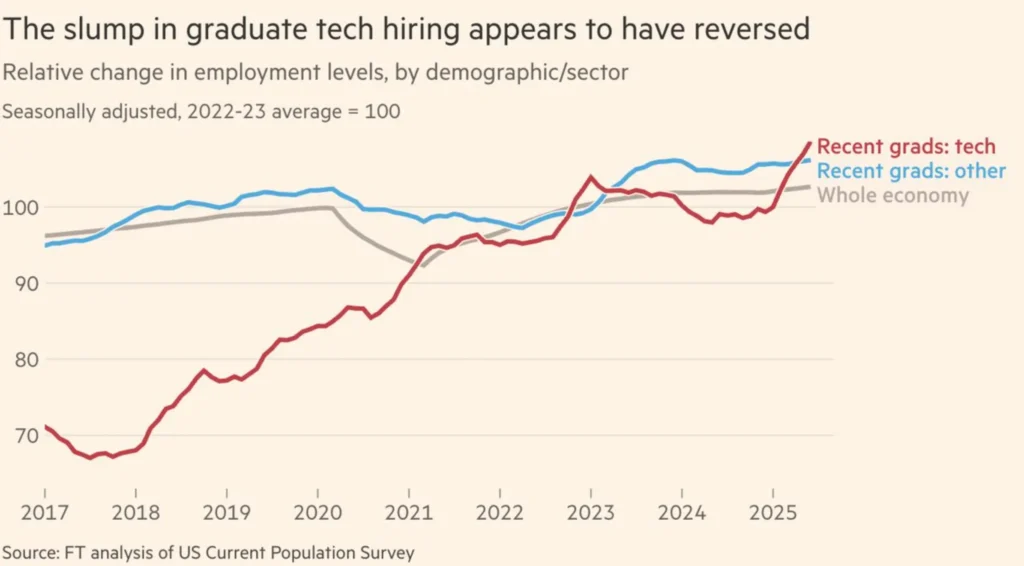
This chart from a Financial Times analysis provides a clear visual of the changing tides in the job market for recent graduates, particularly in the tech sector. The data, which measures the relative change in employment levels against a 2022-23 average, shows that the previously observed slump in hiring for tech graduates appears to have reversed.
As indicated by the red line (“Recent grads: tech”), there was a noticeable decline in employment levels starting in late 2023. However, this trend has sharply turned around, with the data showing a strong recovery and an upward trajectory moving into 2025. In fact, by 2025, the relative employment level for recent tech graduates has surpassed that of both recent graduates in other sectors and the economy as a whole.
Common Queries Relevant to Hiring Trends
What are the Top hiring trends for 2026?
The main trends include a shift to skills-based hiring, the deep integration of AI tools for efficiency, and a focus on candidate experience to boost the employer brand.
How will AI impact the Recruitment process in 2026?
AI will handle repetitive tasks like sourcing and screening, allowing recruiters to focus on human skills and relationship building, making the hiring process faster and more data-driven.
Why is Skills-based hiring becoming so popular?
It expands the talent pool by prioritising verified abilities over degrees. This approach helps companies find diverse top talent faster and reduces the risk of bad hiring decisions.
Is Remote work still a priority for candidates in 2026?
Yes, flexible remote and hybrid work options remain a critical demand. Companies that offer flexibility have a great advantage in attracting and retaining high-quality job seekers.
How has the Hiring Market changed from 2025 to 2026?
The market has stabilized. While hiring slows in volume compared to the volatility of 2025, the focus has shifted to precision, retention, and strategic workforce planning.
How can Companies improve their Employer brand?
By ensuring a transparent, fast, and respectful candidate experience. Clear communication about pay, culture, and AI adoption builds trust and attracts the best talent in the market.
End Note
Successful companies are focusing on specialised growth areas where technical skills and human adaptability intersect. Healthcare, renewable energy, and cybersecurity are currently leading the charge, but the underlying theme across all sectors is a shift toward quality.
Organisations are prioritising candidates who can grow alongside emerging technologies rather than just filling immediate gaps. This targeted approach ensures that teams remain resilient even as market demands shift.
Keeping a close watch on these high-growth fields provides the clarity needed to make smarter, more strategic decisions for long-term success.