Let’s be honest, hiring has never been easy.
But over the past few years, artificial intelligence has stormed into the recruitment world, promising to make everything faster, smarter, and more efficient.
And while some of those promises hold up, others… well, they’re more hype than substance.
If you’ve followed the technology “Hype Cycle” in HR, you know the pattern: a shiny new tool generates massive excitement, hits a wall of disillusionment, and eventually settles into something genuinely useful. AI in recruitment is right in the middle of that journey.
The real question isn’t whether AI belongs in hiring it absolutely does.
The question is how we strike the right balance between automation and the irreplaceable human touch.
30 Second Snippet: AI in Recruitment
The integration of AI in recruitment is often surrounded by a mix of futuristic hype and deep-seated fear. While myths suggest that algorithms will entirely replace human intuition or eliminate bias instantly, the reality is far more nuanced. In 2026, AI serves as a powerful co-pilot, automating high-volume tasks like resume screening and scheduling to allow recruiters to focus on what matters most: building genuine human connections and assessing cultural fit.
Evolution and Impact of AI in Modern Hiring
The recruitment game has flipped from manual filing cabinets to sophisticated algorithms that can predict a candidate’s future performance in seconds. This transformation isn’t just about speed; it’s a fundamental reimagining of how technology and human intuition collaborate to build the modern workforce.
How AI Tools Streamline the Talent Acquisition Pipeline?
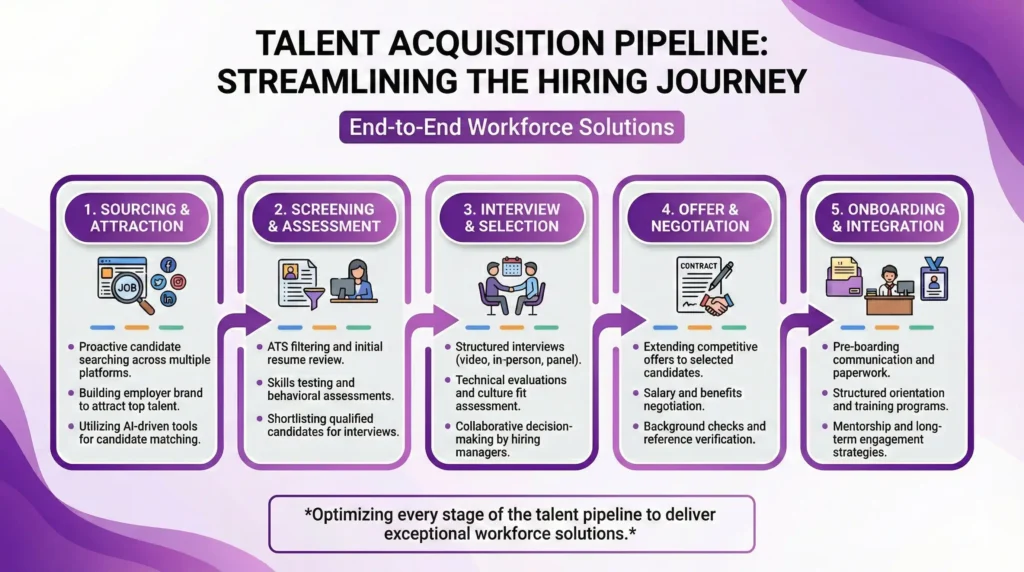
Gone are the days when recruiters had to manually sift through hundreds of resumes with a coffee in one hand and a highlighter in the other. Today, AI is reshaping the entire talent acquisition pipeline from the moment a job is posted to the day a candidate signs their offer letter. But how exactly does it work?
Intelligent Sourcing and AI Resume Screening
Here’s where things get exciting. Traditional resume screening relied heavily on keyword matching. If your resume didn’t contain the exact phrases the system was looking for, it might get tossed aside regardless of how qualified you were. That approach was clunky and, frankly, left a lot of great talent on the table.
Modern AI-powered screening tools use machine learning to go far beyond simple keywords. They leverage semantic search, which means the system actually understands the meaning and context behind the words on a resume. So if a job posting asks for “team leadership experience” and a candidate’s resume says “managed a cross-functional group of twelve engineers,” the AI connects the dots. It identifies top-tier talent faster because it grasps what skills and experiences actually matter not just whether someone used the “right” buzzwords.
The result? Recruiters spend less time wading through unqualified applications and more time engaging with candidates who are genuinely worth talking to.
Predictive Analytics for Data-Driven Hiring
Now, imagine you could look at years of hiring data who succeeded in a role, who didn’t, what traits top performers shared and use that information to predict which new candidates are most likely to thrive. That’s the promise of predictive analytics, and it’s already changing how forward-thinking companies make hiring decisions.
By analyzing historical data, AI models can forecast candidate success with surprising accuracy. They look at patterns that humans might miss: the correlation between a specific career trajectory and long-term retention, or which combination of skills tends to predict high performance in a particular role.
The practical payoff is significant. Companies using predictive hiring tools consistently report reductions in both time-to-hire and cost-per-hire. When you can identify the right candidates earlier in the process, you waste fewer resources on lengthy interview cycles that lead nowhere. It’s not magic, it’s math, applied thoughtfully.
Enhancing the Candidate Experience (CX)
Let’s talk about the other side of the equation: the candidate. Because no matter how efficient your internal processes become, if the experience feels cold, slow, or frustrating for applicants, you’re going to lose great people to companies that do it better.
24/7 Support via AI Recruitment Chatbots
One of the most practical applications of AI in recruitment is the humble chatbot. And before you roll your eyes, today’s recruitment chatbots are far more sophisticated than the clunky “How can I help you?” pop-ups of a few years ago.
Modern AI chatbots can engage with candidates the moment they land on a careers page, regardless of the time zone or hour. They answer frequently asked questions about the role, company culture, and application process. They can even conduct initial screening by asking targeted questions and routing qualified candidates to the next step, all without a recruiter lifting a finger.
For candidates, this means no more submitting an application into a black hole and wondering if anyone even looked at it. They get immediate engagement, which goes a long way toward building trust and keeping them interested.
Automated Interview Scheduling
If you’ve ever tried to coordinate interview schedules between a candidate, a hiring manager, and two panel members across different time zones, you know it can feel like solving a Rubik’s Cube blindfolded. Automated scheduling tools eliminate that friction entirely.
These AI-driven systems sync with everyone’s calendars, identify available slots, and send invitations often within minutes of a candidate advancing to the interview stage. It sounds simple, but the impact is enormous. Faster scheduling means shorter hiring cycles, and shorter hiring cycles mean you’re less likely to lose top candidates to competitors who moved quicker.
Debunking AI Hiring Myths: Fact vs. Fiction
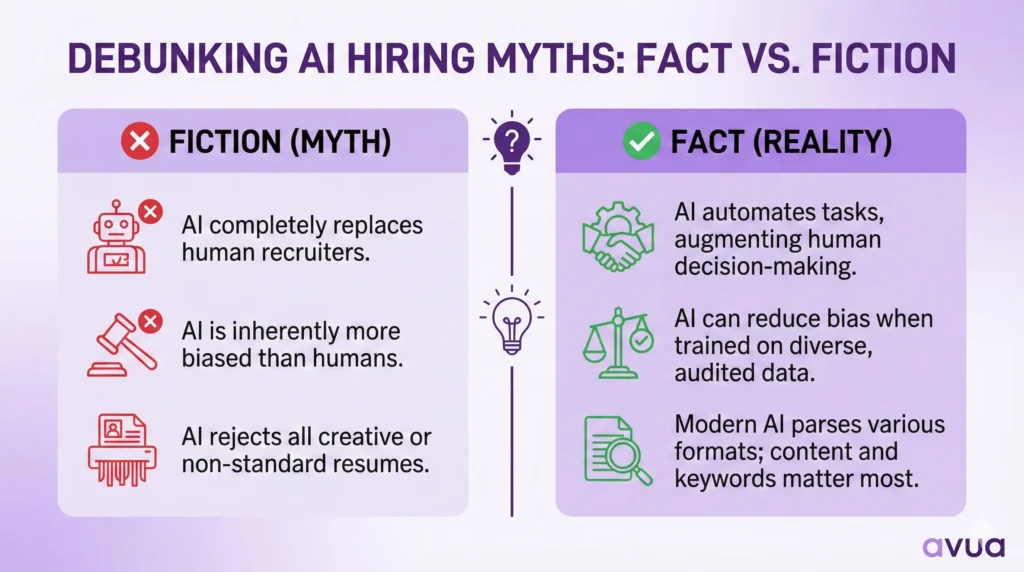
Now that we’ve covered what AI can genuinely do, let’s tackle the myths because there are plenty of them floating around.
Myth 1: AI Will Completely Replace Human Recruiters
This is the big one, and it’s the myth that causes the most anxiety. The idea that AI will eventually make human recruiters obsolete is dramatic, attention-grabbing, and thankfully; not grounded in reality.
The Reality of “Human-in-the-Loop” (HITL) Systems
The most effective AI recruitment systems aren’t designed to work alone. They’re built around a concept called “Human-in-the-Loop,” or HITL. Think of it this way: AI is the co-pilot, not the captain.
In a HITL model, AI handles the heavy lifting, screening resumes, ranking candidates, automating communications, but a human recruiter remains in the decision-making seat. The AI surfaces insights and recommendations, and the recruiter applies judgment, context, and experience to make the final call. It’s a partnership, not a replacement.
The reason is simple: hiring is fundamentally a human decision. You’re not just matching a set of skills to a job description. You’re bringing a person into a team, a culture, and a mission. That requires intuition and relationship-building that algorithms simply cannot replicate.
Why AI Cannot Assess Cultural Fit and Emotional Intelligence?
Here’s where AI hits a hard wall. Cultural fit and emotional intelligence are messy, nuanced, and deeply human concepts. Can someone navigate a difficult conversation with empathy? Will they thrive in a fast-paced, ambiguous environment? Do they bring an energy that elevates the people around them?
These are things you pick up in a conversation, a shared laugh during an interview, or even the way someone responds to an unexpected question. They’re about “vibe,” and no algorithm no matter how sophisticated can reliably assess vibe. AI can tell you if someone has the right skills. It can’t tell you if they’ll be the kind of teammate people actually want to work with.
Myth 2: AI Tools Are Always Objective and Unbiased
This is a particularly dangerous myth, because it sounds so logical. Machines don’t have feelings, prejudices, or bad days, so surely their decisions must be perfectly fair, right? Not quite.
The Problem of Algorithmic Bias in Recruitment
AI systems learn from data, and if that historical data reflects human biases which, let’s face it, it almost always does the AI will replicate and even amplify those biases. A well-known example involved a major tech company whose AI recruiting tool systematically downgraded resumes from women, because the system had been trained on a decade of hiring data that skewed heavily male. The AI didn’t “decide” to be biased. It simply learned from a biased dataset and treated that as the standard.
This is a critical point: AI doesn’t eliminate bias. It automates it unless you’re actively working to prevent that from happening.
Strategies for Implementing Ethical AI
So how do you keep AI tools honest? It starts with regular auditing. Companies need to routinely test their AI systems for disparate impact across gender, race, age, and other protected categories. If the outputs aren’t equitable, the model needs to be retrained.
Diversifying training datasets is equally important. The more representative and balanced the data your AI learns from, the fairer its outputs will be. And beyond the technical fixes, organizations should establish clear ethical AI guidelines for how AI is used in hiring, including transparency about when and how AI is involved in the process.
The bottom line? Ethical AI doesn’t happen by accident. It requires intention, oversight, and a commitment to doing the work.
Myth 3: Candidates Find AI Interactions Impersonal
You might assume that candidates would prefer a fully human-driven process and in some cases, they do. But the reality is more nuanced than the myth suggests.
The Reality of Increased Transparency
One of the biggest frustrations candidates face is the dreaded silence after submitting an application. Weeks go by with no updates, no feedback, and no idea where they stand. AI can actually fix this.
Automated feedback loops keep candidates informed at every stage. Whether it’s a confirmation that their application was received, an update that they’ve moved to the next round, or even a respectful rejection with constructive feedback these touchpoints matter. And studies consistently show that candidates who feel informed and respected throughout the process rate their experience more positively, even if they don’t get the job.
In other words, a well-designed AI system can feel more personal than a process where a human recruiter simply never gets back to you.
Creating a Hybrid High-Tech, High-Touch Model
The smartest companies aren’t choosing between AI and human interaction. They’re using both strategically. The idea is simple: let AI handle the tasks that benefit from speed and scale (screening, scheduling, status updates), so that human recruiters can invest their time where it matters most building genuine relationships with candidates.
When a recruiter isn’t buried in administrative tasks, they can have deeper conversations, provide more thoughtful feedback, and create the kind of candidate experience that makes people genuinely excited about joining the team. AI doesn’t make the process less human. Done right, it frees recruiters up to be more human.
The Future of AI in HR: Ethics and Compliance
As AI becomes more embedded in hiring, the regulatory space is growing right alongside it. Governments and regulatory bodies around the world are taking notice, and new rules are emerging to ensure AI is used responsibly.
In the European Union, frameworks like the GDPR already place strict requirements on how candidate data is collected, stored, and processed. Local labor laws in various jurisdictions are beginning to require transparency around automated decision-making in hiring including the right for candidates to know when AI played a role in evaluating their application.
Data privacy is becoming a non-negotiable concern. Candidates want to know that their personal information is being handled with care, and companies that can’t demonstrate responsible data practices will increasingly find themselves at a competitive and legal disadvantage.
Building compliant, transparent AI hiring practices today will be the foundation for sustainable talent acquisition tomorrow.
Frequently Asked Questions
Will AI eventually replace human recruiters entirely?
No. AI is designed to automate repetitive tasks, allowing human recruiters to focus on complex decision-making, relationship building, and assessing cultural fit.
How does AI identify the best candidates from a resume?
AI uses natural language processing to analyze skills, experience, and achievements, matching them against job requirements more accurately than simple keyword searches.
Can AI hiring tools be biased?
Yes. If historical training data contains human prejudices, the AI can replicate those biases. Regular audits and diverse datasets are essential for fairness.
Does using AI improve the candidate experience?
Generally, yes. AI provides faster responses, 24/7 communication via chatbots, and more efficient scheduling, reducing the “black hole” of traditional applications.
Is AI-driven recruitment legal and compliant?
Yes, provided it follows data privacy laws like GDPR and specific local regulations that require transparency and bias testing for automated systems.
End Note
So where does all of this leave us? Here’s the honest takeaway: AI is a powerful tool for making recruitment more efficient, faster, and more data-driven. But it’s not a silver bullet. It won’t magically solve every hiring challenge, and it certainly won’t replace the judgment, empathy, and intuition that great recruiters bring to the table.
The companies that will win the talent game aren’t the ones that automate the most. They’re the ones that use AI strategically to eliminate busywork, surface better insights, and create smoother experiences, so that the humans on their team can focus on what they do best: connecting with people.
The ultimate reality? The most successful hiring teams use AI to be more human, not less. And that’s not a myth, that’s the future.