There is a category of candidate that most organizations dismiss at the moment they are most valuable and ignore at the moment they are most accessible. They are the people who already know the job, already know the culture, and already know the people, but who left to pursue something else and have since discovered that the grass was not quite as green as advertised, or that what they left behind was more valuable than they realized while they had it.
These are boomerang employees, and in 2026 they represent one of the most underutilized talent pools in professional hiring.
A boomerang employee is a former employee who returns to work for the same organization after a period of employment elsewhere. The departure may have been voluntary: a resignation to pursue a competing offer, a career change, a relocation, a personal circumstance, or simply a desire to try something new. What defines the boomerang employee is not the reason they left but the fact that they are willing to return, and the fact that their return represents a fundamentally different value proposition than a first-time hire.
In 2026, the boomerang employee is no longer a curiosity or an exception. Workforce mobility has increased significantly over the past decade, average tenure at a single employer has declined, and the professional networks that keep former employees connected to their previous organizations have become more robust and more accessible than at any previous point. The result is that a larger proportion of former employees maintain active professional relationships with their previous organizations, that those relationships create visible channels through which return conversations can occur, and that more organizations are building deliberate infrastructure to manage those relationships rather than leaving them to chance.
AI-powered talent platforms have accelerated this trend by making it operationally straightforward to maintain structured engagement with alumni talent pools, track former employee career trajectories, and identify re-engagement windows when a former employee’s circumstances have changed in ways that suggest openness to a return conversation. Organizations that are building these capabilities are accessing a talent pool that their competitors, still focused exclusively on acquiring new talent, are largely ignoring.
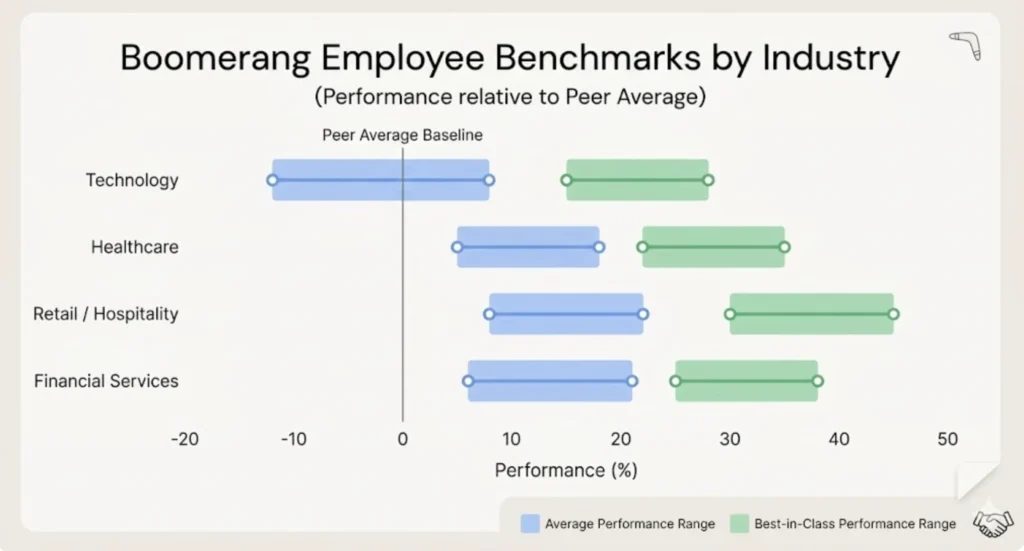
The core metric governing boomerang hire effectiveness is the Boomerang Hire Return Rate (BHRR): the proportion of eligible former employees who, when proactively engaged through a structured alumni program, express interest in returning within a 24-month window. In organizations with no alumni engagement infrastructure, the BHRR is effectively unmeasurable and practically zero because no engagement is occurring. In organizations with structured alumni programs and deliberate re-engagement practices, BHRRs of 8 to 14% are consistently reported across 24-month windows.
What is Boomerang Employee?
A boomerang employee is a professional who rejoins a former employer after leaving voluntarily, bringing a combination of organizational knowledge from their prior tenure and new skills, perspective, and external experience acquired since their departure.
The distinction from a first-time hire is fundamental. A boomerang employee does not need to learn the organization’s culture, systems, informal networks, or institutional processes from scratch. They have pre-existing relationships with colleagues and managers. They understand the organization’s way of working. Their cultural fit has already been demonstrated through actual performance rather than inferred from interview responses. The question for a boomerang hire is not whether they can adapt to the organization. It is what they have learned since they left that makes them more valuable than when they departed.
In practice, boomerang employees fall into several recognizable patterns. The external upgrade boomerang left for what appeared to be a better opportunity, acquired genuinely valuable experience in a new context, and is now seeking to apply that experience in a known environment. The life-stage boomerang left for personal reasons (relocation, family, health) and is now in a position where returning is feasible. The grass-is-greener boomerang left with high expectations of an alternative and has found the reality of that alternative to be less compelling than the role they left. And the career-pivot boomerang left to pursue a different professional direction, found that direction less fulfilling than anticipated, and is returning to a domain where they had demonstrated success.
Each pattern has different implications for what the returning employee brings and what the organization should expect from them. Understanding which pattern applies informs both the re-engagement conversation and the onboarding approach.
Are You Treating Your Departing Employees as Exits or as Future Assets?
The moment a valued employee hands in their resignation, most organizations begin a process focused entirely on the transition: knowledge transfer, workload redistribution, replacement hiring. What most organizations do not do, at that moment, is think about the 15 to 20% of departing employees who will, under the right circumstances, eventually want to come back.
This is a recoverable oversight. The way an organization handles a departure, specifically the quality of the exit experience, the warmth and professionalism of the final interactions, and whether any structured effort is made to maintain the relationship afterward, determines whether a former employee remains connected to the organization or disconnects entirely. Organizations that handle exits well create the conditions for boomerang returns. Organizations that handle exits poorly close that door, often permanently.
The business case for investing in boomerang employees is unusually strong relative to other talent acquisition strategies. Research consistently finds that boomerang hires onboard faster, reach full productivity sooner, require less recruiter resource to identify and close, and demonstrate higher retention rates in their second tenure than comparable first-time hires. A study of mid-market professional services firms found that boomerang employees reached full productivity 44% faster than new hires in equivalent roles, attributing the difference to prior cultural knowledge, existing relationships, and familiarity with organizational systems and processes.
The cost comparison is even more compelling. The average cost to recruit, assess, and onboard a first-time hire includes sourcing costs, recruiter time, assessment costs, and onboarding investment. A boomerang hire from an active alumni pool eliminates most of the sourcing cost, reduces assessment requirements (the organization’s prior experience with the individual is a more reliable data source than most structured assessments), and significantly reduces the onboarding investment required for full productivity. Total cost estimates for boomerang hires consistently come in at 40 to 50% of the equivalent first-time hire cost.
The retention story is equally positive. Boomerang employees in their second tenure demonstrate, on average, 31% lower voluntary attrition than first-time hires in equivalent roles at equivalent tenure. The mechanism is not sentiment or loyalty. It is information: the returning employee has made a deliberate, informed decision to return after experiencing the alternative. That decision reflects a calibrated preference for the organization’s environment that is more stable and more durable than the preference expressed by a first-time hire who has never worked anywhere else.
For TA leaders, the strategic reframe is this: every departing employee is either a closed door or a future asset. The organizational practices that determine which one depends on the exit experience and the post-departure relationship. Neither requires significant resource. Both require intentionality.
Consider the scenario that illustrates this at scale. A consulting firm loses a high-performing senior associate to a technology company offering a 30% salary premium and a compelling innovation mandate. The firm, rather than treating the departure as a loss and moving on, conducts a thorough but warm exit conversation, invites the departing employee to join its alumni network, and assigns an alumni relations contact who checks in periodically.
Fourteen months later, the former associate’s experience at the technology company has been genuinely valuable but the culture is a poor fit and the role has evolved away from the work they found most engaging. The alumni relations contact receives a message asking about openings. The firm extends an offer. The hire is made in 12 days, at a total recruiting cost of approximately $4,200, compared to the firm’s average first-time hire cost of $18,500 for senior associate roles. The returning employee is at full productivity within three weeks. The same outcome through external sourcing would have taken, on average, 11 weeks and cost four times as much.
The ROI calculation for a structured boomerang hire program depends on volume and role level but is consistently favorable. If an organization hires 100 people per year and 12% of those hires could be sourced from a well-managed alumni pool at 45% of first-time hire cost, the annual saving against an average first-time hire cost of $15,000 is $99,000 from sourcing efficiency alone, before accounting for the productivity ramp and retention advantages.
Your Resume Isn’t Getting Read
Let’s Get That Fixed!
75% of resumes get auto-rejected. avua’s AI Resume Builder optimizes formatting, keywords, and scoring in under 3 minutes, so you land in the “yes” pile.
Why Boomerang Employees Return?
Understanding why former employees return is essential to designing a re-engagement strategy that is well-timed and well-pitched. The reasons are more varied and more nuanced than the common assumption (they left for money and came back when the new job did not work out) and each has implications for how the return conversation should be structured.
Career Progression Opportunities
The most common driver of boomerang returns at mid-career levels is the availability of a role that represents a genuine career advancement the individual could not access internally before their departure. An employee who left because the path to a specific level or type of role was blocked may return when that path opens, when the organization has grown into new areas that create new opportunities, or when they have developed external capabilities that make them competitive for a level they could not reach in their first tenure. For these returns, the framing is explicitly about advancement, and the organization should be prepared to discuss role scope, level, and development trajectory as primary topics.
Cultural Re-Alignment
Some employees leave organizations whose culture is a strong fit because an alternative opportunity appeared compelling, only to discover that the alternative culture is a significantly worse fit than they anticipated. This driver is underreported in exit interview data (because the cultural fit of the current role is less salient when you have not yet experienced the alternative) but is consistently cited in re-engagement conversations by boomerang candidates who have been in their new roles for six to eighteen months. For these returns, the onboarding approach should acknowledge the previous cultural familiarity without assuming it is fully current, since organizational culture can shift meaningfully over a one to three year absence.
Life Stage Changes
Personal circumstances that made a particular employment arrangement less suitable (location, travel demands, work intensity) can change significantly over one to three years. A high performer who left because a role required 60% travel and they had a young family may be genuinely interested in returning when their personal circumstances have evolved. These returns are typically straightforward: the individual’s performance track record is established, the cultural fit has been demonstrated, and the barrier that drove the departure has been resolved.
Market Corrections
In some sectors and role types, employees leave during periods of intense market competition for talent when competitor organizations are offering premiums that the original employer cannot or will not match. When market conditions correct, those premiums compress, and the employment relationship quality (manager, team, work content, development opportunity) reasserts its weight in the calculus. Organizations that have maintained alumni relationships are positioned to re-engage these individuals when the market correction occurs rather than discovering only after they have taken their next external move.
Boomerang Employee vs. Other Talent Acquisition Approaches
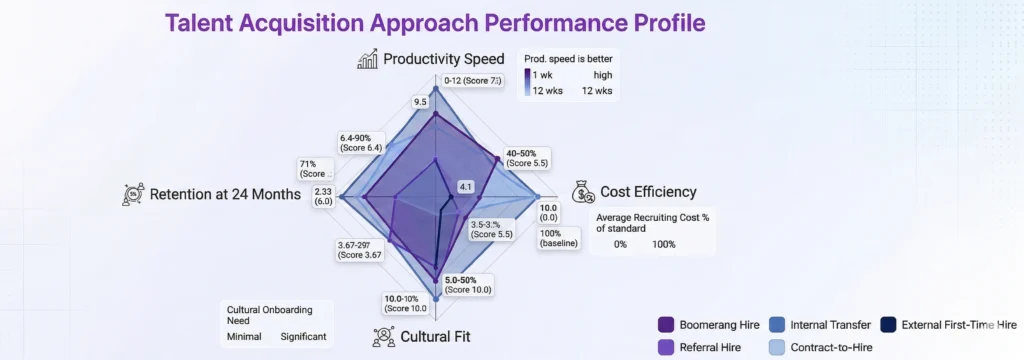
| Approach | Time to Full Productivity | Average Recruiting Cost | Retention at 24 Months | Cultural Onboarding Need |
|---|---|---|---|---|
| Boomerang Hire | 3 to 4 weeks | 40 to 50% of standard | 78% | Minimal to moderate |
| Internal Transfer | 1 to 2 weeks | Near zero | 81% | Minimal |
| External First-Time Hire | 8 to 12 weeks | 100% (baseline) | 62% | Significant |
| Referral Hire | 6 to 9 weeks | 60 to 70% of standard | 71% | Moderate |
| Contract-to-Hire | 4 to 6 weeks | 70 to 80% of standard | 67% | Moderate |
Boomerang hires occupy the second-best position on nearly every metric in this comparison, trailing only internal transfers (who have no cultural or organizational adjustment required) and outperforming first-time external hires on every dimension. The cost-productivity combination is particularly striking: lower cost than external hiring, faster productivity than external hiring, and better retention than external hiring. The investment case for building the infrastructure to identify and engage boomerang candidates is straightforward.
What the Experts Say?
Organizations that treat every departure as a permanent separation are making a strategic error. The employee who leaves is not just a loss today. They are a potential asset tomorrow, if the relationship is managed well enough to keep that option open.
– Karin Kimbrough, Chief Economist at LinkedIn
How to Build and Measure a Boomerang Hire Program?
Formula: Boomerang Hire Return Rate
BHRR = (Rehired Alumni ÷ Total Alumni Pool) × 100
A BHRR below 3% indicates that either the alumni pool is not being actively engaged or that the exit experience is not creating the conditions for return interest. A BHRR between 5 and 12% indicates a functioning engagement program. Above 12% suggests an exceptionally warm alumni culture or a market context in which the organization is particularly competitive relative to alternatives.
Benchmarks by Industry (2026 Data)
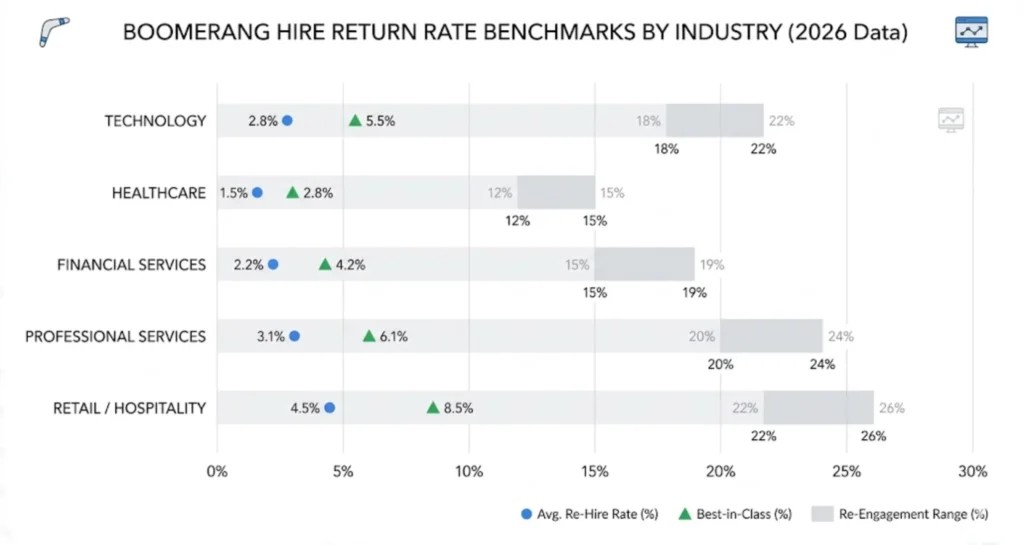
| Industry | Avg. BHRR | Avg. Boomerang Hire Cost (vs. Standard) | Avg. Time to Full Productivity |
|---|---|---|---|
| Professional Services | 11.4% | 43% | 3.2 weeks |
| Technology | 8.7% | 46% | 3.8 weeks |
| Financial Services | 7.2% | 48% | 4.1 weeks |
| Healthcare | 9.6% | 41% | 2.9 weeks |
| Retail / Hospitality | 14.3% | 38% | 2.4 weeks |
Retail and hospitality’s higher BHRR and lower relative cost reflects both higher general workforce mobility in that sector and the relatively lower onboarding complexity of frontline roles, where prior organizational knowledge provides an immediate advantage. Healthcare’s fast time to full productivity reflects the value of pre-existing knowledge of clinical systems and processes that would otherwise require weeks of orientation.
Key Strategies for Building a Boomerang Hire Program
Here are a few key strategies one can consider:
How AI Enables Boomerang Hire Programs?
Stop Juggling
10 Job Boards.
Search One
Your next role is already here. avua pulls opportunities from across the web into a single searchable feed; filtered by role, location, salary, and remote preference.
1.5 Million+
Active Jobs
380+
Job Categories
Boomerang Employees and Diversity, Equity, and Inclusion
Boomerang hiring has an underappreciated relationship with DEI outcomes that cuts in two directions simultaneously.
The Retention Signal
When a specific demographic group is significantly underrepresented in an organization’s boomerang pipeline relative to their representation in the general former employee pool, this is a signal about the quality of their exit experience and the strength of their ongoing connection to the organization.
Employees from underrepresented groups who leave due to cultural friction, bias, limited progression opportunity, or lack of belonging are significantly less likely to maintain alumni engagement or to consider returning than those who left for neutral or positive reasons. A boomerang pipeline that is less diverse than the general alumni pool is therefore an early indicator of differential experience quality that merits investigation.
Second Chances for Structural Improvement
Boomerang hiring is also an opportunity to re-engage high-performing employees from underrepresented groups who left when organizational conditions were less equitable than they are in the current state.
Organizations that have invested in improving their DEI practices since the departure of a valued employee from an underrepresented background may find that the conditions that drove the original departure no longer exist, and that a direct, honest re-engagement conversation that acknowledges what has changed can reopen a door that previously closed for structural rather than personal reasons.
Alumni Network Inclusion
Alumni networks themselves can reproduce demographic exclusion if their design is not deliberately inclusive. Networks that communicate primarily through social events, that are anchored to the social norms of the majority demographic group, or that require active self-promotion to maintain visibility will have lower engagement from underrepresented former employees and will therefore surface fewer boomerang candidates from those groups.
Designing alumni networks with explicit attention to accessibility, communication format diversity, and the range of engagement modalities offered improves the diversity of the boomerang pipeline alongside the depth of engagement from the broader alumni community.
Common Challenges and Solutions
| Challenge | Solution |
|---|---|
| Managers Reluctant to Re-Hire Former Employees | Educate on boomerang hire performance data; establish organizational policy that encourages rather than stigmatizes re-hire consideration |
| Former Employees Who Left on Poor Terms | Conduct structured eligibility assessments for boomerang candidacy; not all former employees are appropriate re-hire candidates, and having clear criteria protects the process |
| Salary Expectations Misaligned with Return Offer | Address re-hire compensation structure explicitly in boomerang hire policy; returning employees who have gained external experience may command above their departure rate |
| Alumni Network Data Privacy and GDPR Compliance | Work with employment counsel to design alumni engagement programs compliant with applicable data retention and consent requirements |
| Lack of Internal Visibility into Alumni Career Activity | Implement AI-powered alumni tracking platform; designate an alumni relations owner with responsibility for maintaining and engaging the pool |
Real-World Case Studies
Case Study 1: The Management Consulting Firm
A global management consulting firm formalized its alumni program after noticing that a significant proportion of its senior hires were former employees being brought back through informal channels without any systematic tracking. By formalizing the program, including a structured exit conversation, an alumni portal with role visibility, and a designated alumni relations manager, the firm converted ad hoc boomerang hiring into a structured talent channel.
In the first full year of the formalized program, boomerang hires accounted for 18% of senior associate and manager-level hires, at an average recruiting cost of $6,200 compared to the firm’s standard recruiting cost of $21,000 for those levels. Alumni hires at 12 months had performance ratings averaging 4.3 out of 5.0, compared to 3.7 for first-time hires at equivalent levels. The program generated an estimated $1.1 million in sourcing cost savings in its first full year of operation.
Case Study 2: The Technology Company
A Series B technology company with 200 employees had experienced significant attrition during a period of rapid growth, losing 34 employees in an 18-month window, many of whom left for larger organizations with higher compensation packages. Rather than treating these departures as permanent losses, the people team implemented a lightweight alumni engagement approach: a monthly newsletter featuring company updates and open roles, a Slack alumni channel for informal connection, and proactive check-in messages from former managers at the 12-month mark.
Within two years, 9 of the 34 departed employees had returned to the company, each at a higher level than their original departure point and each bringing external experience from larger-scale technical environments that the company needed as it scaled. The 9 returns represented a combined sourcing cost saving of $162,000 compared to external recruitment and produced an average time to full productivity of 2.6 weeks.
Case Study 3: The Healthcare Provider
A regional hospital network with high clinical staff turnover implemented a structured boomerang hire program specifically for registered nurses who had left voluntarily. The program included warm exit conversations, alumni network membership with clinical development resources and role visibility, and a dedicated re-hire coordinator. In the first 18 months, the program facilitated the re-hire of 23 registered nurses who had left within the preceding three years.
Re-hire processing time averaged 8 days compared to the standard hire process of 31 days for external nursing candidates. First-year attrition among re-hired nurses was 4%, compared to 19% for first-time nursing hires in the same period. The combination of speed, reduced attrition, and lower sourcing cost produced an estimated $390,000 in annual talent acquisition savings for the nursing function alone.
Building a Boomerang Hire Program Dashboard: What to Track?
If you’re serious about boomerang hire program as a crucial parameter, you need a dedicated dashboard. Here’s what belongs on it.
Boomerang Employees Across the Talent Lifecycle
Exit Stage
The boomerang pipeline begins at exit. The quality of the exit experience, whether the departure is handled with warmth, professionalism, and genuine interest in maintaining a relationship, determines whether the former employee remains connected to the organization or disconnects entirely. Organizations that have standardized warm exit processes and that explicitly invite departing employees to join their alumni network are building the boomerang pipeline at the moment it is seeded.
Early Post-Departure Engagement
The first six months after departure are the period of highest engagement saturation: the former employee is adapting to a new role, building new relationships, and is unlikely to be actively considering a return. Light-touch engagement during this period (a welcome to the alumni network, an occasional update communication) maintains the connection without creating pressure.
Active Re-Engagement Window
The 12 to 24 month post-departure window is typically the highest-probability period for boomerang re-engagement. By this point, the novelty of the new role has typically worn off, any disappointments with the alternative have accumulated to the point of influencing career decisions, and the former employee has sufficient perspective to make a genuine comparative assessment of their options. Organizations with AI-powered alumni tracking can identify behavioral signals in this window and initiate timely re-engagement conversations.
Re-Hire and Second Tenure
The re-hire process for a boomerang candidate should be streamlined relative to the standard hire process, reflecting the existing organizational knowledge. Onboarding should acknowledge what has changed since the employee’s departure (new systems, new people, evolved culture) while building on what they already know. The re-hire is not a blank-slate onboarding. It is a re-orientation for a person who already speaks the language.
The Real Cost of Ignoring the Boomerang Pipeline: By the Numbers
| Scenario | Boomerang Hire Rate | Avg. Cost per Hire | First-Year Attrition | Estimated Annual Saving vs. External-Only (100 hires) |
|---|---|---|---|---|
| No Alumni Program | 0% | $15,000 | 22% | Baseline |
| Passive Alumni Network | 4% | $12,800 | 19% | $38,000 |
| Active Alumni Engagement | 11% | $10,200 | 15% | $127,000 |
| AI-Powered Alumni Platform | 16% | $9,100 | 12% | $214,000 |
The annual saving column reflects the combined impact of reduced sourcing cost per boomerang hire and reduced first-year attrition cost (estimated at $30,000 per departure). At 100 hires per year, the difference between no alumni program and an AI-powered alumni engagement platform represents $214,000 in annual recoverable value, from a program whose operating cost is a fraction of that figure.
Related Terms
| Term | Definition |
|---|---|
| Alumni Network | A structured community of former employees maintained by an organization to preserve professional relationships and facilitate boomerang hiring |
| Employee Retention | The practice and metrics of keeping employees engaged and employed rather than losing them to attrition |
| Passive Candidate | A professional not actively seeking a new role; many boomerang candidates are passive at the time of re-engagement |
| Talent Pool | A maintained collection of candidate profiles available for future hiring consideration; the alumni pool is a specific talent pool of former employees |
| Offboarding | The formal process of transitioning an employee out of an organization; the foundation of the boomerang pipeline when executed with relationship preservation in mind |
| Re-Hire Eligibility | An organization’s documented criteria for determining whether a former employee is eligible for consideration for re-employment |
Frequently Asked Questions
Do boomerang employees actually perform better than new hires?
The evidence is consistent but nuanced. Boomerang employees reach full productivity faster and demonstrate higher retention rates in their second tenure than comparable first-time hires in equivalent roles. Post-hire performance ratings are roughly equivalent between boomerang and first-time hires at equivalent levels. The boomerang advantage is primarily in the speed and cost of the productivity ramp and in the stability of the retention outcome, not in a systematic performance premium at full productivity.
Should all former employees be eligible for re-hire consideration?
No. Organizations should maintain documented re-hire eligibility criteria that distinguish between departures that were handled professionally and those that were not. Former employees who were terminated for performance, misconduct, or conduct violations should not be considered boomerang candidates. Former employees who left voluntarily in good standing, and whose performance record during their prior tenure was satisfactory, are the appropriate boomerang candidate pool. Having clear, consistently applied eligibility criteria protects the organization from inappropriate re-hires and makes the program governable.
How should organizations handle salary for returning employees?
Boomerang hires who have gained external experience and increased their market value since departure typically command a salary above their departure rate. Organizations that attempt to re-hire returning employees at their prior salary without acknowledging this will find that the re-hire conversation stalls on compensation, or that the returning employee accepts but harbors a pay equity concern that affects their engagement. Re-hire compensation should be benchmarked to the current market rate for the role and experience level, with the returning employee’s prior tenure recognized as a seniority input that supports the upper range of the applicable salary band.
How long should alumni network engagement be maintained?
The optimal duration of alumni network engagement depends on the nature of the role and the organization’s typical career lifecycles. For professional services and knowledge-work organizations, active alumni engagement is most productive for former employees who have been gone for less than five years. Beyond five years, organizational change is typically significant enough that the former employee’s institutional knowledge is substantially outdated, and the re-hire value proposition shifts from cultural familiarity to external experience. For operational roles with more stable environments, meaningful alumni engagement can extend further.
What are the data privacy implications of maintaining an alumni network?
Maintaining and actively engaging an alumni network requires compliance with applicable data protection legislation, including GDPR in the European Union and analogous legislation in other jurisdictions. Former employees must provide consent for their data to be retained and used for alumni engagement purposes beyond the employment relationship. Organizations should work with employment counsel to design consent processes at exit, establish data retention policies aligned with applicable legal requirements, and provide alumni network members with clear mechanisms to update their preferences or request removal. These requirements are manageable but should be addressed in the program design phase rather than retroactively.
Conclusion
Every departing employee is an intersection of two truths: they are leaving, and they might come back. Most organizations invest all of their attention in the first truth and none in the second. The organizations that invest in both are building a talent pipeline from a pool that is pre-qualified, cost-efficient to re-engage, and faster to productive contribution than any other external hire source available.
The boomerang employee is not a consolation prize. They are not a sign that the original departure was a mistake that corrected itself. They are a professional who made a deliberate decision to pursue an alternative, gained experience and perspective they did not have before, and has now made a second deliberate decision: that this organization, this culture, and this opportunity are where they want to be.
That combination of validated fit, accumulated experience, and informed choice is rarer and more valuable than most hiring processes are designed to recognize. The organizations that recognize it, and that build the infrastructure to identify and re-engage these individuals at the right moment, are building a competitive advantage in talent acquisition that compounds over time. Every departure handled well is a seed. Every alumni relationship maintained is a pipeline. Every boomerang hire completed is proof that the seed was worth planting.