Before job boards, finding a job required physical proximity, a newspaper subscription, or a professional network worth calling in favors from. The job board collapsed all of that into a single searchable interface and, in doing so, changed the economics of hiring permanently.
What used to take weeks of institutional effort, reaching qualified candidates, generating applications, managing inbound interest; became a matter of posting a role and watching applications accumulate. The mechanics have evolved substantially since then, but the fundamental disruption holds: job boards remain the most scalable first point of contact between employers and the labor market.
A job board is a digital platform that aggregates, hosts, or distributes job postings from employers and enables job seekers to search, filter, and apply to opportunities, functioning as a marketplace that matches labor supply (candidates) with labor demand (employers) through a combination of search, algorithm-driven matching, application management, and employer branding tools.
In 2026, “job board” is a broader category than it sounds. It encompasses aggregators (Indeed, Glassdoor, avua) that pull listings from across the web; specialist vertical platforms for specific industries or roles; professional network-embedded job search tools (LinkedIn); AI-powered matching platforms that surface roles to candidates based on behavioral signals rather than keyword search; and niche community job boards that serve highly specific professional cohorts.
The category has diversified significantly, and the right channel for any given hire depends heavily on understanding which type of job board best serves that specific role’s sourcing need.
The core metric governing job board effectiveness for employers is Source-to-Hire Rate: the proportion of applications received through a specific job board that result in a completed hire.
Source-to-Hire Rate (%) = (Hires from Job Board ÷ Total Applications from Job Board) × 100
High-performing job board campaigns achieve Source-to-Hire Rates of 2.5–5% for professional roles. Industry average is approximately 1.1–1.8%. The gap is driven by a combination of posting quality, candidate targeting precision, and application process optimization; all of which are within employer control.
What is Job Board?
A job board is an online platform that serves as a marketplace for employment opportunities, enabling employers to post open roles (organically or through paid promotion) and job seekers to search, discover, and apply to those roles; typically offering additional services including candidate management tools, employer branding capabilities, salary benchmarking, and AI-powered candidate matching.
The operational definition varies by platform type: aggregator job boards (Indeed, avua) pull listings from employer career sites and other platforms to create a comprehensive inventory; specialist job boards (Dice, Mediabistro, eFinancialCareers) serve specific professional audiences; professional network platforms (LinkedIn) integrate job search into a broader professional context; and niche community boards serve highly targeted professional cohorts with deep domain relevance.
Are You Getting the Most Out of Your Job Board Strategy, or Just Paying for Volume?
The default job board strategy for most organizations is some version of: post to the largest available platform, add a sponsored listing budget, and process whatever comes in. This approach generates activity. It does not reliably generate the right candidates, and for specialized, senior, or scarce-skill roles, it often generates primarily noise.
The issue is channel-role misalignment. Job boards vary dramatically in the audience they attract, the professional context they provide, and the matching quality they deliver. Using a high-volume generalist board for a senior specialist hire is like advertising a restaurant exclusively on a platform for a different cuisine; you will get traffic, but it will be largely the wrong traffic, and the cost per qualified lead will be significantly higher than a channel-specific approach.
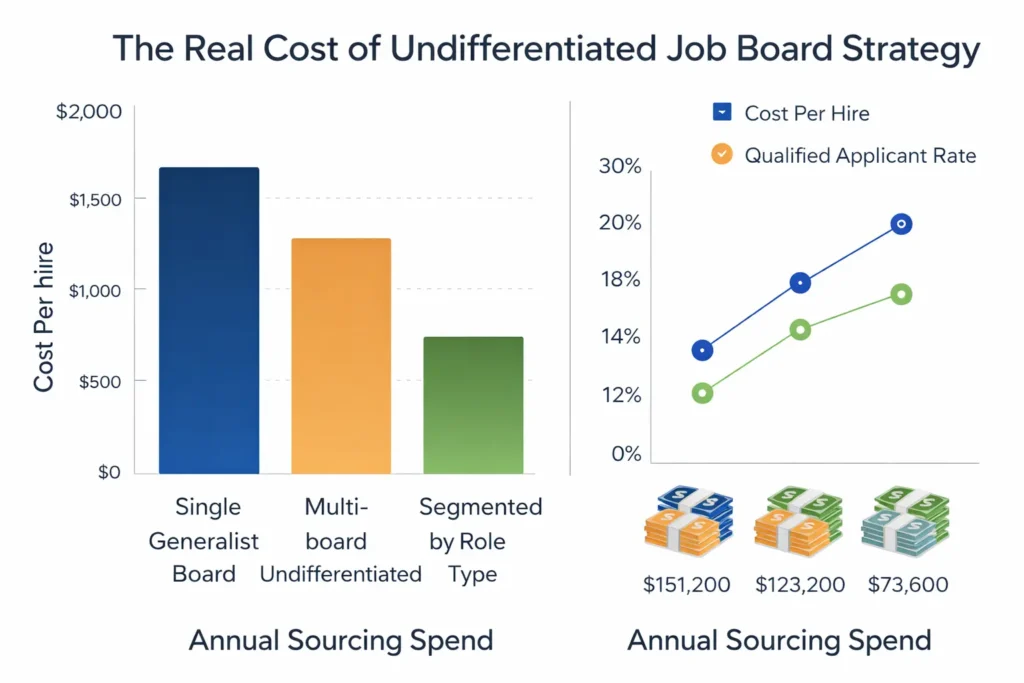
The data makes this concrete. Analysis of source-of-hire data across mid-size organizations consistently finds that companies with an undifferentiated, single-platform job board strategy pay an average of $89 per qualified application for professional and specialist roles; compared to $34–47 for organizations with a segmented, channel-matched strategy that uses specialist boards and AI-powered platforms for role types where generalist boards underperform. The cost differential compounds at scale: for an organization making 80 hires per year across a mix of role types, the channel strategy gap translates to approximately $40,000–55,000 in annual sourcing cost difference for equivalent hiring output.
The more significant cost is what the volume strategy misses. Candidates who would be genuinely excellent fits for a role but who don’t actively search the large generalist boards; because they are semi-passive, because they use specialist communities, or because AI-powered platforms have already surfaced the role to them in a different context; are invisible to employers who rely exclusively on single-channel strategies. The organizations with multi-channel, role-segmented job board strategies are not just paying less per qualified application. They are reaching candidates their competitors are not reaching.
For TA leaders, the practical framework is a quarterly channel audit: which boards are producing qualified applications for which role categories, at what cost per qualified application, and with what source-to-hire conversion? This audit, conducted on actual hire data rather than application volume data, almost always reveals that two or three channels account for the majority of actual hires, while several others generate significant application volume at low conversion and high screening cost.
Your Resume Isn’t Getting Read
Let’s Get That Fixed!
75% of resumes get auto-rejected. avua’s AI Resume Builder optimizes formatting, keywords, and scoring in under 3 minutes, so you land in the “yes” pile.
The Psychology Behind Job Board Behavior
Decision Paralysis and the Paradox of Choice
High-volume generalist job boards present job seekers with thousands of potentially relevant results for any given search. Research on choice architecture consistently finds that large choice sets reduce decision quality and increase decision abandonment; job seekers presented with 200 results frequently engage less deeply with any individual listing than those presented with 15 highly relevant results. AI-powered job boards that curate a smaller, highly relevant result set for each user consistently show higher application engagement rates than those presenting ranked-but-undifferentiated volume.
Trust Signals and Platform Credibility Transfer
Job seekers extend a degree of employer credibility to postings simply through the platform they appear on. A role posted on a specialist platform with a strong reputation in a professional community carries implicit quality signaling that the same role on a generic aggregator does not. This credibility transfer is a real component of posting performance; the choice of platform communicates something to the candidate about the employer’s knowledge of and investment in the relevant professional community.
Mobile Search Behavior and Impulsive Application
The majority of job search activity on mobile devices is browse-driven rather than intent-driven; candidates scrolling job boards as a habitual activity rather than an active search session.
Mobile-optimized applications that enable impulsive completion (under five minutes, no document upload required) capture a significant additional application volume that desktop-first, form-heavy processes do not. The tradeoff is that impulsive mobile applications have lower average qualification rates, a consideration for application design that depends on whether the hiring need is volume-first or quality-first.
Job Board Types and Use Cases
| Job Board Type | Best For | Audience | Cost Model | Key Difference |
|---|---|---|---|---|
| Generalist aggregator (Indeed, Avua) | High-volume, broad professional roles | Largest reach; all active seekers | Free + paid promotion | Maximum audience scale |
| Professional network (LinkedIn) | Mid-senior professional, passive candidates | Professional context; network leverage | Pay-per-click / recruiter license | Passive candidate reach |
| Specialist vertical (Dice, eFinancialCareers) | Deep technical or sector roles | Domain-qualified audience | Posting fee / subscription | Audience precision |
| Niche community board | Highly specific role types | Tightly defined professional cohort | Variable | Deepest audience qualification |
| AI-powered platform (Avua, ZipRecruiter) | All role types with matching optimization | Broad + matched | Variable | Algorithm-driven quality matching |
| Company career site | All roles | High-intent, brand-engaged candidates | Fixed tech cost | Direct; highest conversion |
What the Experts Say?
The question isn’t ‘are you on the right job board?’ — it’s ‘is your job board strategy segmented by role type, or are you paying volume rates for precision hiring needs?’ Most organizations haven’t asked the second question yet.
– Hung Lee, Curator, Recruiting Brainfood
How to Measure Job Board Effectiveness?
Formula
Source-to-Hire Rate (%) = (Hires Attributed to Board ÷ Total Applications from Board) × 100
Cost Per Qualified Application = Board Spend ÷ Qualified Applications from Board
Cost Per Hire by Source = Total Spend on Board ÷ Total Hires from Board
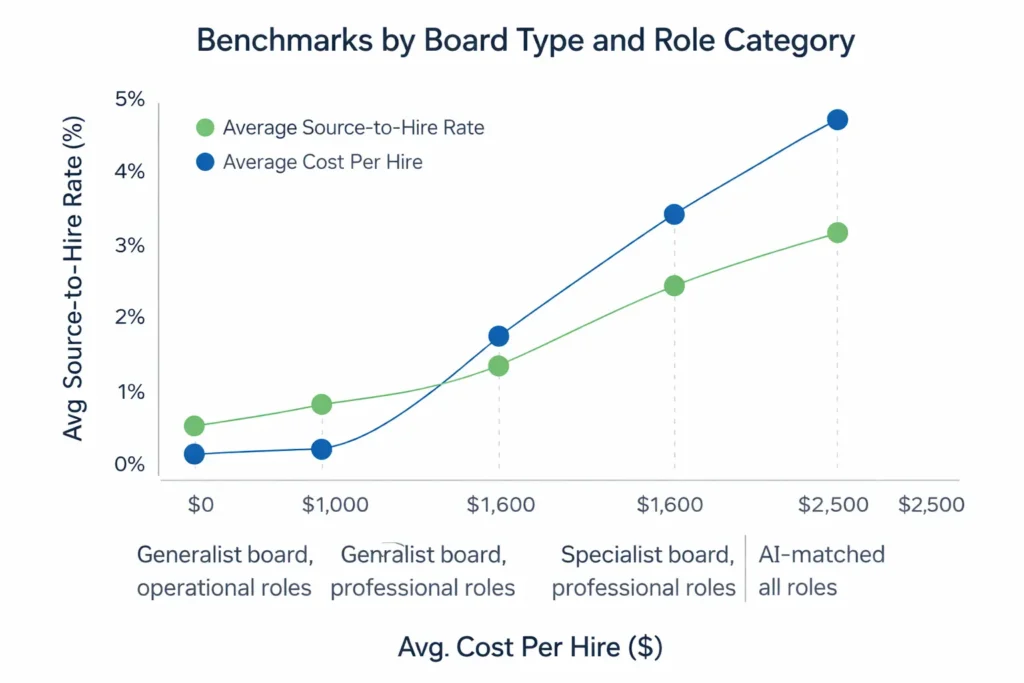
Benchmarks by Board Type and Role Category
| Board + Role Combination | Avg. Source-to-Hire Rate | Avg. Cost Per Hire |
|---|---|---|
| Generalist board, operational roles | 2.8–4.2% | $520–780 |
| Generalist board, professional roles | 1.1–1.9% | $1,200–2,100 |
| Specialist board, professional roles | 2.4–3.8% | $650–1,100 |
| AI-matched platform, all roles | 3.1–5.2% | $490–850 |
Key Strategies for Improving Job Board Optimization
How Can AI and Automation Improve Job Board ROI?
AI-Powered Candidate Matching
AI matching systems analyze candidate behavioral and profile data to surface relevant job postings to candidates who have not explicitly searched for them, expanding the effective reach of a posting beyond the active searchers who find it through keyword search. For employers, AI-matched candidate traffic consistently shows higher qualification rates than keyword-search traffic because the algorithm is selecting for fit, not just keyword presence.
Programmatic Job Advertising
AI-powered programmatic tools manage job posting budgets in real time across multiple platforms; allocating spend toward the specific job boards and campaigns producing the highest qualified application rates, and reducing spend on those underperforming. Programmatic optimization typically produces 20–35% cost efficiency improvements versus manually managed fixed-budget campaigns.
Predictive Application Scoring
AI tools integrated with job board application flows can score incoming applications for predicted hire probability; enabling recruiters to prioritize their screening effort toward the applications most likely to convert rather than processing a chronological queue. Predictive scoring at scale is one of the highest-leverage automation applications for high-volume job board campaigns.
Posting Performance Analytics
AI analytics platforms can analyze posting performance data; click rates, application rates, qualified application rates, and source-to-hire conversion; to generate specific recommendations for posting optimization: title changes, requirement revisions, salary range adjustments, and platform budget reallocation. This continuous optimization loop improves campaign ROI over time without manual analysis effort.
Stop Juggling
10 Job Boards.
Search One
Your next role is already here. avua pulls opportunities from across the web into a single searchable feed; filtered by role, location, salary, and remote preference.
1.5 Million+
Active Jobs
380+
Job Categories
Job Boards and Diversity & Inclusion
Platform Reach and Demographic Composition
Different job boards attract meaningfully different demographic audiences. Generalist aggregators attract the broadest demographic cross-section of active job seekers. Professional network platforms over-index for college-educated, formally employed professionals. Community-based niche boards may serve specific underrepresented professional communities. An inclusive sourcing strategy deliberately includes platforms that reach underrepresented groups as a component of the sourcing mix, not as a tokenistic gesture but as a genuine pipeline-building investment.
Application Friction as a Demographic Filter
Application processes that require long forms, desktop navigation, or significant time investment create differential barriers for candidates with less flexible schedules, less stable internet access, or less prior experience with formal online application systems. Platforms that support low-friction mobile applications remove these barriers and produce more demographically diverse application pools for equivalent postings.
Algorithmic Bias in Job Matching
AI matching systems on job boards are trained on historical application and hiring data, creating the risk that demographic patterns in historical hiring are perpetuated by the matching algorithm. Organizations relying heavily on AI-matched candidate traffic should periodically audit the demographic composition of AI-matched candidate pools versus organic keyword search pools to identify any systematic matching disparity.
Common Challenges and Solutions
| Challenge | Solution |
|---|---|
| High application volume with very low qualified application rate | Introduce screening questions at the application stage; optimize job title and requirements for precision; consider moving budget to specialist platform for the role type |
| Unable to determine which board is driving actual hires | Implement UTM tracking or ATS source attribution for all postings; require all applicants to indicate how they found the role |
| Posting performance declining over time without changes to the role | Refresh posting copy every 3–4 weeks; rotate sponsored placement to avoid audience fatigue; consider re-posting as new rather than continuing an aging posting |
Real-World Case Studies
Case Study 1: The Financial Services Firm
A financial services firm spending $8,400/month on job board advertising across three platforms conducted a source-to-hire audit for the first time and found that 71% of their actual hires over the previous year had come from a single specialist platform that was receiving only 22% of their budget. The two generalist platforms combined accounted for 78% of the budget and 29% of hires. They reallocated budget 60/40 in favor of the specialist platform. Cost per hire fell from $2,100 to $1,240 within two quarters, on equivalent hiring volume.
Case Study 2: The Technology Scale-Up
A technology scale-up was experiencing a 9% qualified application rate on their engineering job board campaigns, most applications were from candidates significantly below the required experience level. Investigation found that their job titles used internal grading language (“IC4 Software Engineer”) that generated broad unqualified traffic. They redesigned all engineering titles to use market-standard terminology with specific technology focus (“Senior Backend Engineer, Go/Kubernetes”). Qualified application rate rose from 9% to 24% within the first month, with no change in posting content or budget.
Case Study 3: The Retail Group
A retail group redesigned their job board applications to be fully mobile-first, with a maximum of six required fields and no document upload at the initial stage. They enabled Indeed Apply and Avua’s quick-apply functionality for all store-level postings. Application completion rates on mobile improved from 28% to 74%. The group reached full headcount for seasonal hiring four weeks ahead of the prior year’s schedule.
Building a Job Board Performance Dashboard: What to Track?
Job Boards Across the Hiring Lifecycle
Awareness Stage: Platform Selection and Employer Brand
Candidates’ first encounter with an employer’s opportunity often happens on a job board; making platform selection and posting quality employer brand decisions as much as sourcing decisions. The employer page quality, review scores, and posting presentation on each platform shape first impressions that affect whether qualified candidates investigate further.
Application Stage: Friction Management and Qualification Design
The application experience on a job board determines what proportion of candidates who click through actually apply, and what proportion of those applicants are genuinely qualified. Low-friction applications maximize volume; well-designed qualification screens optimize quality. The right design depends on the role’s position on the volume-versus-quality spectrum.
Screening Stage: Source Attribution and Pipeline Management
Maintaining accurate source attribution through the screening and interview stages is the operational foundation of job board ROI measurement. ATS systems that capture job board source at application and track it through to hire enable the source-to-hire analysis that makes rational channel investment decisions possible.
Post-Hire: Quality Measurement and Channel Optimization
Closing the measurement loop from job board application to hire and then to post-hire performance is the step that converts job board strategy from guesswork to optimization. Organizations that track hire quality by source channel; rating performance, retention, and quality of hire at the platform level; continuously improve their channel allocation based on evidence rather than volume.
The Real Cost of Undifferentiated Job Board Strategy
| Strategy | Cost Per Hire | Qualified App Rate | Annual Sourcing Spend (80 hires) |
|---|---|---|---|
| Single generalist board | $1,890 | 14% | $151,200 |
| Multi-board undifferentiated | $1,540 | 18% | $123,200 |
| Segmented by role type | $920 | 29% | $73,600 |
Related Terms
| Term | Definition |
|---|---|
| Source of Hire | The recruiting channel attributed with generating a candidate who was ultimately hired |
| Applicant Tracking System (ATS) | Software that manages candidate applications and recruiting workflow from application to hire |
| Programmatic Advertising | Automated, data-driven management of job board advertising budgets across multiple platforms |
| Qualified Application Rate | The proportion of received applications that meet minimum role qualification criteria |
| Employer Branding | The reputation and identity of an organization as an employer, as perceived by current and potential candidates |
Frequently Asked Questions
What is the difference between a job board and a job aggregator?
A job board hosts postings directly submitted by employers. A job aggregator (like Indeed) crawls employer career sites and other job boards to compile listings from across the internet into a single searchable inventory. In practice, many platforms operate as both; hosting direct postings while also aggregating from external sources.
How do you choose which job boards to use?
The primary selection criteria: the demographic and professional composition of the platform’s audience relative to your target candidate profile; the platform’s performance data for your specific role categories (available through industry benchmarks or your own historical source data); the cost model and your budget constraints; and the platform’s integration with your ATS for source tracking.
Is it worth paying for sponsored listings on job boards?
For most professional roles where competition for candidate attention is significant, yes. Sponsored listings consistently generate 3–5x the application volume of organic listings on the same platform. The question is whether the marginal applications generated by sponsored placement are qualified; which depends on the role type, the platform, and the posting quality.
How long should a job posting stay active?
For most professional roles, 30–45 days is the effective window for active candidate engagement. Applications received in the first two weeks account for approximately 65% of qualified applications on most platforms. After 45 days, organic posting performance typically degrades significantly due to audience saturation; the relevant active seekers on the platform have already seen the posting. Refreshing or re-posting is more effective than continuing an aged listing.
Do job boards work for passive candidate hiring?
For genuinely passive candidates; those not actively searching; traditional keyword-driven job boards have minimal reach. AI-powered platforms and professional network tools with active candidate matching capabilities are more effective for passive candidate engagement. The line between active and passive is also blurring as AI platforms proactively surface relevant opportunities to semi-passive candidates who are not actively searching but respond to matched suggestions.
Conclusion
The job board is not a monolith; it is a category that encompasses vastly different platforms serving different audiences, different role types, and different hiring objectives.
Organizations that treat it as a single channel, posting everything everywhere and measuring success by application volume, are overspending on noise and underspending on signal. The ones with a segmented, evidence-driven job board strategy, matched to role type, measured by source-to-hire, and continuously optimized by actual hire quality data; consistently produce better hiring outcomes at lower cost. The channel is not the strategy.
Knowing which channel to use, and why, is the strategy.