Most organizations don’t have a hiring plan. They have a hiring list. There’s a meaningful difference. A hiring list is a compilation of open requisitions, roles that managers have requested, HR has approved, and finance has budgeted. A hiring plan is something more deliberate: a strategic document that connects each hire to a business outcome, sequences hiring against team capacity and budget cycles, and provides a framework for prioritization when, not if; something changes.
A hiring plan is a structured, forward-looking document that defines an organization’s intended recruitment activity over a defined period (typically a quarter, half-year, or full fiscal year), specifying the roles to be filled, the timing, headcount targets by department and level, budget allocations, sourcing strategies, and the business objectives each hire is designed to advance.
In the AI hiring era, the quality of a hiring plan has become a more significant competitive differentiator than it was in previous cycles. Organizations with access to AI-powered workforce analytics can build hiring plans on real-time skill gap analysis, predictive attrition modeling, and competitive talent market data, rather than on the traditional inputs of manager requests and last year’s headcount.
AI-powered platforms like avua enable the kind of granular, data-informed hiring planning that was previously the exclusive domain of organizations with large People Analytics teams. The organizations using these capabilities are planning hiring with substantially more precision, and wasting substantially less sourcing investment on roles that turn out to be misaligned with evolving business needs.
The core metric governing hiring plan quality is Plan Attainment Rate: the proportion of planned hires that are completed on schedule and within budget over the plan period.
Plan Attainment Rate (%) = (Roles Filled on Schedule and Budget ÷ Total Planned Roles) × 100
High-performing organizations achieve Plan Attainment Rates of 78–88%. Industry average sits around 54%. The gap is driven primarily by planning quality (are roles well-defined, correctly sequenced, and realistically resourced?) rather than execution quality.
What is a Hiring Plan?
A hiring plan is a structured, formally documented commitment to a defined set of recruitment activities over a specified period, including the roles to be filled, the business rationale for each hire, the target timeline, the budget allocation, the sourcing approach, and the evaluation criteria — designed to connect headcount decisions to strategic business objectives rather than to individual manager requests.
The hiring plan differs from a headcount budget in that it specifies not just the number and cost of approved roles but the sequence, sourcing strategy, and strategic purpose of each hire. A headcount budget tells you what you can spend. A hiring plan tells you what to do with what you can spend, and in what order, and why.
Is Your Hiring Plan Actually a Plan — or a Wish List?
The most common failure mode in hiring planning is not poor execution; it’s poor planning. Specifically, the gap between what a hiring plan says will happen and what actually happens is almost always explained by one of three planning failures: roles defined too loosely to source effectively, timelines that don’t account for actual hiring cycle duration, or prioritization that reflects political dynamics rather than strategic value.
The most damaging of these is the timing failure. The average time-to-fill across all roles in the US market in 2026 is approximately 44 days. The average time allocated in most hiring plans is 30 days or fewer. The predictable result: hiring plans that assume January start dates for roles approved in December, with no sourcing activity beginning until the approval lands, consistently produce Q2 start dates rather than Q1; with downstream effects on team capacity, project timelines, and budget variance that cascade through the organization.
The math is unambiguous. If a company’s hiring plan for a 30-role cohort assumes a 30-day time-to-fill and the actual TTF is 44 days, the hiring plan will miss its schedule by an average of two weeks per role. Across 30 roles, that is 420 hiring days of unplanned vacancy. At a conservative vacancy cost of $300/day per role, the planning optimism costs approximately $126,000 in unplanned productivity loss; not counting the project delays and manager frustration that accompany the missed schedule.
The right question for every hiring plan is not “what do we want to hire?” but “what would we need to be true for each hire on this plan to actually happen on this timeline?” For each role: Is the job description ready? Is the hiring manager available to interview? Is the budget released? Is the market for this role supply-constrained in ways that will extend TTF beyond standard benchmarks? Is there an internal candidate who should be considered first? Each of these questions, answered before the plan is finalized, converts a wish list into a plan.
A concrete data point: LinkedIn’s 2025 Talent Trends research found that organizations with formally documented hiring plans that include sourcing strategy, timeline sequencing, and hiring manager preparation requirements achieve Plan Attainment Rates 34 percentage points higher than those operating on headcount budgets without formal plans. The 34-point gap is not explained by organizational scale, recruiting team size, or budget, it is explained by the quality of the upfront planning work.
For TA leaders, the practical implication is clear: the ROI of investing significant upfront time in quality hiring plan construction; rather than jumping directly to sourcing when requisitions open, is among the highest in the recruiting function. A plan that takes two days to build properly saves weeks of misaligned sourcing activity and executive expectation-management conversations afterward.
Your Resume Isn’t Getting Read
Let’s Get That Fixed!
75% of resumes get auto-rejected. avua’s AI Resume Builder optimizes formatting, keywords, and scoring in under 3 minutes, so you land in the “yes” pile.
The Psychology Behind Hiring Planning
Planning Fallacy and Optimism Bias
The planning fallacy, the systematic tendency to underestimate how long tasks will take, even when historical data suggests a longer timeframe; is particularly pronounced in hiring planning. Hiring managers and TA leaders who have experienced slow, difficult searches in the past still consistently build hiring plans assuming faster timelines. The correction is structural: base hiring timeline assumptions on actual historical data from your organization’s own ATS, not on aspirational targets or industry averages that don’t reflect your specific roles, markets, and processes.
Commitment and Consistency in Role Definition
Once a role is defined and approved in a hiring plan, the commitment-and-consistency effect makes it resistant to revision even when business conditions change and the original role definition is no longer accurate. Hiring managers who defined a role in Q4 planning often continue to recruit for that definition in Q2, despite the team’s needs having evolved significantly. Building explicit revision checkpoints into hiring plans, formal brief reviews at the 60-day mark, counteracts the commitment effect and keeps plans calibrated to current business needs.
Stakeholder Ownership and the Diffusion of Accountability
A hiring plan shared across many stakeholders but owned by none produces lower Plan Attainment than a plan with a single named owner per role who is explicitly accountable for on-schedule, on-budget delivery. Diffuse accountability in planning creates diffuse effort, everyone assumes someone else is managing the dependency that’s about to cause a delay.
Hiring Plan vs. Related HR Planning Documents
| Document | Scope | Horizon | Primary Audience | Key Difference from Hiring Plan |
|---|---|---|---|---|
| Hiring Plan | Specific roles, timing, budget | Quarter / Year | TA, HR, Business units | Operationally actionable, role-level detail |
| Headcount Budget | Number and cost of approved roles | Annual | Finance, HR | Approval document, not execution plan |
| Workforce Plan | Broad org capability and structure | 1–5 years | CHRO, CEO, Board | Strategic, not operationally detailed |
| Succession Plan | Internal progression for critical roles | 1–3 years | HR, Leadership | Future-focused internal mobility |
| Capacity Plan | Team capacity against anticipated workload | Quarterly | Ops, Engineering, Finance | Work-focused, not people-focused |
What the Experts Say?
The difference between a great recruiting team and a good one is not sourcing technology or candidate experience — it’s planning. Great teams know what they’re hiring for three months before the req opens, and they’ve built the pipeline while they were waiting.
– Madeline Laurano, Founder, Aptitude Research
How to Build and Measure a Hiring Plan?
Formula
Plan Attainment Rate (%) = (Roles Filled on Time and Budget ÷ Total Planned Roles) × 100
Planning Accuracy Rate (%) = (Roles That Required No Major Brief Revision ÷ Total Planned Roles) × 100
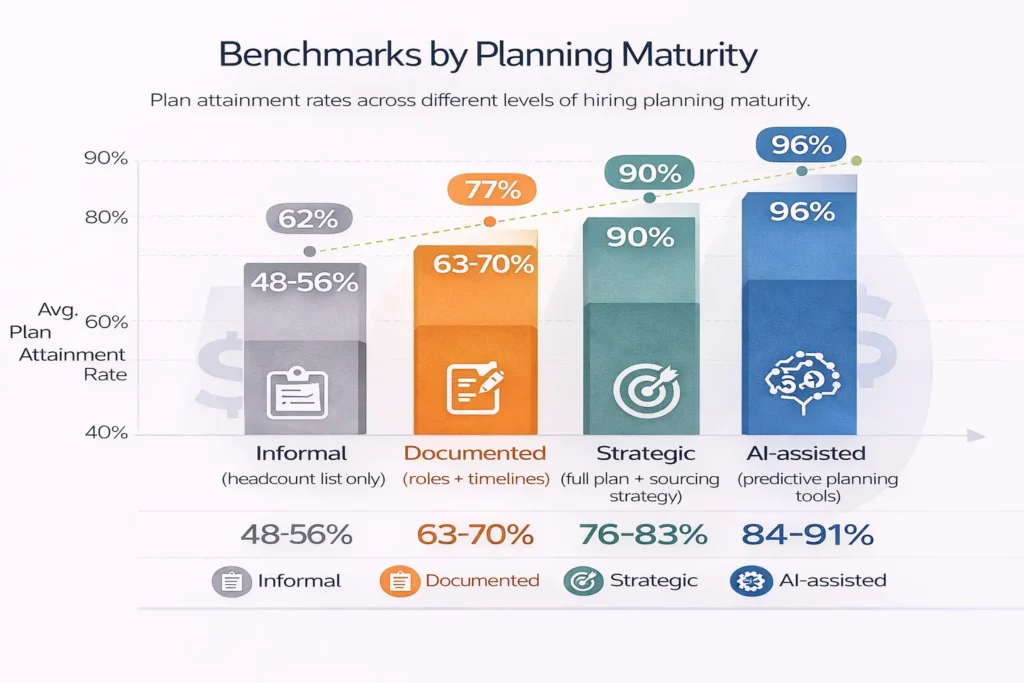
Benchmarks by Planning Maturity
| Planning Maturity | Avg. Plan Attainment Rate | Best-in-Class |
|---|---|---|
| Informal (headcount list only) | 48–56% | 62% |
| Documented (roles + timelines) | 63–70% | 77% |
| Strategic (full plan + sourcing strategy) | 76–83% | 90% |
| AI-assisted (predictive planning tools) | 84–91% | 96% |
Key Strategies for Effective Hiring Planning
How Can AI and Automation Support Hiring Planning?
Predictive Attrition Modeling
Machine learning models trained on employee tenure, engagement, performance, and demographic data can predict which roles are likely to open through attrition before those roles actually open. This converts reactive backfill hiring into proactive planned hiring — building pipeline for roles before the vacancy is official, substantially reducing the TTF for roles in high-attrition segments.
Skill Gap Analysis
AI-powered workforce analytics tools can compare the current workforce’s skill profile against the projected skill demands of the business at a 12–18 month horizon, identifying the specific skills gaps that should inform hiring plan prioritization. This makes skill-strategic hiring — prioritizing roles that build future organizational capability, not just fill current vacancies, operationally feasible rather than theoretically aspirational.
Market Supply Calibration
AI talent intelligence tools can model the supply of qualified candidates for each planned role in the target geography, providing TTF estimates that are calibrated to actual market conditions rather than historical averages. For highly specialized or competitive roles, this market intelligence is the difference between a plan that reflects reality and one that produces an inevitable miss.
Automated Plan Monitoring
AI-powered ATS and HRIS integrations can monitor plan attainment in real time, surfacing roles that are tracking behind schedule before they miss their target dates — enabling proactive intervention rather than post-mortem analysis.
Hiring Plans and Diversity & Inclusion
DEI Targets as Plan Inputs, Not Post-hoc Aspirations
A hiring plan that does not include explicit DEI targets at the role level produces DEI outcomes that are incidental to the hiring process rather than designed into it. Representation goals should be specified in the plan — for example, defining that the longlist for a role should include a minimum proportion of candidates from underrepresented groups — not added as an afterthought to a process that has already been designed around other criteria.
Sourcing Budget Allocation and Diverse Pipeline Building
Hiring plans that allocate sourcing budget exclusively to channels that have historically produced hires will reproduce the demographic composition of historical hires. Intentional budget allocation to non-traditional sourcing channels — community organizations, professional associations for underrepresented groups, HBCUs, apprenticeship programs — needs to be specified in the plan to be funded and executed.
Pipeline Lead Time for DEI Hiring
Building diverse candidate pipelines for specialized roles typically requires longer lead time than traditional sourcing. A hiring plan that accounts for this — starting DEI-targeted sourcing earlier in the timeline for roles where diverse candidate supply is constrained — produces better diversity outcomes than one that treats all sourcing channels as equivalent in lead time.
Common Challenges and Solutions
| Challenge | Solution |
|---|---|
| Hiring managers submitting roles too late for plan cycle inclusion | Create a formal plan submission window with defined deadlines; roles submitted after the window go into the next planning cycle |
| Planned timelines consistently missed due to process delays | Build a quarterly plan vs. actual retrospective; identify the three most frequent sources of delay and address them structurally |
| Plans becoming obsolete as business strategy shifts mid-period | Schedule formal plan revision checkpoints at weeks 6 and 12 of every quarter; build an explicit fast-track exception process for urgent hires outside the plan |
Stop Juggling
10 Job Boards.
Search One
Your next role is already here. avua pulls opportunities from across the web into a single searchable feed; filtered by role, location, salary, and remote preference.
1.5 Million+
Active Jobs
380+
Job Categories
Real-World Case Studies
Case Study 1: The Technology Scale-Up
A 250-person technology company implemented its first formal hiring plan after completing its Series B. Prior to the plan, hiring was reactive — requisitions opened as managers noticed capacity constraints, sourcing began at the req opening date, and average time-to-fill was 52 days. The new plan built 60-day sourcing lead times into all engineering roles, defined explicit “must hire before” dates tied to product launch milestones, and allocated dedicated sourcing budget by role tier. Time-to-fill fell to 34 days by Q3 of the plan year. Plan Attainment Rate for the first year was 71%, versus a pre-plan baseline of effectively unmeasurable (no plan existed to measure against).
Case Study 2: The Financial Services Firm
A financial services firm running a significant technology transformation identified a 34-role plan for the year but discovered during the planning process that the market supply for cloud infrastructure engineers in their primary hiring city was insufficient to fill all roles within the planned timeline. AI-powered market intelligence suggested three alternative cities with better supply at competitive salary points. The plan was revised to include two distributed team structures, allowing 11 of the 34 roles to be sourced in alternative markets. The result: 29 of 34 planned roles filled on schedule versus an initial model that projected 18.
Case Study 3: The Retail Chain
A national retail chain redesigned its seasonal hiring plan to be mobile-first — all job postings, applications, and hiring manager review tools optimized for mobile devices, with a maximum application time of eight minutes. The plan included the mobile redesign as a prerequisite before the seasonal sourcing launch. The mobile-first approach produced a 44% higher application completion rate versus the previous year’s seasonal plan, enabling the chain to reach full seasonal headcount three weeks earlier than the prior cycle.
Building a Hiring Plan Dashboard: What to Track?
Hiring Plans Across the Talent Lifecycle
Pre-Planning: Business Strategy Translation
The highest-value work in hiring planning happens upstream of the plan document itself: translating business strategy into talent implications. What capabilities does the business need to build in the next 12 months? Where will the team be doing different work, and what skills do they need to do it? What attrition is predictable, and which roles are most critical to backfill quickly? This translation work is what distinguishes a hiring plan from a headcount list — and it requires TA leaders to be active participants in business planning conversations, not passive recipients of approved requisitions.
Active Hiring: Plan Execution and Deviation Management
A plan is only useful if it drives behavior, which means it needs to be actively managed against actual execution. Weekly or bi-weekly plan attainment reviews — comparing actual fills, actual TTF, and actual spend against plan — with clear escalation protocols for roles tracking behind schedule convert the plan from a planning artifact into an operational management tool.
Offer Stage: Compensation Benchmarking Against Plan
Hiring plans built with realistic compensation benchmarks produce fewer offer-stage failures than those built on aspirational or outdated salary assumptions. AI-powered compensation intelligence tools should be used at the planning stage to validate that the plan’s compensation assumptions are achievable in the current market — not discovered to be inadequate at the offer stage.
Post-Hire: Plan Retrospective and Next-Cycle Input
The most underutilized input to next-cycle hiring planning is the current cycle’s deviation analysis. Every hire that missed schedule, every role that required a major rebrief, and every offer that was declined contains information about what the next plan should do differently. Organizations that close this feedback loop build planning capability continuously; those that treat each plan as a fresh start repeat the same planning errors every cycle.
The Real Cost of Poor Hiring Planning
| Scenario | Plan Attainment Rate | Avg. Vacancy Duration (30 roles) | Estimated Productivity Cost |
|---|---|---|---|
| No formal plan | 48% | 61 days avg. TTF | $549,000 |
| Basic documented plan | 66% | 48 days avg. TTF | $432,000 |
| Strategic hiring plan | 83% | 38 days avg. TTF | $342,000 |
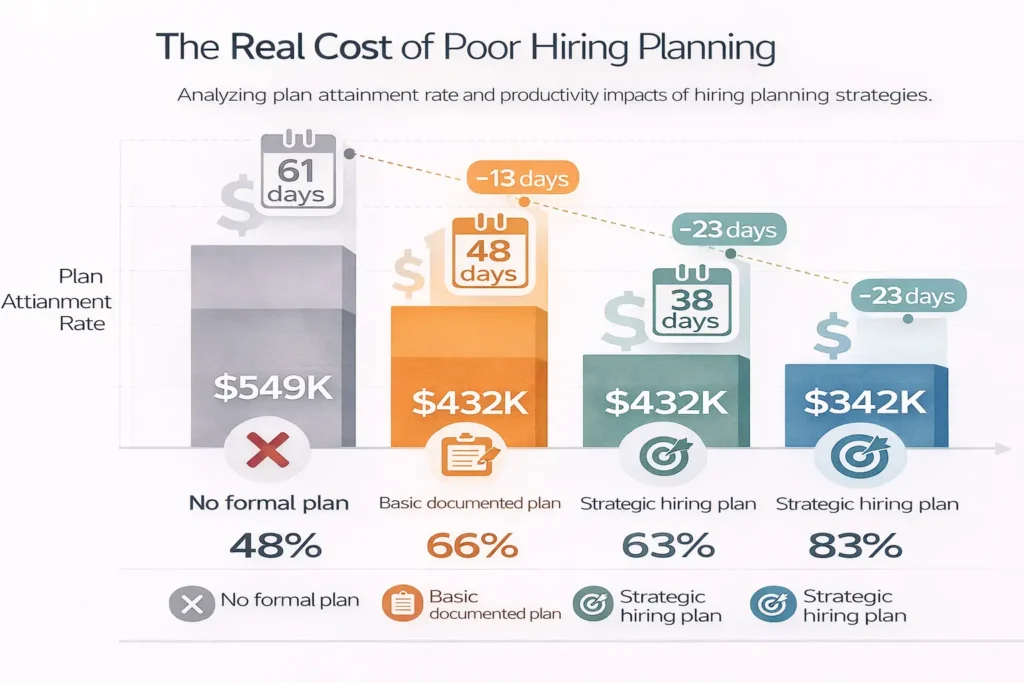
Vacancy cost estimated at $300/day per role. Costs illustrate the relationship between planning quality and vacancy duration.
Related Terms
| Term | Definition |
|---|---|
| Headcount Planning | The determination of how many employees an organization needs, typically expressed as a budget number |
| Workforce Planning | Strategic analysis of organizational capability gaps and talent needs over a 1–5 year horizon |
| Requisition | A formally approved request to recruit for a specific position |
| Time-to-Fill | The elapsed time from requisition approval to offer acceptance |
| Talent Pipeline | The pool of potential candidates at various stages of engagement for current or anticipated roles |
Frequently Asked Questions
What should a hiring plan include?
At minimum: a list of all planned roles with job titles, departments, and seniority levels; the target start date for each hire; the business rationale connecting each hire to a specific business objective; the compensation range and budget source; the sourcing strategy and key channels; the hiring manager and any panel members; and the key evaluation criteria. More mature plans also include TTF assumptions calibrated to historical data, DEI targets, and pipeline pre-build timelines.
How far in advance should a hiring plan be built?
For annual hiring plans, the standard is to begin planning 60–90 days before the plan year starts. For quarterly plans, 30–45 days of lead time is typical. For specific high-priority or hard-to-fill roles, individual sourcing plans should be built as soon as the business decision driving the hire is made — not when the requisition is formally approved.
Does a hiring plan need to be a formal document?
For organizations hiring more than 20 roles per year, yes. Informal hiring management at that scale produces coordination failures, sourcing duplication, and budget management problems that a formal plan resolves. The plan doesn’t need to be elaborate — a well-structured spreadsheet or ATS-native planning tool is sufficient — but it needs to exist and be actively managed.
How often should a hiring plan be revised?
Formal revision checkpoints at weeks 6 and 12 of each quarter are standard practice. Ad hoc revisions should be triggered by significant business changes (strategy shifts, funding events, major wins or losses) rather than by individual role difficulty. Plans that are revised too frequently lose their value as coordination tools.
What is the difference between a hiring plan and a workforce plan?
A workforce plan is strategic — it identifies what capabilities the organization needs to build or acquire over a 1–5 year horizon to execute its business strategy. A hiring plan is operational — it specifies the specific roles to be recruited, on what timeline, with what resources, in the next quarter or year. A workforce plan informs the hiring plan; the hiring plan executes a portion of the workforce plan.
Conclusion
The hiring plan is the bridge between talent strategy and talent execution.
Organizations that treat it as a bureaucratic exercise; producing a headcount list and calling it a plan; consistently underperform against their talent ambitions. Those that invest in genuine planning, with realistic timelines, explicit business rationale, sourcing strategies calibrated to market reality, and active management against plan; achieve substantially better hiring outcomes with the same or lower recruiting investment.
Plan quality is not a nice-to-have. It is the primary determinant of whether your talent acquisition function is building organizational capability or just filling vacancies.