Before the panel interview, before the technical assessment, before any serious evaluation begins, there is usually a fifteen-minute phone call standing between a candidate and the next stage. Unassuming as it sounds, the phone screen is one of the most consequential filters in the entire hiring process, and how it is structured says a lot about how seriously an organisation takes its candidate experience.
A phone screen is an initial, brief conversation between a recruiter and a candidate designed to verify basic fit before investing in a fuller interview process. It sits at the top of the hiring funnel, acting as the first human touchpoint after automated screening has done its initial pass. Done well, it saves everyone time. Done poorly, it loses good candidates to organisations that made them feel valued from the very first conversation.
For teams managing large applicant pool volumes, the phone screen is also a critical data point. When tracked consistently, it feeds into data-driven recruiting metrics that reveal where qualified candidates are dropping off and why. Pair that insight with structured candidate nurturing and you have a top-of-funnel process that is both efficient and human.
This guide covers what a good phone screen looks like, what questions actually reveal fit, and how to run one that works for both the recruiter and the candidate.
The core metric governing phone screen effectiveness is the Phone-to-Interview Conversion Rate: the proportion of candidates who complete a phone screen and are advanced to a formal interview stage.
Phone-to-Interview Conversion Rate (%) = (Candidates Advanced to Interview Stage / Total Phone Screens Conducted) x 100
High-performing recruiting teams maintain Phone-to-Interview Conversion Rates of 40-50%, indicating well-targeted sourcing and precise screening criteria. Industry average sits closer to 25-30%. Rates consistently below 20% typically signal misaligned job descriptions, poor sourcing targeting, or screening criteria that are either too broad or too vague to be applied reliably across recruiters.
What is a Phone Screen?
A phone screen is a structured or semi-structured conversation, typically 15-30 minutes, conducted by a recruiter or HR professional with a candidate who has passed initial application review. It is designed to verify essential qualifications, assess communication skills and professional demeanor, gauge cultural fit signals, and determine whether the candidate should advance to the formal interview process.
The phone screen is distinct from a phone interview in its scope and intent. A phone interview is typically a substantive evaluation conducted by a hiring manager or technical assessor as a formal stage of the selection process. A phone screen is a gatekeeping mechanism operated by the recruiting function, focused on verifying basics rather than evaluating depth. The question the phone screen answers is not “is this the right candidate?” but “is this candidate worth the organization’s investment of further evaluation time?”
Why the Phone Screen Is the Most Underestimated Stage in Hiring?
The question of whether the phone screen still earns its place in a world of AI screening and automated assessments is a legitimate one. The answer is yes, but its value has shifted from information gathering to signal calibration.
Before AI-powered applicant screening, recruiters used phone screens partly to collect information that was difficult to assess from an application: communication style, energy level, salary expectations, notice period, and basic role understanding. Many of those data points are now gathered more efficiently through application forms, chatbot pre-screening, and automated qualification checks. A recruiter with access to a modern screening layer already knows, before the phone screen begins, whether the candidate meets the fundamental requirements for the role.
What that means is that the phone screen’s primary value in 2026 is no longer informational, it is evaluative. The recruiter is no longer asking “does this candidate qualify?” They are asking: “Does this candidate’s quality of thinking, communication, and genuine interest in this role justify the hiring manager’s time?” That is a substantially harder question, and one that requires human judgment rather than a qualification checklist. The candidate experience begins here, and the impression formed in this 20-minute call shapes the candidate’s perception of the organization throughout the rest of the process.
A concrete data point from LinkedIn’s 2025 Talent Trends research: organizations that conduct structured phone screens, using a defined set of questions with explicit evaluation criteria, report 31% higher offer acceptance rates than those using unstructured screening calls. The structured screen produces better candidate information, more confident recruiter recommendations, and a hiring manager shortlist that is more likely to convert at the offer stage.
The ROI math is direct. If a company is conducting 150 phone screens per month and advancing 35% to interview stage, each interview costs approximately 4.5 hours of combined recruiter and hiring manager time. A phone screen that filters poorly, advancing candidates who are not genuinely qualified or genuinely interested, costs that time on every false positive. Improving phone screen precision by 10 percentage points reduces the interview load for the same quality output by 25%, freeing significant recruiter and hiring manager capacity for higher-value work.
The ROI of investing in structured phone screen design is among the clearest in the recruiting function. A screening guide that takes four hours to build properly reduces misaligned shortlists across every search that uses it. Organizations that treat the phone screen as a precision instrument, and invest in the recruiter training and outcome tracking that precision requires, consistently produce higher-quality shortlists with fewer downstream interview cycles than those treating the screen as an administrative step between application and interview.
For TA leaders, the practical implication is clear: the phone screen is not overhead. It is the recruiter’s primary contribution to hiring quality, and the organizations that measure its effectiveness, track its outcomes, and invest in its structure will outperform those that do not.
Your Resume Isn’t Getting Read
Let’s Get That Fixed!
75% of resumes get auto-rejected. avua’s AI Resume Builder optimizes formatting, keywords, and scoring in under 3 minutes, so you land in the “yes” pile.
The Psychology Behind the Phone Screen
First Impressions and the Halo Effect
Research on interpersonal judgment consistently finds that evaluators form stable impressions of a candidate within the first 90 seconds of a phone conversation, based on voice quality, communication confidence, and the coherence of the candidate’s opening response. This rapid impression-formation is the halo effect in action: a positive first impression elevates subsequent assessments of unrelated attributes, while a negative one suppresses them.
Recruiters conducting unstructured phone screens are particularly vulnerable to this effect because the absence of a structured evaluation framework gives the first impression disproportionate influence over the screening outcome. Structured screening guides with specific, sequenced questions reduce halo effect influence by providing an evaluative framework that requires assessing defined criteria rather than a global impression.
Paralinguistic Cues and Communication Assessment
The phone screen is uniquely suited to assessing what psychologists call paralinguistic cues, the elements of communication that carry meaning beyond the literal words: pace, pause, confidence, clarity under ambiguity, and the quality of thinking made audible in real time. These cues are measurable in a phone conversation in ways they are not in a resume or application form.
A candidate who writes fluently but speaks haltingly is a different hire than one who does both; the phone screen is the instrument that reveals the difference. Recruiters trained to attend to paralinguistic signals rather than content alone produce significantly more predictive screening assessments than those listening only for “correct” answers.
Candidate Self-Selection and the Engagement Signal
One of the phone screen’s most undervalued functions is giving the candidate an accurate sense of the role and organization before they invest further time in the process. A recruiter who represents the role accurately, including its challenges and context, enables candidates who are not genuinely interested to self-select out during or after the screen. This candidate-driven attrition is not a failure; it is the screen functioning correctly.
Research on candidate engagement in hiring shows that candidates who continue past a well-run phone screen are significantly more likely to accept offers than those who continue past a poorly run one, because the screen has done the work of building genuine interest rather than simply confirming availability.
Phone Screen vs. Related Screening Methods
| Method | Format | Duration | Conducted By | Primary Purpose |
|---|---|---|---|---|
| Phone Screen | Live voice call | 15-30 mins | Recruiter | Qualification and fit signal |
| Video Screen | Live or async video | 20-45 mins | Recruiter or HM | Communication and visual assessment |
| Automated Chatbot Screen | Text-based Q&A | 5-15 mins | AI tool | Qualification verification |
| Application Knockout Questions | Form-based | 3-10 mins | Applicant (self) | Basic eligibility filter |
| Technical Phone Screen | Live voice with problem | 30-60 mins | Technical lead | Role-specific skill assessment |
The critical distinction between a phone screen and a phone interview is accountability: the phone screen is a recruiting function gatekeeping tool, while the phone interview is a substantive evaluation owned by the hiring team. Conflating the two, asking hiring managers to conduct phone screens or asking recruiters to conduct substantive technical evaluations, produces misaligned effort and weakens the quality of both functions.
What the Experts Say?
The phone screen is where recruiters earn their fees. Not in the job posting, not in the sourcing, but in the twenty minutes where they decide, based on judgment and structured criteria, whether this person is worth everyone else’s time. That call is where recruiting expertise lives.
– Lou Adler, CEO, The Adler Group; Author of Hire with Your Head
How to Measure Phone Screen Effectiveness?
Formula
Phone-to-Interview Conversion Rate (%) = (Candidates Advanced to Interview / Total Screens Conducted) x 100
Screen-to-Offer Rate (%) = (Offers Extended / Total Screens Conducted) x 100
Average Screen Duration (mins) = Total Screen Time / Number of Screens Conducted
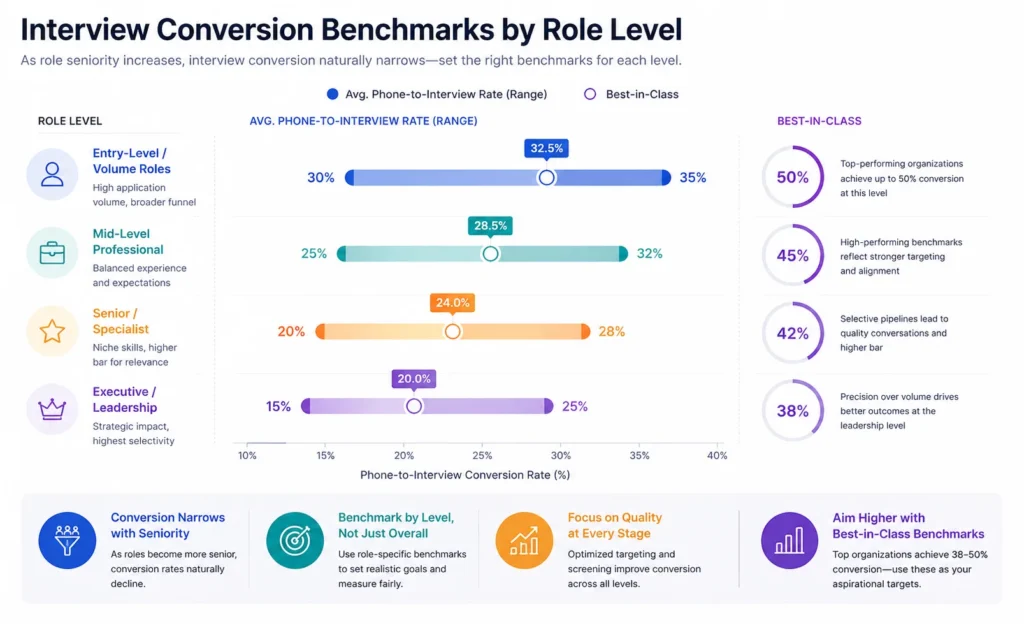
Benchmarks by Role Level
| Role Level | Avg. Phone-to-Interview Rate | Best-in-Class |
|---|---|---|
| Entry-Level / Volume Roles | 30-35% | 50% |
| Mid-Level Professional | 25-32% | 45% |
| Senior / Specialist | 20-28% | 42% |
| Executive / Leadership | 15-25% | 38% |
Key Strategies for Effective Phone Screening
How Can AI and Automation Support Phone Screening?
Pre-Screen Qualification Automation
Automated screening tools can verify basic qualifications, right-to-work status, location, years of experience, salary expectations, and availability, before the phone screen begins. This ensures that every screen conversation starts from a confirmed qualification baseline rather than spending the first five minutes on information the system already has. Pre-screen automation shortens screen duration and concentrates recruiter attention on the elements of candidate assessment that genuinely require human judgment.
AI-Generated Screening Guides
Natural language AI tools can generate role-specific, competency-mapped screening guides from a brief description of role requirements, saving recruiters time building from scratch and standardizing the evaluation criteria applied across all screens for a given role. This consistency reduces screening quality variance across the team and makes post-screen calibration conversations more productive and actionable.
Asynchronous Video Screening
For high-volume roles, AI-powered asynchronous video screening platforms allow candidates to record responses to structured screening questions at a time that suits them, with AI tools providing preliminary scoring of communication quality, response coherence, and engagement signals. This layer handles the volume reduction that the phone screen traditionally performed, freeing phone screen capacity for roles where live human interaction adds genuine evaluation value.
Post-Screen Analysis and Pattern Recognition
AI analytics tools can identify patterns across phone screen outcomes, correlating screen assessment scores with downstream outcomes like interview pass rates, offer acceptance, and 90-day retention, to provide recruiters with feedback on which screening criteria are most predictive of success in each role type. This feedback loop enables continuous improvement of screening effectiveness rather than relying on recruiter intuition alone.
Stop Juggling
10 Job Boards.
Search One
Your next role is already here. avua pulls opportunities from across the web into a single searchable feed; filtered by role, location, salary, and remote preference.
1.5 Million+
Active Jobs
380+
Job Categories
Phone Screen and Equitable Hiring Practices
Accent and Communication Bias in Voice-Based Screening
Phone screens introduce a specific and well-documented equity risk: the tendency for evaluators to apply communication standards that disadvantage candidates whose first language is not English, who come from regions with different communication norms, or whose speaking register differs from the evaluator’s own.
Research published in the Journal of Applied Psychology consistently finds that accent-based evaluation bias operates independently of actual communication effectiveness. Structured screening guides with explicit, defined evaluation criteria reduce this bias by requiring evaluators to assess communication against specific standards rather than general impression.
Standardization as an Equity Tool
The single most effective equity intervention in phone screening is standardization: ensuring that every candidate for a given role receives the same questions in the same order and is evaluated against the same criteria. Unstandardized screens, where recruiters ask whatever comes to mind and evaluate based on overall impression, systematically advantage candidates who share communication styles, cultural references, and professional backgrounds with the evaluator. Bias in hiring at the screen stage is upstream of every other diversity intervention in the process: a diverse shortlist cannot emerge from a screen that systematically filters for similarity rather than competence.
Access and Format Equity
Phone screens create access barriers for candidates who have difficulty with live voice communication due to hearing impairment, anxiety, or situational constraints such as noisy environments or shared living spaces. Organizations committed to equitable screening should offer alternative formats, including asynchronous video or written screening options, for candidates who request them, and ensure these alternatives are evaluated against equivalent criteria. The objective is to assess the candidate’s fit for the role, not their ability to perform in a specific communication format the role itself may not require.
Common Challenges and Solutions
| Challenge | Solution |
|---|---|
| Recruiters conducting inconsistent screens for the same role | Implement a standardized screening guide with mandatory question sets and scoring rubrics; require written notes for each screen before the next begins |
| Candidates declining or no-showing scheduled phone screens | Send a 24-hour confirmation with the screen agenda and estimated duration; offer flexible scheduling windows including early morning and evening options |
| Screen-to-interview conversion rate too low despite adequate applicant volume | Audit sourcing channel quality and job description accuracy; misaligned expectations at the application stage produce poor-quality screens regardless of screening execution |
| Hiring managers requesting to conduct their own phone screens | Redefine role boundaries clearly: recruiter screens for qualification and communication baseline; hiring manager interviews for substantive fit assessment |
Real-World Case Studies
Case Study 1: The E-Commerce Scale-Up
A 300-person e-commerce company was conducting unstructured phone screens across a team of six recruiters, producing significant inconsistency in shortlist quality. Hiring managers routinely found that candidates presented to them had been screened on different criteria and to different standards. The TA team built a structured screening guide for each of their eight primary role families, trained recruiters in a 60-minute session, and required evaluation form completion within 30 minutes of each screen. Phone-to-Interview Conversion Rate improved from 21% to 38% over two hiring cycles, and hiring manager feedback scores on shortlist quality increased by 44%.
Case Study 2: The Regional Healthcare Provider
A healthcare network running high-volume nursing recruitment was spending significant recruiter time on phone screens that duplicated information already collected in the application form, checking qualifications, certifications, and geographic availability that could be verified systematically. They implemented an AI-powered pre-screen qualification layer that handled all basic requirement verification before the recruiter call, reducing average screen duration from 28 minutes to 14 minutes. Recruiter screen capacity effectively doubled with the same headcount, reducing time-to-shortlist by 19 days.
Case Study 3: The Financial Services Firm
A financial services firm identified that their phone screen no-show rate was 31%, significantly above industry benchmarks, driven primarily by scheduling friction. Screens were being booked through email back-and-forth and candidates were dropping out before the call. They implemented automated scheduling with a self-select booking link sent immediately after application review, 24-hour text reminders, and a brief agenda email explaining screen format and duration. No-show rate fell to 9% within six weeks, increasing effective screen volume by 32% with no additional recruiter time investment.
Tracking What Matters: Key Metrics to Monitor
Phone Screen Across the Hiring Lifecycle
Pre-Screen: Preparation and Guide Design
The quality of the phone screen is determined before the call begins. Screening guides should be built at the role family level, reviewed and updated each time a role opens, and signed off by the hiring manager, ensuring that the criteria the recruiter is evaluating against reflect the role’s current requirements rather than a generic template. Candidate context, including the application and sourcing note, should be reviewed immediately before the call rather than skimmed during it.
During Screen: Structured Evaluation in Real Time
The screen itself should follow a defined structure: a brief company and role overview (2-3 minutes), a set of standardized qualifying questions (8-12 minutes), an opportunity for candidate questions (3-5 minutes), and a clear close with explicit next steps (1-2 minutes). Notes should be recorded during the call rather than reconstructed afterward. Evaluation against defined criteria should happen before the recruiter speaks to the hiring manager, so the recommendation is based on structured assessment rather than post-call impression.
Post-Screen: Debrief and Advancement Decision
The advancement decision should be made immediately after the screen, while the evaluation is fresh, and recorded in the ATS before the next screen begins. Candidates who are not advanced deserve prompt, respectful communication. The candidate journey continues even for those who are not progressing, and the organization’s employer brand is affected by every interaction at every stage of the funnel.
Offer Stage: Screen Quality as a Downstream Predictor
Organizations that track their screening data over time consistently find that certain screen criteria are more predictive of offer acceptance than others, specifically the candidate’s articulation of genuine interest in the role at the screen stage. Candidates who express specific, informed enthusiasm in the phone screen accept offers at substantially higher rates than those whose interest is generic or transactional. Building an interest-quality assessment into the screening rubric measurably improves offer acceptance rates downstream.
The Real Cost of Mismanaged Phone Screens
| Scenario | Screen Quality | False Positive Rate | Annual Interview Cost (100 hires/yr) |
|---|---|---|---|
| Unstructured, no guide | Low | 45% | $198,000 |
| Basic checklist approach | Moderate | 28% | $141,000 |
| Structured guide, trained recruiters | High | 14% | $87,000 |
| AI-assisted and structured screening | Optimized | 8% | $62,000 |
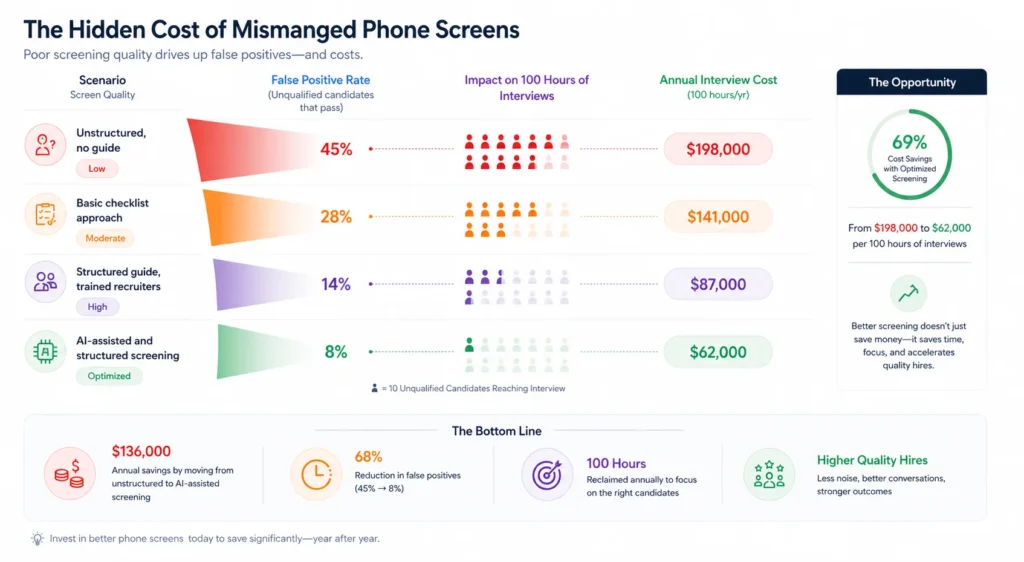
Cost model assumes 4.5 hours of combined recruiter and hiring manager time per interview at a fully-loaded cost of $95/hour. False positive rate measures candidates interviewed who were not advanced further in the process.
Related Terms
| Term | Definition |
|---|---|
| Pre-Screening | The earlier-stage process of filtering candidates against minimum role requirements before the phone screen occurs |
| Applicant Tracking System (ATS) | Software platform managing candidate data, applications, and hiring process workflow |
| Structured Interview | An interview format using predefined questions evaluated against explicit scoring criteria |
| Candidate Pipeline | The pool of candidates at various stages of the hiring process for current or anticipated roles |
| Screening Scorecard | A standardized evaluation tool used to score candidate responses against defined criteria during a screen |
Frequently Asked Questions
What is the difference between a phone screen and a phone interview?
A phone screen is a brief recruiter-led conversation verifying basic qualifications and fit signals, typically 15-30 minutes. A phone interview is a substantive evaluation conducted by a hiring manager or technical assessor as a formal selection stage, typically longer and more in-depth in scope.
Should phone screens be recorded?
With candidate consent, recording phone screens enables post-call review, calibration between recruiters, and audit trail documentation. In all cases, candidates should be informed of and consent to recording before the screen begins. SHRM’s guidelines on lawful interview practices provide a practical compliance reference by jurisdiction.
What questions are off-limits in a phone screen?
Questions about age, marital status, pregnancy or family planning, national origin, religion, disability status, or criminal history (in jurisdictions with ban-the-box laws) are legally restricted in most hiring contexts. Recruiters should receive jurisdiction-specific legal training before conducting screens independently.
How do you handle a candidate who talks too much in a phone screen?
Structured redirection is a professional skill: “That is helpful context. I want to make sure we cover a few more areas in our time together. Let me ask you about…” Most candidates respond well to gentle refocusing if it is framed as a time management issue rather than a correction.
Does a phone screen affect employer brand?
Yes, significantly. The phone screen is frequently a candidate’s first direct human interaction with the organization. Research on candidate experience consistently finds that screen quality is one of the strongest predictors of overall employer brand perception, regardless of whether the candidate advances in the process.
How long should a phone screen be?
Research on screening effectiveness suggests 20-30 minutes as the optimal window for professional roles. Screens under 15 minutes rarely provide enough candidate signal to make confident advancement decisions. Screens over 40 minutes typically indicate poor structure rather than greater candidate insight.
Conclusion
The phone screen is not a formality between the application and the interview. It is the recruiter’s primary contribution to hiring quality.
In a world where AI handles qualification verification and sourcing automation builds the candidate pool, the phone screen is where human judgment earns its place: assessing the quality of thinking, the authenticity of interest, and the communication capability that no algorithm reliably captures.
Organizations that treat the phone screen as a structured, measured, recruiter-skill-dependent function consistently produce better shortlists, faster time-to-fill, and higher offer acceptance rates than those that treat it as an administrative step between application and interview. The call matters.
Make it count.