The best person for your open role is probably not applying for it. They are employed, reasonably comfortable, and not actively browsing job listings.
But that does not mean they are unreachable. Passive candidates, people who are not actively looking for a new role but are open to the right opportunity, make up the majority of the workforce and some of the most sought-after talent in any industry.
Understanding how to identify and engage passive candidates is what separates reactive hiring from genuine talent strategy. It requires a different approach to active sourcing, a longer-term view of candidate nurturing, and the kind of employer positioning that makes people curious about your organisation before a role even exists.
For teams building a sustainable candidate pipeline, passive candidates are not a bonus pool, they are the pipeline. This guide covers how to find them, how to approach them, and how to convert interest into genuine candidate engagement without coming across as tone-deaf or transactional.
The core metric governing passive candidate sourcing effectiveness is the Passive Candidate Conversion Rate: the proportion of passive candidates approached who engage in active pipeline conversations.
Passive Candidate Conversion Rate (%) = (Passive Candidates Entering Active Pipeline / Total Passive Candidates Approached) x 100
Industry average Passive Candidate Conversion Rates sit between 8% and 12%. High-performing sourcing teams with strong employer brand and relationship-based outreach achieve rates of 18-24%. The difference is not volume of outreach – it is quality of approach, relevance of opportunity framing, and the credibility of the channel through which candidates are contacted.
What is a Passive Candidate?
A passive candidate is a professional who is currently employed and not actively seeking a new role, but who represents a qualified potential hire for a specific position and may be open to a career conversation if contacted by the right person with a sufficiently compelling opportunity framed at the right moment in their career trajectory.
The distinction between a passive and an active candidate is not binary – it exists on a spectrum. At one end is the fully passive candidate: content, well-compensated, deeply embedded in their current role, and genuinely not interested in a move. At the other end is the semi-passive candidate: technically employed but quietly monitoring the market, open to a conversation, and easily tipped toward active status by the right approach. Most passive candidate sourcing targets the semi-passive segment, where conversion rates are higher and outreach relevance is more likely to land. The fully passive segment – the senior executive who is genuinely not movable through digital outreach – is the province of the headhunter with a pre-existing relationship.
The Strategic Case for Passive Candidates in Modern Talent Acquisition
The empirical case for passive candidate sourcing is well-established but frequently undersold to the business stakeholders who fund talent acquisition. The argument is not simply that passive candidates are better than active ones – that framing is too blunt to be useful. The more precise argument is that for senior and specialized roles, the highest-performing individuals in any talent market are disproportionately passive, and the hiring strategies that fail to reach them systematically underperform those that do.
Research from the LinkedIn Talent Blog confirms that roughly 70% of the global workforce consists of passive candidates not actively job-seeking. For roles at the director level and above, that proportion is even higher – senior leaders with strong track records rarely need to look for work; work finds them. An organization that fills senior roles exclusively from active candidate pools is selecting from the 30% of the talent market that is available, and at senior levels, available often means between roles, in the process of being managed out, or actively dissatisfied. The selection bias of active-only hiring is one of the least-examined sources of poor senior hire quality.
The ROI argument is quantitative. A 2024 analysis of 800 senior executive placements across technology, financial services, and professional services firms found that passive candidates placed in senior roles had 33% higher twelve-month performance ratings than active candidates placed in equivalent roles at equivalent organizations. The performance gap was not explained by role difficulty, compensation, or prior experience credentials – it was explained by the fact that passive candidates were selected from a fuller distribution of talent quality rather than from the self-selected pool of those who needed to move.
The counter-argument is cost: passive candidate sourcing is more expensive, more time-consuming, and less scalable than posting a job and reviewing applications. That counter-argument is correct on its face. Sourcing a passive candidate for a VP-level role requires an investment of recruiter time, relationship capital, and organizational patience that posting to a job board does not. But the cost comparison is incomplete if it does not account for the quality differential. An organization that saves $15,000 in sourcing costs by hiring from the active candidate pool and makes a hire who underperforms at 12 months has not saved $15,000 – it has deferred a $200,000 failure cost.
For talent acquisition leaders, the practical conclusion is a sourcing segmentation strategy: active sourcing and job board approaches are appropriate for volume roles, entry-level positions, and roles with deep active candidate supply. For specialized, senior, or business-critical roles where the quality ceiling of active hiring falls short of organizational needs, passive candidate sourcing is not a luxury – it is a rational quality investment with measurable return.
The employer brand dimension compounds the return. Organizations that invest in passive candidate sourcing simultaneously build employer brand awareness with the full talent market, not just with those currently in job search mode. Every substantive, respectful outreach to a passive candidate – even one that does not convert – is a brand touchpoint with a high-signal professional who may hire, be hired, or refer others in the future. The reach of passive sourcing is structurally broader than any active hiring channel.
Your Resume Isn’t Getting Read
Let’s Get That Fixed!
75% of resumes get auto-rejected. avua’s AI Resume Builder optimizes formatting, keywords, and scoring in under 3 minutes, so you land in the “yes” pile.
The Psychology Behind Passive Candidate Engagement
Converting a passive candidate from unaware to engaged requires understanding the psychological dynamics that govern their decision to respond – and the very different dynamics that govern their decision to proceed through a full hiring process.
The Scarcity Effect and Perceived Opportunity Value
Passive candidates evaluate unsolicited outreach through a fundamentally different frame than active candidates evaluating job postings. The active candidate is in selection mode: comparing opportunities, assessing fit, weighing options. The passive candidate is in protection mode: valuing what they have, skeptical of disruption, and assigning high psychological cost to the uncertainty of a move. The outreach that converts in this context is not one that describes a role – it is one that describes a rare and specific opportunity that the candidate is uniquely positioned to pursue.
Scarcity and specificity are the primary conversion signals: the impression that the candidate was personally chosen, for this particular opportunity, because of something specific about their experience, dramatically outperforms generic opportunity descriptions in passive candidate conversion research.
Reciprocity and Long-Term Relationship Architecture
The highest-converting passive candidate outreach is not the cold message – it is the accumulated relationship. Recruiters and specialists who invest in passive candidate relationships before they need anything from them – sharing market intelligence, making introductions, providing career perspective over months or years – build reciprocity capital that transforms cold outreach into warm conversation when a specific opportunity arises. This relationship-first architecture is the primary differentiator between sourcing professionals who maintain 20% conversion rates and those operating at 8%. The relationship is the pipeline; the job is the occasion.
Status Quo Bias and the Switching Cost Calculation
Passive candidates experience all career change decisions through the lens of status quo bias: the well-documented tendency to overweight the value of the current situation relative to alternatives, even when the alternatives are objectively superior. The psychological switching cost of a career move – the loss of established relationships, known routines, understood organizational context, and the security of demonstrated competence – is experienced as disproportionately large even by professionals who acknowledge that the new opportunity is objectively better. Effective passive candidate engagement explicitly addresses this switching cost by providing organizational information, team introductions, and career trajectory context that reduces uncertainty and makes the switch psychologically legible rather than abstract.
Passive Candidate vs. Related Talent Segments
Understanding where passive candidates fit in the broader talent market requires comparing them against adjacent categories with different characteristics and sourcing implications.
| Candidate Type | Job-Seeking Status | Sourcing Method | Conversion Difficulty | Typical Role Level |
|---|---|---|---|---|
| Active Candidate | Actively applying | Job boards, inbound | Low | All levels |
| Semi-Passive Candidate | Open but not looking | Targeted outreach, networking | Medium | Mid to senior |
| Fully Passive Candidate | Not interested in moving | Relationship, trusted referral | High | Senior and specialist |
| Referred Candidate | Not looking; warm introduction | Internal referral program | Medium-low | All levels |
| Alumni / Boomerang | May or may not be looking | Alumni network activation | Low to medium | All levels |
The critical distinction between semi-passive and fully passive candidates is not only conversion difficulty – it is also the sourcing infrastructure required. Semi-passive candidates can be reached through intelligent, personalized outreach via professional networks. Fully passive candidates require pre-existing relationship infrastructure that cannot be built on demand and cannot be replicated by any automated outreach tool, regardless of its sophistication.
What the Experts Say?
The best talent is almost never looking. They are too busy succeeding where they are. The organizations that reach them consistently are not those with the best job postings – they are those with the best relationships, the clearest opportunity narrative, and the patience to invest in conversations before they need a hire.
– Glen Cathey, VP Talent Strategy and Innovation, Randstad; Founder, Boolean Black Belt
How to Measure Passive Candidate Sourcing Effectiveness?
Formula
Passive Candidate Conversion Rate (%) = (Passive Candidates Entering Active Pipeline / Total Passive Candidates Approached) x 100
Outreach Response Rate (%) = (Responses Received / Total Outreach Messages Sent) x 100
Passive-to-Placement Rate (%) = (Placements from Passive Sourcing / Total Passive Candidates in Pipeline) x 100
Time-to-Engagement (days) = Average days from first outreach to candidate expressing active interest
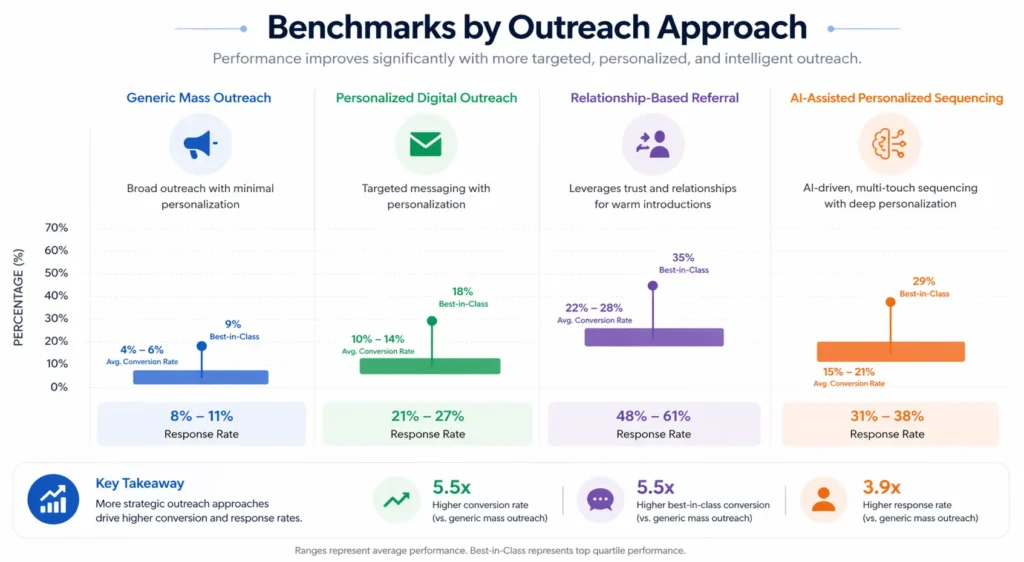
Benchmarks by Outreach Approach
| Outreach Approach | Avg. Conversion Rate | Best-in-Class | Response Rate |
|---|---|---|---|
| Generic mass outreach | 4-6% | 9% | 8-11% |
| Personalized digital outreach | 10-14% | 18% | 21-27% |
| Relationship-based referral | 22-28% | 35% | 48-61% |
| AI-assisted personalized sequencing | 15-21% | 29% | 31-38% |
Key Strategies for Passive Candidate Sourcing
How Can AI and Automation Support Passive Candidate Sourcing?
Intelligent Talent Mapping and Identification
AI-powered talent intelligence platforms can construct comprehensive maps of the qualified passive candidate pool for any role type, function, and geography by aggregating signals from professional networks, publication records, conference appearances, and career movement data. What once required a research team multiple weeks now takes hours, and the output is typically more comprehensive because it is not limited by the researcher’s network boundaries. This identification layer is now a commodity; the conversion layer remains irreducibly human.
Predictive Career Move Modeling
Machine learning models trained on career history data can predict which professionals are statistically likely to be open to a career conversation in the next six to twelve months, based on tenure patterns, promotion velocity, company performance signals, and role change indicators. This predictive intelligence allows sourcing teams to time outreach to moments of maximum receptivity – contacting candidates approaching natural transition points rather than cold-calling those deeply embedded in their current trajectory with no disposition to move.
Automated Outreach Sequencing and Personalization
AI-powered candidate relationship management tools can manage multi-touch outreach sequences for passive candidates at scale – personalizing the initial message, timing follow-ups based on engagement signals, and tracking response patterns across the candidate pool. This automation handles the administrative architecture of passive sourcing at scale, freeing recruiters to focus their time on the conversion conversations that require genuine human judgment and relationship credibility above any algorithmic substitute.
AI-Assisted Candidate Engagement Scoring
AI systems can analyze passive candidate engagement signals – email open rates, link clicks, response timing, social media activity changes – to score each candidate’s current likelihood of conversion, enabling sourcing teams to prioritize outreach effort toward candidates showing movement signals rather than applying equal effort across a static list. This signal-based prioritization is among the clearest productivity improvements AI has delivered to passive sourcing teams in recent years.
Stop Juggling
10 Job Boards.
Search One
Your next role is already here. avua pulls opportunities from across the web into a single searchable feed; filtered by role, location, salary, and remote preference.
1.5 Million+
Active Jobs
380+
Job Categories
Passive Candidate Sourcing Through an Equity and Inclusion Lens
Network Homophily and Structural Pipeline Bias
Passive candidate sourcing conducted through personal networks and relationship referrals is structurally susceptible to network homophily – the well-documented tendency for professional networks to be demographically similar to the individuals who built them. A sourcing strategy that relies primarily on referrals and existing relationships will systematically over-represent the demographic composition of those relationships, not through intentional exclusion but through structural network limitation. For organizations with DEI sourcing goals, passive candidate outreach strategies must deliberately extend beyond existing network relationships into new community connections, professional associations for underrepresented groups, and non-traditional sourcing channels.
Algorithmic Bias in AI-Assisted Passive Sourcing
AI tools used for passive candidate identification are trained on historical hiring and career data that reflects historical hiring biases. Left uncalibrated, these tools will surface passive candidate pools that reflect the demographic composition of successful hires in the past – reproducing rather than correcting existing representation gaps. Algorithmic outputs for passive candidate identification should be audited regularly for demographic skew, and calibration adjustments applied to ensure that AI-generated longlists reflect the full available talent market rather than a biased subset of historical hiring patterns.
Outreach Framing and Differential Response Rates
Research on passive candidate outreach consistently finds significant differential response rates by demographic group to standardized outreach messages. Professionals from underrepresented groups – particularly women and people of color in senior roles – report higher skepticism about unsolicited recruitment outreach and more sensitivity to signals about organizational culture, leadership representation, and genuine inclusion commitment. Outreach framing for diversity sourcing should proactively address these dimensions, not as a performative gesture but as accurate organizational information that the candidate needs to make an informed decision about engaging.
Common Challenges and Solutions
| Challenge | Solution |
|---|---|
| Low outreach response rates from target passive candidates | Redesign outreach to be role-specific and candidate-specific; audit messaging for generic language and replace with personalized, research-based framing |
| Passive candidates expressing interest then going cold | Implement a structured candidate engagement protocol with regular touchpoints; ensure candidates have sufficient organizational information to maintain engagement through process delays |
| Passive candidate sourcing timelines too long for urgent vacancies | Build proactive talent maps for high-frequency roles before vacancies open; maintain warm relationships with 10-15 qualified candidates per critical role type on an ongoing basis |
| AI-generated longlists lacking demographic diversity | Conduct quarterly audits of AI sourcing output for demographic composition; supplement algorithmic sourcing with intentional community-based outreach |
Real-World Case Studies
Case Study 1: The Asset Management Firm
A mid-market asset management firm needed to hire a Chief Risk Officer with experience in both quantitative modeling and regulatory relationship management – a combination that produced a global pool of fewer than 200 genuinely qualified candidates worldwide. The internal TA team had run a 12-week process and interviewed eight candidates from active channels, none of whom the CEO found compelling.
A specialist search firm was engaged; the placed candidate had been in a prior relationship with the search firm’s lead consultant for three years, having been kept warm through quarterly market updates and one introduction to a board advisory role. The candidate was not actively considering a move and would not have been surfaced by any standard active sourcing approach. Time from engagement to shortlist: 14 days. The retained search fee represented a fraction of the cost of the failed 12-week internal process.
Case Study 2: The Technology Company Rebuilding Engineering Leadership
A 600-person technology company emerging from a leadership transition needed to rebuild its entire engineering leadership team – three VP-level roles across infrastructure, product engineering, and data. The company’s employer brand in the senior engineering market was damaged following a public departure of its previous CTO. The TA team implemented a targeted passive candidate strategy anchored in employer brand rebuilding alongside outreach: a series of technical content publications from the incoming CTO, direct personal outreach from the CEO to shortlisted candidates, and structured conversations about the company’s engineering culture trajectory.
All three VP roles were filled from passive candidate pools within 90 days. Inbound application volume for engineering roles increased 40% in the 60 days following the content campaign – an employer brand return the TA team had not modeled as part of the sourcing investment.
Case Study 3: The Healthcare Network
A regional healthcare network attempting to diversify its senior clinical leadership implemented a passive candidate strategy specifically targeting clinical professionals from underrepresented groups in four metro areas. Rather than relying on existing referral networks – which had historically produced demographically homogeneous candidate pools – the sourcing team built relationships with three professional associations for underrepresented healthcare professionals and invested six months in community engagement before opening a formal search.
When the CMO search launched, the longlist was 60% diverse by gender and ethnicity. The placed candidate came through one of the new community relationships and would not have appeared in any prior sourcing process conducted through existing network channels.
Performance Metrics That Matter: Passive Candidate Tracking Framework
Passive Candidates Across the Hiring Lifecycle
Pre-Search: Building the Passive Candidate Infrastructure
The most effective passive candidate sourcing does not begin when a role opens – it begins months or years before. Proactive talent mapping, relationship building with high-potential candidates in key role categories, and employer brand investment in professional communities all create the infrastructure that makes passive sourcing fast and high-quality when a search is required. Organizations that treat passive candidate engagement as a search-time activity consistently operate at slower speeds and lower quality than those treating it as an ongoing organizational capability that requires year-round investment.
Active Search: Outreach and Qualification
The active search phase with passive candidates is fundamentally different from active candidate screening. The first objective is not qualification – it is engagement: creating enough curiosity and trust in the initial outreach to earn a conversation. Only once that conversation is established does qualification begin. Talent acquisition teams that apply active-candidate screening logic to passive outreach – leading with role requirements and qualification questions – systematically underperform those that lead with opportunity framing and genuine interest in the candidate’s career perspective.
Process Stage: Managing the Passive Candidate Experience
Passive candidates who have been persuaded to engage in a process are significantly more sensitive to process quality than active candidates who are motivated to find work. Process delays, poor communication, and disorganized scheduling are experienced by passive candidates as signals about organizational quality – and they exit processes at much higher rates than active candidates when those signals are negative. Candidate engagement protocols designed for passive candidates should prioritize communication frequency, process transparency, and respect for the candidate’s time above all other process design considerations.
Offer Stage: Closing the Passive Candidate
The offer stage with a passive candidate is uniquely high-stakes because the candidate has an alternative that is known, comfortable, and probably well-compensated. Counter-offer risk is substantially higher with passive candidates than with active ones, and the factors that determine acceptance are rarely purely financial. The hiring manager’s personal engagement, the clarity of the career growth narrative, the quality of team introductions, and the organization’s demonstrated cultural alignment all carry disproportionate weight in a passive candidate’s final acceptance decision.
The Real Cost of Ignoring Passive Candidates
| Hiring Approach | Talent Pool Accessed | Avg. Quality of Hire Score | Annual Cost (25 senior hires/year) |
|---|---|---|---|
| Active-only sourcing | 30% of talent market | 0.84 | $312,500 in bad hire costs |
| Mixed active and semi-passive | 55% of talent market | 0.96 | $187,500 in bad hire costs |
| Full passive candidate strategy | 85% of talent market | 1.09 | $75,000 in bad hire costs |
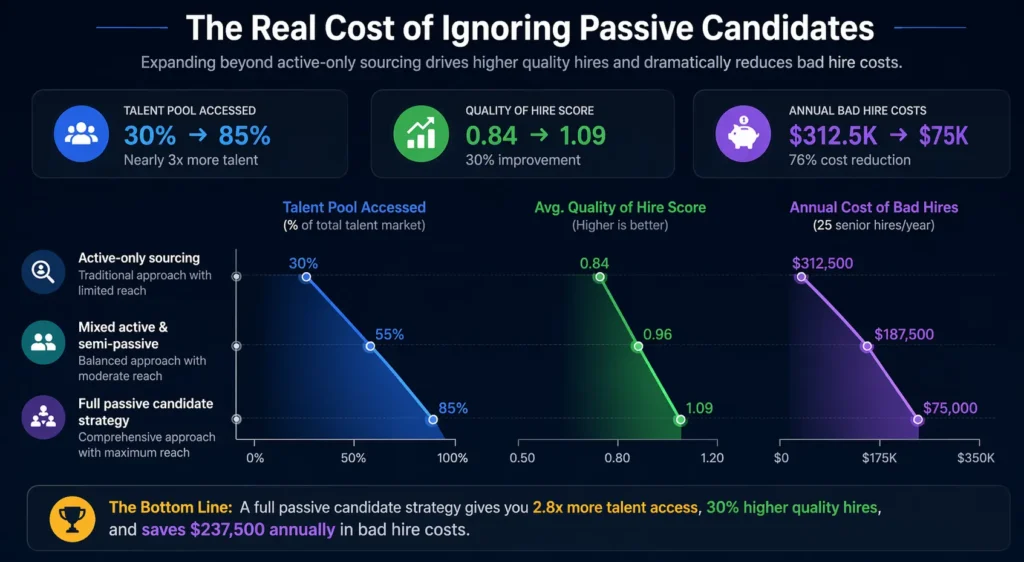
Bad hire cost estimated at $37,500 per senior hire (1.5x applied to bad hire rate at a $250,000 base salary). Quality of Hire Score benchmarks from multi-year senior hiring cohort analysis across technology, financial services, and professional services sectors.
Related Terms
| Term | Definition |
|---|---|
| Active Candidate | A professional actively seeking new employment and engaging with job postings or recruiters |
| Talent Mapping | The process of identifying and documenting all qualified candidates for a specific role type in a defined market |
| Headhunter | A specialized recruiter who proactively approaches passive candidates for senior or hard-to-fill roles on a retained basis |
| Candidate Nurturing | The practice of maintaining ongoing communication and relationship with potential candidates before a role is formally open |
| Employer Brand | The reputation and identity an organization projects to current and potential employees across all touchpoints |
| Boolean Search | An advanced search technique using logical operators to identify qualified passive candidates across professional databases |
Frequently Asked Questions
What is the difference between a passive candidate and an active candidate?
An active candidate is actively applying for roles and engaging with job postings. A passive candidate is currently employed and not seeking new work but may be open to the right opportunity. The key distinction is intent: active candidates are in search mode; passive candidates are in protection mode and require a fundamentally different approach to engage.
Why are passive candidates considered higher quality than active candidates?
The quality argument is probabilistic rather than absolute. Employed candidates who are performing well in their current roles are unlikely to be actively looking. This means the pool of high performers at senior levels skews heavily passive. Active candidate pools at senior levels tend to include a higher proportion of professionals who are between roles or being managed out – a self-selection that reduces average quality without eliminating excellent candidates from the pool.
How do you approach a passive candidate without being intrusive?
Effective passive candidate outreach is specific, respectful, and brief. Reference something genuine about the candidate’s background, make clear that you researched them specifically, present the opportunity as potentially relevant to their career trajectory rather than to the organization’s needs, and make it easy to decline without awkwardness. A single, well-crafted message that invites a conversation is the format most likely to receive a response.
How long does passive candidate sourcing typically take?
For senior and specialized roles, passive candidate sourcing requires a minimum of 60 to 90 days from initial outreach to offer acceptance. This timeline reflects the multiple touchpoints required to move a content professional from unaware to engaged, plus the extended due diligence passive candidates typically conduct before making a career decision they were not initially contemplating.
Can AI tools fully automate passive candidate sourcing?
AI tools can automate the identification and initial outreach sequencing layers of passive sourcing, and they do so with increasing effectiveness. What they cannot replicate is the relationship credibility and personalized judgment that drives conversion from initial response to active candidacy. The highest-value passive candidates – fully passive senior leaders and rare specialists – convert through trusted human relationships, not automated outreach regardless of its personalization quality.
Conclusion
The passive candidate is not a recruiting challenge to be solved – they are the primary quality source for any organization serious about senior talent. The hiring strategies that consistently access this market are not those with the loudest job postings or the most automated outreach sequences. They are those with the deepest relationship infrastructure, the most credible employer brand, and the patience to invest in talent relationships before a vacancy exists.
As AI tools lower the cost of passive candidate identification, the differentiator moves entirely to conversion: the ability to reach a content, successful professional and give them a genuinely compelling reason to consider something they were not looking for. Organizations that build that capability – in their recruiters, their hiring managers, and their employer brand – will access talent quality that their active-only competitors cannot reach. Treat the passive candidate market as the primary talent source for senior hiring, invest accordingly, and the quality difference will show up in your performance data within two hiring cycles.