Most job descriptions are written for compliance, not attraction. They list qualifications, tasks, and reporting lines. What they rarely contain is any useful description of the actual person the organization is trying to hire: what motivates them, where they spend time online, and what would make them respond to an outreach message.
The result is active sourcing built around a role rather than a person, which is roughly equivalent to running a marketing campaign without knowing who the customer is.
A candidate persona is a research-based profile of the ideal candidate for a specific role, built from data on professionals who actually succeed in it. It covers career background, motivations, decision-making criteria, and the factors that drive candidate engagement or kill it.
In 2026, AI hiring platforms like avua make persona development faster and smarter, turning candidate behavior data into continuously updated insights that sharpen every stage of the candidate journey, from first touchpoint to offer.
The core metric governing candidate persona effectiveness is the Persona-Sourcing Alignment Rate (PSAR): the proportion of candidates entering the active hiring pipeline whose actual characteristics match the defined persona for the role being recruited.
PSAR (%) = (Pipeline Candidates Matching Persona Profile / Total Active Pipeline Candidates) x 100
A PSAR consistently below 50% indicates that the sourcing and attraction strategy is reaching the wrong candidate population, either because the persona was incorrectly defined, the sourcing channels do not reach the target audience, or the messaging is not resonating with the intended persona.
What is Candidate Persona?
A candidate persona is a structured, research-informed profile of the ideal candidate for a specific role, describing not just their qualifications and experience but their career motivations, professional identity, communication preferences, job search behavior, and the specific organizational characteristics that would make them more likely or less likely to engage with an employment opportunity.
The distinction from a job description or role specification is fundamental. A job description describes the role. A candidate persona describes the person who would be outstanding in it. A job description lists required skills. A candidate persona describes what the person who has those skills cares about, how they make career decisions, and what they need to hear to consider a move. The job description is input to the hiring organization. The candidate persona is input to the talent acquisition strategy.
A well-constructed candidate persona for a senior data scientist role at a healthcare technology company might include: typical career background (computational biology or statistics PhD, three to five years in clinical analytics or health informatics), professional motivations (impact on patient outcomes, technically complex problems, peer respect), decision criteria for a new role (quality of data infrastructure, scope for publication or conference contribution, caliber of technical team), job search behavior (passive rather than active, responsive to direct LinkedIn outreach from technical leaders rather than recruiters, follows specific data science community platforms), communication preferences (detailed technical information about the role over employer brand messaging, prefers async communication), and red flags that would cause disengagement (vague role description, generic recruiter outreach, unclear data governance standards).
This profile tells the recruiting team not just who they are looking for, but how to find them, how to approach them, and what to say when they do.
Is Your Sourcing Strategy Based on Research or Assumptions?
Most organizations develop their sourcing and attraction strategies based on what the recruiter already knows, what worked last time they hired for a similar role, and what the job description says about minimum requirements. This is not sourcing strategy. It is informed guessing, and its results are inconsistent because the assumptions it rests on are rarely validated.
The question that a candidate persona forces is: who specifically is the person we need, and what do we actually know about how to reach them? The answer, when it is based on research rather than assumption, frequently produces sourcing and messaging strategies that differ substantially from what the recruiter would have done by instinct, and it produces better results consistently rather than occasionally.
The research foundation of a candidate persona draws from several sources: interviews with high performers currently in the role who can describe their own career path and decision-making; analysis of the professional profiles and career trajectories of successful past hires; engagement data from prior outreach campaigns that identifies which messages generated response and which did not; and behavioral analytics from job boards and professional networks that show where candidates with the target profile spend their time and how they respond to different content types.
Organizations that invest in persona research report a 47% improvement in outreach response rates compared to those using generic sourcing messaging, and a 31% reduction in time-to-shortlist because their sourcing efforts are concentrated on the candidate populations that are actually responsive to them rather than distributed across all channels with equivalent investment.
For TA leaders, the persona development process also serves a critical internal alignment function. Hiring managers, HR business partners, and recruiters frequently have different mental models of who the ideal candidate is. The process of developing a candidate persona, which requires all stakeholders to articulate and then validate their assumptions against actual data, surfaces these discrepancies early, before they produce disagreements about shortlist quality or offer decisions.
A hiring manager who believes the ideal candidate has an MBA from a target university and a recruiter who believes the ideal candidate has a specific technical background but not necessarily an elite credential are two people who will not agree on a shortlist without a prior conversation that the persona development process naturally facilitates.
The scenario that illustrates the cost of assumption-based sourcing: a mid-size software company hires for a product manager role using a sourcing strategy built entirely on the recruiter’s assumption that product managers find roles through LinkedIn job postings and respond best to outreach messages emphasizing career growth opportunity.
After six weeks, the pipeline contains 23 candidates, of whom 14 have been pre-screened by the recruiter and 6 have advanced to hiring manager review. The hiring manager rejects 5 of the 6, finding them technically shallow. Post-rejection analysis of the rejected candidates reveals that they were primarily from business backgrounds without strong technical foundations, which is not what the job description specified but is what the LinkedIn sourcing approach was consistently surfacing.
A persona built from interviews with the three strongest product managers currently at the company reveals that all three came from engineering backgrounds, found roles primarily through community referrals in technical product communities rather than LinkedIn job boards, and were motivated to move primarily by the complexity of the technical challenge rather than career advancement framing.
The sourcing strategy built from this persona, targeting engineering-to-PM career transition profiles in technical product forums with messaging emphasizing architectural complexity, produces a pipeline of 11 candidates from the first outreach cycle, of whom 8 advance to hiring manager review and 4 proceed to final interview. The persona-informed sourcing produced better results from a smaller pipeline in less time because it was reaching the right people with the right message.
Your Resume Isn’t Getting Read
Let’s Get That Fixed!
75% of resumes get auto-rejected. avua’s AI Resume Builder optimizes formatting, keywords, and scoring in under 3 minutes, so you land in the “yes” pile.
The Components of a Well-Built Candidate Persona
A candidate persona that is genuinely useful for sourcing and attraction decisions contains specific information across several distinct dimensions. Generic personas that describe the target candidate as “driven,” “collaborative,” and “passionate about impact” are not useful. They describe every candidate who has ever written a cover letter, not the specific person who excels in this particular role.
Professional Background and Career Trajectory
The typical educational and professional path that brings someone to the target role. This is not a statement of requirements but an empirical description of where successful candidates actually come from. For many roles, the actual background of strong performers differs substantially from what the job description lists as requirements: the role that requires an MBA may be filled most successfully by candidates with specific operational experience and no MBA, or the role that asks for ten years of experience may be filled by candidates with seven years and a specific functional specialization.
Understanding the actual backgrounds of high performers, rather than the theoretical backgrounds listed in job descriptions, is the most important research input to persona development and the one most frequently skipped.
Professional Motivations and Career Values
What drives this person professionally at this stage of their career? What are they optimizing for in a career decision: impact, intellectual challenge, compensation, title progression, organizational stability, mission alignment, peer caliber, technical quality, or some specific combination? Professional motivations vary significantly by seniority level, functional specialty, and career stage, and they determine what messaging will be compelling and what will be ignored.
A senior individual contributor who is motivated primarily by technical challenge and peer respect requires fundamentally different attraction messaging than a mid-career professional motivated primarily by career advancement opportunity and compensation, even if both have identical qualifications on paper.
Job Search and Information Behavior
Where does this person spend their professional time? Which communities do they participate in, which publications or newsletters do they read, which events do they attend? Are they active on LinkedIn, or do they primarily engage through specialist communities, GitHub, Slack workspaces, or industry forums? Do they respond to recruiter outreach, or do they find roles exclusively through their professional network?
Understanding job search and information behavior is the direct input to sourcing channel selection. A sourcing strategy built on LinkedIn InMail reaches candidates who are responsive to LinkedIn InMail. Many of the highest-quality candidates for technical, creative, and specialist roles are not responsive to LinkedIn InMail and require entirely different sourcing approaches to reach.
Decision Criteria for a Role Change
What would make this person seriously consider leaving their current role? What are the specific characteristics of a new opportunity that would pass the initial filter? And what are the specific red flags that would cause them to disengage from an opportunity they had initially been interested in?
Decision criteria are not the same as job preferences. A candidate may prefer an interesting technical problem but decide based on compensation. They may prefer a collaborative culture but decide based on title. Understanding the distinction between what candidates say they want and what actually drives their decision requires behavioral research rather than candidate self-report.
Communication Preferences and Outreach Receptivity
How does this person prefer to be contacted? What length, format, and tone of message are they likely to respond to? What should be in the subject line of the first outreach email to maximize open rate? What level of personalization is required to distinguish a genuine approach from automated bulk outreach?
This dimension of the persona is the direct input to recruiter outreach message design, and it is the one with the most immediately measurable impact on sourcing efficiency: the right message to the right channel at the right time produces response rates three to five times higher than generic outreach to the same candidate.
Candidate Persona vs. Related Concepts
| Concept | What It Describes | How It Differs from Candidate Persona |
|---|---|---|
| Job Description | Role requirements and responsibilities | Organizational perspective; describes the role, not the person |
| Ideal Candidate Profile (ICP) | Minimum and preferred qualifications | Lists criteria; does not describe behavior, motivation, or decision-making |
| Role Specification | Detailed competency and performance criteria | Assessment-focused; describes what to evaluate, not who to attract |
| Buyer Persona (Marketing) | Ideal customer characteristics and buying behavior | Source concept for candidate persona; same methodology applied to recruiting |
| Talent Segment | Grouping of candidates by shared characteristics | Broader categorization; persona provides behavioral and motivational depth |
| Competency Framework | Defined skills and behaviors for a role | Defines what to assess; persona defines who to reach and how |
The relationship between the candidate persona and the ideal candidate profile (ICP) is important to distinguish. The ICP lists the minimum and preferred qualifications the organization needs the hire to have: years of experience, specific technical skills, required certifications, preferred educational background.
The candidate persona describes the human being who typically has those qualifications: where they came from, what they care about, how they make decisions, and where they can be found. The ICP answers “what do we need?” The persona answers “who has it and how do we reach them?”
What the Experts Say?
The persona is not a fantasy of the perfect candidate. It is a hypothesis about who they are and how to reach them, built from data and tested through sourcing. The teams that update their personas based on what they learn are the ones that get better at finding the right people every cycle.
– Maisha Cannon, Senior Director of Talent Acquisition
How to Build a Candidate Persona: A Research Framework
Candidate personas built from desk research alone are assumptions with structure. The research that produces genuinely useful personas combines multiple primary and secondary data sources.
Step 1: Interview Current High Performers
The most valuable data source for candidate persona development is conversation with the people currently performing the role at high levels. These conversations should cover: their actual career path to the role (which frequently differs from what the job description assumes), what motivated them to join the organization and what has kept them engaged, what they were specifically looking for when they made their last move, where they were looking when they found this role, and what would have caused them to disengage from an opportunity they were initially interested in.
Three to five interviews with high performers in the target role family typically produces enough pattern data to build a persona first draft with meaningful specificity.
Step 2: Analyze Successful Hire Profiles
Review the professional profiles and application sources of the strongest hires in the role over the past two to three years. What educational and professional backgrounds appear most consistently? Which sourcing channels produced the highest-quality hires rather than simply the most applications? What interview signals (not just assessment scores but specific behavioral indicators) predicted who performed best?
Step 3: Review Failed Sourcing Data
Sourcing campaigns that produced poor results contain as much persona information as those that worked. What candidate profiles were reached by prior outreach but did not respond? What profiles responded but did not advance through the hiring process? What reasons did declined candidates give for their disengagement? These failure modes identify the gaps between who the sourcing was reaching and who the role actually needed.
Step 4: Analyze Candidate Behavior Data
Job board analytics, LinkedIn campaign data, email open and response rates by message type, and community engagement data from professional networks provide behavioral evidence about where the target candidate population is active and what content generates their engagement. This data is increasingly available through AI-powered sourcing platforms that aggregate behavioral signals across multiple channels and identify the patterns most predictive of engagement from specific candidate types.
Step 5: Validate with Recruiters and Hiring Managers
The persona built from research should be reviewed and validated by the recruiters who will use it and the hiring managers who have the deepest knowledge of what success looks like in the role. Validation should challenge assumptions, surface blind spots, and ensure that the persona is genuinely useful for the decisions it is meant to inform rather than a theoretical exercise that remains in a document and does not change sourcing behavior.
Stop Juggling
10 Job Boards.
Search One
Your next role is already here. avua pulls opportunities from across the web into a single searchable feed; filtered by role, location, salary, and remote preference.
1.5 Million+
Active Jobs
380+
Job Categories
Candidate Persona and Diversity, Equity, and Inclusion
The candidate persona is a powerful DEI tool when used correctly and a significant DEI risk when used poorly. The distinction depends on how the persona is built and what assumptions are embedded in it.
Personas That Expand vs. Restrict Access
A persona built exclusively from the profiles of the organization’s existing high performers in a role may encode demographic biases that have historically been present in the hiring process. If the current high performers are predominantly from a narrow set of universities, professional backgrounds, and demographic characteristics, a persona built from their profiles will describe sourcing and attraction strategies that replicate those characteristics rather than expanding access to the full range of qualified candidates.
The corrective approach is to build personas from performance data rather than profile data: what motivations, behaviors, and capabilities predict high performance in the role, regardless of the demographic characteristics of those who currently hold it? A persona built from performance-grounded research may describe a substantially different candidate from one built from profile-grounded research, particularly in roles where historical hiring has been demographically narrow.
Inclusive Sourcing Channel Recommendations
Candidate personas that accurately describe where different candidate populations seek professional information and opportunities naturally produce more inclusive sourcing strategies than those built from the assumption that all candidates use the same channels. A persona that identifies that a significant proportion of the target candidate population for a technical role is active in communities specifically associated with underrepresented groups in technology (Women Who Code, NSBE) produces sourcing strategies that deliberately reach those communities, rather than relying exclusively on channels where underrepresented candidates are systematically less visible.
Motivational Diversity Within the Persona
A single candidate persona for a role should not assume that all candidates with the target qualifications have identical professional motivations. Within any target candidate population, different individuals are motivated by different aspects of an opportunity, and some of those motivational differences correlate with background and experience. A persona that acknowledges motivational diversity within the target population, and that designs attraction messaging to address multiple motivation profiles, is more inclusive than one that treats the target population as monolithic.
How AI Is Transforming Candidate Persona Development?
Common Challenges and Solutions
| Challenge | Solution |
|---|---|
| Persona Built from Assumptions Rather Than Research | Commit to at least three high-performer interviews before finalizing any persona; treat the first version as a hypothesis to be validated |
| Persona Too Generic to Drive Different Sourcing Behavior | Add a “what this persona is not” section that explicitly excludes the profiles the sourcing has been reaching that do not perform; specificity through exclusion |
| Persona Becoming Outdated | Schedule quarterly persona review as part of the role intake process; update based on sourcing data from each hiring cycle |
| Hiring Manager Disagreement with Persona | Make the disagreement explicit and data-driven: bring sourcing response rate data and hire quality data to the conversation; the persona should reflect evidence, not hierarchy |
| Multiple Personas Needed for Same Role | Build multiple persona variants for roles that attract genuinely different candidate populations (career-changers versus specialists, for example) and maintain separate sourcing strategies for each |
Real-World Case Studies
Case Study 1: The Financial Technology Company
A financial technology company had been recruiting for a compliance technology role with a sourcing strategy based on a job description that emphasized regulatory knowledge and financial services experience. After eight weeks, the pipeline contained 24 candidates, of whom the hiring manager had advanced three to final stages. Frustration on both sides was high.
A persona development exercise, built from interviews with the two strongest compliance technology professionals already at the company and analysis of the profiles of comparable professionals across the industry, revealed that the strongest candidates for this role were not career compliance professionals but technology professionals who had transitioned into compliance, motivated primarily by the intellectual complexity of translating regulatory requirements into system logic. They were not active on LinkedIn job boards and did not self-identify as “compliance professionals,” which is why the existing sourcing strategy was not reaching them.
The revised sourcing strategy, targeting regulatory technology communities, technical architecture forums, and professionals with hybrid compliance-engineering titles, produced 11 candidates in three weeks, of whom the hiring manager advanced 7. The persona had identified not just a different candidate but a completely different sourcing landscape. The role was filled in 18 days from persona implementation.
Case Study 2: The Healthcare Organization
A healthcare organization building a data analytics capability found that its sourcing for senior healthcare data analysts was producing candidates with strong general analytics skills but limited healthcare domain knowledge, producing persistent quality concerns from hiring managers. The sourcing strategy was targeting data analyst job titles on general job boards with messaging emphasizing technical complexity.
A persona built from interviews with two senior analysts the organization considered its strongest performers revealed that both had clinical backgrounds (one a former nurse, one a former healthcare administrator) who had developed analytics skills specifically because they needed data capabilities to solve clinical problems they cared about.
The sourcing strategy rebuilt from this persona targeted clinical professionals who were developing data skills, through clinical professional associations and healthcare-specific analytics communities, with messaging emphasizing clinical impact rather than technical opportunity. The quality-of-hire score for healthcare data analyst roles improved from 3.4 to 4.2 out of 5.0 within three hiring cycles, with no change in role requirements and no additional sourcing spend.
Case Study 3: The Consumer Goods Company
A consumer goods company recruiting for a brand management role had been successfully sourcing candidates through traditional MBA program recruiting for several years. Following a DEI audit that identified demographic homogeneity in the brand management function, the company undertook a persona analysis to understand whether the MBA recruiting strategy was the only path to qualified candidates or whether it was producing demographic narrowness without corresponding quality justification.
Analysis of performance data across all brand managers over five years found no statistically significant performance difference between MBA recruits from target schools and candidates from other backgrounds who had demonstrated equivalent commercial and creative capabilities through other paths. The persona was rebuilt to describe the performance-grounded profile: commercial instinct demonstrated through any background, creative problem-solving evidenced across any professional context, and consumer empathy developed through any relevant experience.
The sourcing strategy expanded to include non-MBA pathways: specialist marketing programs, consumer-facing brand roles outside traditional CPG, and entrepreneurial backgrounds. Within two years, the demographic composition of brand management new hires improved significantly, and 12-month performance ratings for the expanded-persona cohort were statistically equivalent to the prior MBA-sourced cohort.
Building a Candidate Persona Dashboard: What to Track?
If you’re serious about treating candidate persona as a strategic KPI, you need a dedicated dashboard. Here’s what belongs on it.
Candidate Persona Across the Talent Acquisition Workflow
Job Description and Posting Design
The candidate persona is the input to job description language, not the output of it. A posting written with the persona in mind addresses the specific motivational triggers, career interests, and decision criteria of the target candidate rather than describing the role in organizational terms that may be accurate but not compelling to the person being recruited. Persona-informed job postings generate higher application quality from the channels that reach the target persona, because they speak directly to what that candidate is evaluating.
Sourcing Channel Selection
The persona’s description of where the target candidate spends their professional time is the direct input to sourcing channel decisions. Organizations spending budget on channels that do not reach their target persona are generating volume without quality. The persona makes the case for investing in channels that may be less familiar (specialist communities, technical forums, industry associations) but more effective for the specific candidate type.
Outreach Messaging
The persona’s description of what messages resonate with the target candidate, at what level of personalization, and through which communication channel, directly informs recruiter outreach message design. A recruiter with a well-researched persona for the role they are filling writes substantially different outreach messages than one working from generic templates, and achieves substantially different response rates as a result.
Interview and Assessment Design
The persona’s description of the candidate’s professional identity and decision criteria informs not just the attraction strategy but the interview design. Understanding that the target candidate values peer caliber, for instance, suggests including a technical peer interview in the process. Understanding that they value clarity about the role’s impact suggests building a specific impact discussion into the hiring manager interview. The persona makes the interview experience more relevant to the target candidate’s evaluation criteria, which improves both the quality of the organization’s assessment and the quality of the candidate’s experience.
The Real Cost of Persona-Free Sourcing
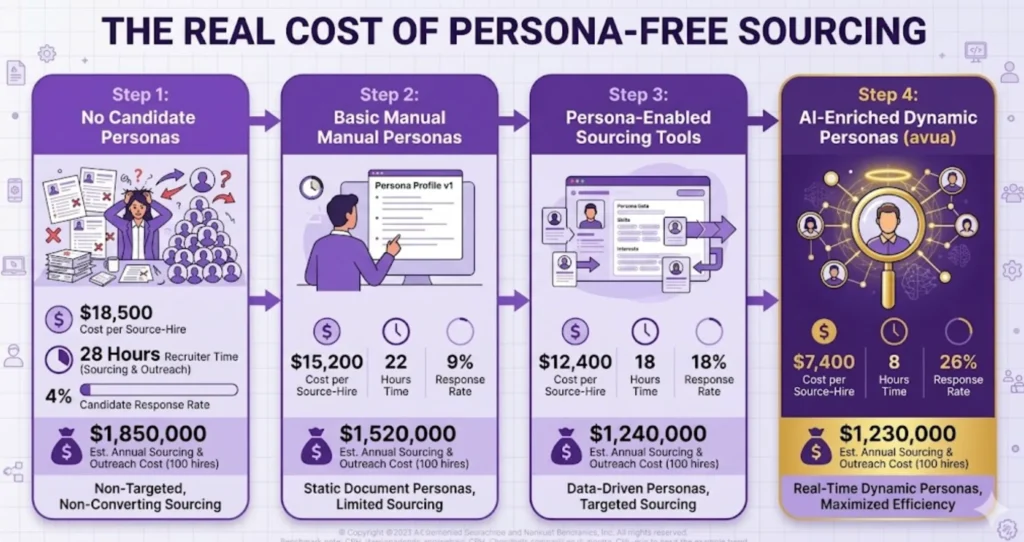
| Sourcing Approach | Outreach Response Rate | PSAR | Pipeline-to-Hire Ratio | Est. Annual Sourcing Efficiency (100 hires) |
|---|---|---|---|---|
| No Persona, Generic Outreach | 9% | 34% | 1 hire per 11.4 pipeline | Baseline ($1,240,000) |
| ICP Only, No Behavioral Persona | 14% | 51% | 1 hire per 7.8 pipeline | $890,000 |
| Basic Persona, Manual Sourcing | 21% | 64% | 1 hire per 5.1 pipeline | $670,000 |
| AI-Optimized Persona (avua) | 34% | 79% | 1 hire per 3.2 pipeline | $490,000 |
The efficiency improvement from no persona to AI-optimized persona represents $750,000 in annual recoverable sourcing cost at 100 hires per year, from the combination of higher outreach response rates (requiring less outreach to generate the same pipeline), higher persona-sourcing alignment (reducing recruiter review time on misaligned candidates), and lower pipeline-to-hire ratios (reflecting the quality improvement from persona-informed sourcing).
Related Terms
| Term | Definition |
|---|---|
| Ideal Candidate Profile (ICP) | A list of minimum and preferred qualifications for a role; the criteria-based complement to the behavior-focused candidate persona |
| Sourcing Channel | A specific platform, community, or network through which candidates for a role are identified and approached |
| Employer Value Proposition (EVP) | The full set of what the organization offers employees; the content that should speak to the persona’s motivational triggers |
| Outreach Message | A direct communication sent by a recruiter to a potential candidate; its effectiveness depends on alignment with persona communication preferences |
| Talent Segment | A defined grouping of candidates sharing common characteristics; the persona provides motivational and behavioral depth within a segment |
| Persona-Sourcing Alignment Rate (PSAR) | The proportion of pipeline candidates whose actual characteristics match the defined persona; the primary persona effectiveness metric |
Frequently Asked Questions
How many candidate personas should an organization maintain?
One persona per distinct role family is a solid general principle, with role-specific overlays where needed. Organizations with diverse hiring needs across ten or more role families should maintain a corresponding library. Those with more concentrated hiring typically need three to five well-developed personas to cover the majority of their volume.
How long does it take to build a candidate persona?
A properly researched persona, including high-performer interviews and hiring data analysis, typically requires 15 to 20 hours per persona. That investment is recovered within one to two hiring cycles from sourcing efficiency gains alone. The objection that it takes too long usually compares it against one sourcing cycle. The right comparison is against three to five cycles built on assumptions that produce inconsistent results.
Should candidate personas include demographic characteristics?
No. Demographic characteristics are not predictors of job performance and their inclusion creates legal exposure. However, sourcing channel recommendations derived from the persona may appropriately include channels associated with underrepresented professional communities, as reaching those communities is a legitimate diversity sourcing strategy. The persona describes who someone is professionally and motivationally, not what demographic groups they belong to.
How does a candidate persona differ from a competency framework?
A competency framework defines what skills and behaviors are required for success in a role. A candidate persona describes who has those competencies, what motivates them, and where they can be found. The two are complementary: the competency framework informs what to assess; the persona informs who to attract and how to reach them.
Can a candidate persona be used for internal mobility as well as external hiring?
Yes, and it is underutilized in this context. Applied to internal mobility, a persona identifies which employee populations are most likely to have developed the relevant capabilities, enabling proactive outreach rather than relying on passive job posting responses. This surfaces qualified internal candidates who would not have self-nominated, improving both quality and diversity of the internal pipeline.
Conclusion
The candidate persona is the answer to the question that most recruiting strategies never ask: who, specifically, is the person we are trying to reach, and what do we actually know about them?
Every sourcing decision made without a research-grounded answer to that question is a decision made by instinct in a context where instinct is unreliable. The channels being used may not reach the target candidate. The messages being sent may not address their actual decision criteria. The job description may be written for a role rather than for a person. And the result is a sourcing effort that generates volume without predictable quality, because the strategy was not designed for the specific person it is trying to find.
The candidate persona does not guarantee a perfect hire. No tool does. What it does is convert talent attraction from an activity based on assumption into one based on research, and from a strategy that reaches whoever responds into one designed to reach the specific person who would be outstanding. The difference between those two versions of sourcing is not a marginal improvement in efficiency. It is a structural difference in whether the recruiting process is actually finding the people it needs.
The best candidate for the role you are opening is out there. The persona is the map to where they are.