Ask any experienced recruiter which sourcing channel produces their best hires and the answer is almost always the same: employee referrals. Ask them what proportion of their budget goes to referrals and the answer is almost never proportionate.
The employee referral program is the most consistently underinvested high-yield asset in talent acquisition. It produces the lowest cost-per-hire, the highest retention rates, the fastest time-to-productivity, and the most culturally aligned candidates of any sourcing channel in most organizations. And it is run, in most companies, as an afterthought: a bonus announced in an email, a form on the intranet, and an assumption that employees will refer when they have someone to suggest.
An employee referral program is a structured talent acquisition initiative that incentivizes and enables current employees to recommend qualified candidates from their professional networks for open positions, typically through a financial reward upon successful hire and retention, and that systematically activates the organization’s existing workforce as a sourcing channel to generate high-quality candidate pipeline with lower cost, faster time-to-fill, and higher retention rates than most external sourcing alternatives.
The word “structured” is doing significant work in that definition. The distinction between a structured referral program and an informal one is the difference between a sourcing channel and a sourcing wish. A structured program has defined incentives, a clear submission process, regular communication of open roles to employees, tracking of referral outcomes, and accountability for program performance. An informal one has a bonus that employees sometimes remember and mostly do not.
In 2026, the employee referral program has been significantly enhanced by AI tools that make it easier to match employee networks to open roles, automate communication to employees about relevant opportunities, and track referral pipeline quality in real time. But the fundamentals of what makes referral programs work have not changed: the incentives must be meaningful, the process must be frictionless, and employees must actually know what roles are open and why their referral matters.
The primary metric is the Referral Conversion Rate (RCR):
RCR (%) = (Hires from Referrals ÷ Total Referrals Submitted) × 100
Industry benchmarks for RCR range from 8 to 15% for well-run programs. An RCR below 5% suggests the program is receiving poor-fit submissions; above 20% may indicate the referral pool is too narrow (employees only referring highly pre-screened candidates).
What is an Employee Referral Program?
An employee referral program is a formal talent acquisition mechanism that structures the process by which current employees recommend candidates from their networks, defines the incentives for successful referrals, communicates open opportunities systematically to the employee base, and tracks referral pipeline quality and outcomes against the program’s cost-per-hire and retention targets.
The program operates on a simple but powerful principle: employees who are engaged with the organization and who are aware of open roles will, with appropriate incentive and a frictionless submission process, introduce candidates from their professional networks who are likely to be both qualified for the role and culturally aligned with the organization. The cultural alignment component is what makes referred candidates outperform non-referred ones on retention: the referring employee has already made an informal cultural fit assessment before submitting the referral, because their professional reputation is attached to the quality of the candidate they recommend.
Is Your Referral Program Working or Just Existing?
Most employee referral programs exist. Far fewer work.
The gap between existing and working is visible in the program metrics: a referral program producing 8% of hires in an organization where referrals should be producing 30 to 40% is existing. It has a bonus structure and a submission process. It is just not generating the pipeline it should.
The reasons programs underperform are consistent. Employees do not know what roles are open. The submission process is inconvenient enough to deter casual referrals. The bonus amount is not meaningful enough to motivate deliberate referral behavior. Feedback on referral status is slow or nonexistent. And the program is not promoted consistently enough to remain top-of-mind when employees encounter potentially qualified candidates in their networks.
LinkedIn Talent Solutions research finds that referred candidates are 4 times more likely to be hired than non-referred candidates, have 45% higher retention at 24 months, and reach full productivity 18% faster than candidates from other sourcing channels. These outcomes are not produced by the referral program itself. They are produced by the pre-screening that happens before the referral is submitted: the employee’s informal assessment that this person is both qualified and likely to fit. The program’s job is to make it easy for employees to submit those assessments and to reward them meaningfully when they are right.
Stop Juggling
10 Job Boards.
Search One
Your next role is already here. avua pulls opportunities from across the web into a single searchable feed; filtered by role, location, salary, and remote preference.
1.5 Million+
Active Jobs
380+
Job Categories
The Architecture of a High-Performing Referral Program
Incentive Design
The referral bonus is the most visible component of most programs and the least differentiating. A bonus of $1,000 for a successful placement at a role valued at $120,000 is not motivating at the margin; the employee knows the hire is worth more than that to the organization and may not submit a high-quality candidate for a reward that feels token relative to their implicit understanding of the value they are creating.
Effective referral incentives share three characteristics: they are meaningful relative to the role level (typically $1,000 to $5,000 for professional roles, with senior role bonuses above this range); they are paid in a way that rewards retention rather than just hire (splitting the bonus between hire date and a retention milestone of 3 or 6 months); and they are supplemented by non-financial recognition that makes the referring employee feel visible and valued.
Communication Cadence
The most common reason employees do not refer is that they do not know what roles are open. Most referral programs rely on employees to check the careers page; most employees do not. Active programs push relevant open roles to employees based on their network relevance (engineering employees see engineering roles) at a regular cadence (weekly or bi-weekly email or Slack notification) with a direct, frictionless referral submission mechanism attached to each role communication.
Process Simplicity
Every additional step in the referral submission process reduces referral volume. The optimal submission process takes under two minutes: employee provides candidate name, contact information, and the role they are referring for, with an optional brief note on the candidate’s background. The recruiter handles the rest. Programs that require employees to submit full candidate profiles, write formal recommendations, or navigate multi-step forms consistently generate less than half the referral volume of simplified programs.
Feedback Loop Quality
Employees who refer candidates and then hear nothing about what happened are less likely to refer again. A structured feedback loop that acknowledges the referral within 24 hours, provides a status update at each stage the candidate advances through, and notifies the referring employee of the outcome (and why, in the case of non-advance) produces significantly higher repeat referral rates than programs where submitting a referral feels like dropping a candidate into a void.
Common Misconceptions About Employee Referral Programs
| Misconception | Reality |
|---|---|
| A larger bonus always produces more referrals | Above a threshold of meaningfulness, bonus size has diminishing marginal impact on referral volume. Process simplicity and communication frequency have larger marginal impacts at most bonus levels. |
| Referral programs only work for entry and mid-level roles | Research shows referral programs are effective at all levels, including senior roles. Senior employees have senior networks. The incentive structure may need adjustment for senior roles (higher bonus, longer retention milestone) but the channel works. |
| Referral hires are less diverse than other sources | Default referral programs reproduce the demographic concentration of the existing workforce. Diversity-optimized referral programs, with explicit incentives for referrals that expand demographic representation and tools that help employees reach beyond their immediate network, produce diverse referral pipelines. |
| All referral programs produce the same quality | Referral quality varies significantly by program design. Programs with no submission screening produce high volume, low quality. Programs with frictionless submission but recruiter-led qualification produce better quality. The program design shapes the quality of what it generates. |
| The bonus is the whole program | The bonus is one component. Communication frequency, process simplicity, feedback quality, and non-financial recognition collectively produce more referral volume than the bonus alone in most well-analyzed programs. |
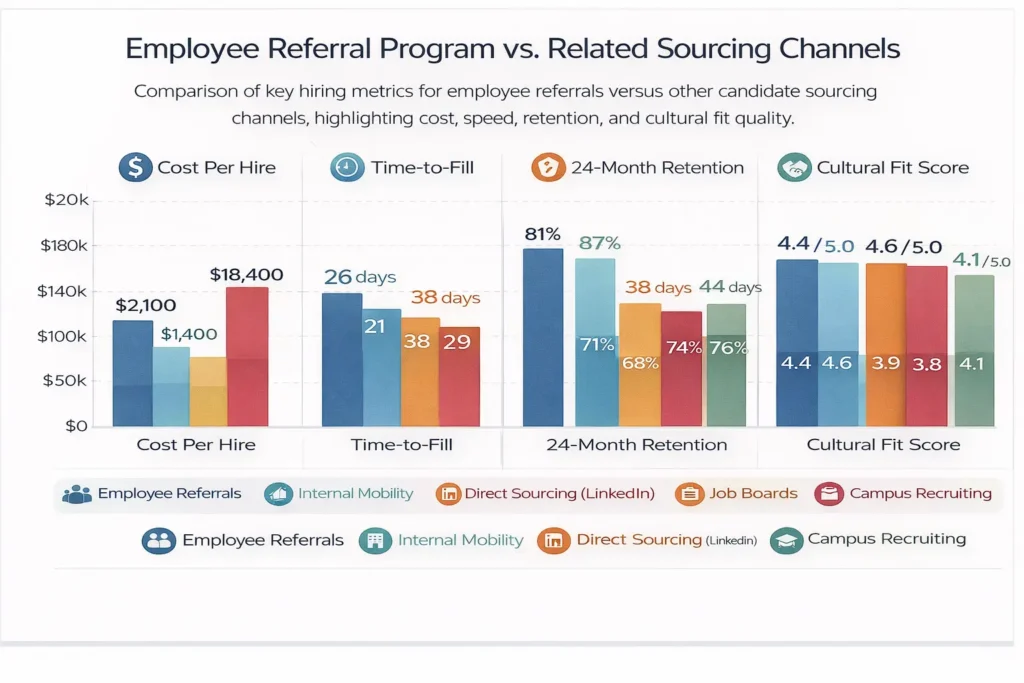
Employee Referral Program vs. Related Sourcing Channels
| Channel | Cost Per Hire | Time-to-Fill | 24-Month Retention | Cultural Fit Score |
|---|---|---|---|---|
| Employee Referrals | $2,100 | 26 days | 81% | 4.4 / 5.0 |
| Internal Mobility | $1,400 | 21 days | 87% | 4.6 / 5.0 |
| Direct Sourcing (LinkedIn) | $5,800 | 38 days | 71% | 3.9 / 5.0 |
| Job Boards | $3,900 | 33 days | 68% | 3.7 / 5.0 |
| Contingency Agency | $18,400 | 29 days | 74% | 3.8 / 5.0 |
| Campus Recruiting | $4,200 | 44 days | 76% | 4.1 / 5.0 |
What the Experts Say?
The best referral programs I have seen do one thing differently from the rest: they treat every employee as a recruiter who just needs the tools and information to do it well. Not a passive participant in a bonus program, but an active partner in building the team. That mindset shift changes everything about how the program is designed and communicated.
– Stacy Zapar, Founder of The Talent Agency
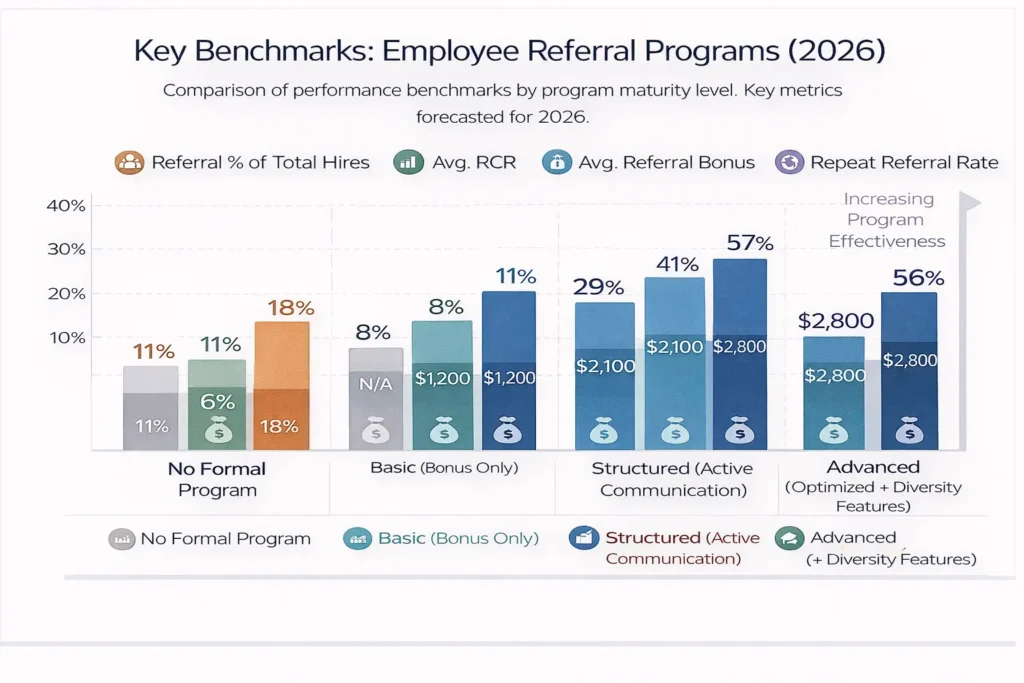
Key Benchmarks: Employee Referral Programs (2026)
| Program Maturity | Referral % of Total Hires | Avg. RCR | Avg. Referral Bonus | Repeat Referral Rate |
|---|---|---|---|---|
| No Formal Program | 11% | 6% | N/A | 18% |
| Basic (Bonus Only) | 18% | 8% | $1,200 | 24% |
| Structured (Active Communication) | 29% | 11% | $2,100 | 41% |
| Advanced (Optimized + Diversity Features) | 37% | 14% | $2,800 | 56% |
Quick-Reference Cheat Sheet
Key Formula
RCR (%) = (Hires from Referrals ÷ Total Referrals Submitted) × 100
Referral Program Design Checklist:
- Bonus: Meaningful relative to role level ($1,000+ for professional roles)
- Communication: Push open roles to employees weekly via email or Slack
- Process: Submission in under 2 minutes; recruiter handles qualification
- Feedback: Acknowledge within 24 hours; update at each stage
- Diversity: Include specific incentives for referrals that expand demographic representation
- Recognition: Non-financial acknowledgment for successful referrers
Dos:
Don’ts:
Gig Talent Engagement Dos:
Gig Talent Engagement Don’ts:
Related Terms
| Term | Definition |
|---|---|
| Referral Conversion Rate (RCR) | The proportion of referrals submitted that result in a hire; the primary referral program quality metric |
| Employee Advocacy | The broader practice of employees sharing organizational content and recommendations with their networks; referral programs are the talent acquisition application |
| Source of Hire | The channel through which a hired candidate first entered the pipeline; referral tracking is essential for measuring program ROI |
| Employee Branding | The employer brand value generated by employee voices; referral programs are the direct behavior equivalent of the brand advocacy intent captured by eNPS |
Frequently Asked Questions
What percentage of hires should come from referrals?
Well-run referral programs typically produce 25 to 40% of total hires. Organizations below 15% are underperforming on what is typically their highest-ROI sourcing channel. The target percentage varies by role type (senior roles may run lower; high-volume roles may run higher) and by the strength of the employee base’s professional networks.
Should all employees be eligible to refer for all roles?
Generally yes, with two practical modifications: employees should not refer candidates for roles in their direct reporting chain (conflict of interest in the hiring process), and hiring managers should not receive the referral bonus for roles they are directly filling (they have a financial incentive in any hire). Beyond these guardrails, broad eligibility produces broader network reach.
How do you prevent nepotism in referral programs?
By maintaining rigorous assessment standards for all candidates, including referred ones. Referred candidates should go through the same structured assessment process as all other candidates. The referral bonus is paid based on successful hire and retention, not based on the decision to interview. Hiring managers who advance unqualified referred candidates because of the referring employee’s relationship are identified and addressed through standard hiring quality monitoring.
Conclusion
The employee referral program is the sourcing channel that most organizations know they should invest in and most organizations under-invest in. The barrier is not belief in the concept; every TA leader has data showing referrals outperform other channels. The barrier is program design: the willingness to invest in making the submission process genuinely frictionless, the communication cadence genuinely consistent, and the feedback loop genuinely responsive.
Organizations that make that investment get a sourcing channel that produces better candidates at lower cost with higher retention. And they get something else: a workforce that feels like a genuine partner in building the team, rather than an afterthought in the recruiting strategy.
That partnership, built one referral at a time, is the highest-yield talent acquisition investment most organizations are not yet making.