For most of its existence, HR operated on instinct dressed up as expertise. Compensation decisions were made because “that’s what the market pays.” Attrition was a surprise because “we didn’t see it coming.” Hiring decisions were made because the hiring manager “had a good feeling.” None of that is unprofessional, it is simply what happens when the data doesn’t exist or isn’t being used. HR Analytics changed the terms of that bargain. Now the data exists. The question is whether the organization is using it.
HR Analytics (also called People Analytics or Workforce Analytics) is the practice of collecting, organizing, and analyzing workforce data to generate insights that inform human resource decisions, optimize talent practices, and connect people strategy to business outcomes. It ranges from descriptive reporting (what is currently happening in the workforce) through diagnostic analysis (why it is happening) to predictive modeling (what is likely to happen next) and prescriptive analytics (what should be done about it).
In 2026, HR Analytics is the fastest-growing investment area in HR technology. AI-powered analytics platforms have democratized capabilities that were previously available only to organizations with dedicated People Analytics teams, making predictive attrition modeling, compensation equity analysis, and hiring effectiveness measurement accessible to organizations that would not have had the analytical resources to build these capabilities five years ago.
The core metric of HR Analytics maturity is the Analytics Activation Rate: the proportion of HR decisions in a defined period that are informed by quantitative data analysis rather than intuition or precedent alone.
Analytics Activation Rate (%) = (Data-Informed HR Decisions ÷ Total HR Decisions in Period) × 100
Best-in-class people analytics organizations report Analytics Activation Rates above 70% for strategic decisions. The industry average is significantly lower, approximately 29%; reflecting the gap between organizations that have invested in analytics infrastructure and those that have the data but lack the culture, capability, or tools to use it.
What is HR Analytics?
HR Analytics is the systematic application of data analysis, statistical methods, and increasingly machine learning techniques to workforce data, with the objective of generating insights that improve HR practice, talent outcomes, and organizational performance. It encompasses both the technical discipline of data analysis and the organizational capability of translating analytical outputs into decisions that HR professionals and business leaders actually make.
The defining characteristic of HR Analytics as a discipline, what distinguishes it from HR reporting; is the move from describing what happened to explaining why it happened and predicting what will happen next. An HR report tells you that turnover was 18% last year. HR Analytics tells you which teams had disproportionate attrition, what factors predicted that attrition, and what interventions would have reduced it.
Is HR Running on Data or Running on Gut Feel?
The honest answer, for most organizations, is: some of both, and the balance is shifting faster than most HR leaders are comfortable admitting.
The gut-feel era of HR was not irrational. For most of the history of the function, the data infrastructure to support analytical decision-making simply didn’t exist. Employee data was in paper files or siloed administrative systems. The analytical tools available to HR were spreadsheets. The competitive pressure to make data-driven people decisions was modest, because everyone was operating with similar information constraints.
None of those conditions exist today. HRIS platforms capture detailed employee data at scale. Analytics tools are accessible and increasingly embedded in the HR software stack. And the competitive pressure is significant: organizations that use people analytics effectively identify flight risks before they become departures, fill roles faster with higher-quality candidates, and allocate development investment to the people and skills most likely to drive business outcomes.
The cost of not shifting is quantifiable. Research by McKinsey & Company found that organizations in the top quartile of people analytics maturity had 18% lower attrition and 22% higher revenue per employee than those in the bottom quartile. The performance gap is not explained by industry, scale, or talent market, it is explained by whether the organization is making its people decisions with data or without it.
A concrete scenario: a professional services firm with 1,200 employees has been experiencing consistent voluntary attrition in its senior consultant population; the cohort that represents the highest training investment and the greatest client relationship value. The CHRO describes it as a “compensation market problem“; a conclusion reached through informal benchmarking and exit interview anecdotes. When the firm builds a simple predictive attrition model from HRIS data, they find that compensation explains only 31% of the attrition variance.
The dominant predictors are manager quality (measured by direct report engagement scores), career velocity (measured by time-in-band versus peer average), and project allocation (measured by the proportion of billable hours on development projects versus production work). None of these variables had appeared in exit interview anecdotes, which systematically overrepresent compensation as the stated reason for departure. The analytical finding redirects intervention spend from compensation adjustments, which were being considered, to manager effectiveness programs and career velocity policies that address the actual causes.
The ROI calculation: the firm was considering a 12% compensation increase for the senior consultant band at an annual cost of approximately $2.4M. The analytics finding redirected to a manager program at $180,000 and a career velocity policy at negligible cost. If those interventions reduce senior consultant attrition by 25%, a conservative estimate given the strength of the predictive signal, the firm avoids approximately $1.8M in replacement and productivity loss costs annually. The analytics investment that produced this finding: approximately $65,000 in platform licensing and 80 hours of analyst time.
Your Resume Isn’t Getting Read
Let’s Get That Fixed!
75% of resumes get auto-rejected. avua’s AI Resume Builder optimizes formatting, keywords, and scoring in under 3 minutes, so you land in the “yes” pile.
The Psychology Behind HR Analytics Adoption
Analyst’s Paradox and the Threat of Quantification
One of the most consistent barriers to HR Analytics adoption is the resistance of experienced HR professionals to having their judgment quantified and therefore evaluated. If analytical models reveal that certain hiring managers consistently select underperforming candidates, or that certain recruitment channels produce lower-quality hires, those findings challenge the professional self-conception of the people responsible for those outcomes. Managing the psychological safety of analytical findings, presenting data as learning tools rather than performance verdicts, is a critical implementation skill that purely technical approaches to HR Analytics consistently overlook.
Data Literacy as a Status Signal
In organizations where quantitative capability is concentrated in finance and engineering, HR’s historical non-quantitative identity has been a source of functional distinction rather than acknowledged deficit. Introducing HR Analytics programs in these organizations can feel like ceding cultural ground to the finance mindset, which creates resistance that is not about the data itself but about what the data represents for the function’s identity. HR Analytics programs that are positioned as expanding HR’s strategic influence rather than importing finance’s operational logic have significantly higher adoption rates.
Confirmation Bias in Analytical Interpretation
The same cognitive bias that affects unstructured interviews, the tendency to weight evidence that confirms prior beliefs more heavily than evidence that contradicts them, operates in HR data interpretation. HR Analytics programs that produce findings consistent with existing organizational narratives are embraced; those that challenge accepted explanations are questioned, rationalized, or selectively reported. Building analytical governance processes that require findings to be reviewed before conclusions are drawn reduces (though never eliminates) confirmation bias in analytical interpretation.
HR Analytics vs. Related Data Practices
| Practice | Question It Answers | Output | Key Difference from HR Analytics |
|---|---|---|---|
| HR Reporting | What happened? | Descriptive dashboards; headcount reports | Historical; no predictive or diagnostic element |
| HR Analytics | Why did it happen? What will happen next? | Diagnostic and predictive models | Causal and forward-looking |
| People Analytics | Same as HR Analytics; emphasis on individual/team level | People-level insights | Often used interchangeably with HR Analytics |
| Workforce Analytics | What does the workforce look like at strategic level? | Workforce composition and capability analysis | Strategic lens; typically longer time horizon |
| Talent Intelligence | What does the external talent market look like? | Market data; competitive intelligence | External focus; informs sourcing and compensation |
What the Experts Say?
The ROI of People Analytics is not in the models, it’s in the decisions they change. An organization that builds a 94% accurate attrition model but continues making retention decisions the same way it always has has bought sophisticated reporting software, not a competitive advantage.
– Josh Bersin
How to Measure HR Analytics Effectiveness?
Formula
Analytics ROI = (Business Value of Analytics-Informed Decisions − Cost of Analytics Program) ÷ Cost of Analytics Program
Decision Quality Improvement Rate (%) = (Avg. Outcome Score of Analytics-Informed Decisions − Avg. Outcome Score of Gut-Feel Decisions) ÷ Avg. Outcome Score of Gut-Feel Decisions × 100
Benchmarks by Analytics Maturity Stage
| Maturity Stage | Avg. Analytics Activation Rate | Best-in-Class Outcome Impact |
|---|---|---|
| Reporting only | 8–12% | Minimal |
| Diagnostic analytics | 28–35% | Moderate (15–20% improvement in targeted decisions) |
| Predictive modeling | 52–61% | Significant (25–35% improvement) |
| AI-embedded analytics | 72–84% | Transformative (40%+ improvement) |
Key Strategies for Building HR Analytics Capability
- Start with the three questions your CHRO can’t currently answer. The most effective HR Analytics programs don’t begin with data — they begin with the business decisions that most need to be informed by data. Define three to five decisions that are currently being made on intuition and build the analytical capability to inform those specific decisions first.
- Invest in data quality before analytical sophistication. A simple regression model on clean, complete data outperforms a sophisticated machine learning model on dirty data. Data quality investment is the highest-leverage analytical infrastructure investment available to most HR organizations.
- Embed analytics in decisions, not reports. Analytics delivered through periodic dashboard reports that HR leaders browse at their convenience produces a fraction of the decision impact of analytics embedded in the workflow where decisions are made. Attrition risk scores surfaced in the HRIS when a manager conducts a performance review change decisions. Attrition risk reports delivered in a monthly PDF rarely do.
- Build data literacy alongside technical capability. Analytics programs that outpace the data literacy of the HR professionals they are designed to support produce analytical outputs that are not used. HR Analytics implementation should include structured data literacy development for the HR generalist and HRBP population who will be the primary consumers of analytical insights.
- Use Avua’s built-in hiring analytics to start with the most data-rich domain in HR, recruitment, and build analytical credibility and organizational data habits from there.
How Can AI and Automation Advance HR Analytics?
Predictive Attrition Modeling
Machine learning models trained on historical HRIS data, incorporating tenure, performance trajectory, compensation position, manager quality, team stability, and career velocity, can predict individual-level attrition risk with 80–90% accuracy at 90-day horizons. This converts attrition from a surprise to a managed risk, enabling targeted retention interventions for high-risk, high-value employees before they resign.
Natural Language Survey Analysis
AI-powered text analytics can process open-ended survey responses, exit interview transcripts, and performance review comments at organizational scale, extracting thematic patterns, sentiment trajectories, and early warning signals that would be invisible in aggregate quantitative survey data.
A cohort of employees whose survey language includes increasing frequency of words associated with purpose deprivation, managerial conflict, or compensation frustration can be identified for targeted intervention months before those themes appear in quantitative attrition data.
Compensation Equity Analysis
AI analytics platforms can run continuous pay equity analysis across the full workforce, controlling for role, level, tenure, performance, and geography, and surface equity gaps in real time rather than at annual audit cycles. Continuous monitoring converts pay equity from a compliance exercise into an operational practice.
Skills Gap Forecasting
AI tools trained on both internal workforce data and external skills market data can forecast the skills gaps that the organization will face at 12–18 month horizons, based on projected business initiatives, current workforce skill profiles, and training completion trajectories. This forward-looking skills intelligence is the foundation of genuine workforce planning.
Stop Juggling
10 Job Boards.
Search One
Your next role is already here. avua pulls opportunities from across the web into a single searchable feed; filtered by role, location, salary, and remote preference.
1.5 Million+
Active Jobs
380+
Job Categories
HR Analytics and Diversity & Inclusion
Representation Analytics at Every Lifecycle Stage
Effective DEI analytics tracks demographic representation not just at hire and aggregate workforce level, but at every stage of the employee lifecycle: hiring funnel conversion by stage, promotion rates by demographic group, performance rating distribution, compensation equity, and attrition rates. The gap between representation at entry and representation at senior levels, when disaggregated by lifecycle stage — reveals precisely where the organizational system is filtering out specific groups and enables targeted intervention.
Bias Detection in People Decisions
HR Analytics can detect systematic patterns in people decisions that are consistent with demographic bias, performance rating distributions that differ by race or gender independent of tenure and role, promotion decisions that systematically favor specific demographic profiles, compensation offers that differ by gender in ways not explained by role or experience. These patterns are not detectable through individual review of individual decisions; they require analytical aggregation to become visible.
Inclusive Survey Design
The validity of HR Analytics findings depends on the quality of the data inputs, including survey data. Survey instruments designed without attention to language accessibility, cultural context sensitivity, and anonymity assurance produce systematically biased response patterns that undermine analytical conclusions. Inclusive survey design is a technical prerequisite for analytically valid DEI measurement.
Common Challenges and Solutions
| Challenge | Solution |
|---|---|
| HR Analytics findings are produced but not acted on | Assign a named decision owner for each analytical output; require action plan documentation within 30 days of finding delivery |
| Insufficient data quality for reliable predictive modeling | Prioritize a 90-day data quality sprint on the two or three variables most critical to the target use case before building models |
| HRBP population lacks confidence interpreting analytical outputs | Build a structured data literacy program covering the specific analytical tools and outputs HRBPs will encounter |
Real-World Case Studies
Case Study 1: The Professional Services Firm
A 900-person professional services firm experiencing persistent attrition among its 3–5 year tenure cohort built a predictive attrition model from HRIS data. The model identified manager quality (measured by direct report engagement scores) as the strongest single predictor of attrition, stronger than compensation, project allocation, or career progression velocity.
The firm invested $120,000 in targeted manager effectiveness programs for the 15 managers identified as highest-risk. Attrition in that cohort fell from 24% to 16% in the subsequent year, an improvement worth approximately $1.8M in avoided replacement costs.
Case Study 2: The Retail Group
A national retail group used HR Analytics to investigate a persistent quality-of-hire gap between candidates sourced through two different channels. Analysis found that candidates from Channel A (a major job board) had 12-month performance ratings averaging 3.2/5.0, while candidates from Channel B (an AI-powered hiring platform) averaged 3.9/5.0. The sourcing budget was reallocated toward Channel B for high-value roles. Quality-of-hire scores improved by 0.4 points on average, and 90-day attrition fell by 11 percentage points.
Case Study 3: The Technology Company
A technology scale-up deployed a mobile-first HR Analytics dashboard for its managers, surfacing team-level engagement trends, attrition risk signals, and performance distribution data on mobile devices for managers who rarely used desktop applications. Manager engagement with people analytics jumped from 12% (desktop only) to 71% (mobile-accessible), and the number of HR-prompted manager conversations triggered by analytics alerts increased from four per month to 23.
Building an HR Analytics Capability Dashboard: What to Track?
Here is how can get it done:
HR Analytics Across the Employee Lifecycle
Sourcing and Hiring Analytics
The highest-data-density stage of the employee lifecycle, and typically the first place organizations invest in analytics capability. Hiring funnel conversion rates, source quality analysis, time-to-fill trends, cost-per-hire, and Quality of Hire measurement provide a foundation of analytical practice that is easier to build than longitudinal workforce analytics because the data is more structured and the outcomes are faster to measure.
Engagement and Retention Analytics
The highest-business-value analytics domain for most organizations, predicting and preventing voluntary attrition in high-value populations. Effective engagement analytics requires longitudinal HRIS data, quality engagement survey infrastructure, and the analytical capability to integrate multiple data streams into predictive models.
Performance and Development Analytics
Analytics applied to performance rating distributions, development investment allocation, and career progression velocity. The primary use cases are identifying high-potential employees for development investment, detecting performance management inconsistency across managers, and connecting development spend to performance outcome improvement.
Compensation Analytics
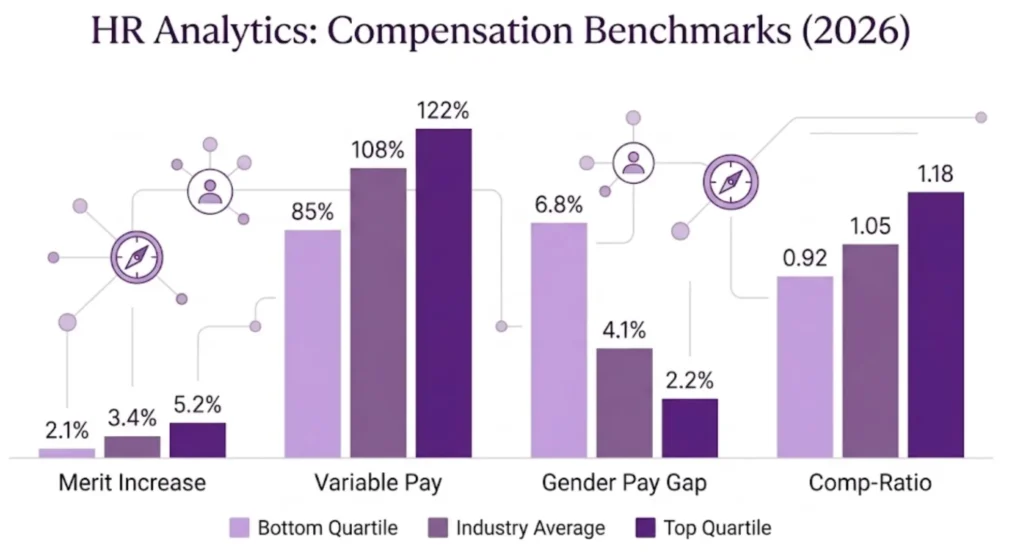
Pay equity analysis, compensation benchmarking, and compensation-attrition correlation analysis. Compensation analytics is the most technically straightforward HR analytics domain (compensation data is the most consistently structured in most HRIS platforms) and among the most high-stakes from a legal and employee trust perspective.
| Scenario | Analytics Maturity | Attrition Rate | Est. Annual Attrition Cost |
|---|---|---|---|
| No analytics (gut feel) | None | 22% | $3.3M |
| Reporting only | Low | 19% | $2.85M |
| Diagnostic analytics | Medium | 16% | $2.4M |
| Predictive + embedded | High | 12% | $1.8M |
Assumes 500-employee organization, $30K average replacement cost per employee.
Related Terms
| Term | Definition |
|---|---|
| People Analytics | Often used interchangeably with HR Analytics; typically refers to analytics applied at the individual or team level |
| Predictive Analytics | Statistical modeling techniques used to forecast future outcomes based on historical data patterns |
| Quality of Hire | A composite metric measuring the performance, retention, and contribution of employees relative to hiring expectations |
| Attrition Rate | The rate at which employees leave an organization in a defined period |
| HRIS | The system of record for employee data that serves as the primary data source for HR analytics |
Frequently Asked Questions
What is the difference between HR reporting and HR analytics?
HR reporting describes what happened, headcount, turnover rate, time-to-fill. HR Analytics explains why it happened and predicts what will happen next. Reporting is backward-looking; analytics is diagnostic and forward-looking. The distinction matters because organizations that invest in reporting without analytics have visibility into outcomes but not the insight to change them.
How do you start an HR analytics program?
Begin with three specific business questions that are currently being answered with gut feel, and build the simplest possible analytical approach to inform those three decisions better. Secure one business win with demonstrable ROI, use it to fund the next phase, and build analytical credibility before investing in platform sophistication.
Do you need a data scientist to do HR analytics?
For basic descriptive analytics and simple predictive models on structured HRIS data, no. Modern HRIS platforms and standalone people analytics tools include statistical modeling capabilities accessible to HR professionals with modest quantitative skills. For complex multi-variable predictive modeling or unstructured data analysis (text analytics on survey comments), data science capability is valuable, either in-house or through vendor partnerships.
How do you ensure HR analytics is used ethically?
Key principles: transparency (employees should know what data is collected and how it is used), purpose limitation (data collected for one purpose should not be repurposed without employee knowledge), fairness validation (models should be tested for demographic bias), and human oversight (algorithmic outputs should inform, not replace, human decisions on individual employees).
What is the ROI of investing in HR analytics?
Research consistently shows returns of 3–8x on people analytics investments for organizations that successfully translate analytical outputs into decisions. The ROI comes primarily from attrition reduction (largest dollar value), quality-of-hire improvement (second largest), and labor cost optimization. Organizations that invest in analytics capability but fail to change decisions produce near-zero ROI.
Conclusion
HR Analytics is not a technology purchase, it is an organizational capability that changes how people decisions are made. The technology is the easy part; the culture change is the hard part.
Organizations that have built genuine analytics cultures, where HR professionals are expected to bring data to decisions, where gut feel is a starting hypothesis rather than a final answer, and where analytical findings change outcomes not just reports, are outperforming their peers on every workforce metric that matters.
The shift from reporting what happened to predicting what will happen and prescribing what to do about it is the transformation that separates the HR function that is a strategic partner from the one that is an administrative support service.