Hiring across international borders used to force a tough choice: establish an expensive legal entity or risk non-compliance with independent contractors.
Today, the Employer of Record (EOR) model offers a seamless third way, allowing you to hire global talent without the bureaucratic headache. In 2026, this has become a cornerstone of global talent acquisition, transforming how we view the employee lifecycle on a global scale.
By utilizing an EOR, companies can navigate complex DEI (Diversity, Equity, and Inclusion) goals by accessing diverse talent pools in over 150 countries. This flexibility is essential in a gig economy where speed and compliance are paramount.
Whether you are scaling a remote team or testing new markets, understanding the EOR framework ensures your employee experience remains top-tier from day one, regardless of geography. It’s no longer just a workaround; it’s a competitive necessity.
The primary metric for EOR program effectiveness is EOR Compliance Rate (ECR):
ECR (%) = (Workers Employed Within Compliant Local Labor Framework ÷ Total Workers in EOR Arrangements) × 100
A target ECR of 100% is the baseline requirement; anything below 100% indicates compliance exposure. Secondary metrics include time-to-employment (the speed from candidate selection to compliant employment start), cost per EOR employee versus entity establishment cost, and worker satisfaction with the EOR employment experience.
What is an Employer of Record?
An EOR is a legally recognized employer entity that, by contractual arrangement with a client organization, assumes all formal employment obligations for workers in a specific jurisdiction on behalf of the client, including executing employment contracts under local law, administering payroll and statutory benefits, remitting taxes and social contributions, and managing compliance with employment regulations, while the client organization retains control over work direction, performance management, and business activities.
Three parties are involved in every EOR arrangement. The EOR is the legal employer: the entity whose name appears on the employment contract, payroll records, and benefits enrollment. The client company is the business that directs the work: the organization whose projects and priorities the worker actually serves. And the worker is the individual employed by the EOR, performing work for the client under an EOR structure.
The arrangement is sometimes described as a triangular employment relationship, which accurately captures the distribution of responsibility: legal employment obligations sit with the EOR; operational direction sits with the client; and the worker receives employment from one party and work assignments from another.
When Does EOR Make Sense, and What Are Its Limits?
The EOR model isn’t a one-size-fits-all silver bullet. To avoid overpaying or walking into a management nightmare, you need to know exactly where it adds value and where it starts to feel like a bureaucratic straightjacket.
The “Sweet Spot” for EOR
EOR shines brightest in four specific scenarios:
- The Need for Speed: When you need to hire immediately. Establishing a legal entity can take 3 to 12 months; an EOR can have someone onboarded in weeks.
- Small Footprints: If your headcount in a country is under 10 to 15 people, the administrative overhead of a local entity simply isn’t cost-effective.
- Market Testing: When you’re dipping a toe into a new geography and do not want to commit to permanent, expensive infrastructure.
- High-Stakes Talent: When a critical hire is at risk of ghosting in recruitment because you cannot offer a compliant local contract fast enough.
The Reality Check: Limitations to Consider
EOR has real boundaries. First, there is the “EOR tax“: you’ll typically pay a premium of 10% to 15% over total employment costs. Then there’s the triangular relationship. When you aren’t the “legal” employer, performance management and terminations require a delicate dance between your managers and the EOR’s HR team.
Furthermore, some countries view long-term EOR usage with suspicion, requiring specific structures to avoid legal recharacterization. You also lose a degree of cultural control; you are often stuck with the EOR’s payroll cycles and benefit packages, which might not align with your internal brand.
The Data-Driven Verdict
Research from the Everest Group highlights why companies take the plunge: organizations using EOR services reach operational productivity with new hires 62% faster and achieve compliance rates 34% higher than those using contractors. Embracing data-driven recruiting allows you to see that while the sticker price is higher, the “cost of waiting” is often much higher.
A Concrete Example: The “Germany Dilemma“
Imagine a US tech firm needing a senior product manager in Germany for a project launching in two months.
- Option A (DIY): Establishing a German entity takes 4+ months and $15,000 in fees.
- Option B (EOR): The hire starts in 3 weeks. The 12-month EOR premium is roughly $9,000.
In this case, EOR is the winner. However, if that same firm plans to hire 20 people in Berlin, their cost-per-hire would eventually skyrocket under an EOR. At that scale, hiring a compliance specialist and opening an office is the smarter play to solve future remote work challenges.
EOR is your bridge to a global market; just make sure you know when it’s time to stop paying the toll and build your own road.
Your Resume Isn’t Getting Read
Let’s Get That Fixed!
75% of resumes get auto-rejected. avua’s AI Resume Builder optimizes formatting, keywords, and scoring in under 3 minutes, so you land in the “yes” pile.
EOR vs. Related Employment and Staffing Models
| Model | Legal Employer | Work Director | Use Case | Compliance Level |
|---|---|---|---|---|
| Employer of Record (EOR) | Third-party EOR | Client company | International hire without local entity | High (EOR manages local compliance) |
| Professional Employer Organization (PEO) | Co-employment: client + PEO | Client company | Domestic HR outsourcing; benefits pooling | High (PEO manages compliance with client) |
| Staffing Agency | Staffing agency | Client company | Temporary staffing; specific skill needs | High (agency manages employment) |
| Independent Contractor | None (self-employed) | Client company | Project-based; specialized skills | Risk (misclassification exposure) |
| Direct Entity Employment | Client company | Client company | Long-term presence; scale employment | Full (client manages compliance) |
| Contractor of Record (COR) | Third-party COR | Client company | Contractor compliance management | Moderate (manages contractor status) |
The most important distinction in this table is between EOR (which establishes a genuine employment relationship under local law) and independent contractor arrangements (which do not). Many organizations that have historically used contractor arrangements for international hires have significant misclassification exposure under local labor law, which EOR arrangements specifically address.
Common Misconceptions About EOR
| Misconception | Reality |
|---|---|
| EOR and PEO are the same thing | EOR is used for cross-border hiring without a local entity; the EOR is the sole legal employer. PEO is primarily domestic and involves co-employment: both the PEO and the client company share employer status. The legal structures and use cases are distinct. |
| EOR workers are contractors | EOR workers are employees: they have employment contracts, receive statutory benefits, accrue leave, and have all the protections of local employment law. The EOR arrangement is a solution to the contractor misclassification problem, not a version of it. |
| EOR is always more expensive than entity establishment | For small headcounts (under 10 to 15 employees in a single country), EOR is typically less expensive than entity establishment when all-in costs (legal fees, registered address, accounting, compliance) are calculated. At scale, entity establishment becomes cost-effective. The breakeven analysis should be conducted before choosing between models. |
| EOR providers manage all local employment risk | The EOR manages compliance with local employment law. Client companies retain responsibility for work direction, performance management decisions, and any instructions to the EOR that could expose the arrangement to legal challenge. Client compliance with the structure of the EOR arrangement is a shared responsibility. |
| EOR is only for permanent hires | EOR is also used for fixed-term employment, project-based hires, and trial employment periods in countries where direct contractor engagement creates misclassification risk. The employment term is defined in the EOR contract and can be structured for the specific engagement type |
What the Experts Say?
EOR has genuinely changed the economics of international talent acquisition. The conversation used to be ‘can we afford to hire in this country?’ Now it is ‘which model makes the most sense for this hire at this stage?’ That is a fundamentally different conversation, and it has opened up the global talent market to a much broader range of organizations than could access it before.
– Tomer London, co-founder of Gusto and widely cited voice in global payroll and employment infrastructure
Key EOR Benchmarks (2026)
| Metric | EOR Average | Entity Employment Average | Contractor Arrangement |
|---|---|---|---|
| Time to Compliant Employment Start | 2 to 3 weeks | 3 to 12 months | 1 to 2 weeks |
| Compliance Rate | 97% | 99% | 61% |
| Cost Premium vs. Direct Employment | 10 to 15% | Baseline | -20% (but with misclassification risk) |
| Worker Satisfaction with Employment Experience | 3.8 / 5.0 | 4.2 / 5.0 | 3.4 / 5.0 |
| Countries with EOR Provider Coverage | 150+ | Requires per-country entity | N/A |
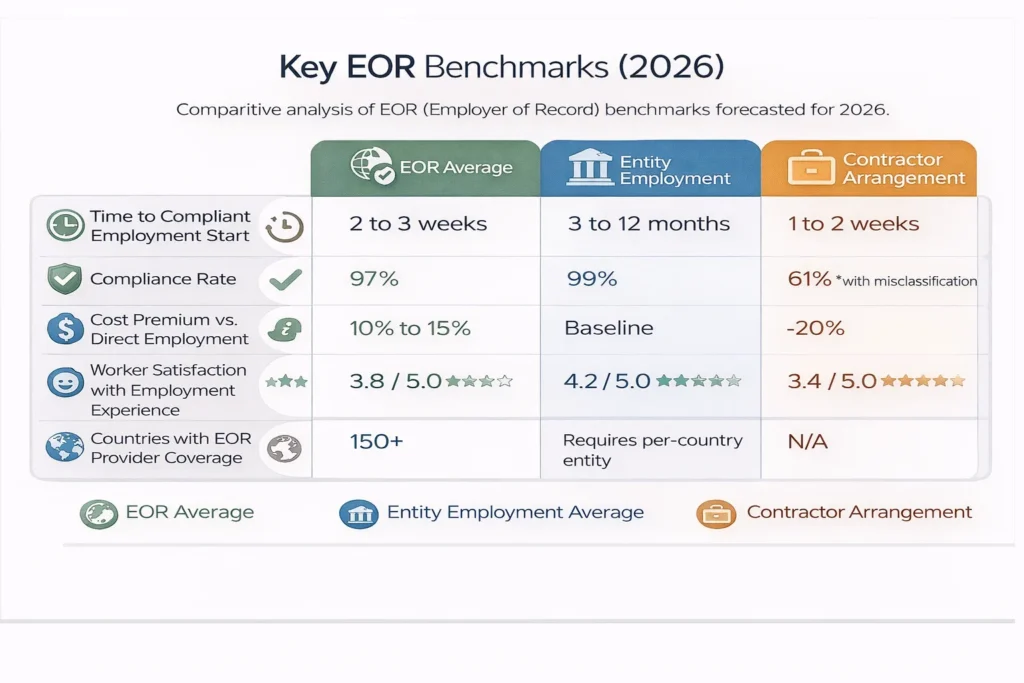
The compliance rate differential between EOR arrangements (97%) and contractor arrangements (61%) for equivalent roles is the most important figure in this table. The contractor model’s lower cost comes with a misclassification exposure that, when realized, produces penalties that typically exceed the cost savings many times over. EOR’s compliance premium is the primary reason organizations are migrating from contractor arrangements to EOR for roles that genuinely require an employment relationship under local law.
Stop Juggling
10 Job Boards.
Search One
Your next role is already here. avua pulls opportunities from across the web into a single searchable feed; filtered by role, location, salary, and remote preference.
1.5 Million+
Active Jobs
380+
Job Categories
How AI Is Affecting EOR Decisions?
Key Strategies for EOR Program Management
Here are a few key strategies you can use for appropriate EOR program management:
Quick-Reference Cheat Sheet
Key Formula
ECR (%) = (Workers in Compliant EOR Arrangements ÷ Total Workers in EOR) × 100
EOR vs. Entity Establishment Decision Framework:
| Factor | Favors EOR | Favors Entity Establishment |
|---|---|---|
| Headcount in country | Under 10 to 15 | Over 15 to 20 |
| Timeline | Under 3 months needed | Over 6 months acceptable |
| Strategic intent | Testing market; temporary | Permanent; long-term |
| Cost priority | Speed over unit cost | Unit cost over speed |
| Compliance certainty | Need immediate compliance | Can invest in local infrastructure |
Dos:
Don’ts:
Gig Talent Engagement Dos:
Gig Talent Engagement Don’ts:
Common Challenges and Solutions
| Challenge | Solution |
|---|---|
| EOR Worker Feeling Disconnected from Client Organization | Explicitly include EOR workers in team rituals, communications, and organizational events; assign an internal buddy or manager contact |
| Compliance Exposure from Manager Overreach | Train managers on EOR structural boundaries; define in writing which decisions require EOR coordination |
| Cost Escalation at Scale | Build workforce planning triggers for entity establishment; conduct annual cost-benefit review of EOR vs. entity for each country above 5 employees |
| Variable Compliance Quality Across EOR Provider Countries | Require country-specific compliance documentation from provider; conduct independent review for high-risk jurisdictions |
| Slow Payroll or Benefits Enrollment | Establish SLA expectations with EOR provider at contract; escalation process for administrative delays |
Related Terms
| Term | Definition |
|---|---|
| PEO (Professional Employer Organization) | A co-employment arrangement primarily used domestically for HR outsourcing and benefits pooling; distinct from EOR in legal structure and use case |
| Contractor of Record (COR) | A third-party organization that manages the contractual relationship and compliance obligations for independent contractors; addresses contractor compliance but does not create an employment relationship |
| Worker Misclassification | The erroneous treatment of an employee as an independent contractor; EOR arrangements are specifically designed to prevent misclassification for international hires |
| Global Mobility | The organizational function managing international employee movement; EOR is one of the primary tools in the global mobility toolkit |
| Co-Employment | An employment structure where two organizations share employer obligations for the same worker; characteristic of PEO (domestic) but not standard EOR (where the EOR is the sole employer) |
Frequently Asked Questions
What is the difference between EOR and PEO?
EOR is used for international hiring without a local entity: the EOR is the sole legal employer in the target country. PEO is primarily domestic and involves co-employment: both the PEO and the client share employer status, with the PEO providing HR and benefits services. EOR is the solution for international expansion without entity establishment; PEO is primarily an HR outsourcing and benefits pooling solution for domestic employees.
Can EOR be used for full-time permanent hires?
Yes. EOR supports permanent, full-time employment relationships. The EOR arrangement does not limit the term of employment; it structures the legal employer relationship. Many organizations use EOR for indefinitely-tenured employees in countries where they do not have a local entity.
What happens to the EOR arrangement when the client establishes a local entity?
When a client establishes a legal entity in a country where they have EOR workers, they typically transition those workers from EOR employment to direct employment through the new entity. Most EOR contracts address this transition scenario; the specific timeline, notice requirements, and process depend on the EOR agreement and local employment law. The transition is generally straightforward but should be managed with appropriate notice to workers and coordination between the EOR provider, the client’s legal team, and the new entity.
Is EOR the same as staffing?
No. Staffing agencies place temporary or permanent workers in client organizations, with the staffing agency as the legal employer during the placement. EOR specifically structures a relationship where a client-identified worker (not a worker the EOR sourced) is employed by the EOR while performing work for the client. The key difference is sourcing: in staffing, the agency finds the worker; in EOR, the client finds the worker and the EOR employs them. EOR is a legal structure tool, not a sourcing channel.
How do EOR workers receive benefits?
EOR providers administer the statutory benefits required under local employment law (pension contributions, health insurance where mandated, paid leave, social security) as part of the employment relationship. Additional benefits, beyond statutory requirements, may be provided by the EOR provider as part of their service offering, funded by the client’s fee, or arranged separately. The benefits experience for EOR workers may differ from direct employees of the client because it is administered through the EOR’s plans rather than the client’s corporate plans.
Conclusion
The Employer of Record model has genuinely democratized access to global talent. Organizations that previously faced a binary choice between expensive entity establishment and legally risky contractor arrangements now have a compliant, cost-effective path to employing the best available talent in any of more than 150 countries.
That access comes with responsibilities: selecting EOR providers whose compliance depth matches the legal requirements of the specific jurisdictions involved, managing the structural boundaries of the arrangement to maintain its legal integrity, and designing an employment experience for EOR workers that preserves the organizational connection and engagement that their unusual employment structure might otherwise erode.
Organizations that build these capabilities are accessing a global talent pool that was, until recently, effectively closed to most of them. That access, used well, is a genuine competitive advantage in talent markets where the best person for the role is increasingly unlikely to be within commuting distance of the office.