The term migrated from dating culture into professional life sometime around 2015, and it arrived with the full weight of the emotional register it carried in its original context: the sudden, unexplained cessation of communication by someone who was, until recently, a willing participant in an active exchange. In recruiting, ghosting describes the same phenomenon, applied to one of the most significant professional decisions most people make: whether to accept a job or continue in a hiring process.
And it goes both ways.
Ghosting in recruitment is a phenomenon in which either a candidate or an employer abruptly and without explanation terminates communication during an active hiring process, failing to show up for scheduled interviews, declining to respond to follow-up communication, withdrawing from a process without notification, or, in the case of employer ghosting, failing to provide status updates, hiring decisions, or offer notifications to candidates who have completed assessment stages and who are reasonably expecting a response.
The phenomenon has become significantly more common since 2020 and has emerged as one of the most consequential candidate experience and process quality problems in talent acquisition. Its causes, consequences, and remedies are substantially different on the candidate side and the employer side, which is why understanding both is essential for TA professionals.
In 2026, ghosting has become normalized enough in some markets that its presence is anticipated and its absence is a competitive differentiator. Organizations that do not ghost candidates, that communicate promptly, specifically, and respectfully at every stage, are distinguishable in candidate experience surveys and are consistently cited in positive Glassdoor reviews as evidence of a respectful process. The bar is, unfortunately, not as high as it should be.
The primary metric for ghosting program impact is Candidate Communication Completion Rate (CCCR):
CCCR % = (Candidates Updated / Total Candidates) * 100
A CCCR of 100% means no candidate who completes a stage or is exited from the process is left without communication. Most organizations achieve CCCR of 55 to 70%. Best-in-class processes achieve above 90%.
What is Ghosting in Recruitment?
Recruitment ghosting is a communication failure by either party in a hiring process, in which a candidate or employer fails to provide expected status updates, notifications of decisions, or explanations for changes in process engagement, leaving the other party in an unresolved state of uncertainty that damages the relationship, the candidate experience, and in the case of employer ghosting, the employer’s talent brand.
The asymmetry between candidate ghosting and employer ghosting is significant. When a candidate ghosts, an organization loses one candidate from a pipeline that may include others. When an employer ghosts, the organization damages its reputation with the candidate, risks the candidate sharing their experience publicly, and contributes to the broader erosion of candidate trust in employer brand communications.
The power dynamic in the employment relationship, and the reputational consequences of employer-brand damage in a world where Glassdoor reviews are permanent and social sharing is instant, makes employer ghosting significantly more consequential than candidate ghosting, even when the candidate initiated the behavior first.
Why Ghosting Is Getting Worse Before It Gets Better?
Ghosting rates in recruitment have increased substantially since 2020, driven by structural changes in how the hiring process operates. The causes are different on each side.
Candidate ghosting has increased because the labor market has given more candidates more options simultaneously. A candidate who is two-thirds of the way through a three-week interview process and receives an offer from another employer has a rational calculation to make: invest two more weeks in this process with uncertain outcome, or accept the certain offer. The process that loses the candidate to a faster competitor often experiences what looks like ghosting but is actually a rational response to an elongated timeline. The organization that is ghosted is often the one whose process did not keep pace with the candidate’s option value.
Employer ghosting has increased because hiring volume and recruiter capacity have diverged. Recruiters managing 20 or more simultaneous open roles, each with multiple candidates in multiple stages, face genuine administrative constraints on consistent communication. The candidate who interviewed three weeks ago and has not heard back is not being ignored deliberately. They are being lost in a pipeline that the recruiter lacks the capacity to manage with the communication frequency the candidate deserves.
SHRM research finds that 60% of job seekers report having been ghosted by an employer during a hiring process, and that 72% of ghosted candidates share their experience with at least one person in their network. The word-of-mouth and review platform consequences of employer ghosting are not isolated to the individual candidate relationship. They compound across every ghosted candidate’s network, and in aggregate, they shape the talent brand that determines whether the next strong candidate applies.
The scenario that makes the systemic cost visible: a financial services company processes 1,200 applications per year for professional roles. Of these, 340 reach the phone screen stage and 110 complete first-round interviews. Current CCCR is 61%: 39% of candidates at each stage do not receive a status communication after completing that stage.
In absolute numbers, approximately 469 candidates per year are left without a response. If 72% of those share the experience with someone in their network, approximately 338 people in the professional networks of the company’s candidate pool hear a story about the company not responding to candidates. Over three years, that is over 1,000 people with a second-hand negative impression of the organization as an employer. The hiring team is generating a talent brand liability at scale without intending to.
Your Resume Isn’t Getting Read
Let’s Get That Fixed!
75% of resumes get auto-rejected. avua’s AI Resume Builder optimizes formatting, keywords, and scoring in under 3 minutes, so you land in the “yes” pile.
The Anatomy of Ghosting: Types and Causes
Candidate Ghosting
Employer Ghosting
Common Misconceptions About Ghosting in Recruitment
| Misconception | Reality |
|---|---|
| Candidate ghosting is primarily motivated by rudeness | Research on candidate ghosting consistently identifies time pressure, competing offers, and process length as the primary causes. Most candidates who ghost do not intend disrespect; they are managing competing options under time pressure. |
| Employer ghosting only affects candidates who are rejected | Candidates who are advancing through the process but not receiving status communication experience ghosting anxiety even when they are actually progressing well. The uncertainty itself is an experience problem. |
| Ghosting is inevitable in high-volume hiring | High-volume hiring makes ghosting more likely without automation. With ATS-integrated automated communications, CCCR of 90%+ is achievable at any volume. The constraint is process design, not volume. |
| A ghosted candidate is lost forever | Research on candidate re-engagement shows that candidates who were ghosted by an organization sometimes reapply if their experience at other organizations was worse or if they receive direct, personalized re-engagement outreach that acknowledges the poor prior experience. |
| Automating candidate communications removes the personal touch | Automated communications that are personalized (candidate name, specific role, specific stage) and respectfully written feel significantly less robotic to candidates than the silence they replace. The alternative to automation is not personal communication; it is no communication. |
Ghosting vs. Related Communication Failures
| Communication Failure | Description | Primary Impact | Remedy |
|---|---|---|---|
| Ghosting | Complete cessation of communication | Candidate experience; employer brand | Automated communication workflows; CCCR monitoring |
| Slow Communication | Communication occurring but delayed | Candidate experience; competing offer risk | SLA setting; recruiter accountability |
| Vague Communication | Communication occurring but uninformative | Candidate experience; confusion | Communication templates with specific content |
| Inconsistent Communication | Frequency varies unpredictably | Candidate anxiety; trust erosion | Standardized communication cadence |
| Rejection Without Feedback | Notified but without explanation | Candidate experience; missed improvement signal | Structured rejection with general feedback |
What the Experts Say?
Ghosting is a symptom of a process designed around the organization’s convenience rather than the candidate’s experience. Every candidate who completes an interview stage has made a significant investment of time and vulnerability in the organization. Leaving them without a response is not just rude. It is a statement about organizational values that candidates carry into their networks and onto review platforms.
– Kevin Grossman, President of Talent Board
Key Ghosting Benchmarks (2026)
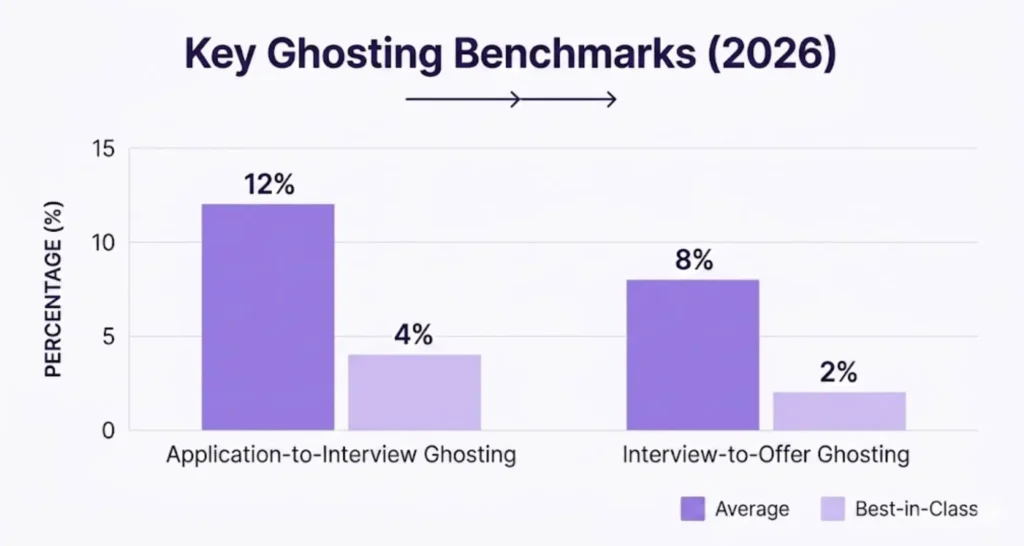
| Metric | Problematic | Average | Best-in-Class |
|---|---|---|---|
| Employer Ghosting Rate (Overall) | Above 45% | 30 to 40% | Under 10% |
| CCCR (All Stages) | Under 55% | 60 to 75% | Above 90% |
| Time to Post-Application Acknowledgment | Over 5 days | 2 to 4 days | Same day or next day |
| Time to Post-Interview Decision Communication | Over 10 days | 5 to 8 days | Under 3 days |
| Candidate NPS Impact of Ghosting | -28 to -41 points | -18 to -25 points | N/A (goal is prevention) |
| Candidate Ghosting Rate (No-Show) | Above 20% | 8 to 15% | Under 5% |
Key Strategies for Eliminating Employer Ghosting
How AI Is Reducing Ghosting?
Quick-Reference Cheat Sheet
CCCR (%) = (Candidates Receiving Status Update at Stage Transition / Total Candidates at Stage) × 100
The Anti-Ghosting Communication Calendar:
| Trigger Event | Maximum Time to Communication | Communication Type |
|---|---|---|
| Application submitted | 24 hours | Auto-acknowledgment |
| Screening decision made | 3 business days | Status update or rejection |
| Interview completed | 5 business days | Advance or rejection |
| Final interview completed | 3 business days | Decision communication |
| Offer extended verbally | 48 hours | Written offer documentation |
| Offer accepted | 1 business day | Pre-boarding initiation communication |
Dos:
Don’ts:
Common Challenges and Solutions
| Challenge | Solution |
|---|---|
| Recruiter Capacity Preventing Manual Communication | Implement automated communication workflows; CCCR is achievable at any volume with automation |
| Internal Decision Delays Leaving Candidates in Limbo | Communicate the delay specifically (“we are in our final decision stage and expect to have an update by X date”) rather than leaving candidates without any communication |
| Hiring Manager Slow to Make Decision Post-Interview | Set hiring manager SLA commitments; build debrief urgency into the process design; escalate when SLAs are missed |
| Candidate Ghosting Mid-Process | Audit process length; accelerate stages where candidates are most likely to receive competing offers; proactive check-in at 5-business-day marks |
| Candidate No-Show for Interview | Reminder email 24 hours before; same-day text confirmation; immediate rescheduling outreach if no-show occurs |
Real-World Case Studies
Case Study 1: The Technology Startup
A 200-person technology startup was experiencing candidate no-show rates of 28% for first-round interviews and a candidate NPS of -12 from post-process surveys. Analysis of candidate feedback identified that 67% of surveyed candidates cited “poor communication” as the primary reason for their negative process experience.
An audit of the ATS workflow revealed that application acknowledgment was manual (sent by recruiters when they had time), post-stage communication was ad hoc, and there was no structured rejection notification process. Candidates frequently experienced weeks of silence between each communication.
The startup implemented three automation workflows: an automatic 24-hour application acknowledgment, a 48-hour post-screen status update, and a structured rejection notification template for all stages. CCCR improved from 44% to 87% within two hiring cycles. No-show rate for first-round interviews declined from 28% to 9%. Candidate NPS improved from -12 to +31. The improvement required no additional headcount; it required process design.
Case Study 2: The Financial Services Firm
A financial services firm was experiencing high rates of offer acceptance followed by no-start (offer-to-start attrition of 21%) for mid-level professional roles. Investigation revealed that the average time between offer acceptance and start date was 31 days, and the average number of communications in that window was 1.2 per candidate.
Candidates who accepted offers were being left without contact for weeks, during which competing offers were arriving and current employer counteroffers were being made. The firm implemented a structured pre-boarding communication sequence: welcome communication same day as offer acceptance, introductory team video 3 days post-acceptance, “what to expect on Day 1” guide 7 days pre-start, and a personal manager call 3 days pre-start.
Offer-to-start attrition declined from 21% to 8% within three cohorts. The communication investment was minimal; the retention of accepted offers represented a substantial recovery of recruiting investment.
Related Terms
| Term | Definition |
|---|---|
| Candidate Experience | The overall quality of all candidate interactions with the hiring process; ghosting is one of the most damaging single factors in candidate experience quality |
| CCCR (Candidate Communication Completion Rate) | The proportion of candidates receiving status communications at each stage transition; the primary anti-ghosting operational metric |
| Candidate NPS | Candidate Net Promoter Score; the summary metric most directly affected by ghosting at the organization level |
| Pre-boarding | The structured communication period between offer acceptance and Day 1; the period where offer-to-start ghosting (by both parties) is most preventable |
| Employer Brand | The organization’s reputation as a place to work; employer ghosting is one of the primary causes of employer brand damage in candidate research channels |
Frequently Asked Questions
Should organizations inform candidates why they were rejected?
Yes, organizations should always provide feedback. Brief, matching-based rejections suffice for applications, while interviewees deserve more specific, professional insights. Even generic language is far superior to silence, fostering respect and supporting candidate development without legal risk.
Is candidate ghosting a dealbreaker for re-engaging them later?
Not necessarily. Candidates often ghost for rational reasons, like competing offers, meaning they remain high-quality prospects. Re-engaging them later without judgment for new roles can be successful, as their prior advancement proves their initial viability and market value.
How do you prevent internal decision delays from turning into candidate ghosting?
Separate internal delays from candidate communication. If a decision is lagging, send a transparent update with a specific follow-up date. This honesty transforms a frustrating silence into a professional process update, successfully maintaining the relationship and candidate interest.
What is the right way to respond when a candidate ghosts?
Send one direct follow-up message after a missed touchpoint to offer a reschedule or confirm interest. If they don’t respond, close the application immediately. Repeatedly chasing non-responsive candidates is unproductive and risks crossing the line into harassment.
Conclusion
Ghosting is, at its core, a communication problem. Candidates ghost because the process gives them no reason to invest in the relationship. Employers ghost because the process was not designed to make communication systematic and automatic.
Both sides of the problem are addressable. Candidate ghosting is reduced by shortening processes, accelerating decisions, and maintaining the candidate’s sense of momentum and investment. Employer ghosting is eliminated by automating communications, setting SLAs, and building the cultural expectation that every candidate who engages with the process receives a respectful, timely response at every stage.
The organizations that have built anti-ghosting cultures are not doing anything heroic. They are doing the basic things consistently: acknowledging applications, updating candidates after interviews, sending rejections promptly, and treating every candidate’s time and investment with the respect it deserves.
That consistency is not the ceiling of excellent candidate experience. But it is the floor. And an enormous number of organizations have not yet reached it.