The way work gets done is changing fast. Businesses are moving away from rigid headcounts and toward flexible, on-demand talent, and the gig economy is at the centre of that shift.
Whether you’re a hiring manager weighing contingency recruiting against full-time hires, or an HR leader rethinking your candidate engagement strategy, understanding how gig talent fits into your workforce is no longer optional. It’s a competitive advantage.
This guide breaks down what the gig economy actually means for hiring, where the opportunities are, and where the compliance traps hide, so you can build smarter, leaner teams without the guesswork.
And yes, we’ll talk about cost per hire too.
The primary talent acquisition metric for gig workforce management is Gig Talent Quality Index (GTQI):
GTQI = (On-Time/On-Quality Projects / Total Projects) × (Gig-to-Hire Conversion Rate / 100)
A GTQI approaching 1.0 indicates a gig talent management program that is producing high-quality project outcomes and identifying talent that converts to permanent employment when appropriate. A GTQI below 0.5 indicates either project quality problems or an absence of talent pipeline development from gig relationships.
What is Gig Economy?
The gig economy encompasses all forms of work arrangements that fall outside traditional permanent employment, including independent contractor engagements, platform-based task work, freelance project assignments, fractional executive arrangements, consulting retainers, and temporary staffing placements, characterized by the transactional rather than relational nature of the work relationship and the absence of the standard employment benefits and protections associated with permanent employment.
The taxonomy of gig work is broader than most casual discussions suggest. The gig economy is not only the Uber driver or the Fiverr logo designer. It includes the fractional Chief Marketing Officer engaged for 10 hours per week by a growth-stage startup, the specialist consultant engaged for a six-month transformation project, the software developer contracted for a specific feature build, and the research analyst hired for a two-month market study. All of these are gig arrangements, and all require the same legal discipline around classification, engagement structure, and intellectual property as any other contractor engagement.
The Strategic and Compliance Duality of Gig Talent
Organizations that approach the gig economy strategically extract significant value from access to specialized expertise, workforce flexibility, and risk-managed talent evaluation. Organizations that approach it opportunistically, seeking contractor cost structures without contractor legal discipline, create significant liability.
The strategic value is real and well-documented. McKinsey Global Institute research finds that organizations with mature flexible workforce strategies achieve 13% higher workforce agility, 22% faster skill deployment for new initiatives, and 18% lower fixed labor costs than those relying entirely on permanent headcount.
Gig talent enables organizations to access expertise they do not need at the scale of a full-time hire, to scale workforce capacity rapidly in response to project demand, and to evaluate talent in a context of actual work performance before committing to the permanent hire costs that an employment relationship involves. For teams already using data-driven recruiting frameworks, integrating gig talent into workforce planning is a natural extension of that thinking.
The compliance risk is equally real. Independent contractor misclassification, where workers who functionally operate as employees are classified as contractors to avoid employment taxes, benefits obligations, and labor law protections, has been the subject of significant enforcement action in the United States, United Kingdom, European Union, and Australia. This is one area where bias in hiring decisions, specifically the bias toward cost optimization over legal due diligence, creates the most organizational exposure.
The legal tests for employee versus contractor status in most jurisdictions are multifactorial: they evaluate behavioral control (does the organization direct how the work is done?), financial control (does the organization control payment and expense reimbursement?), and relationship type (is the arrangement permanent, is it the worker’s primary income source, does it include employee benefits?).
Organizations that fail these tests, regardless of what their contracts say, are misclassifying employees as contractors. Understanding where your gig arrangements sit on that spectrum is as important as any competency-based evaluation you run during hiring.
The scenario that makes this concrete: a technology company engages 12 software engineers as independent contractors for two years, working exclusively for the company, using company equipment, following company processes, and reporting to company managers. The contracts describe them as independent contractors. California’s AB5 and its successors describe them as employees. The legal exposure, including back taxes, benefits obligations, and penalties, is substantial. The cost per hire savings on contractor fees were real. The liability is larger.
Stop Juggling
10 Job Boards.
Search One
Your next role is already here. avua pulls opportunities from across the web into a single searchable feed; filtered by role, location, salary, and remote preference.
1.5 Million+
Active Jobs
380+
Job Categories
The Gig Talent Taxonomy: Types and Characteristics
| Gig Worker Type | Engagement Duration | Exclusivity | Primary Mediation | Common Roles |
|---|---|---|---|---|
| Freelancer | Project-based; variable | Non-exclusive | Direct or platform | Writing, design, coding, consulting |
| Independent Contractor | Project or fixed-term | Often exclusive during project | Direct contract | Specialized professional services |
| Fractional Executive | Ongoing; part-time | Often exclusive per domain | Direct or agency | CMO, CFO, CTO, CPO in growth companies |
| On-Demand Platform Worker | Task-based; immediate | Non-exclusive | Platform | Delivery, driving, cleaning, care |
| Temp Staff | Fixed-term | Exclusive | Staffing agency | Administrative, operational, seasonal |
| Consultant | Project-based | Non-exclusive typically | Direct or firm | Strategy, technology, HR, finance |
Industry-by-Industry Breakdown: Where Gig Work Dominates?
Gig work isn’t evenly distributed. Some industries have restructured almost entirely around flexible talent, while others are still warming up to it.
If your sector is on this list, gig talent isn’t a workaround. It’s a viable hiring strategy worth building infrastructure around.
Common Misconceptions About the Gig Economy in Hiring
| Misconception | Reality |
|---|---|
| Gig workers are primarily low-skilled | The gig economy spans the full skill spectrum. Fractional executives, specialized consultants, and expert freelancers in technical and professional domains represent a significant and growing proportion of gig worker income. |
| Contractor classification is determined by what the contract says | Legal classification of workers as employees or contractors is determined by the actual economic and behavioral reality of the relationship, not by contract language. A contract that says “independent contractor” does not make the worker a contractor if the working relationship tests as employment. |
| Gig talent is always lower quality than permanent hires | Many highly capable professionals deliberately choose gig work for flexibility, portfolio diversity, or the ability to work with multiple clients. The quality distribution of gig talent overlaps significantly with the quality distribution of the permanent employee market. |
| The gig economy is primarily a US phenomenon | The gig economy is a global labor market development. Platform-mediated work, freelance engagement, and flexible contractor arrangements are growing in most developed and developing economies, with significant variation in the legal frameworks governing them. |
| Gig workers do not want permanent employment | Research shows significant variation: some gig workers prefer the flexibility of independent engagement; others would prefer permanent employment with comparable compensation and benefits but choose gig work because it is more accessible, better paying for their specific skills, or more flexible than available permanent positions. |
Gig Economy vs. Traditional Employment: A Hiring Decision Framework
| Dimension | Gig/Contractor | Permanent Employee | Decision Signal |
|---|---|---|---|
| Skill Need Duration | Project-bound; time-limited | Ongoing; indefinite | If time-limited: gig may be appropriate |
| Cost Structure | Variable; project-priced | Fixed; salary + benefits | If variable capacity is needed: gig |
| Legal Classification | Contractor (if truly independent) | Employee | If behavioral/financial control is present: employee |
| Institutional Knowledge Need | Low; project-specific | High; organizational embedding | If knowledge continuity matters: permanent |
| Management Control | Low; outcomes-directed | High; process-directed | If process direction needed: permanent |
| IP Sensitivity | Higher risk; requires contract discipline | Lower risk; work-for-hire by default | Review IP clauses carefully for gig |
The Hidden Costs (and Savings) of Gig Hiring
Hiring gig workers looks cheaper on paper, and sometimes it genuinely is. But the full picture is more nuanced than the absence of a benefits line item.
On the savings side, the math is real. No employer-side payroll taxes, no health insurance contributions, no paid leave accruals. For short-term or project-based needs, you’re paying for output, not presence. That’s a meaningful efficiency gain when scoped correctly.
But costs don’t disappear, they shift. Platform fees on marketplaces like Upwork or Toptal typically run 10–20% on top of the worker’s rate. Onboarding a freelancer who needs context, tools access, and ramp-up time carries its own overhead, especially if the engagement is short enough that you never fully recoup it.
The biggest hidden cost? Misclassification. Treating a gig worker like an employee, setting their hours, dictating their tools, creating economic dependence, without the legal classification to match can trigger back taxes, penalties, and in some jurisdictions, retroactive benefits liability. One misclassified contractor in California or the UK can cost more than a full-time hire would have.
The honest answer to “Is gig hiring cheaper?” is: it depends on whether you’ve accounted for all of it.
What the Experts Say?
The gig economy has given organizations a powerful tool for workforce agility, and most of them are using it legally and strategically responsibly. The ones that are not are typically those who have not asked the right compliance questions: not ‘can I classify this person as a contractor?’ but ‘does this working relationship actually meet the legal tests for independent contractor status?’ Those are very different questions, and the second one is the one that matters.
– Sara Sutton, Founder of FlexJobs
Key Gig Economy Benchmarks (2026)
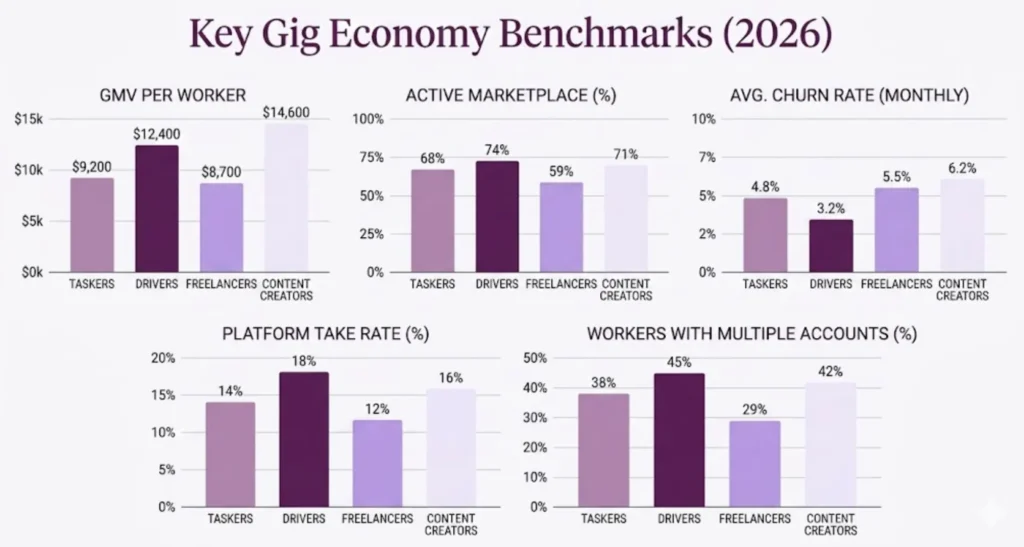
| Metric | US Average | Best-in-Class | Compliance Risk Threshold |
|---|---|---|---|
| Gig Workers as % of Workforce | 18% | Up to 35% (highly optimized) | Over 40% warrants legal review |
| Gig-to-Hire Conversion Rate | 14% | 28% | Under 5% suggests poor talent pipeline strategy |
| Avg. Project Quality Score | 3.7 / 5.0 | 4.4 / 5.0 | Under 3.0 indicates selection or briefing problem |
| Contractor Misclassification Exposure Rate | 22% of organizations | Under 5% | Over 15% warrants compliance audit |
| Gig Worker Engagement Score | 3.4 / 5.0 | 4.2 / 5.0 | Under 3.0 indicates culture integration problem |
Key Strategies for Strategic Gig Talent Management
Here are a few key strategies you can use for appropriate Gig talent management:
Quick-Reference Cheat Sheet
GTQI = (On-Time/On-Quality Projects / Total Projects) × (Gig-to-Hire Conversion Rate / 100)
Contractor vs. Employee Classification Quick Reference (US):
- Does your organization control HOW the work is done? → Employee signal
- Does the worker work exclusively for you indefinitely? → Employee signal
- Does the worker use your equipment and follow your schedule? → Employee signal
- Is the worker free to work for other clients simultaneously? → Contractor signal
- Does the worker have independent business operations and multiple clients? → Contractor signal
Gig Talent Engagement Dos:
Gig Talent Engagement Don’ts:
The Technology Stack Behind Modern Gig Hiring
Most hiring technology was built with a permanent employee in mind. Post a job, collect applications, run them through an ATS, extend an offer, done. Gig hiring doesn’t work that way, and the cracks show fast when you try to force it into the same infrastructure.
The ATS problem is usually the first thing teams notice. Traditional applicant tracking systems are optimised for linear pipelines, one candidate, one role, one outcome. Gig hiring is messier. You might engage the same contractor across three projects, re-engage them six months later, or run five parallel briefs simultaneously. Most ATS setups aren’t built to handle that relationship history cleanly, which means it gets managed in spreadsheets, inboxes, or nowhere at all.
Candidate management has a similar gap. Tagging, segmenting, and re-engaging a bench of vetted freelancers requires a system that thinks in talent pools, not just active pipelines. Without it, you’re re-sourcing from scratch every time a need comes up, which defeats the efficiency argument for gig hiring entirely.
Payment and contract tooling is where operational risk concentrates. Mismatched invoicing cycles, unclear deliverable sign-off, and informal agreements are the norm at smaller scale, until something goes wrong. Purpose-built platforms handle SOW generation, milestone tracking, and payment release in one place, which matters both for compliance and for maintaining relationships with contractors who have options.
The integration layer is the final piece most teams underestimate. Your gig tech stack needs to talk to your core HR systems, finance tools, and project management platforms. Fragmented tooling creates fragmented visibility, and fragmented visibility is where compliance gaps quietly grow.
This is exactly the kind of infrastructure problem Avua is built to address. Rather than stitching together five separate tools, avua brings AI-powered hiring capability, candidate management, and a growing contractor-friendly workflow into a single platform, designed from the ground up for how modern hiring actually works, not how it worked a decade ago. If your current stack is showing its age every time a gig need comes up, it’s worth seeing what a purpose-built solution looks like.
Related Terms
| Term | Definition |
|---|---|
| Independent Contractor | A worker engaged on a project or service basis who meets legal tests for contractor status: behavioral independence, financial independence, and independent business operation |
| Freelancer | An independent contractor who typically serves multiple clients and is engaged on project-specific or time-limited bases through direct contract or platform mediation |
| Misclassification | The erroneous classification of an employee as an independent contractor; a compliance risk with significant legal and financial consequences |
| EOR (Employer of Record) | A third-party organization that employs workers on behalf of a client; one compliance mechanism for international gig talent engagement |
| Platform Economy | A subset of the gig economy mediated by technology platforms (Upwork, Fiverr, Uber, TaskRabbit) that match work providers with work seekers |
| Fractional Executive | A senior leader engaged on a part-time, fractional basis to provide executive-level expertise without the full-time cost and commitment of a permanent hire |
Frequently Asked Questions
How do organizations avoid misclassification exposure with gig workers?
By ensuring that the actual working relationship meets the applicable legal tests for contractor status: the contractor controls how they do their work, is free to work for other clients, provides their own tools and equipment, and is engaged on a project basis rather than indefinitely. If the relationship involves behavioral control, financial control, or an employment-like permanence, it should be structured as employment. Employment counsel should review contractor relationships in jurisdictions where the test is particularly strict (California, UK, EU member states).
How should organizations think about gig talent in their workforce planning?
As a deliberate portfolio component: identifying in advance which roles and skill needs are best served by flexible gig arrangements (time-limited, specialized, scalable) and which require the institutional knowledge, management control, and organizational investment of permanent employment. The workforce plan should include gig talent supply as a conscious element with its own strategy and compliance framework, not as an afterthought to headcount planning.
What exactly is the gig economy and how does it work today?
It is a labor market defined by short-term contracts and freelance hustle. Individuals use digital platforms to find flexible tasks, offering enviable autonomy while requiring the self-management of benefits, retirement, and taxes.
Is the gig economy a permanent feature of the labor market?
Research and trend data suggest yes. The structural drivers of gig work, including technology platforms that reduce transaction costs, organizational preference for workforce flexibility, and worker preferences for autonomy in segments of the labor market, are not trend-driven. The regulatory environment will continue to evolve, with some jurisdictions creating new legal categories between employee and contractor. But the gig economy as a significant feature of the labor market appears durable.
What are the primary benefits for workers choosing gig work over traditional employment?
Workers enjoy unparalleled flexibility, choosing when and where to work. This model allows for diverse income streams and the ability to balance personal life or passion projects alongside diverse professional skill-building opportunities.
What are the biggest challenges gig workers face in the current modern economy?
Lacking traditional benefits like health insurance remains a hurdle. Additionally, income instability and the delightful responsibility of managing complex self-employment taxes can create significant financial stress for those navigating this independent path.
How do companies benefit from hiring gig workers instead of full-time staff members?
Organizations gain access to specialized talent on demand without long-term overhead costs. This scalability allows businesses to adapt instantly to market shifts while maintaining lower fixed expenses and significantly higher operational agility.
How will the gig economy evolve as technology and labor laws continue changing?
Future shifts likely include increased regulatory protections for workers and advanced AI-driven platforms. As remote work persists, the gig model will expand further into high-skilled, professional consulting and tech-heavy sectors globally.
Conclusion
The gig economy has created genuine strategic value for organizations that engage it thoughtfully: access to specialized expertise, workforce agility, and project-based talent evaluation that permanent headcount structures cannot provide with equivalent flexibility.
The same economy has created significant compliance exposure for organizations that engage it opportunistically: contractor misclassification that produces tax, benefits, and labor law liability that consistently exceeds the cost savings that motivated the classification decision.
The organizations navigating this well are those that have separated these two dimensions: building deliberate gig talent strategies that extract genuine value, while maintaining the legal discipline around classification that ensures the value creation is sustainable. Neither the opportunity nor the compliance requirement is going away.
Managing both is what the gig economy demands.