Remember when working from home was a perk reserved for a lucky few?
Then 2020 happened, and suddenly everyone was on Zoom in their kitchen. Now, a few years on, most organisations have landed somewhere in the middle, and that middle ground has a name: hybrid work.
Hybrid work is a flexible working model where employees split their time between a physical office and a remote location. Simple in concept, but surprisingly complex to get right. Done well, it gives people the autonomy they want without sacrificing the collaboration and culture that comes from being in the same room.
For HR and hiring teams, hybrid work has reshaped everything from employee experience and employee engagement to how organisations approach candidate experience during recruitment. Even employee onboarding looks completely different when half your new starters are logging in from home.
This guide breaks down what hybrid work actually means, how to structure it, and what separates the organisations doing it well from those still figuring it out.
The core metric governing hybrid work’s impact on talent acquisition is Hybrid Policy Offer Acceptance Rate: the proportion of offers accepted by candidates for roles with explicitly communicated hybrid arrangements.
Hybrid Policy OAR (%) = (Offers Accepted in Hybrid Roles ÷ Total Offers Extended for Hybrid Roles) × 100
Roles with clearly communicated, credibly structured hybrid arrangements achieve OARs averaging 78–83%. Roles where hybrid arrangements are described vaguely (“flexible work arrangements available”) or inconsistently applied achieve OARs of 58–63%. The 20-point gap is essentially entirely attributable to candidate trust in the arrangement, not to the intrinsic quality of the role or compensation.
What is Hybrid Work?
Hybrid work is a work arrangement model in which employees formally divide their working time between an employer-designated location (office, headquarters, co-working space) and a remote location, with the split determined by a defined policy, manager agreement, or role-specific requirement, combining the collaboration and connection benefits of physical co-location with the autonomy and productivity benefits of remote work.
The key word in any serious definition of hybrid work is “formal.” The arrangement is not informal flexibility or ad-hoc manager permission; it is a defined organizational policy with specified expectations, supported by the physical, technological, and managerial infrastructure required to deliver both the in-office and remote components of the model effectively.
Why Is Hybrid Work a Hiring Advantage, and a Liability When Done Wrong?
Hybrid work is the dominant recruiting conversation of 2026. Not because it is new, it has been the majority professional work model since 2022, but because the gap between organizations doing it well and those doing it poorly has become a primary driver of hiring outcomes in knowledge-economy talent markets.
The simplest way to understand hybrid’s hiring impact is through candidate preference data. LinkedIn’s 2025 Global Workforce Report found that 72% of professional candidates list hybrid or remote work capability as a top-three factor in employment decisions, ahead of compensation in all age cohorts under 45 and roughly equal to compensation in the 45–54 cohort. That is not a marginal preference, it is a primary job selection variable for the majority of your candidate pool.
The implication for TA leaders is straightforward: organizations without credible hybrid policies are effectively competing with one hand behind their back in virtually every knowledge-economy role recruitment. But the more nuanced implication is that vague hybrid policies are nearly as damaging as no hybrid policy. Candidates who have experienced bait-and-switch hybrid offers, arrangements described in the interview process as flexible that were mandated to daily in-office attendance after hire, have become significantly more skeptical. In Gallup’s 2025 employee experience survey, 31% of hybrid workers reported that their current arrangement was less flexible than described during their hiring process. That 31% represents a substantial population of cynical future candidates who will apply additional scrutiny to hybrid claims in subsequent job searches.
The organizations winning the hybrid hiring advantage are not necessarily the most flexible. They are the most credible. They describe their arrangements specifically (three days in office, Tuesday–Thursday; Mondays and Fridays remote), they train managers to implement them consistently, and they don’t walk them back when executives get nostalgic for a full office. The credibility is the competitive advantage, not the specific day count.
The ROI of getting hybrid right is measurable at the recruiting level. An analysis of offer acceptance rate data across 300 mid-size companies found that those with clearly documented and consistently applied hybrid policies achieved OARs approximately 19 percentage points higher than those with vague or inconsistently applied arrangements. For a company making 80 professional hires per year and extending 120 offers to achieve that number, a 19-point OAR improvement means 23 additional acceptances, eliminating the need to re-source those roles and saving approximately $184,000 in additional sourcing cost (at $8,000 per re-sourced role).
Your Resume Isn’t Getting Read
Let’s Get That Fixed!
75% of resumes get auto-rejected. avua’s AI Resume Builder optimizes formatting, keywords, and scoring in under 3 minutes, so you land in the “yes” pile.
The Psychology Behind Hybrid Work Preferences
Autonomy and Self-Determination Theory
Self-determination theory identifies autonomy, control over one’s own time and work context, as one of three fundamental psychological needs whose satisfaction drives intrinsic motivation and wellbeing. Hybrid work arrangements that give employees genuine control over when and where they work satisfy the autonomy need in ways that fixed-location work cannot, producing engagement and retention benefits that are not primarily about commute reduction or work-life balance but about fundamental psychological need satisfaction.
Proximity Bias and In-Office Advantage Perception
One of the most significant hybrid work management challenges is proximity bias, the tendency of managers to perceive in-office employees as more committed, more productive, and more promotable than equivalent remote employees, simply because their presence is physically observable. Proximity bias creates a structural inequity in hybrid environments where some employees choose (or are required) to be in the office more frequently, and generates the perception among remote employees that career advancement requires in-office presence regardless of stated policy. Organizations that don’t actively counter proximity bias in their management practices will see their hybrid arrangements gradually self-select toward higher in-office presence as career-conscious employees make risk-averse location choices.
Boundary Management and the Flexibility Paradox
Research on remote and hybrid work consistently identifies a paradox: the flexibility of remote work, while preferred by most workers, also creates boundary management challenges that increase stress for workers who struggle to psychologically separate work from home. Hybrid arrangements that include designated in-office days provide an externally imposed structure that many workers experience as both constraining and psychologically helpful, the office day provides a rhythm that the home day does not automatically supply. The best hybrid policies are not maximally flexible; they are optimally structured.
Hybrid Work vs. Related Work Arrangement Models
| Model | Location | Flexibility Level | Office Requirement | Key Difference from Hybrid |
|---|---|---|---|---|
| Full-time in-office | Office | None | 5 days/week | No remote component |
| Fixed hybrid | Office + remote | Low | Defined days (e.g., 3 in/2 remote) | Fixed schedule; no day-choice autonomy |
| Flexible hybrid | Office + remote | Medium | Minimum days, employee chooses which | Schedule autonomy within minimum |
| Fully remote | Remote | High | None or occasional | No regular office requirement |
| Remote-first | Remote primary | High | Occasional / optional | Office available but not expected |
| Activity-based | Both | High | When work requires | No schedule-based requirement; task-driven |
What the Experts Say?
Hybrid work isn’t a policy. It’s a management capability. Companies that got it right are the ones whose managers learned how to lead distributed teams, not the ones whose executives wrote the best return-to-office memo.
– Laszlo Bock, Former SVP People Operations, Google
How to Measure Hybrid Work’s Impact on Hiring?
Formula
Hybrid Policy Offer Acceptance Rate (%) = (Accepted Hybrid Offers ÷ Total Hybrid Offers Extended) × 100
Hybrid Attrition Premium = Attrition Rate (Hybrid Roles) − Attrition Rate (In-Office Roles)
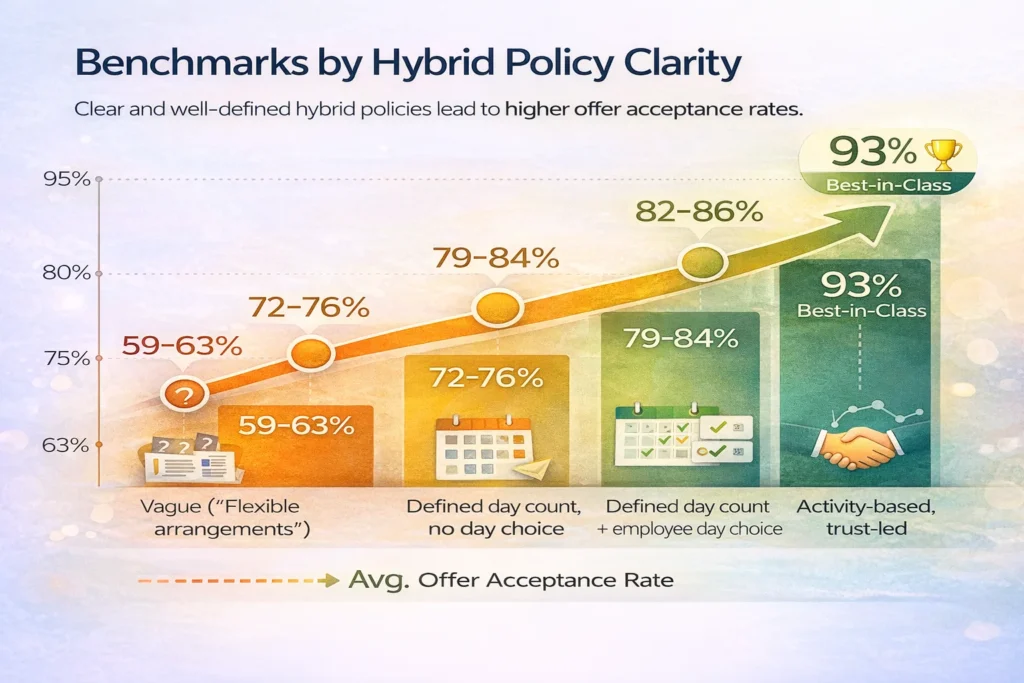
Benchmarks by Hybrid Policy Clarity
| Policy Clarity | Avg. Offer Acceptance Rate | Best-in-Class |
|---|---|---|
| Vague (“flexible arrangements”) | 59–63% | 70% |
| Defined day count, no day choice | 72–76% | 82% |
| Defined day count + employee day choice | 79–84% | 91% |
| Activity-based, trust-led | 82–86% | 93% |
Key Strategies for Hybrid Work in Talent Acquisition
How Can AI and Automation Support Hybrid Work Management?
AI-Powered Scheduling Optimization
AI tools can optimize hybrid scheduling across teams, identifying the office days that maximize the overlap of team members who most benefit from in-person collaboration, while honoring individual flexibility preferences. This converts the scheduling problem from a managerial negotiation into a data-informed optimization, reducing schedule friction significantly in larger hybrid teams.
Engagement Signal Monitoring for Remote Employees
AI-powered engagement analytics can monitor engagement signals from remote employees, participation rates in virtual meetings, response times, collaboration tool usage patterns, and surface early disengagement signals that managers might miss in the absence of physical observation. This provides a partial compensation for proximity bias by making remote employee engagement more visible to managers.
Virtual Collaboration Intelligence
AI tools embedded in collaboration platforms can analyze meeting patterns, communication flows, and collaboration network health to identify hybrid team structures that are functioning well versus those where the split between in-office and remote is creating collaboration fragmentation. This intelligence informs hybrid policy refinement based on actual collaboration behavior rather than assumption.
Candidate Preference Matching
AI-powered hiring platforms can match candidate work arrangement preferences (captured at the application stage) against the actual hybrid policy for each role, surfacing arrangement mismatches before the interview stage rather than at the offer stage. This reduces the offer decline rate attributable to arrangement mismatch, which research suggests accounts for 14–19% of all professional offer declines.
Stop Juggling
10 Job Boards.
Search One
Your next role is already here. avua pulls opportunities from across the web into a single searchable feed; filtered by role, location, salary, and remote preference.
1.5 Million+
Active Jobs
380+
Job Categories
Hybrid Work and Diversity & Inclusion
Flexibility as a DEI Lever
Hybrid and remote work flexibility is disproportionately valued by several employee populations that are systematically underrepresented in knowledge-economy organizations: primary caregivers (disproportionately women), employees with disabilities for whom commuting is a significant burden, and employees in geographic markets where the commute to urban offices is disproportionately time-costly. Organizations that offer genuine hybrid flexibility expand their effective talent market to include these populations; those that don’t systematically narrow it.
The Proximity Bias DEI Intersection
Proximity bias in hybrid environments intersects with DEI in a specific way: if the employees most likely to choose higher in-office presence are those in the demographic majority (due to lower caregiver burden, lower commute distance, greater social connection to in-office culture), then proximity bias in performance and advancement decisions systematically disadvantages the demographic groups for whom remote flexibility is most valuable. Addressing proximity bias is therefore not just a management effectiveness issue, it is a DEI equity issue.
Accessible Hybrid Infrastructure
Hybrid work policies that work for the majority of employees but are not accessible to employees with specific disabilities, because the remote infrastructure lacks accessibility features, or the in-office days coincide with medical treatment schedules, or the collaboration platforms are not screen-reader compatible, create de facto exclusions that are invisible in aggregate hybrid adoption data.
Common Challenges and Solutions
| Challenge | Solution |
|---|---|
| Managers applying hybrid policy inconsistently across teams | Publish clear policy documentation; include hybrid arrangement consistency in manager performance reviews |
| Candidates accepting hybrid roles and then requesting more remote flexibility after hire | Set arrangement expectations explicitly in offer letters with specific day-count language |
| Proximity bias reducing hybrid employee promotion rates | Disaggregate promotion data by work arrangement in regular HR analytics reports; investigate and address any statistically significant gaps |
Real-World Case Studies
Case Study 1: The Consulting Firm
A mid-size consulting firm that had operated a “come in when needed” hybrid policy for three years found its office utilization declining while employee complaints about unclear expectations were rising. They introduced a structured hybrid policy: Tuesday, Wednesday, Thursday in-office; Monday and Friday remote. Critically, they communicated the why, client collaboration days, team design work, and learning activities were scheduled on in-office days; deep individual work and external client calls were protected for remote days. Offer acceptance rate improved from 67% to 81% over two hiring cycles. Early attrition (90-day) fell from 18% to 9%.
Case Study 2: The Technology Company
A technology company undergoing a return-to-office push (from fully remote to two days per week) ran the change as a communication-first program rather than a mandate. They surveyed employees on which two days created least disruption, used the data to establish Tuesday and Thursday as default in-office days for most teams, and published detailed guidance on the collaboration design logic for those days. Voluntary attrition during the transition period was 8% versus an industry peer average of 14% for comparable RTO transitions.
Case Study 3: The Financial Services Firm
A financial services firm redesigned its hybrid model to be fully mobile-accessible, all in-office booking, team calendar sharing, and collaboration tools optimized for mobile. The redesign was driven by the finding that 64% of employees were managing their hybrid schedules on mobile devices but their previous tools were desktop-only. Mobile-first hybrid management tools reduced scheduling friction significantly and improved in-office day attendance rates by 22%.
Building a Hybrid Work Impact Dashboard: What to Track?
Hybrid Work Across the Hiring Lifecycle
Job Posting: Arrangement Transparency
The hybrid arrangement should be specified explicitly in the job posting, not in vague flexibility language but in specific terms (days in office, flexibility within that, whether the arrangement is fixed or role-dependent). Clear arrangement communication at the posting stage improves candidate self-selection and reduces misalignment discovery costs later in the process.
Interview: Arrangement Conversation Quality
The interview stage is where hybrid arrangements are explored substantively by serious candidates. Hiring managers and recruiters should be prepared to describe the arrangement with specificity, explain the collaboration design logic, and address the candidate’s practical questions about commute, home office setup, and team communication norms. Inconsistent or evasive responses to hybrid arrangement questions are a primary source of candidate withdrawal at the late evaluation stage.
Offer: Arrangement Documentation
The hybrid work arrangement should be documented in the offer letter with specific language, not by reference to a “flexible work policy” that the employee has not seen, but with the explicit arrangement that was discussed. This creates a shared reference point and reduces post-hire arrangement disputes.
Onboarding: Arrangement Integration
The first weeks of a hybrid role are the highest-risk period for arrangement misalignment discovery. New employees who arrive expecting the arrangement they were promised but find a different informal norm, managers who prefer more in-office presence, teams where remote employees feel disconnected, or in-office days that don’t deliver the collaboration they were supposed to, exit early. Onboarding for hybrid roles should specifically address arrangement navigation, hybrid team norms, and manager expectations.
The Real Cost of Hybrid Work Done Poorly
| Scenario | Hybrid Policy Clarity | Avg. OAR | Annual Re-Sourcing Cost (80 hires) |
|---|---|---|---|
| Vague policy | Low | 59% | $268,000 |
| Defined but inflexible | Medium | 74% | $163,000 |
| Defined and flexible | High | 83% | $102,000 |
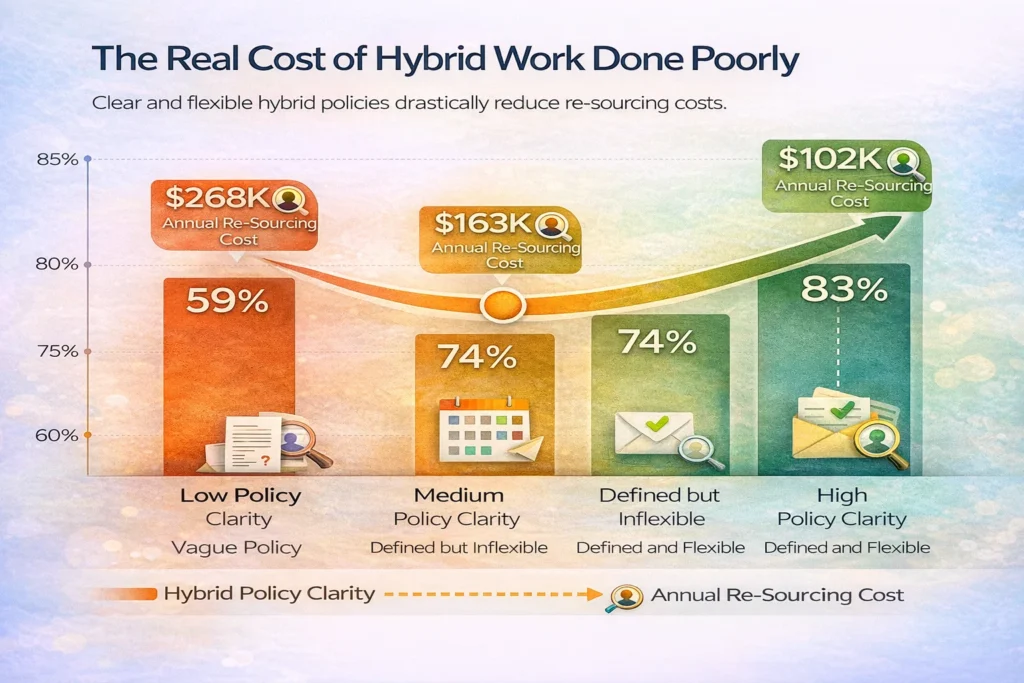
Re-sourcing cost assumes $8,000 per declined offer re-sourced; calculation applies declined offers against average cost.
Related Terms
| Term | Definition |
|---|---|
| Remote Work | A work arrangement in which the employee works exclusively from a location outside the employer’s office |
| Return to Office (RTO) | An organizational directive to return to full or increased in-office attendance after a period of remote or hybrid work |
| Work Flexibility | The degree to which an employee has control over when, where, and how they work |
| Proximity Bias | The tendency to perceive in-person employees as more productive or committed than equivalent remote employees |
| Asynchronous Work | A work style in which team members complete their work independently without requiring simultaneous presence or real-time communication |
Frequently Asked Questions
How many days in office is considered “hybrid”?
There is no universal standard, but market conventions have emerged: one to two days per week is commonly described as “mostly remote hybrid,” three days per week is the most common “standard hybrid” arrangement, and four days is frequently described as “primarily in-office” rather than hybrid. Candidate expectations vary significantly by industry, career stage, and geography, tech and media markets tend toward more remote-heavy hybrid expectations than finance and consulting.
Does hybrid work reduce productivity?
The evidence is mixed and context-dependent. Structured hybrid work, with thoughtful allocation of in-office days to collaboration-intensive work and remote days to deep individual work, consistently produces productivity equivalent to or above full in-office. Unstructured hybrid, where in-office days are used for the same individual tasks as remote days, shows no productivity advantage and sometimes shows disadvantage due to commute time cost. Productivity in hybrid is primarily a design question, not a location question.
How should hybrid work be communicated to candidates?
Specifically and proactively. State the arrangement in the job posting, confirm it in the first recruiter conversation, discuss the collaboration design in the hiring manager interview, and document it in the offer letter. Organizations that describe hybrid arrangements with this level of specificity and consistency at every stage have significantly higher candidate trust and offer acceptance rates.
Does hybrid work affect employee retention?
Positively, when done well. Gallup’s research consistently shows that employees in hybrid arrangements who have meaningful choice over their schedule report higher engagement and lower attrition intention than equivalent employees in either full in-office or fully remote arrangements. The benefit is conditional on genuine arrangement quality, hybrid arrangements perceived as surveillance-adjacent or inconsistently applied produce worse retention outcomes than either of the alternatives.
How do you prevent proximity bias in hybrid environments?
Structural approaches are more effective than awareness approaches. Key practices: ensure that remote employees have equal access to high-visibility work and senior leadership exposure; evaluate performance on output metrics rather than presence metrics; disaggregate promotion data by work arrangement and investigate gaps; and make managers accountable for equitable career development outcomes across arrangement types.
Conclusion
Hybrid work is not going away, and organizations that treat it as a concession rather than a strategic talent asset will continue to pay the hiring and retention premium that ambiguity creates.
The winners in hybrid talent markets are not the most flexible, they are the most credible. They define their arrangements specifically, deliver them consistently, and build the management infrastructure to make them work fairly for every employee regardless of where they sit.
Get the arrangement right, communicate it honestly, and hold managers accountable for delivering it, and hybrid becomes one of the most powerful words in your employer value proposition rather than a source of candidate skepticism.