What if your next great hire is already on your payroll?
Internal mobility is the practice of moving employees into new roles, projects, or departments within the same organisation, and it remains one of the most underutilised levers in modern talent strategy. While most hiring teams are busy optimising their candidate pipeline, the best retention move might be looking inward.
With employee engagement at a global low and attrition rates climbing across industries, organisations that invest in internal mobility don’t just fill roles faster. They build loyalty, reduce cost per hire, and keep institutional knowledge where it belongs: inside the business.
This guide covers what internal mobility looks like in practice, why it matters, and how to build a programme that actually works.
The core metric governing internal mobility effectiveness is Internal Mobility Rate: the proportion of employees who change roles internally in a defined period.
Internal Mobility Rate (%) = (Employees Who Changed Roles Internally in Period ÷ Total Employees) × 100
Organizations with high-functioning internal mobility programs maintain rates of 25–35% annually. The industry average is approximately 12–15%. Rates below 10% typically indicate structural barriers, manager hoarding, limited opportunity visibility, or a cultural norm that treats internal movement as disloyalty rather than development.
What is Internal Mobility?
Internal mobility is the organizational capability that enables employees to move fluidly between roles, functions, teams, and locations within the same organization, supported by transparent opportunity visibility, equitable access processes, manager accountability for talent development, and career architecture that makes non-linear paths both legible and achievable.
The defining word in that definition is “capability.” Internal mobility is not a program or a technology. It is an organizational capacity that must be built deliberately, through job architecture that makes lateral moves legible, management practices that encourage rather than impede movement, information systems that make opportunities visible, and cultural norms that treat employee development as an organizational asset rather than a departmental resource.
Is Your Organization Growing Its People, or Just Growing Its Headcount?
Organizations without functional internal mobility programs are caught in a paradox they rarely articulate clearly: they invest significantly in recruiting external talent while simultaneously losing internal talent that would have stayed had they seen a future in the organization. The net result is a hamster wheel, high external hiring spend, high voluntary attrition, and an organizational knowledge base that never accumulates because the people carrying it keep leaving.
The data makes this pattern visible. LinkedIn’s 2025 Workforce Confidence Report found that employees who had made at least one internal move in their current organization had 41% lower attrition intent than those who had not, independent of compensation, manager relationship, and role satisfaction. The effect was additive: employees who had made two or more internal moves showed attrition intent 59% lower than their non-mobile peers. Internal mobility is not just a career development benefit, it is the single most powerful retention mechanism most organizations are not systematically using.
The cost gap between organizations that do this well and those that don’t is significant and compounding. Deloitte’s Human Capital research found that organizations in the top quartile of internal mobility effectiveness had voluntary attrition rates 43% lower than those in the bottom quartile. For a 1,000-employee organization with an average turnover cost of $20,000 per departure and an average turnover rate of 18%, a 43% reduction in voluntary attrition represents approximately $1.5M in annual avoided cost, before accounting for the quality and speed improvements in hiring the roles that do need to be filled externally.
The concrete scenario that brings this alive: a global consulting firm conducts an exit interview analysis and finds that over a three-year period, 62% of high-performer voluntary departures cited “limited internal opportunity” as a primary reason for leaving. The firm’s internal job board exists, but posts roles only after 30 days of external search, requires manager sign-off before application, and has no notification system. In effect, the firm has an internal mobility infrastructure that creates the appearance of investment without the mechanics of function. The departing employees were not wrong about their options, they were accurately reading an organizational signal.
For TA and HR leaders, the practical shift is from thinking about internal mobility as a benevolent employee benefit to treating it as a core talent retention and capability-building strategy. The organizations doing this explicitly, building talent marketplaces, training managers on mobility support, tracking mobility rates with the same rigor as attrition rates, and connecting mobility activity to compensation and advancement outcomes, are building organizational resilience that compounds over time.
Your Resume Isn’t Getting Read
Let’s Get That Fixed!
75% of resumes get auto-rejected. avua’s AI Resume Builder optimizes formatting, keywords, and scoring in under 3 minutes, so you land in the “yes” pile.
The Psychology Behind Internal Mobility Barriers
The Endowment Effect in Talent Management
Managers who have developed a strong team member experience a version of the endowment effect, valuing that employee’s presence on their team more highly than an equivalent external hire would be valued, simply because they already “own” the talent. This psychological ownership creates resistance to mobility that is disproportionate to the actual cost of the transition. Recognizing manager behavior as endowment-effect-driven, rather than purely rational resource protection, points toward the right intervention: changing the incentive structure, not just raising awareness.
Identity Threat and Career Non-Linearity
Many professionals have internalized career narratives where upward promotion is the legitimate form of advancement and lateral moves signal stagnation. In these frameworks, a lateral transfer feels like a demotion in disguise, something to be explained, justified, and potentially embarrassed about. Organizations that want to enable genuine career lattices need to actively reshape the narrative around lateral mobility: making it visible when leaders have non-linear career histories, celebrating lateral moves in internal communications, and building compensation frameworks that reward skill breadth, not just hierarchical position.
Information Asymmetry and Learned Helplessness
Employees who have attempted to explore internal opportunities and been blocked, by manager resistance, by opaque posting processes, by a failed internal application with no feedback, develop a form of learned helplessness around internal mobility. They stop looking because their experience has taught them that looking is ineffective. This learned helplessness is invisible in engagement surveys (employees don’t report having given up on something they never pursued) but is highly visible in exit interviews, where it frequently surfaces as “I didn’t see a path forward here.”
Internal Mobility vs. Related Talent Development Concepts
| Concept | Scope | Initiative Source | Permanence | Key Difference from Internal Mobility |
|---|---|---|---|---|
| Internal Mobility | All role and function changes within org | Employee + system | Permanent and temporary | Broadest scope; includes all movement types |
| Internal Hiring | Filling a specific vacancy with internal candidate | TA team + employee | Permanent | Vacancy-triggered; narrower scope |
| Succession Planning | Pipeline for critical future roles | HR / Leadership | Future-oriented | Targeted to specific critical roles |
| Rotational Programs | Structured cross-function exposure | HR-designed | Temporary | Programmatic; defined in advance |
| Career Pathing | Defined progression routes | HR + employee | Framework | Maps options; doesn’t execute movement |
What the Experts Say?
Every recruiting failure is ultimately a hiring manager failure. Not because they’re bad managers, but because we’ve never invested in them the way we invest in the process Internal mobility isn’t a retention program. It’s an answer to the question every ambitious employee is silently asking: ‘Is there a future for me here?’ Organizations that answer that question with a functioning system, not just a promise, are the ones their competitors struggle to hire talent away from.
– Josh Bersin
How to Measure Internal Mobility Effectiveness?
Formula
Internal Mobility Rate (%) = (Internal Movers in Period ÷ Total Employees) × 100
Mobility-Adjusted Retention Rate (%) = (Mobile Employee Retention − Non-Mobile Employee Retention)
Internal Opportunity Awareness Rate (%) = (Employees Aware of Internal Opportunity Platform ÷ Total Employees) × 100
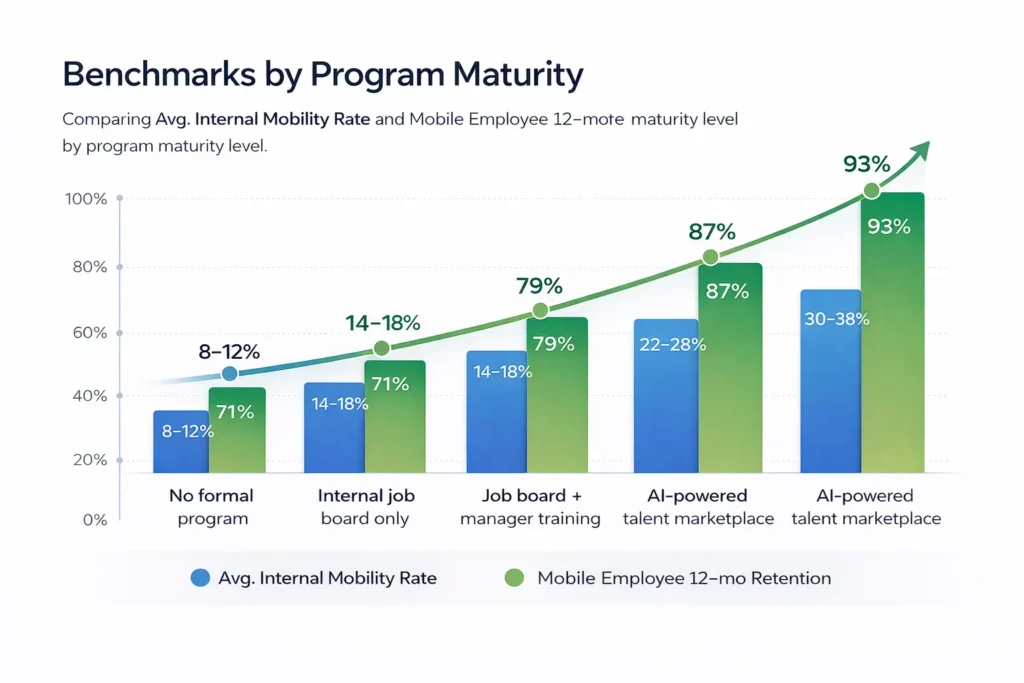
Benchmarks by Program Maturity
| Program Maturity | Avg. Internal Mobility Rate | Mobile Employee 12-mo Retention |
|---|---|---|
| No formal program | 8–12% | 71% |
| Internal job board only | 14–18% | 79% |
| Job board + manager training | 22–28% | 87% |
| AI-powered talent marketplace | 30–38% | 93% |
Key Strategies for Building Internal Mobility
How Can AI and Automation Power Internal Mobility?
AI-Powered Skills Matching
AI talent marketplace platforms analyze the skills, experience, and career trajectory data in an organization’s HRIS and match each employee’s profile against all internal opportunities, open roles, project assignments, mentorship programs, and learning pathways, surfacing relevant opportunities the employee would not have found through self-directed search. This is the core automation value in internal mobility: converting a network-dependent discovery process into a data-driven one.
Predictive Career Pathing
Machine learning models trained on career progression data across the organization can identify the most common and successful pathways from any current role to any aspirational role, generating specific, evidence-based career pathing recommendations rather than generic development advice. An employee who wants to move from financial analyst to product manager can receive a data-informed map of the skills they need to build, the roles that typically serve as stepping stones, and the timeline based on historical patterns at their organization.
Mobility Barrier Detection
AI analytics can identify patterns in internal mobility data that indicate systematic barriers, departments or manager populations with significantly lower-than-average outbound mobility rates, job families where internal candidates consistently fail to advance despite high-quality assessment scores, or career stages where mobility rates drop below organizational average. These patterns are invisible in aggregate mobility rate data but actionable when surfaced at the department or manager level.
Automated Opportunity Alerts
AI-powered talent marketplace tools can send personalized, timely opportunity alerts to employees, calibrated to their skills profile, career interests, and readiness signals, without requiring constant HRBP or TA team intervention. Automated alerts that match the quality of a personally curated opportunity conversation convert the internal discovery process from a high-effort exception to a low-friction default.
Stop Juggling
10 Job Boards.
Search One
Your next role is already here. avua pulls opportunities from across the web into a single searchable feed; filtered by role, location, salary, and remote preference.
1.5 Million+
Active Jobs
380+
Job Categories
Internal Mobility and Diversity & Inclusion
Mobility as the Engine of Senior-Level Representation
The most persistent DEI challenge in most organizations is not entry-level diversity, it is the attrition of diverse talent between entry and senior levels. Internal mobility programs that proactively identify and support diverse employees for advancement are the primary organizational tool for converting entry-level diversity into senior-level representation. Tracking internal mobility rates by demographic group reveals where in the career architecture diverse employees are advancing more slowly than majority peers, the specific career stages where targeted mobility support will produce the most representation impact.
Dismantling the Informal Mobility Network
In organizations without formal internal mobility infrastructure, advancement is primarily network-mediated: people advance because a senior leader knows them, sponsors them, and creates opportunities for them. This informal network advantage is not equally distributed. Employees who are demographically or socially similar to the senior leadership population have stronger network-mediated access to informal mobility opportunities. Formalizing mobility through visible postings, structured evaluation, and AI-powered matching does not eliminate informal sponsorship, but it creates a parallel formal channel that is not blocked to employees who lack the right informal connections.
Equitable Access to Stretch Assignments
Temporary project assignments and secondments, the informal internal mobility that builds skills and organizational visibility without a formal role change, are among the most powerful career development levers available. They are also among the most unequally distributed, typically allocated by manager discretion rather than structured process. Organizations committed to DEI in internal mobility need to apply the same rigor to stretch assignment allocation that they apply to formal promotion decisions.
Common Challenges and Solutions
| Challenge | Solution |
|---|---|
| Managers actively discouraging team members from applying internally | Remove manager veto; add internal mobility rate to manager performance evaluation; make talent hoarding a named and managed behavior |
| Employees unaware of internal opportunities until they see them on LinkedIn | Implement AI-powered proactive opportunity notification; require all roles to be posted internally simultaneously with external posting |
| Internal applications receiving less thorough candidate experience than external ones | Apply identical communication standards, feedback timelines, and process quality to internal and external candidates |
Real-World Case Studies
Case Study 1: The Professional Services Network
A 2,400-person professional services firm experiencing 22% annual voluntary attrition among its senior associate population implemented an AI-powered talent marketplace that matched employees’ skills against internal project opportunities, leadership roles, and cross-office assignments. In the 18 months following implementation, senior associate attrition fell from 22% to 13%. Of the attrition reduction, the firm estimated 65% was attributable to employees finding internal opportunities they would not have discovered otherwise. Internal mobility rate rose from 11% to 29%. The platform investment was recovered in less than five months through avoided external hiring and onboarding costs.
Case Study 2: The Technology Company
A technology scale-up with a well-established engineering team found that product managers and engineers were regularly leaving for roles at competitors that were essentially identical to roles that existed within the company’s own portfolio of products, but in different teams. The TA team discovered that no process existed for employees to express interest in roles in other teams except through direct manager conversation. They implemented an internal interest registration system, employees could anonymously flag interest in role types and geographies, and would be contacted when matching roles opened. Within 12 months, 34% of product manager and senior engineer vacancies were filled through the interest registration system.
Case Study 3: The Global Retail Group
A global retail group with operations across 40 countries built a mobile-first internal mobility platform after discovering that 78% of their store manager and operations population had no desktop access during working hours. The mobile platform displayed open roles, project assignments, and training pathways in a format that required under two minutes to engage with. Store manager internal mobility rate improved from 6% to 19% in the first year. The group reported that three of their five top-performing regional director promotions in that year were from populations that had previously had near-zero internal visibility.
Building an Internal Mobility Dashboard: What to Track?
Internal Mobility Across the Employee Lifecycle
Early Career: Foundation Building Through Lateral Exposure
Internal mobility in the first two to three years of an employee’s tenure is primarily about breadth, building cross-functional exposure that creates organizational context and skill adjacency. Rotational programs, project secondments, and lateral moves during this period produce employees who understand the organization’s systems, culture, and interdependencies at a depth that purely vertical career paths cannot replicate. The investment in early-career mobility produces leaders who are substantially better equipped for senior roles than those whose early career was a straight line.
Mid-Career: The Mobility Retention Window
The 3–7 year tenure window is when internal mobility most directly affects retention. This is the period when high performers are at peak external market attractiveness, they have proven their value, built transferable skills, and become visible to external recruiters. It is also the period when the gap between internal advancement pace and external market opportunity is most acutely felt. Organizations with active internal mobility programs that serve this population, with proactive opportunity identification, manager-supported transitions, and genuine advancement pathways, produce retention outcomes in this critical window that organizations without these programs simply cannot match.
Senior Career: Knowledge Transfer and Succession Readiness
Internal mobility at senior levels serves a different organizational function: knowledge transfer and succession readiness. Senior leaders who have moved across functions carry organizational knowledge that is irreplaceable, they understand how decisions made in one function affect outcomes in another, and they have the relationships across the organization to implement change effectively. Building succession pipelines from internally mobile senior leaders rather than external executive search produces a quality of organizational continuity that external hiring cannot replicate.
Exit: Mobility Failure as Departure Driver
Exit interview data consistently shows internal mobility failure as a top-three voluntary departure driver across all career stages. Employees who leave citing “lack of internal opportunity” are providing a diagnostic: the organization failed to surface or enable internal options that existed. This data should feed directly into internal mobility program investment decisions, the departure cost of mobility failure is the primary ROI justification for mobility infrastructure investment.
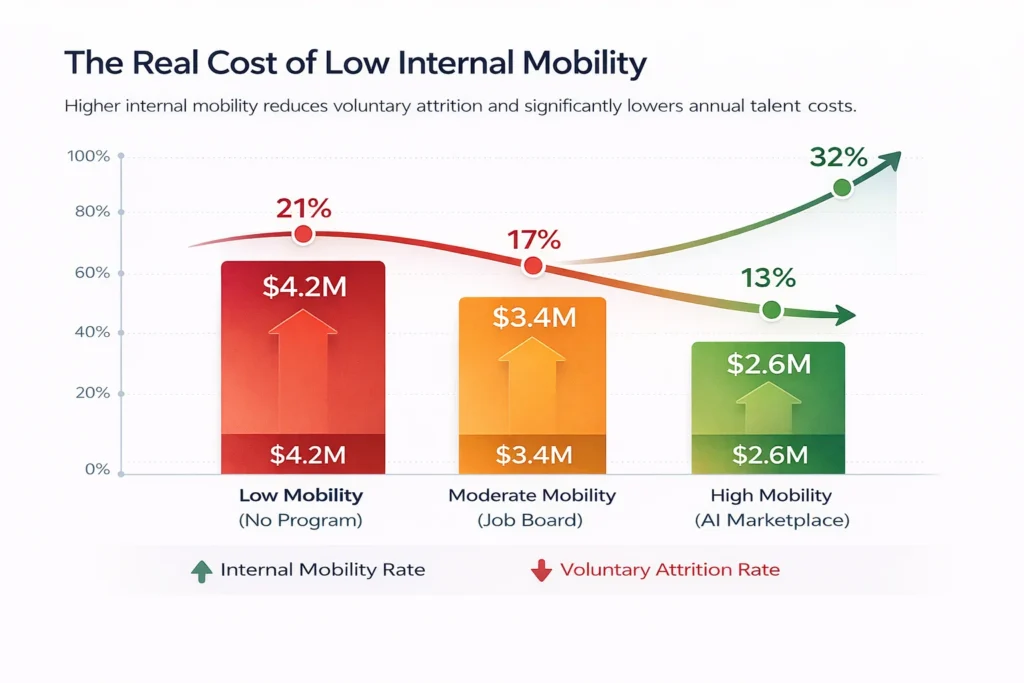
The Real Cost of Low Internal Mobility
| Scenario | Internal Mobility Rate | Voluntary Attrition Rate | Annual Talent Cost (1,000 employees) |
|---|---|---|---|
| Low mobility (no program) | 10% | 21% | $4.2M |
| Moderate mobility (job board) | 17% | 17% | $3.4M |
| High mobility (AI marketplace) | 32% | 13% | $2.6M |
Annual talent cost assumes $20,000 average replacement cost per departure.
Related Terms
| Term | Definition |
|---|---|
| Talent Marketplace | A technology platform that matches employee skills and interests to internal opportunities in real time |
| Career Lattice | A career development model that includes lateral and diagonal moves alongside vertical promotion |
| Talent Hoarding | Manager behavior that actively prevents or discourages team members from pursuing internal opportunities |
| Succession Planning | The identification and development of internal candidates for critical future leadership roles |
| Skills-Based Organization | An organizational model in which work is assigned and careers advance based on demonstrated skills rather than job title or tenure |
Frequently Asked Questions
What is the difference between internal mobility and internal hiring?
Internal hiring is a recruitment practice, filling a specific open requisition with an existing employee. Internal mobility is a broader organizational capability, the culture, systems, and infrastructure that enable employees to move throughout the organization over the course of a career. Internal hiring is a transaction within internal mobility; internal mobility is the ecosystem that makes those transactions frequent, equitable, and strategically valuable.
How do you start an internal mobility program?
The minimum viable internal mobility program has four components: all open roles posted internally before or simultaneously with external posting; employee self-nomination capability without manager pre-approval; consistent candidate experience quality for internal applicants; and structured feedback for all internal candidates regardless of outcome. That baseline can be implemented within 30 days for most organizations and will immediately improve internal mobility metrics.
Does internal mobility hurt team performance?
In the short term, losing a high performer to an internal move creates a transition cost for the originating team. In the medium and long term, organizations with high internal mobility rates consistently show superior team performance relative to those without, because managers in high-mobility cultures develop replacement capability, team members are more engaged (knowing advancement exists), and organizational knowledge is more widely distributed. The short-term transition cost is real; the medium-term performance return is larger.
How do AI talent marketplace tools work?
AI talent marketplace platforms (Gloat, Eightfold, Beamery, and similar) analyze employee skills data, career history, stated interests, and behavioral signals to match individuals against all internal opportunities, roles, projects, mentorships, and learning pathways. They operate continuously in the background, surfacing personalized recommendations without requiring employees to actively search or managers to manually identify candidates. The matching improves over time as employee behavior data (which opportunities they engage with) refines the algorithm’s understanding of each individual’s preferences.
What is the role of the manager in internal mobility?
The manager is the most consequential variable in internal mobility outcomes, for better and for worse. Managers who actively support mobility conversations, create stretch assignment opportunities for their team, and facilitate transitions when team members are selected for internal roles are the foundation of a high-mobility culture. Managers who hoard talent, discourage mobility conversations, and create friction for departing team members are the primary barrier to internal mobility at scale. Building manager accountability for mobility outcomes is the single most important systemic intervention in internal mobility program design.
Conclusion
Internal mobility is one of those organizational capabilities that looks optional until you model the cost of not having it, and then it looks like one of the highest-return investments on the HR strategy list.
The organizations building genuine mobility infrastructure are compounding their talent advantage every year: employees who stay longer, develop broader skills, and carry more institutional knowledge than the market rate alternative of continuous external hiring and continuous attrition.
The ones treating internal mobility as an occasional goodwill gesture are paying external hiring premiums for talent they already employed and chose not to keep.