There is a version of inclusive hiring that exists almost entirely in policy documents, diversity dashboards, and annual reports. It has a stated commitment, a percentage target, and a committee. It produces no measurable change in who gets hired. And then there is the other version, the one built into the design of the hiring process itself, in the structure of the job description, the composition of the interview panel, the criteria used to evaluate candidates, and the outcome data tracked to know whether any of it is working. The difference between these two versions is not intention. It is method.
Inclusive hiring is the practice of designing and executing the recruitment process in a way that actively removes barriers to access and advancement for candidates from underrepresented or historically excluded groups, including modifications to job description language, sourcing channel diversification, structured evaluation methods, interview accessibility accommodations, and systemic tracking of demographic representation at every stage of the hiring funnel.
The definition matters because inclusive hiring is not diversity hiring. Diversity hiring sets demographic targets for outcomes. Inclusive hiring focuses on the process, removing the barriers that produce inequitable outcomes, and trusts that equitable processes produce more representative results over time. In practice, the most effective inclusive hiring programs combine both: clear outcome accountability and rigorous process redesign.
The core metric governing inclusive hiring effectiveness is Stage-Level Representation Consistency Rate: the degree to which demographic representation remains stable as candidates advance through hiring stages, measured as the ratio of each group’s representation at offer stage to their representation at application stage.
Representation Consistency Rate = (% Representation at Offer Stage) ÷ (% Representation at Application Stage)
A score of 1.0 indicates no differential attrition by demographic group through the process. Scores below 0.75 for any group indicate systematic process barriers warranting investigation. Most organizations that conduct this analysis for the first time find rates between 0.45 and 0.68 for their underrepresented groups, a finding that rarely matches organizational self-assessments of their inclusive hiring maturity.
What is Inclusive Hiring?
Inclusive hiring is the practice of designing recruitment processes that remove structural, procedural, and evaluative barriers that have historically prevented qualified candidates from underrepresented groups from accessing and advancing through hiring systems on an equitable basis, encompassing job description design, sourcing strategy, assessment method, interview structure, evaluation criteria, and outcome measurement.
The critical distinction between inclusive hiring and diversity recruitment is the focus of intervention. Diversity recruitment focuses on increasing the representation of underrepresented groups in the candidate pipeline. Inclusive hiring focuses on ensuring that the process treats all candidates equitably once they are in the pipeline. Both are necessary; neither is sufficient without the other.
Is Your Hiring Process Inclusive, or Just Diverse at the Top of the Funnel?
Many organizations have made genuine progress in sourcing diverse candidate pipelines. Fewer have made equivalent progress in ensuring that those candidates advance through the hiring process at equitable rates.
The phenomenon is well-documented. Organizations that invest in targeted sourcing, partnering with HBCUs, community organizations, and professional associations for underrepresented groups, often succeed in building demographically diverse application pools. The quality of that diversity investment is then revealed in the hiring funnel: the proportion of diverse applicants who advance from each stage to the next. In many organizations, that proportion reveals a systematic problem that sourcing investment cannot solve.
A concrete data point that many TA leaders find genuinely surprising: McKinsey’s 2025 hiring equity research found that in organizations without structured interview programs, Black and Hispanic candidates were 34% less likely to advance from hiring manager interview to final round than white candidates with equivalent qualifications, measured by the same standardized assessment scores. The gap existed not at the screening stage (where structured assessment tools had been applied consistently) but at the interview stage (where evaluation was unstructured and evaluator-dependent). The disparity was not caused by sourcing failure, the candidates were in the funnel. It was caused by evaluation design failure, the process treated them differently once there.
The cost of this process failure is not merely ethical. It is strategic. An organization whose inclusive sourcing investment produces a demographically diverse pipeline that then loses half its diversity through biased evaluation has spent significant effort to produce no outcome change. The sourcing budget is wasted. The employer brand built on DEI commitments is undermined by the demographic homogeneity of the actual hire cohort. And the talent it failed to hire almost certainly ended up at a competitor whose process treated them more fairly.
The ROI of fixing the evaluation process is the same as the ROI of fixing any process that wastes significant inputs: massive. Boston Consulting Group research found that companies with above-average diversity in management reported innovation revenue (share of revenue from new products and services) that was 19 percentage points higher than those with below-average diversity. For an organization where inclusive hiring process improvements increase management-level diversity by 15 percentage points over three years, the expected innovation revenue premium, based on BCG’s research, represents a multiple of any conceivable investment in hiring process redesign.
The practical implication for TA leaders is a shift in where inclusive hiring investment is concentrated. Many organizations have over-invested in sourcing diversity and under-invested in evaluation equity. The process fix, structured interviews, standardized evaluation rubrics, blind resume review, calibration conversations, and systematic representation tracking at every funnel stage, is where the return is now.
Your Resume Isn’t Getting Read
Let’s Get That Fixed!
75% of resumes get auto-rejected. avua’s AI Resume Builder optimizes formatting, keywords, and scoring in under 3 minutes, so you land in the “yes” pile.
The Psychology Behind Inclusive Hiring
Affinity Bias and the Similarity-Attraction Effect
The most pervasive barrier to inclusive hiring is also the hardest to address through awareness: the tendency of evaluators to assess more favorably candidates who share demographic, educational, cultural, and communication characteristics with themselves. This affinity bias operates largely below conscious awareness, it is experienced as “good fit” or “strong presence” rather than “demographic similarity.” The structural fix is evaluation criteria that are specific, behavioral, and observable rather than holistic or impressionistic.
Stereotype Threat and Candidate Performance
Research on stereotype threat shows that candidates who are aware of negative stereotypes about their demographic group’s performance in a domain, engineering, leadership, analytical work, perform worse on evaluations when that stereotype is made salient. Hiring processes that activate stereotype threat (through evaluator comments, question framing, or absence of representation in the interview panel) produce artificially depressed performance from strong candidates in targeted groups, not because those candidates are less capable but because the evaluation environment is not equal. Structured, professionally conducted evaluations in which the assessment criteria are explicit and the evaluator panel is representative reduce stereotype threat effects substantially.
Confirmation Bias and First-Impression Persistence
The five-minute first impression problem is not equally distributed. Research on initial impression formation in interviews consistently finds that evaluators’ first impressions of candidates from underrepresented groups are more resistant to updating, both upward and downward, than their first impressions of candidates from majority groups. Structured evaluation processes that require evidence-based assessment against explicit criteria counteract this asymmetric confirmation bias by forcing evaluators to engage with behavioral evidence rather than holistic impressions.
Inclusive Hiring vs. Related DEI Concepts
| Concept | Focus | Intervention Point | Measurement | Key Difference from Inclusive Hiring |
|---|---|---|---|---|
| Inclusive Hiring | Process barriers to equitable evaluation | Hiring process design | Stage-level representation consistency | Process-focused; applies to all candidates |
| Diversity Recruiting | Representation in candidate pipeline | Sourcing channels | Pipeline demographic composition | Pipeline-focused; applied pre-evaluation |
| Equal Opportunity Employment | Legal non-discrimination baseline | Legal compliance | Complaint and violation rates | Compliance floor, not best practice |
| Belonging and Inclusion (post-hire) | Employee inclusion experience | Post-hire employee environment | Engagement and belonging scores | Post-hire focus; different lifecycle stage |
| Pay Equity | Compensation fairness by demographic group | Compensation decisions | Pay gap statistics | Compensation-specific; post-hire |
What the Experts Say?
Every recruiting failure is ultimately a hiring manager failure. Not because they’re bad managers, but because we’ve never invested in them the way we invest in the process ar“”
– Laszlo Bock, Former SVP People Operations, Google
How to Measure Inclusive Hiring Effectiveness?
Formula
Representation Consistency Rate = (Group % at Offer Stage) ÷ (Group % at Application Stage)
Inclusive Hiring Index = Average Representation Consistency Rate across all underrepresented groups
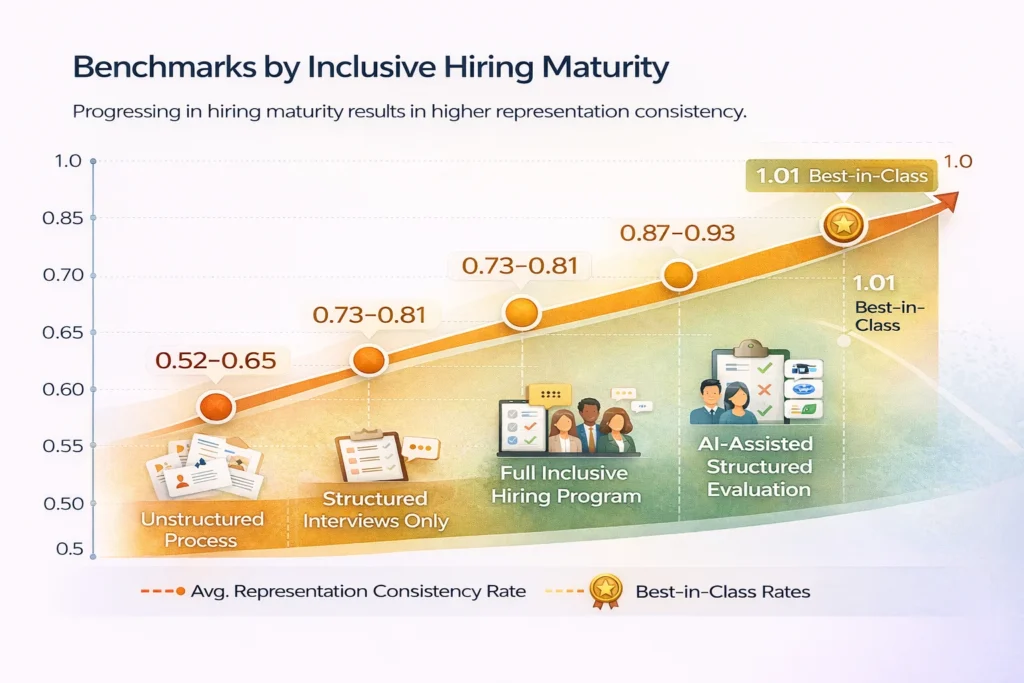
Benchmarks by Inclusive Hiring Maturity
| Maturity Level | Avg. Representation Consistency Rate | Best-in-Class |
|---|---|---|
| Unstructured process | 0.52–0.65 | 0.71 |
| Structured interviews only | 0.73–0.81 | 0.87 |
| Full inclusive hiring program | 0.87–0.93 | 0.98 |
| AI-assisted structured evaluation | 0.91–0.96 | 1.01 |
Key Strategies for Inclusive Hiring
How Can AI and Automation Support Inclusive Hiring?
Bias Detection in Job Descriptions
AI-powered language tools can analyze job descriptions for language patterns associated with differential application rates by demographic group, identifying not only stereotypically gendered language but also educational credentialism language, geography-exclusionary requirements, and experience-requirement inflation that serves as a proxy barrier to non-traditional candidates.
Structured Assessment at Scale
AI-powered pre-screening tools can apply consistent, standardized assessment criteria to all candidates at the application screening stage, eliminating the evaluator discretion that is the primary vector for bias entry in the early funnel stages. Consistency of evaluation criteria across all candidates is a structural equity tool, not a reduction in evaluation quality.
Blind Review Options
AI-powered systems can strip demographic-correlating information from resumes and profiles before hiring manager review, removing names, addresses, educational institution names, and graduation years that serve as demographic proxies. Blind review research consistently finds improved representation consistency for underrepresented groups at the resume screening stage.
Real-Time Bias Alerts
AI tools integrated into interview evaluation platforms can flag evaluation patterns that are inconsistent with structured criteria, alerting calibration session facilitators to assessments that appear to reflect holistic impressions rather than behavioral evidence. This real-time feedback is more effective at reducing bias than post-hoc awareness training.
Stop Juggling
10 Job Boards.
Search One
Your next role is already here. avua pulls opportunities from across the web into a single searchable feed; filtered by role, location, salary, and remote preference.
1.5 Million+
Active Jobs
380+
Job Categories
Inclusive Hiring and Diversity & Inclusion
Beyond the Pipeline Problem
The most common framing of inclusive hiring’s relationship to DEI is the “pipeline problem”, the idea that demographic underrepresentation in senior or specialized roles is caused by insufficient diversity in the candidate pool, and that the fix is sourcing more diverse candidates. The pipeline framing is partially correct and substantially misleading. Pipeline quality matters; so does what the process does with that pipeline. Organizations that fix the pipeline without fixing the evaluation process will continue to produce homogeneous outcomes from diverse inputs, and will exhaust the goodwill of diverse candidates who apply, advance to late stages, and are declined at rates inconsistent with their qualifications.
Intersectionality in Hiring Data
DEI hiring data that aggregates demographic groups obscures the compounding disadvantage experienced by candidates with multiple underrepresented identities. Women of color, for example, consistently show lower representation consistency rates than either women as a group or people of color as a group, a finding that is invisible when data is reported by single demographic category. Intersectional analysis of hiring funnel data reveals the specific compounding barriers that affect candidates with multiple marginalized identities and enables more precisely targeted interventions.
Disability and Accessibility in Hiring
Inclusive hiring for candidates with disabilities requires specific process accommodations that go beyond general structured evaluation design: accessible application platforms (WCAG 2.1 AA compliance at minimum), interview format accommodations (extended time, written alternatives to verbal questions, physical accessibility of interview locations), and assessment method alternatives for candidates for whom standard assessment formats create barriers unrelated to the competencies being assessed. Organizations that do not have a documented reasonable accommodation process for candidates are both leaving talent on the table and creating legal compliance exposure.
Common Challenges and Solutions
| Challenge | Solution |
|---|---|
| Interview panel lacks diversity for specific role types | Build a cross-functional panel with members from outside the immediate team; invest in developing diverse evaluators who can participate across business units |
| Hiring managers resist structured evaluation as bureaucratic | Frame structured evaluation as evaluation quality improvement, not compliance, and share the Quality of Hire outcome data that demonstrates the difference |
| Diverse candidates are declining offers at higher rates than majority candidates | Conduct post-decline interviews with a representative sample; investigate whether offer presentation, compensation structure, or arrangement details show differential patterns |
Real-World Case Studies
Case Study 1: The Law Firm
A mid-size law firm with a stated commitment to associate diversity conducted a hiring funnel analysis for the first time and found that candidates from non-target law schools (defined as schools outside their traditional ten-school recruiting list) had a screening-to-interview conversion rate of 14%, versus 61% for candidates from target schools, despite target and non-target candidates having statistically equivalent bar exam passage rates and first-year performance reviews.
The firm redesigned its screening criteria to evaluate writing samples and structured assessment scores rather than school pedigree, and expanded its recruiting to 28 law schools. Non-target school representation at hire increased from 8% to 31%. First-year attrition remained unchanged, and three-year performance data showed no significant difference between cohorts.
Case Study 2: The Technology Company
A technology company using unstructured technical interviews found through a hiring audit that female candidates were advancing from technical screen to offer at 0.57 the rate of equivalent-scoring male candidates. Investigation found that the unstructured technical interview format systematically disadvantaged candidates who communicated less assertively, a communication style correlated in the interview data with female candidates but not with post-hire technical performance. The company introduced a structured pair-programming evaluation format with defined performance criteria. Female candidate advancement rate rose to 0.94 within three hiring cycles, with no change in post-hire technical performance distribution.
Case Study 3: The Financial Services Firm
A financial services firm redesigned its entire application process to be mobile-first and accessible after discovering that 34% of candidates from lower socioeconomic backgrounds (identified through educational institution and zip code proxy) were abandoning multi-step desktop-required applications without completing them, versus 9% for candidates from higher-SES backgrounds. The simplified mobile application had a maximum completion time of 8 minutes. Application completion rates across all groups converged to within 4 percentage points, and the firm’s demographic diversity at application stage improved significantly.
Building an Inclusive Hiring Dashboard: What to Track?
Inclusive Hiring Across the Candidate Lifecycle
Pre-Application: Job Description and Accessibility
The candidate’s first interaction with the inclusive hiring process is the job posting. Language, requirements (especially education and years-of-experience requirements that serve as barriers without predicting performance), application format, and stated accommodation availability all signal whether the organization genuinely welcomes diverse applicants or is performing inclusivity while maintaining traditional filtering.
Application and Screening: Structured Consistency
The screening stage is the highest-leverage point for inclusive hiring intervention because of its scale. Consistent, criteria-based screening that applies the same evaluation standards to all candidates is the primary process tool for equitable funnel advancement. AI-powered screening tools that apply structured criteria consistently outperform human screening on evaluation equity, provided the evaluation criteria themselves are bias-audited.
Interview and Evaluation: Structured Design
The interview stage is where most demographic attrition in inclusive hiring occurs and where the most concentrated inclusive hiring investment is warranted. Structured questions, scored rubrics, representative panels, and calibration conversations are the standard toolkit, none of which are complex to implement, and all of which produce measurably more equitable outcomes than unstructured alternatives.
Offer Stage: Equity in Presentation
Offer equity is the final inclusive hiring frontier. Organizations where compensation offers vary by demographic group, even when controlling for role, level, and experience, are undermining their entire inclusive hiring investment at the moment of closing. Regular pay equity analysis of offers extended (not just accepted) is the primary tool for identifying and correcting differential offer patterns.
The Real Cost of Inequitable Hiring Processes
| Scenario | Representation Consistency Rate | Estimated Diverse Talent Lost per 100 Applicants | Est. Annual Talent Cost |
|---|---|---|---|
| Unstructured process | 0.58 | 31 qualified candidates | $248,000 |
| Partially structured | 0.77 | 18 qualified candidates | $144,000 |
| Fully inclusive process | 0.94 | 4 qualified candidates | $32,000 |
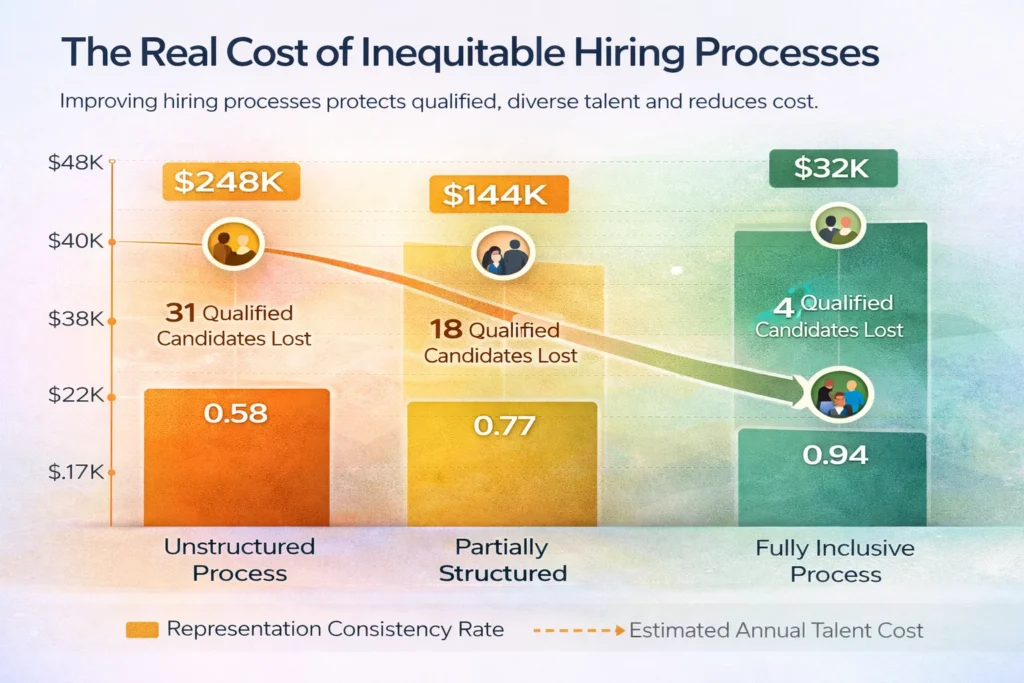
Talent cost assumes $8,000 average cost per qualified candidate lost to inequitable evaluation, including sourcing investment writeoff.
Related Terms
| Term | Definition |
|---|---|
| Structured Interview | A standardized interview format using identical questions and scored evaluation criteria across all candidates |
| Affinity Bias | The tendency to evaluate more favorably candidates who share characteristics with the evaluator |
| Blind Recruitment | A process in which demographic-correlating information is removed from candidate materials before evaluation |
| DEI (Diversity, Equity, and Inclusion) | An organizational framework for ensuring workforce representation, fair process, and an inclusive environment |
| Representation Parity | The state in which demographic groups are represented in an organization at rates proportional to their representation in the qualified talent market |
Frequently Asked Questions
What is the difference between inclusive hiring and diversity hiring?
Diversity hiring focuses on the demographic composition of the candidate pipeline and hire outcomes. Inclusive hiring focuses on the equity of the evaluation process, ensuring that qualified candidates from all backgrounds are assessed fairly regardless of their demographic characteristics. Both matter; inclusive hiring is the process foundation that makes diversity hiring investment produce outcomes rather than pipelines.
Does structured interviewing make the process feel impersonal to candidates?
When implemented well, no. Research on candidate experience in structured versus unstructured interviews consistently finds that candidates perceive structured interviews as more professional and fairer, not more impersonal. The perception of impersonality typically comes from poorly designed structured interviews that are rigidly scripted without room for candidate elaboration, not from structured evaluation design itself.
How do you audit a hiring process for bias?
The core method is funnel-level demographic analysis: tracking the demographic composition of candidates at each stage transition and calculating representation consistency rates for key groups. Disparate impact analysis, comparing advancement rates by demographic group while controlling for qualifications, identifies specific stages where evaluation is producing inequitable outcomes. Process-level audit typically follows the data, examining the evaluation design at the stages where disparate impact is found.
Can AI tools reduce bias in hiring?
Yes, and no. AI tools that apply structured, consistent evaluation criteria to all candidates reduce the evaluator discretion that is the primary vector for bias entry. However, AI tools trained on historically biased hiring data can perpetuate and scale historical bias. The answer depends on how the AI evaluation criteria are designed and whether they have been audited for demographic disparate impact.
Is inclusive hiring a legal requirement?
Equal opportunity employment law establishes a baseline non-discrimination requirement in most jurisdictions. Inclusive hiring practice goes substantially beyond the legal baseline, it is not required, but the business case for it (talent quality, innovation outcomes, employer brand) is independent of legal compliance and increasingly compelling.
Conclusion
Inclusive hiring is not a DEI program layered on top of a hiring process that was designed for a different era. It is a fundamental rethinking of how the process is designed, starting from the question “what barriers have we built in that have nothing to do with whether someone can do this job?“
The organizations that have answered that question honestly and rebuilt their processes accordingly are not making charitable concessions to underrepresented groups. They are removing inefficiencies from their talent acquisition systems that were costing them qualified candidates every single hiring cycle.
Inclusive hiring, done properly, is not just the right thing to do. It’s the smart thing to do.