Before you post a job and start sifting through applications, it is worth asking one question: does the right person already work for you? Internal hiring is the process of filling open roles by considering existing employees first, whether through promotions, lateral moves, or structured internal job postings.
It is a strategy that pays off on multiple fronts. It accelerates time-to-fill, lowers cost per hire, and sends a clear signal to your workforce that growth is available without having to look elsewhere. For organisations dealing with rising attrition rates, that signal alone can shift how employees think about their future with the company.
Internal hiring also feeds directly into stronger employee engagement, giving people a visible path forward. And when a role does go external, having a healthy candidate pipeline alongside a robust internal process means you are never starting from scratch.
The core metric governing internal hiring effectiveness is Internal Fill Rate: the proportion of all hires made in a defined period that are filled by existing employees rather than external candidates.
Internal Fill Rate (%) = (Internal Hires ÷ Total Hires) × 100
High-performing organizations achieve Internal Fill Rates of 30–45%. The industry average sits around 18–22%. Organizations with Internal Fill Rates below 15% typically have structural internal mobility barriers, insufficient job posting visibility, manager hoarding behaviors, or candidate experience gaps in the internal process, rather than genuine absence of qualified internal talent.
What is Internal Hiring?
Internal hiring is the recruitment of existing employees to fill open roles within the organization, either in response to employee applications through an internal job board, or through proactive identification and outreach to employees whose skills, experience, and career interests make them qualified for specific openings, prioritizing the retention and development of existing talent before committing to external sourcing investment.
The definition encompasses a spectrum of organizational practice: from reactive programs where employees can apply to posted internal jobs, to proactive programs where TA teams and managers actively identify and recruit internal candidates, to AI-powered talent marketplace systems where skills-based matching surfaces the best internal candidates for every opening automatically.
Are You Hiring Strangers When You Already Have the Answer in Your Own Building?
The external hiring bias in most organizations is real, well-documented, and significantly more costly than it is usually acknowledged to be.
The standard narrative is that external hiring brings “fresh perspectives” and “new ideas.” That is sometimes true. But it is also sometimes a rationalization for a process that is fundamentally more familiar and less friction-intensive than navigating internal mobility, particularly for organizations where internal job postings are poorly visible, where managers actively discourage their team members from applying for other roles, or where the internal candidate experience is materially worse than the external one.
The cost data is unambiguous. Research by Wharton Business School found that external hires are paid 18–20% more than internal candidates in comparable roles, take up to two years to achieve the performance level of equivalent internal hires, and have 61% higher turnover rates in their first two years than internal promotions. If those statistics applied to a machine or a process, the organization would have fixed it immediately. Because they apply to a hiring practice, most organizations have continued it anyway.
The counterpoint, that internal candidates may lack skills the role requires, is legitimate for some roles. It is not legitimate for most roles, most of the time. LinkedIn’s research on internal mobility found that 61% of employees who left their organization externally cited limited internal advancement opportunities as a primary reason, meaning they were candidates the organization knew about, whose skills the organization had invested in developing, and who ultimately built their next chapter elsewhere because the organization failed to make its own opportunities visible and accessible to them.
The ROI of systematic internal hiring is straightforward to calculate. If an organization with 500 employees and an annual turnover rate of 15% (75 departures per year) can reduce that rate by 5 percentage points through improved internal mobility (a conservative estimate based on published research on mobility programs), they avoid 25 voluntary departures annually.
At an average replacement cost of $20,000 per departed employee, the retention improvement is worth $500,000. The investment required to build a functional internal hiring program, an internal job board, manager training, a talent marketplace tool, and a dedicated internal mobility recruiter, typically costs $80,000–120,000 annually. The return on that investment: 4–6x in retention savings alone, before accounting for quality-of-hire premium on internal candidates.
A concrete scenario: a professional services firm discovers during an annual talent review that three of its most experienced analysts have been quietly exploring external opportunities for four months. All three have the skills required for a strategist role the firm has been sourcing externally for six weeks.
None of them knew the role was open, it was posted in the external ATS but not in the internal job board, which only visible-posted roles after 21 days of external search. The firm’s external search had cost approximately $15,000 in recruitment agency fees. All three analysts were hired externally by a competitor before the firm’s process was complete. The total cost: $60,000 in turnover and replacement, plus three years of institutional knowledge walking out the door.
Your Resume Isn’t Getting Read
Let’s Get That Fixed!
75% of resumes get auto-rejected. avua’s AI Resume Builder optimizes formatting, keywords, and scoring in under 3 minutes, so you land in the “yes” pile.
The Psychology Behind Internal Hiring Barriers
Manager Hoarding and Territorial Behavior
The most significant barrier to functional internal hiring is not process design, it is manager behavior. Managers who have invested in developing a high-performing team member have a rational short-term incentive to resist that team member moving to another role. Their team loses a valuable contributor, they face the disruption and time cost of backfilling the role, and their team’s performance metrics may decline during the transition. \
This rational short-term self-interest produces “talent hoarding”, the informal suppression of internal mobility through discouragement, delayed references, and strategic amnesia about posted opportunities. Organizations that tolerate talent hoarding have internal mobility programs that exist on paper and fail in practice.
Self-Selection Bias and the Fear of Internal Rejection
Employees who apply internally for roles they don’t get face an additional consequence that external candidates don’t: they remain in an organization where their manager now knows they were trying to leave, and they may experience judgment or relational damage as a result. This asymmetric risk relative to external job searching creates self-selection bias in internal applications, employees who apply internally for stretch roles are taking a career risk that external candidates are not, which suppresses application volume particularly among earlier-career employees with less organizational capital to cushion a rejection.
Information Asymmetry and Opportunity Visibility
A substantial proportion of internal hiring failures occur before a single application is submitted: employees don’t know the opportunity exists. Internal job boards with limited visibility, notification systems that require employees to actively seek information rather than receive it proactively, and manager networks that are selective in who they inform about openings all produce the same result, employees who would have been strong internal candidates never become candidates because the organizational information architecture failed them.
Internal Hiring vs. Related Talent Development Practices
| Practice | How Employees Move | Initiative | Selection Process | Key Difference from Internal Hiring |
|---|---|---|---|---|
| Internal Hiring / Job Posting | Open application to posted role | Employee-initiated | Full internal recruitment process | Formalized, competitive; all employees eligible |
| Internal Promotion | Manager nomination; performance-triggered | Manager or HR-initiated | Approval process, no competitive selection | Not competitive; based on performance in current role |
| Succession Planning | Pre-designated candidates for critical roles | HR / Leadership-initiated | Assessment and development process | Future-oriented; targeted to critical roles |
| Project-Based Mobility | Temporary assignment to different team | Manager agreement | No formal selection; informal match | Non-permanent; no role change |
| Career Lattice | Lateral moves to develop breadth | Employee-initiated with manager support | Informal; network-dependent | Developmental; not necessarily vacancy-driven |
What the Experts Say?
The best predictor of whether employees will stay is whether they believe they have a future in the organization. Not a future in their current role, a future in the organization. Internal mobility programs are how organizations make that belief real.
– Josh Bersin, Global HR Analyst, The Josh Bersin Company
How to Measure Internal Hiring Effectiveness?
Formula
Internal Fill Rate (%) = (Internal Hires ÷ Total Hires) × 100
Internal Mobility Rate (%) = (Employees Who Changed Role Internally in Period ÷ Total Employees) × 100
Internal Hire Retention Rate (%) = (Internal Hires Still in Role at 12 months ÷ Total Internal Hires) × 100
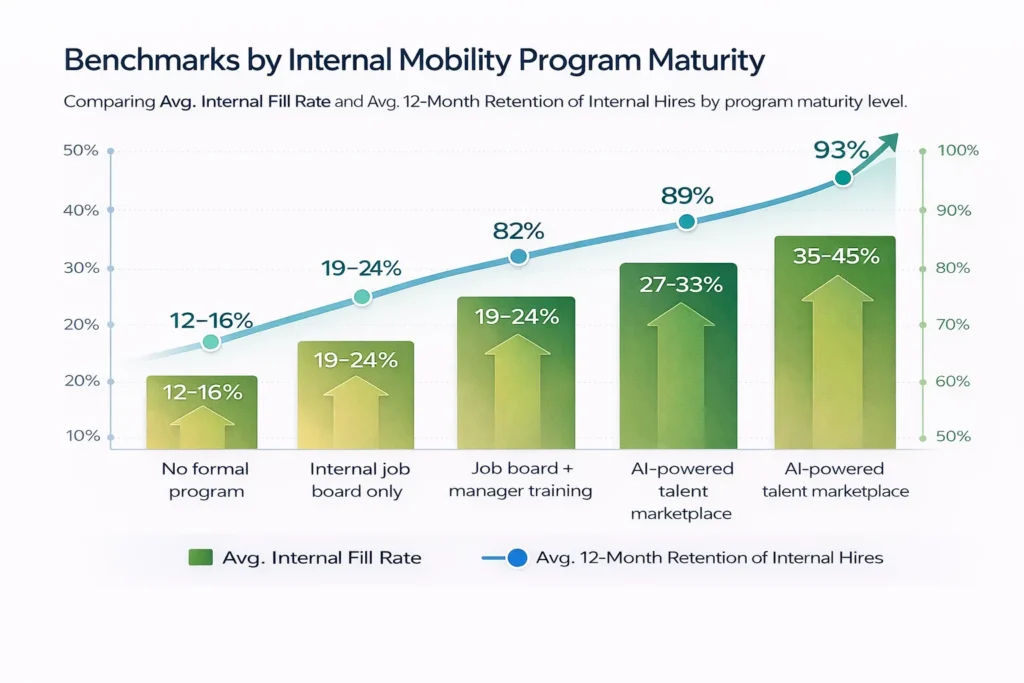
Benchmarks by Internal Mobility Program Maturity
| Program Maturity | Avg. Internal Fill Rate | Avg. 12-Month Retention of Internal Hires |
|---|---|---|
| No formal program | 12–16% | 76% |
| Internal job board only | 19–24% | 82% |
| Job board + manager training | 27–33% | 89% |
| AI-powered talent marketplace | 35–45% | 93% |
Key Strategies for Internal Hiring Effectiveness
How Can AI and Automation Support Internal Hiring?
AI-Powered Talent Marketplace
AI-powered talent marketplace tools (Gloat, Eightfold, Beamery, and similar platforms) can analyze the skills, experience, career history, and stated interests of every employee in the organization and match them against open role requirements, surfacing qualified internal candidates for every opening without relying on employee self-nomination or manager networks. This closes the information asymmetry gap that is the single largest barrier to internal mobility at scale.
Skills Gap Analysis and Development Pathways
AI analytics tools can identify the specific skill gaps between an employee’s current profile and their stated career development interests, and generate targeted learning pathways that build the capabilities needed for internal advancement. This converts internal mobility from a reactive opportunity into a planned development journey, increasing the pool of employees who are mobility-ready at any given point.
Predictive Internal Mobility Modeling
Machine learning models can predict which employees are most likely to benefit from proactive internal mobility outreach, based on tenure in current role, career velocity relative to peers, engagement signals, and the current roster of open roles that match their skills. This proactive intelligence enables TA teams and HRBPs to engage high-potential employees in mobility conversations before they begin external job searches.
Automated Internal Application Experience
AI-powered tools can streamline the internal application experience, pre-populating application forms with HRIS data, suggesting relevant internal candidates to hiring managers based on skills matching, and managing communication throughout the internal candidate journey. A high-quality internal candidate experience (comparable to the external experience in professionalism and communication) is a prerequisite for internal hiring programs that employees actually trust and use.
Stop Juggling
10 Job Boards.
Search One
Your next role is already here. avua pulls opportunities from across the web into a single searchable feed; filtered by role, location, salary, and remote preference.
1.5 Million+
Active Jobs
380+
Job Categories
Internal Hiring and Diversity & Inclusion
Internal Mobility as a Representation Lever
Organizations that have successfully built diversity at entry levels but struggle with representation at senior levels frequently find that the problem is not in hiring diverse talent, it is in advancing it. Internal mobility programs that proactively identify and support the advancement of diverse employees through the organizational ranks are one of the most powerful long-term tools for improving senior-level representation.
Tracking internal mobility rates by demographic group surfaces the specific career stages where diverse employees are advancing more slowly than their majority peers, and enables targeted intervention.
Manager Network Bias in Informal Mobility
The informal internal mobility that operates through manager networks, where senior leaders hear about candidates through personal networks and tap them for advancement opportunities, replicates the network homophily problem of external headhunting inside the organization. Employees outside the manager’s demographic or social network are systematically underrepresented in informal advancement conversations.
Formalizing internal mobility through visible job postings and structured evaluation processes partially counteracts this, but only if the formal program is the primary channel, not a supplement to informal network-based advancement.
Career Lattice Accessibility
Lateral mobility, moving across functions to develop broader organizational experience, is one of the most reliable pathways to senior leadership in most organizations. But access to lateral mobility opportunities is frequently unequal: employees in functions with strong manager support for mobility, or who are personally networked to the right managers, have substantially more lateral mobility opportunities than those who are not.
Systematic internal mobility programs that post lateral development opportunities transparently and evaluate applicants against objective criteria democratize access to career development pathways.
Common Challenges and Solutions
| Challenge | Solution |
|---|---|
| Managers blocking or discouraging internal applications | Remove manager veto from the application process; include internal mobility rate in manager performance evaluation |
| Internal candidates receiving worse candidate experience than external applicants | Apply the same communication standards, feedback protocols, and process quality to internal candidates as to external ones |
| Internal hires leaving their previous role leaving a team gap | Build backfill planning into the internal mobility process; create a standard hand-off and backfill timeline as part of every internal transition |
Real-World Case Studies
Case Study 1: The Technology Company
A 1,200-person technology company with a 25% annual voluntary turnover rate in its senior engineering population implemented an AI-powered talent marketplace that matched engineers’ skills profiles against internal project opportunities, team openings, and open roles. In the first year, 34% of open senior engineering roles were filled by internal candidates, up from 9% the previous year. Senior engineering attrition fell from 25% to 16%. The cost saving from reduced external hiring at senior engineering compensation levels was estimated at $1.2M in recruitment fees and time-to-fill costs.
Case Study 2: The Financial Services Firm
A financial services firm found that its internal job board had a posting-to-application rate of 3%, dramatically lower than industry benchmarks, despite employees reporting genuine interest in internal mobility in engagement surveys. Investigation revealed that the internal job board required employees to log in through a separate system from their normal HRIS, that jobs were posted without compensation information, and that there was no notification system alerting employees to new postings in their areas of interest.
After rebuilding the internal job board within the primary HRIS with salary visibility and smart notifications, the posting-to-application rate rose to 11%, and internal fill rate improved from 14% to 28% over two hiring cycles.
Case Study 3: The Retailer
A national retailer with 15,000 employees across 200+ locations implemented a mobile-first internal job application system, recognizing that the majority of their hourly employees did not have regular desktop access. The mobile application experience mirrored the consumer app experience of major job boards: simple profile setup, one-tap applications, and push notifications for roles matching the employee’s stated preferences.
Internal mobility activity across the store associate population increased from near-zero (the previous system was desktop-only) to 18% of open assistant manager roles filled internally within the first six months.
Building an Internal Hiring Dashboard: What to Track?
Internal Hiring Across the Talent Lifecycle
Pre-Application: Opportunity Visibility
The most impactful internal hiring intervention is not in the selection process, it is in ensuring that employees know opportunities exist. Proactive internal job notifications, AI-powered matching alerts, and manager conversations about career interests are all more effective at generating internal applications than passive job board posting.
Application and Selection: Fairness and Process Quality
The internal application process should be indistinguishable from the external process in quality and professionalism. Internal candidates who experience materially worse candidate experiences than external candidates develop a lasting negative perception of internal mobility that suppresses future application behavior across the organization.
Transition: Backfill and Hand-off Management
One of the most significant friction points in internal mobility is the transition period between an employee’s departure from their old role and their arrival in the new one. The “backfill problem”, the previous manager’s reluctance to release the employee until a replacement is found, is the mechanism through which many approved internal moves stall or collapse. Organizations with functional internal mobility programs define standard hand-off timelines (typically 30–45 days) that are consistently enforced regardless of the previous manager’s backfill readiness.
Onboarding: Internal Transition Support
Internal hires often receive less formal onboarding than external hires, an organizational assumption that familiarity with the company reduces onboarding need. Research on internal hire performance consistently finds that the performance ramp for internal hires who receive structured onboarding for their new role is significantly faster than for those who are expected to orient themselves. The context the internal hire knows is the organization; the context they don’t know is the new role, team, and expectations, which is exactly what onboarding should address.
The Real Cost of External Bias in Hiring
| Scenario | Internal Fill Rate | Avg. Hire Quality Score | Annual Talent Cost (100 hires) |
|---|---|---|---|
| Mostly external | 15% | 3.4/5.0 | $2.1M |
| Balanced | 30% | 3.8/5.0 | $1.65M |
| Internal-first | 42% | 4.1/5.0 | $1.35M |
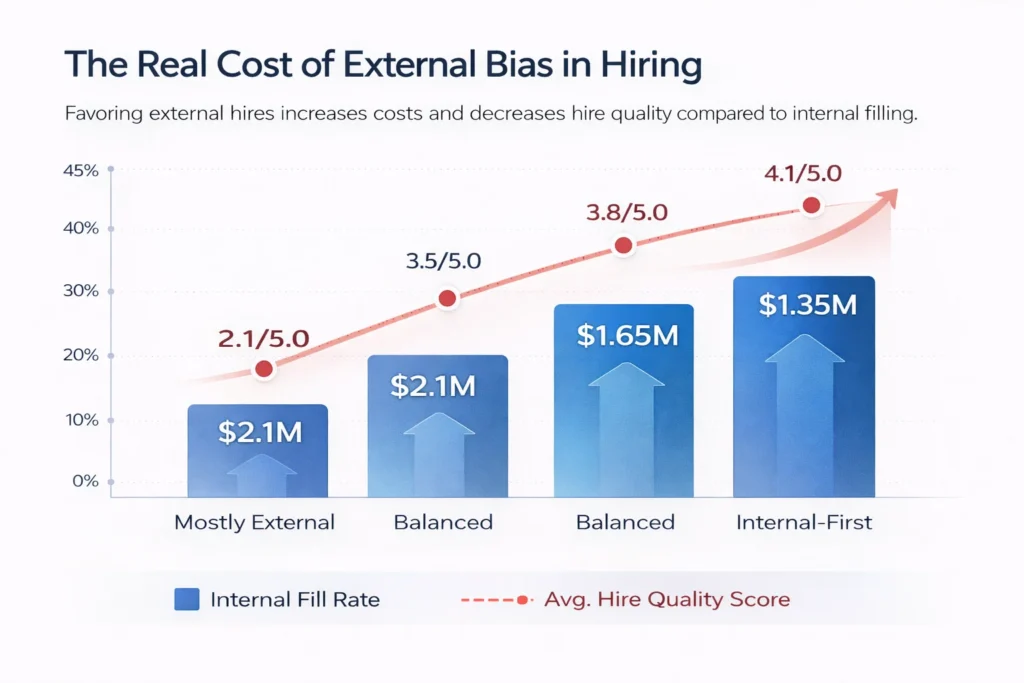
Annual talent cost includes recruiting spend, onboarding time, and ramp period productivity. Quality score is simulated 12-month performance average.
Related Terms
| Term | Definition |
|---|---|
| Internal Mobility | The movement of employees within an organization to different roles, projects, or locations |
| Talent Marketplace | A technology platform that matches employees’ skills and career interests to internal opportunities in real time |
| Succession Planning | The identification and development of internal candidates for critical future roles |
| Career Pathing | The process of defining potential progression routes for employees within an organization |
| Talent Hoarding | Manager behavior that discourages or prevents team members from applying for internal roles in other parts of the organization |
Frequently Asked Questions
Should internal candidates always be prioritized over external ones?
Not unconditionally, but they should always be considered first. The principle behind internal-first hiring is not that external talent is inferior, but that the costs of external hiring (monetary, cultural, and retention-related) are high enough that the organization has an obligation to exhaust internal options before committing to them. For roles requiring skills genuinely absent in the current workforce, external hiring is both necessary and appropriate.
How do you prevent manager talent hoarding?
The most effective combination of interventions: remove manager veto from the application process, include internal mobility rate in manager performance evaluation, and recognize managers publicly for developing talent that advances in the organization. Awareness training alone has minimal long-term impact on hoarding behavior.
Do internal hires perform better than external hires?
On average, yes, particularly in the first 12–18 months. Wharton research consistently finds that internal hires outperform comparable external hires in early tenure performance, and have substantially lower 12-month attrition. The advantage diminishes over time as external hires complete their performance ramp. For senior roles, the performance advantage of internal hires is particularly pronounced.
How do you build an internal mobility program from scratch?
The minimum viable internal mobility program has four components: a visible internal job board with all open roles posted simultaneously with external; a standard application process that does not require manager pre-approval; communication standards equal to external candidates; and a commitment to provide feedback to all internal applicants. That foundation can be built in 30 days and will immediately increase internal fill rate for most organizations.
What is the difference between internal hiring and succession planning?
Succession planning is forward-looking and targeted, identifying and developing specific employees for specific critical future roles. Internal hiring is present-tense and broadly accessible, filling current vacancies from the existing employee population through open, competitive processes. Succession planning feeds into internal hiring by developing the candidates who become available for key roles; internal hiring creates the career visibility that makes succession planning investment credible to employees.
Conclusion
Internal hiring is the talent acquisition strategy most organizations know they should be doing more of, and most organizations are doing less of than they think. The gap between intention and execution is almost always explained by the same three barriers: limited opportunity visibility, manager talent hoarding, and an internal candidate experience that doesn’t match the organization’s external hiring standards.
Fix those three barriers, and the return, in cost savings, quality of hire, and retention, is among the highest available in talent acquisition. The talent you need to hire from outside is a smaller pool than you think. The talent you already have, and aren’t fully using, is larger than you know.